
Emeute de petits épargnants à El Facher – mai 2010
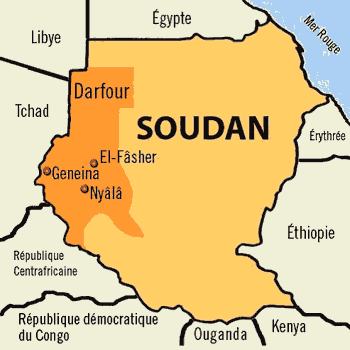
Sanglante répression contre des épargnants floués au Darfour
pressafrik.com
3 mai 2010
Une manifestation, qui a opposé des centaines d’épargnants et les services de sécurité soudanais le dimanche 2 mai, aurait dégénéré et au moins 4 personnes auraient été tuées selon des témoins à El-Fasher capitale du Nord Darfour. Depuis quelques semaines la situation était tendue car des milliers de petits investisseurs ont perdu beaucoup d’argent dans une escroquerie du type de celle de l’Américain Madoff : ce qu’on appelle une pyramide de Ponzi, ou une escroquerie par cavalerie.
La recette est connue des escrocs du monde entier, de Wall Street au Darfour. Ils promettent des intérêts élevés à des gens qui leur confient leur argent ou leurs biens. Mais, ils rémunèrent en fait leurs victimes avec les dépôts de nouveaux investisseurs, et ainsi de suite, jusqu’à ce que la bulle spéculative explose.
A El-Fasher, grande ville du Darfour, des milliers de personnes auraient ainsi perdu de fortes sommes d’argent, et des biens. Là bas, toute cette escroquerie est baptisée Al-Mawassir. La situation était tendue depuis quelques semaines déjà, et des centaines de personnes ont voulu manifester le 2 mai, comme le raconte Kemal Saïki, de la mission Onu-Union africaine au Darfour, la Minuad, qui a son siège à El-Fasher.
«Cela a commencé tôt dans la matinée. Environ un millier de personnes ont décidé de manifester afin de protester contre le crash financier qu’il y a eu récemment ici. Nous avons entendu des tirs sporadiques, très irréguliers, des tirs de dissuasion, des coups de feu tirés en l’air par les forces de l’ordre. Je n’ai entendu aucun rapport de pertes ou de blessés.»
Les autorités locales sont visiblement embarrassées. Elles ont annoncé l’arrestation de deux personnes impliquées dans cette affaire. Ces dernières assurent n’y être pour rien, et le gouverneur du Darfour Nord a promis la semaine dernière des compensations aux investisseurs floués. Mais des habitants d’El-Fasher affirment que la promesse avait déjà été faite avant les élections du mois dernier, et qu’ils n’ont rien vu venir.

Four killed in Darfur protest
AFP
3 May 2010 –
At least four people died on Sunday in clashes between Sudanese security forces and protesters angry over a failed investment scheme in Darfur, an aid source and witnesses said.
Automatic gunfire erupted after about 1,000 people marched on the centre of El Fasher, the capital of North Darfur state, U.N. officials and aid workers said.
Local residents said protesters were angry after losing money in a Ponzi scheme, a pyramid model where money is paid from one investor to the other and presented as profit.
« Between four and 10 people have been killed … and 30 to 40 people injured … There was intense fighting. We cannot say who killed who, » said an aid official, asking not to be named.
North Darfur’s police chief Abdul Rahman al-Tayeb issued a statement late on Sunday saying three protesters died in the demonstration and a total of 104 people were arrested.
Ponzi scheme
El Fasher, and Darfur’s other major cities, have become thriving commercial centres during the remote western region’s seven-year conflict, boosted by foreign cash brought in by aid workers and peacekeepers and accelerating urbanisation.
Local residents told Reuters two men set up a business in El Fasher around 10 months ago, taking in cash and other goods and promising returns of more than 50 percent after a month.
Investors received certificates for their goods and did receive payments in the early days of the scheme, one investor said. But the business closed down before last month’s national elections, leaving thousands unpaid, he said.
Police arrested a number of men accused of setting up the investment operation, the secretary general of North Darfur’s government, Ali Mohammed Ibrahim, told Reuters last week.

Ponzi scam protesters killed in streets of Darfur
Amsterdam News.Net
Sunday 2nd May, 2010
Gunfire broke out on the streets of Darfur on the weekend when victims of a failed pyramid scheme gathered to angrily protest the loss of their money.
The protest erupted in Sudan’s war-torn Darfur region, with reports of at least four civilians and six policemen dead in El-Fasher, capital of North Darfur state.
Police used batons and tear gas on the protesters, who were on the streets after losing money in a so-called « Ponzi scheme, » which is a fraud involving the payment to investors of funds which have to be topped up by new investors.
Many investors sold property or ploughed savings into the get-rich-quick scheme.
The governor of Darfur had promised during Sudan’s elections last month to compensate the victims, but failed to do so.
Many protesters were arrested during the fighting by police who claimed they had been destroying property on the way to the governor’s house.
4 killed in Darfur protest
presstv.ir
Sun, 02 May 2010
Clashes between Sudanese security forces and angry investors who were protesting an abortive investment scheme left at least four dead in
Darfur.
The joint United Nations and African Union peacekeeping forces in Darfur have said that gunfire was heard after hundreds of angry protesters marched toward El Fashir, the capital city of Sudan’s north Darfur to demand reimbursements.
Local residents were apparently tricked into participating in an investment scheme called « Ponzi », which is a fraudulent financial operation that pays returns to separate investors from their own funds or on the money paid by subsequent investors.
According to witness reports, Sudanese police forces opened fire on protesters, some of whom were armed, prompting sporadic exchanges of fire.
Meanwhile, an aid official told Reuters on condition of anonymity that between four and 10 people have been killed and 30 to 40 others injured. « There was intense fighting, » he said. « We cannot say who killed who. »
« There is a lot of confusion … we don’t know if it is police shooting, or civilians… They lost a lot of money and are very unhappy, » said another aid worker in El Fashir.
Foreign investments, mainly by aid workers and peacekeepers, in El Fashir have turned the region into a booming commercial hub in recent years.
Bloody day in Darfur’s El-Fasher after demonstrators march to governor residence
sudantribune.co
May 2, 2010 (KHARTOUM) — The Sudanese police fired at demonstrators in North Darfur capital city of El-Fasher who staged protests and marched to the governor’s house over money they lost in a huge Ponzi scheme that collapsed last month.
There has been conflicting figures over the number of people who were killed but the North Darfur government said put the toll at 3 and 25 injured.
However, other sources said that at least ten people were shot dead including policemen who exchanged fire with some of the demonstrators who appeared to be armed.
« There have been four to 10 deaths as well as 20 to 30 people injured, » the humanitarian worker told AFP on condition of anonymity. Aid workers and U.N. officials took refuge in their compounds during the confrontation.
« There is a lot of confusion … We don’t know if it is police shooting, or civilians, or the Arab militias in town. They lost a lot of money and are very unhappy, » said one aid worker, speaking to Reuters by phone.
The incident follow a previous demonstration that took place this week by hundreds of defrauded investors in front of the El-Fasher’s prosecutor’s office. The police used tear gas to break up the protestors.
The demonstrators were angry that the governor of North Darfur Osman Kibir backtracked on a promise to compensate them for the money they lost but his office later issued a statement saying that this is « interest money » which is forbidden under Islamic Sharia’a law.
Furthermore, it was reported that aggregate losses could be anywhere from 240-350 million Sudanese pounds($120-$175 million) which included money belonging to investors in other parts of country and abroad.
« It was a Ponzi scheme, » said a U.N. official in Darfur to Reuters, referring to a pyramid model where money is illegally paid from one investor to the other and presented as profit.
« This has been going on for months. It came to a head, » added the official, speaking on condition of anonymity. « It went beyond El Fasher. It went to the Diaspora. People have been venting their frustration, gathering in places. »
Many investors had sold land or ploughed in their savings to take part in the get-rich-quick scheme. The marketplace in the centre of El-Fasher has been renamed « Al-Mawasir Souk (market), » after the local colloquial Arabic for a swindle. Al-Mawasir has also become the name used across Sudan for the scam.
Khalid, a teacher in El Fasher, said he had lost 12,000 Sudanese pounds ($5,400) to two businessmen who started taking investments around 10 months ago.
« They said if you have $10, they will give you some shares or papers. And then after 30 days they will give you $15. »
At first the men did pay up, said Khalid, who only wanted to be identified by his first name. Then the business closed down just before Sudan’s national election earlier this month and did not open up afterwards, he added.
« They said they were taking the money, going to Khartoum and other places outside Sudan to buy goods to sell in the markets. That is how they said they made their money.
Kibir’s office issued a statement today accusing politicians who lost the elections of standing behind the events today stressing that the situation is now under control.
« The state government is not anything to do with the so-called Mawasir market as it is a market that citizens make the profit and loss without interference from the Government » the governor said.
« This plot is that came into the spotlight during the demonstration is a political plan, around which the political dead-enders who have lost the last election convened to make up [their] losses ».
The official hailed citizens who took the legal route to resolve the matter.
The United Nations-African Union Mission in Darfur (UNAMID) said that it had instructed its personnel to stay at their workplace.
The leader of Sudan Liberation Movement (SLM) Abdel-Wahid Al-Nur told Sudan Tribune that he condemns the killings « in the strongest possible terms ».
« This is a continuation of the pattern by the regime to kill the people of Darfur as they moved from targeting people in the camps to those in the towns. This is why we say there will not be peace without an end to the killings » Al-Nur said.
Hundreds of defrauded investors clash with police in Darfur
sudantribune.com
April 29, 2010 (KHARTOUM) — Hundreds of defrauded investors in the war ravaged region of Darfur staged protests after losing large sums of money in what appeared to be a Ponzi scheme ran by a few people.
Local media said that the police used tear gas to break up the demonstrations which took place in North Darfur capital city of El-Fasher in front of the prosecutor’s office revealing that the true number of people who fell victim to this fraud could reach 20,000.
The demonstrators were angry that the governor of North Darfur Osman Kibir backtracked on a promise to compensate them for the money they lost but his office later issued a statement saying that this is « interest money » which is forbidden under Islamic Sharia’a law.
Furthermore, it was reported that aggregate losses could be anywhere from 240-350 million Sudanese pounds($120-$175 million) which included money belonging to investors in other parts of country and abroad.
« It was a Ponzi scheme, » said a U.N. official in Darfur to Reuters, referring to a pyramid model where money is illegally paid from one investor to the other and presented as profit.
« This has been going on for months. It came to a head, » added the official, speaking on condition of anonymity. « It went beyond El Fasher. It went to the Diaspora. People have been venting their frustration, gathering in places. »
North Darfur’s regional government said a number of men had been arrested after investors complained about losing big sums. A delegation from the justice ministry has been dispatched to the region.
« Everything is under control of the legal authorities. … All the people who are dealing with this, they are arrested, » the secretary general of North Darfur’s government, Ali Mohammed Ibrahim, told Reuters.
He said investors had been asked to register losses with authorities who would try to track down the missing assets.
Ibrahim declined to go into the details of the financial operation under investigation. Descriptions from El Fasher residents were consistent with a Ponzi scheme.
Ponzi schemes, named after the Italian fraudster Charles Ponzi, pay early investors money received from later investors, and they regularly collapse.
Abdul-Jabbar Abdullah Fadul, a professor at El Fasher University, said he had been warning people for months not to touch the scheme.
« But people want to get money very easily. There was no investment. They were taking things … taking people’s money and paying them back with other people’s money. »
Khalid, a teacher in El Fasher, said he had lost 12,000 Sudanese pounds ($5,400) to two businessmen who started taking investments around 10 months ago.
« They said if you have $10, they will give you some shares or papers. And then after 30 days they will give you $15. »
At first the men did pay up, said Khalid, who only wanted to be identified by his first name. Then the business closed down just before Sudan’s national election earlier this month and did not open up afterwards, he added.
« They said they were taking the money, going to Khartoum and other places outside Sudan to buy goods to sell in the markets. That is how they said they made their money.
« The whole thing failed. We went to the bank and their account had been closed … Now all the people are worried. There is no money and all the people are sad. There is unemployment and many things. It is very bad. »
Darfour: heurts sanglants entre police et victimes d’une fraude pyramidale
AFP
2 mai 2010
KHARTOUM — De Wall Street au Darfour, la spéculation financière n’a pas de frontières, mais la réaction des investisseurs floués est plus musclée dans l’ouest du Soudan, où des affrontements meurtriers ont opposé dimanche les victimes d’une fraude pyramidale à la police.
Des centaines de petits épargnants ont manifesté dimanche matin à El-Facher, capitale historique du Darfour et de l’Etat du Darfour-Nord, pour obtenir une compensation après avoir perdu des sommes conséquentes en vendant leurs biens contre une promesse de bénéfices importants.
« Il y a eu entre quatre et dix morts ainsi qu’entre 20 et 30 blessés », a indiqué à l’AFP, un responsable humanitaire sous le couvert de l’anonymat. Le chef de la police du Darfour-Nord, Abdelrahman al-Tayeb Abdel Rahman, a fait état tard dimanche soir de trois morts et de 25 blessés parmi les manifestants.
La police, qui a utilisé les gaz lacrymogènes et distribué les coups de bâton, a aussi arrêté 104 personnes qui tentaient de « détruire » des lieux stratégiques d’El-Facher, a-t-il ajouté dans un communiqué.
Tôt dimanche matin, des centaines de personnes avaient pris la rue d’El-Facher. « Les manifestants voulaient se rendre à la maison du wali (gouverneur) du Darfour-Nord, Mohammed Youssif Kibir, mais la police et les forces de sécurité ont bloqué la rue. La police a ouvert le feu », a dit à l’AFP au téléphone Dirar Abdallah Dirar, un des manifestants.
Les sirènes des ambulances étaient entendues dimanche dans la ville, ont indiqué à l’AFP des humanitaires. « Les coups de feu ont commencé vers 09H00 (06H00 GMT). Nous restons dans nos bureaux », a dit à l’AFP un humanitaire sous couvert de l’anonymat.
« La situation couvait depuis plusieurs semaines, je savais bien qu’un jour où l’autre, l’abcès finirait par crever », a raconté un autre humanitaire également en poste à El-Facher, ville d’environ un demi-million d’habitants relativement épargnée par la guerre civile qui sévit au Darfour depuis 2003.
La situation est tendue depuis quelques semaines après que des milliers de personnes ont perdu des millions de dollars et des biens dans une « chaîne de Ponzi », où les premiers investisseurs sont rémunérés par les dépôts d’investisseurs ultérieurs.
Les victimes de cette fraude dans l’ensemble du Darfour ont vendu leurs biens contre une petite somme d’argent, mais avec la promesse d’intérêts élevés.
Le souk al-rahmat dans le centre d’El-Facher a été rebaptisé « souk al-mawassir » (le marché de l’escroquerie, en arabe vernaculaire), par les habitants. Par ricochet, l’ensemble de cette escroquerie est appelée « al-mawassir » au Soudan.
La révélation de cette fraude a mis dans l’embarras les autorités locales, qui ont annoncé l’arrestation de deux personnes impliquées dans le réseau.
Selon des habitants, le gouverneur du Darfour-Nord avait promis, pendant la campagne des élections nationales du 11 au 15 avril, une compensation aux épargnants volés, mais n’aurait pas tenu cette promesse.
Au cours d’une rencontre vendredi avec des imams et des leaders de la région, M. Kibir avait affirmé que les autorités du Darfour-Nord n’étaient pas impliquées dans cette escroquerie et garanti que les investisseurs floués allaient recouvrer les sommes ou les biens perdus, mais pas la plus-value escomptée, a rapporté l’agence officielle Suna.
M. Kibir a accusé, sans les nommer, des opposants ayant perdu les élections locales de souffler sur les braises afin de déstabiliser le Darfour, a souligné Suna.
« Les manifestations de dimanche semblaient organisées, je ne pense pas que ce soit terminé », a souligné un humanitaire. Et plusieurs citoyens d’El-Facher ont indiqué avoir remarqué une recrudescence de membres de tribus arabes dans la ville.

Darfour: heurts entre police et victimes d’un réseau de commerce pyramidal
tdg.ch
KHARTOUM, 2 mai 2010 | Des heurts ont opposé dimanche plusieurs centaines de victimes d’un réseau local de commerce pyramidal et les forces de sécurité à El-Facher, dans la région soudanaise en guerre civile du Darfour (ouest), ont indiqué des responsables de l’ONU et des témoins.
Des heurts ont opposé dimanche plusieurs centaines de victimes d’un réseau local de commerce pyramidal et les forces de sécurité à El-Facher, dans la région soudanaise en guerre civile du Darfour (ouest), ont indiqué des responsables de l’ONU et des témoins.
« Nous avons eu des indications qu’un certain nombre de personnes présumées victimes d’un système financier parallèle ont protesté à El-Facher (capitale du Darfour-Nord) », a dit à l’AFP Kemal Saïki, chef de la communication de la Mission de paix ONU-Union africaine au Darfour (Minuad) dont le siège est à El-Facher.
« On a entendu des tirs sporadiques. Mais il ne s’agit pas de combats. Nous n’avons pas d’informations sur des gens ayant été atteints. On a demandé à notre personnel de rester sur leur lieu de travail et de limiter leurs déplacements », a-t-il ajouté.
« A 8H00 ce matin, les gens d’El-Facher ont pris la rue pour manifester. Ils voulaient se rendre à la maison du wali (gouverneur) du Darfour-Nord, Mohammed Youssif Kibir, mais la police et les forces de sécurité ont bloqué la rue. La police a ouvert le feu », a dit à l’AFP par téléphone, Dirar Abdallah Dirar, un des manifestants.
« Il y a eu des victimes », a ajouté M. Dirar sans plus de précision. Les sirènes des ambulances étaient entendues dimanche dans la ville d’El-Facher, ont indiqué à l’AFP des humanitaires. « Les coups de feu ont commencé vers 09H00 ce matin (6H00 GMT) et ça continue. Nous restons dans nos bureaux », a dit à l’AFP un humanitaire sous le couvert de l’anonymat.
Il n’a pas été possible dimanche à la mi-journée d’obtenir un bilan des victimes auprès des autorités soudanaises ou des hôpitaux locaux.
La situation est tendue depuis quelques semaines à El-Facher, capitale historique du Darfour, où des milliers de petits investisseurs ont perdu des millions de dollars et des biens dans une « pyramide de Ponzi ».
Cette escroquerie est basée sur une course permanente entre la collecte de nouveaux fonds et des paiements visant à donner confiance aux investisseurs.
Des investisseurs du Darfour ont vendu certains de leurs biens ou donné une partie de leur épargne en échange d’une promesse, non tenue, de gros revenus en retour. La révélation de cette escroquerie, connue localement sous le nom de « mawasir », a déclenché la colère des milliers d’épargnants du Darfour et mis dans l’embarras les autorités locales.
Selon des habitants locaux, le gouverneur du Darfour-Nord avait promis, pendant la campagne pour les élections nationales du 11 au 15 avril dernier, une compensation aux épargnants volés, mais n’aurait pas tenu promesse. Il n’a pas été possible dimanche de confirmer ces informations avec le gouvernorat.






 anthropologie du présent