
Grève générale হরতাল : émeutes à Dhaka – 4 avril 2011

Violent clashes mark day-long hartal
thefinancialexpress-bd.com
FE Report
4 04 2011
Violent clashes in Dhaka city and elsewhere in the country marked countrywide dawn-to-dusk hartal (strike) enforced by Islamic Law Implementation Committee Monday.
The call for hartal was given earlier by Mufti Fazlul Haq Amini, chairman of a faction of the Islami Oikya Jote (IOJ) and also chief of the committee on March 08 protesting the proposedNational Women Development Policy giving women equal rights to paternal property.
The organisers of shutdown termed the policy anti-Islamic.
Dozens of people were detained and scores others injured in the city during the hartal.
In Narayanganj, over 100 people including policemen, were injured in clashes between hartal supporters and the law enforcers.
Our correspondent based in Chittagong said the pro-hartal pickets vandalised about 100 buses and other vehicles and beat up about 30 people at Chittagong Hathajari road around noon.
In Dhaka city, 10,000 police personnel wearing bullet-proof vests and helmets charged batons to disperse the protesters who tried to bring out processions at several points.
The pro-strike elements, mostly madrassa students, under the banner of Islamic Law Implementation Committee blockaded roads and highways, urging the government what they said not to pass laws against the Quoranic injunction.
Control room of Dhaka Metropolitan Police (DMP) said they arrested 125 people from various city areas during the hartal hours on charge of their involvement in violence.
« The strike was mostly peaceful in the capital as they stepped up security to avoid any trouble, » a senior DMP official said, adding that they charged batons on the violent picketers only to maintain law and order in the overpopulated city.
Police also used tear gas shells and water cannons at Signboard area to disperse hundreds of pro-strikers who barricaded Dhaka-Chittagong Highway, which connects the country’s prime seaport with the capital.
At least ten protesters were injured during the chase and counter chase, which had turned the area into a veritable battlefield. The injured were given first aid. Read more…
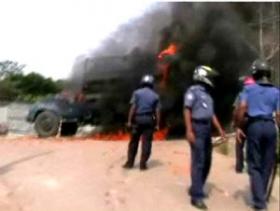
Police vehicle torched in Faridpur
bdnews24.com
Mon, Apr 4th, 2011
Faridpur, Apr 4 (bdnews24.com)—At least 21 people, including 16 police personnel, have been injured in clashes between the law enforcers and pickets in Faridpur.
The hartal supporters also torched a police-carrying truck at Jangurdi during the daylong countrywide shutdown on Monday. Six pickets were also arrested in the district headquarters.
Islamic Law Implementation Committee (ILIC) is enforcing the 6am-6pm hartal to protest the proposed women’s policy, High Court ban on fatwa and the recently formulated education policy.
The protestors in Faridpur brought out a procession from the town’s Nagarkanda area in favour of the lockdown.
At one stage, the picketers locked into an altercation with police leading to a clash around 8:30am.
They hurled brickbats injuring at least 21 people, including 16 police personnel.
Later, several thousand protestors besieged the local police station and the lawmen fired four blank shots to disperse the mob.
The pro-hartal activists also torched a truck, which was carrying additional police force from Faridpur. Read more…
.
Plus d’infos
- 150 injured in Monday’s hartal
- Bombs found, 8 held at Amini’s madrasa
- It’s BNP-Jamaat hartal: Ashraf
- Free arrestees in 24 hrs or face movement: Amini
- Amini announces fresh agitation
Informations
Hartal (also hartaal) (Bengali: হরতাল; Hindi: हड़ताल; Urdu: ہڑتال) is a term in many Indian languages for strike action, used often during the Indian Independence Movement. It is mass protest often involving a total shutdown of workplaces, offices, shops, courts of law as a form of civil disobedience. In addition to being a general strike, it involves the voluntary closing of schools and places of business. It is a mode of appealing to the sympathies of a government to change an unpopular or unacceptable decision.[1]
Hartal was originally a Gujarati expression signifying the closing down of shops and warehouses with the object of realising a demand. MK Gandhi (sometimes referred to by his supporters as Father of the Nation), who hailed from Gujarat, organised a series of anti-British general strikes which he called hartals, thereby institutionalizing it. This form of public protest dates back to days of British colonial rule in India. Repressive actions infringing on human rights by the colonial British Government andprincely states against countrywide peaceful movement for ending British rule in India often triggered such localised public protest.




 anthropologie du présent