
Guerre de l’eau au Kurram کرم – septembre 2010
Trouble in Parachinar
Dawn Editorial
Monday, 20 Sep, 2010
The seemingly interminable violence in the Parachinar area of Kurram Agency has spiked once again. This time a water dispute between two of the four main tribes — Bangash and Mangal — has claimed the lives of over 100 people in weeklong fighting that shows no sign of abating. Water, along with other resources such as forests, has long been a source of inter-tribal rivalry in the agency, but what makes Kurram Agency doubly dangerous is that the violence has been thoroughly infused with sectarian hatreds — starting as far back as 1982, though much of the present blame must lie with the ingress of the Taliban in the area in 2007.
For a couple of years the area remained cut off from the rest of Pakistan with the closure of a key road; however, a political agreement signed in Murree and a limited military operation in the area has helped to reopen the Thall-Parachinar road. Limited traffic continues to move on the road, though many people of the area still use the Afghan route to travel to other parts of Pakistan because of the dangers involved. (The Afghan route is no less dangerous: in July, 11 residents of Parachinar who were en route to Peshawar via Kabul were ambushed and killed in Paktia.)
Bringing an end to the violence in Kurram Agency, and the Parachinar area in particular is a matter of the state taking its responsibilities more seriously. The agreement signed in Murree in October 2008 was in part possible because of the initiative of the then political agent of the agency, who has since been replaced. That agreement remains the best hope for the return of peace to the area and as such should be implemented in all earnestness. From the return of displaced persons, some of whom have not returned home since the 1982 violence, to the payment of compensation for property damaged and destroyed to the return of property confiscated, the agreement encompasses many sensible and pragmatic measures. In addition, cellphone services should be restored in the area (at present, locals have to use Afghan SIMs and networks, which adds to the difficulties of life).
By now it should be apparent that the longer Pakistan delays resolving the crisis in Kurram Agency, the more it will slip back towards the sphere of Afghan, and by extension American, influence. Such a development may only further complicate the resolution of the troubles in the area. The sooner the Murree accord is implemented the better. Unfortunately, implementation isn’t the state’s strongest suit.
Kurram tribal clashes, gunship shelling kill 35
Daily Times
20 09 2010
LAHORE: The death toll of fierce clashes between two rival tribes in Kurram Agency has risen to 35, a private TV channel reported on Sunday.
According to a spokesman of the political administration, at least 16 people were killed and 20 injured when government gunship fired shells at bunkers of the two tribes to stop them from fighting. “We are trying our best to cease hostilities between Mangal and Toori tribes which killed 19 people on Sunday,” he said.
According to sources, at least 138 people had been killed and 180 injured in clashes over water dispute for the last 16 days in the Shalozan area of Upper Kurram Agency.
26 killed in armed clashes in Pakistan’s tribal belt
Agency: PTI
Friday, Sep 17, 2010
Atleast 26 people were killed and 22 others injured today in armed clashes between two rival groups over the distribution of water in Pakistan’s restive tribal belt, taking the death toll in three weeks of fighting to nearly 80.
Fresh clashes erupted between members of the Shalozan and Shalozan Tangi tribes in Kurram Agency, local sources said.
The clashes over the allocation of irrigation water began three weeks ago. Over 70 people have been injured in the fierce fighting.
The local political administration appears to be helpless in controlling the situation as efforts to restore peace have not produced any results.
It is believed that 10 suspected militants were among the 13 people killed in clashes yesterday. Their bodies were taken into custody by local tribesmen.
The rival groups are using heavy and sophisticated weapons to target each other’s positions.
Local residents said the clashes had intensified after militant factions reportedly began faction a group of tribesmen.
The political administration has formed a tribal jirga or council to start negotiations with the fighting tribes.
Kurram Agency has been virtually cut off from the rest of Pakistan for the past two years due to intense clashes between rival Shia and Sunni tribesmen.
13 killed in clashes over irrigation water in Pakistan’s tribal belt
Agency: PTI
Thursday, Sep 16, 2010,
At least 13 people were killed today in a fresh gun battle between two rival groups over distribution of irrigation water in Pakistan’s restive tribal belt, taking to 50 the toll in three weeks of fighting over
the issue.
Armed members of Shalozan and Shalozan Tangi tribes in Kurram clashed again today, leaving 13 people dead and seven injured, local media reports said.
Since the clashes over the allocation of irrigation water began three weeks ago, 50 people have died while over 70 injured.
The local political administration appears to be helpless in controlling the situation as efforts to restore peace have not produced any results.
Kurram tribal agency is virtually cut off from the rest of Pakistan for the past two years due to intense clashes between rival Shia and Sunni tribesmen.
The situation was exacerbated after Taliban infiltrated the area and began targeting the Shias.
Tribesmen in Kurram tribal agency have been forced to use routes passing through Afghanistan even to visit places like Peshawar.
Local residents allege that the governor of Khyber-Pakhtunkhwa province, who functions as the agent of the president in the semi-autonomous region, has not taken any step to control the situation.
13 killed in clash over water in Pakistan
sify.com
2010-09-16
At least 13 people were killed Thursday in a fresh clash between two tribal groups over water dispute in Pakistan’s northwestern Kurram region.
In the clash between Mangal and Bangash tribes, the two rival groups used automatic weapons against each other. As a result, 13 persons, including 10 Afghan nationals, were killed and 19 were seriously injured, Xinhua reported, citing sources.
The dispute between the two groups had taken a new turn after the involvement of militants in the clashes which took place in the tribal region’s Shalozan and Tangi areas.
Some locals said the Afghan nationals were urging the people to violence.
Meanwhile, authorities claimed that steps were being taken to restore peace between the tribes.
So far, at least 49 people have been killed and 80 sustained injuries in the two-week clashes in Kurram near the border with Afghanistan.
Information
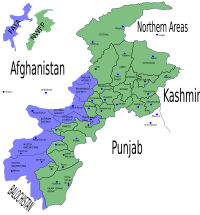
Kurram (Urdu: کرم ) tribal agency is located in the FATA area of Pakistan. Until the year 2000, when divisions were abolished, Kurram District used to be part of the Peshawar Division of the North-West Frontier Province, now Khyber Pakhtunkhwa, of Pakistan.
The Kurram River drains the southern flanks of the Safed Koh mountain range, and enters the Indus plains north of Bannu. It crosses the Afghan-Pakistan border about 80 km southwest of Jalalabad, and joins the Indus near Isa Khel after a course of more than 320 km (200 miles). The district has an area of 3,310 km² (1,278 sq. miles); the population according to the 1998 census was 448,310[1]. It lies between the Miranzai Valley and the Afghan border, and is inhabited by the Pashtun Turis, a tribe of Turki and Pathan origin who are supposed to have subjugated the Bangash Pashtun about six hundred years ago.The main tribes in Kurram Agency are zazai Bangash,Para,Mangal,Turi,Orakzaione of the biggest.The language of the tribes is Pashto, .
It is highly irrigated, well peopled, and crowded with small fortified villages, orchards and groves, to which a fine background is afforded by the dark pine forests and alpine snows of the Safed Koh. The beauty and climate of the valley attracted some of the Mogul emperors of Delhi, and the remains exist of a garden planted by Shah Jahan.
The Kurram River crosses the Afghan-Pakistan border about 80 km southwest of Jalalabad and in ancient times offered the most direct route to Kabul and Gardez, but the route crossed the Peiwar Pass 3,439 m (11,283 ft) high, just over 20 km west of Parachinar, which was blocked by snow for several months of the year.








 anthropologie du présent