
Kashmir indien – septembre 2010

India deploys army to quell Held Kashmir unrest
Afp
18 09 2010
* Three killed as protesters defy curfew, clash with troops
* Food shortage as curfew enters 6th day
SRINAGAR: India deployed soldiers on the streets of Indian-held Kashmir on Friday to restore order, witnesses said, as three more pro-independence demonstrators were shot dead by security forces.
While some Indian officials had called for easing harsh security laws as a goodwill gesture, a top state official said on Friday that the government would use all its powers to restore order. “The government has to assert its writ, and appeasement will not work. We’ll take every legal measure to stop the protests now,” said Taj Mohiudin, an influential cabinet minister in the state government.
Troops were spotted on a key road in Srinagar that leads to the high-security airport, while residents reported seeing soldiers in central Budgam and northern Baramulla villages. Army deployment is likely to further anger locals and separatists who resent any move that heightens the sense of occupation in the disputed region.
“All repressive measures are being used to quell and crush the resistance movement,” said Mirwaiz Umar Farooq. “This is India’s last resort. …What we’ve been repeatedly saying should now be clear to all, that this place is under martial law.”
The army declined to comment on the deployment when contacted, but it was believed to be part of a new strategy drafted by police, paramilitary and army forces on Wednesday to restore order. It appealed to Kashmiris to withdraw plans to protest outside garrisons next week. Syed Ali Shah Geelani, leader of All-Parties Hurriyat Conference, had called for “peaceful sit-in protests” on Tuesday outside army camps across Kashmir. afp
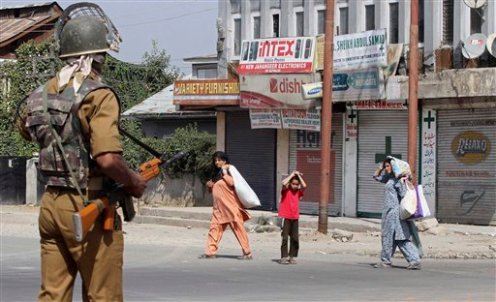
Indian army patrols Kashmir; 3 protesters killed
AP
18 09 2010
SRINAGAR, India — India sent army troops into the streets of Kashmir as it intensified a crackdown on increasingly angry separatist protests in the region, where three more Muslim demonstrators were killed in clashes, police said.
Paramilitary forces and police have taken the lead in confronting protesters since widespread protests began in June, but with violence escalating over the past week, the government has searched for a new strategy, settling on bringing the military in on Friday.
While some Indian officials have called for easing harsh security laws as a goodwill gesture, a top state official said Friday the government would use all its powers to restore order.
« The government has to assert its writ, and appeasement will not work. We’ll take every legal measure to stop the protests now, » said Taj Mohi-u-Din, an influential Cabinet minister in the state government.
At least 97 people have been killed in the recent demonstrations demanding the mostly Muslim region be given independence from Hindu-dominated India or be allowed to merge with predominantly Muslim Pakistan.
As part of a new security plan, army troops patrolled several towns and villages across the Himalayan region Friday and guarded the road leading to the airport in Srinagar, the region’s main city.
The use of the army, which normally patrols the frontier with Pakistan and fights against militants, is likely to further anger residents, who have lived under rolling government curfews and separatist strikes for much of the summer.
« This is India’s last resort, » said Mirwaiz Umar Farooq, a top separatist leader. « What we’ve been repeatedly saying should now be clear to all, that this place is under martial law. »
Chief Minister Omar Abdullah came under heavy criticism in July when, in a symbolic show of force, he called in the army to march in Srinagar. That was the first time in nearly two decades that soldiers patrolled in the city, though they did not get into any confrontations with any protesters at that time.
On Friday, hundreds of people defied an indefinite curfew in Churpora, a village near Srinagar, and attacked the soldiers with stones, a police officer said on condition of anonymity because he was not authorized to talk to reporters. The soldiers fired live ammunition, killing one protester and wounding another three, he said.
However, Ghulam Mohammed, a villager, said the army stopped the protesters and opened fire without any provocation.
Another clash with the army took place in the nearby village of Chichilora, where some teenage marchers attacked the soldiers with stones, the police officer said. At least one person was wounded when soldiers shot at the protesters, he said.
Manzoor Ahmed, a local resident, accused the soldiers of forcibly entering some homes, smashing windows and beating people.
In Shopian, a town south of Srinagar, government forces fired on protesters defying the curfew, killing one person and wounding four others, the police officer said.
Local residents accused government forces of firing on people participating in a peaceful protest rally. However, police said the government forces resorted to firing after protesters attacked them with rocks.
The officer said clashes between police and anti-India demonstrators had also been reported in two other towns — Sopore, northwest of Srinagar, and Awantipura, to the south.
Bashir Ahmed, a schoolteacher in the northern town of Handwara, said the use of the army signaled an escalation in the government’s response to the protests.
« Army soldiers don’t carry batons and tear gas. They only carry guns. So it’s a clear message that army is out to crush us, » he said.
Another protester was killed and seven others were injured when police and paramilitary forces fired at protesters who defied a rigid curfew in Pattan, a village north of Srinagar, the police officer said.
During an overnight clash in the town of Sopore, paramilitary troops fired at protesters, wounding seven people, police said.
The round-the-clock curfew in the region entered the fifth day Friday.
With authorities strictly enforcing the curfew, people could not offer traditional Friday prayers in the main mosques in Srinagar and other places. However, police allowed residents to pray in small mosques in various towns and villages.
The decision to call in the army came Wednesday at a meeting of top security officials who were concerned by a separatist plan to march on army and paramilitary camps Sept. 21 to demand soldiers leave the region.
On Thursday, Lt. Col. J.S. Brar, an army spokesman in Srinagar, asked people to ignore the call.
The Indian army is ubiquitous in Kashmir — a Himalayan region also claimed by Pakistan and divided by a heavily militarized frontier — but its operations are usually aimed at combating insurgents.
Since 1989, a violent, separatist insurgency and the ensuing crackdown by Indian forces have killed an estimated 68,000 people.
While that rebellion has been largely suppressed, public opposition to Indian rule remains deep.
L’armée indienne se déploie au Cachemire, deux manifestants tués
ap
17 09 2010
SRINAGAR, Inde (AP) — L’armée indienne s’est déployée vendredi dans les rues du Cachemire indien, intensifiant sa répression d’un mouvement séparatiste qui monte en puissance, alors que deux nouveaux manifestants musulmans ont été tués dans des affrontements.
La violence ayant escaladé au cours de la semaine écoulée le gouvernement a choisi une nouvelle stratégie en déployant l’armée vendredi, alors que la région himalayenne entrait dans sa cinquième journée sous couvre-feu total.
Si certains responsables indiens estiment qu’il faudrait plutôt alléger les lois sécuritaires en guise de geste de bonne volonté, la ligne dure semble aujourd’hui l’emporter. « L’apaisement ne marchera pas. Nous allons maintenant prendre toutes les mesures légales pour arrêter les manifestations », a déclaré Taj Mohi-u-Din, ministre de premier plan du gouvernement de l’Etat du Jammu-et-Cachemire.
Au moins 96 personnes ont été tuées dans les dernières manifestations réclamant l’indépendance de cet Etat, le seul à majorité musulmane de la fédération indienne, ou le rattachement au Pakistan voisin.
Dans le cadre du nouveau plan de sécurité, l’armée a commencé vendredi à patrouiller les villes et les villages de la région himalayenne, et a pris le contrôle de la route de l’aéroport de Srinagar, principale ville du Cachemire indien.
Le déploiement de l’armée risque de renforcer la colère de la population, coincée entre grèves générales des séparatistes et couvre-feux depuis le début de l’été.
« C’est le dernier recours pour l’Inde », a dénoncé le dirigeant séparatiste Mirwaiz Umar Farooq. « Ce que nous n’arrêtons pas de répéter devrait désormais être évident pour tous, que cet endroit est soumis à la loi martiale ».
Le chef du gouvernement du Jammu-et-Cachemire Omar Abdullah avait déjà été vivement critiqué en juillet lorsqu’il appela l’armée à défiler dans Srinagar: c’était la première fois en près de deux décennies que l’armée indienne patrouillait dans la ville.
Vendredi, des centaines de personnes ont violé le couvre-feu à Churpora, près de Srinagar, attaquant les soldats à coups de pierres, a fait savoir un policier sous couvert de l’anonymat. Au moins un manifestant a été tué et trois autres blessés lorsque les soldats ont riposté, tirant à balles réelles. Mais un villageois a contesté cette version, affirmant que l’armée avait arrêté les manifestants et ouvert le feu sans aucune provocation.
Des affrontements ont eu lieu dans plusieurs villages de la région, notamment à Pattan, au nord de Srinagar, où un manifestant a été tué et sept autres blessés par les tirs des forces de l’ordre.
La décision de déployer l’armée a été prise mercredi, les séparatistes ayant appelé la population à marcher sur toutes les casernes et campements de l’armée et de la gendarmerie le 21 septembre pour réclamer que les forces indiennes quittent le Cachemire. AP







 anthropologie du présent