
Emeute à Shenzhen 深圳 dans le Guangdong 广东 – septembre 2010
China Promises Political Reforms
RFA
2010-09-06
Clashes break out in Shenzhen as President Hu arrives in the Special Economic Zone.
HONG KONG—President Hu Jintao has announced that the southern city of Shenzhen, once the cradle of China’s economic reforms, will begin experimenting with political reforms, including « democratic elections, » although critics remain skeptical that real change will ensue.
« We will continue to push forward the self-improvement of the socialist political system…expanding socialist democracy with democratic elections according to the law, democratic policies, democratic management and supervision, » Hu told a ceremony marking the 30th anniversary of the Shenzhen Special Economic Zone on Monday.
« The central government will continue to support bold experimentation and pioneering work in the special economic zones, » he said.
But a commentary published last weekend by the official news agency Xinhua appeared to quash those hopes for broader reforms.
« Rather than copying the prevalent multi-party system in the West, China aims to blaze a different trail by expanding democracy and autonomy for its 1.3 billion people based on existing political framework, » said the Aug. 29 commentary.
« The reform is aimed at securing the governing party status of the Communist Party of China, under whose leadership other parties jointly participate in state affairs through political consultation, » it said.
Clashes with city officers
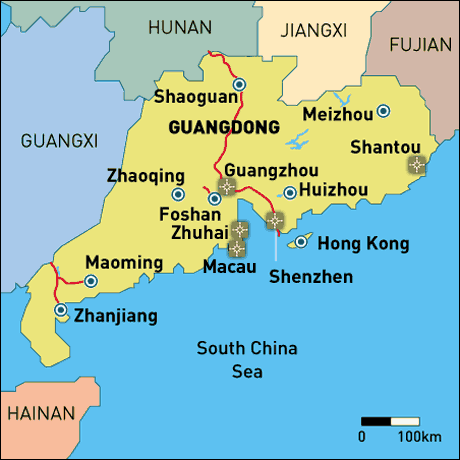
As Hu arrived in the city this weekend to promise reforms, clashes broke out in Shenzhen’s Longhua township between security personnel and an angry crowd after officials tried to clear the streets of hawkers and stall-holders.
Late on Saturday, hundreds of people faced down several « chengguan, » or city officers who patrol the streets to control illegal vending operations and bad parking, after word spread that the officers had beat a vendor and her infant son.
« It was past 10:30 p.m. by the time we finished work, » said an employee at a nearby shopping mall. « They had sealed off the area, and there were several thousand people there, over by McDonald’s. »
« I heard people saying that a kid had been hurt, and that this was the reaction; it caused quite a sensation, » she said.
An employee who answered the phone at Longhua township’s Minzhi Street neighborhood committee offices said four people had been detained by police for « making trouble » during the incident.
A Shenzhen resident surnamed Li blamed the chengguan officials for their lack of education. « They don’t know how they should enforce the law, and they just use violence when they get into a situation like this, » he said.
Democratic reforms?
The transformation of Shenzhen from a quiet fishing village into the first Special Economic Zone able to accept foreign investment in August 1980 ushered in three decades of massive social change and breakneck economic growth.
Amid growing social unrest, a widening income gap, and rampant official corruption, China’s leaders have repeatedly warned that the ruling Communist Party will need to reform if it is to stay in power.
However, official rhetoric has never called for a multi-party democracy, and critics said they doubted that Hu meant the same thing as they did by political reform and democratic elections.
Shenzhen-based rights activist Chen Shuwei said the president had been talking about socialist democratic reforms.
« According to my understanding, this means democracy under the control of the Chinese Communist Party. » Chen said. « It’s just for show. »
« They talk about the rule of law as well, but in actual fact we have never had it. So I think these reforms are fake, » he said.
And user « huojianyaoming » wrote on the microblogging service Twitter: « If anything is empty bombastic talk, then it’s this talk of making the economic zones even better by Hu Jintao. »
A visit by premier Wen Jiabao last month also hinted at political change in the city, sparking a discussion forum in a northern Beijing holiday resort hastily convened by politically active netizens to discuss his speech.
Organizers at the Miyun Reservoir meeting appeared hopeful that Wen’s speech might herald a new era of political change in China, similar to that proposed in the controversial document « Charter ’08 », whose co-author Liu Xiaobo was jailed for subversion in December 2009.

Experimental measures
The Shenzhen experiment would consist of measures aimed at ending the privileged lifestyle of government employees, for example, by smashing civil servants’ « iron rice bowls » guaranteeing jobs for life, Xinhua said.
The reforms would also seek to create a clear distinction between government and non-government civic organizations.
Shenzhen’s 5th Party Congress voted in May to allow the public nomination of candidates for leading posts, and to allow the competitive election of more posts than before.
« By 2015, at least half of Shenzhen’s new promotions for leadership positions below bureau level will be decided through competitive election, » Xinhua said.
Wang Youjin, political science researcher at the Chinese University of Hong Kong, said that the reforms showed the government realized that political restructuring was now a crucial step.
« They will have to take it step by step, one thing at a time, and by carrying them out experimentally in a single region first. »
Under reforms pioneered by late paramount leader Deng Xiaoping, Shenzhen, just across the border from then British-run Hong Kong’s port facilities and financial hub, offered lower taxes and less red tape to attract overseas investors.
Its example was soon followed by neighboring Zhuhai and Shantou in Guangdong province, the port of Xiamen in the southeastern province of Fujian and the southern island of Hainan.
Since the reforms started, the city has seen economic growth at a rate of 25.8 percent over the past 30 years, compared with about 9.8 percent for the entire country.
Original reporting in Mandarin by Xin Yu and Ding Xiao, and in Cantonese by Fung Yat-yiu. Translated and written in English by Luisetta Mudie.
Conflict between Chengguan and Shenzhen Street Sellers Leads to Riots
chinadigitaltimes.net
7 09 2010
Southern Metropolis Daily reports on yet another conflict between street sellers and Chengguan, or urban management officials, on China’s streets, this time in Bao’an district, Shenzhen. In common with other similar incidents, such as the Kunming incident earlier this year, perceived Chengguan brutality in dealing with a female street seller and her child served as the trigger for rioting. These incidents are examples of the fundamental conflict across China between small business owners, often migrants, who wish to sell on China’s streets, and local governments who are generally hostile to such activities.
[…] Yesterday, circa 10pm: The police had blocked the road and traffic from Meilong Road proceeding in the direction of Minzhi Road was being diverted. At the Minzhi and Hengling Zonghe Dalou intersection, pedestrians were congregating in the middle of the road. In the center of the road, in front of a law enforcement car, Ms Weng, carrying a one year old child, sat on a plastic chair refusing to move.
This conflict between Ms Weng and the Chengguan was the catalyst for the incident. “They chased after me hitting me, they even hit the child,” she said. That night at roughly 7pm, she had been carrying her child while her husband pushed their cart, as they peddled goods as normal. At the crossroads the family met with a team of city sanitation officials, who attempted to confiscate their cart, and the two sides got into conflict.
Ms Weng showed Southern Metropolis Daily reporters a bandage around her knee, while her son had a red scar on his hand. She said her son’s forehead had also been bruised – in response to these statements Minzhi law enforcement personnel said they would investigate.
“The Chengguan are beating people, they’re even beating children” – this was the phrase that spread throughout the assembled crowd, some of whom began to question the actions of the law enforcement personnel, and this resulted in the blockade of Minzhi Road.
Minzhi police station assembled police officers, law and order personnel and the People’s Militia to maintain stability by separating the crowd into three groups. The number of people causing a disturbance increased; in addition to verbal abuse, some hurled bottles of mineral water etc. at the officers.
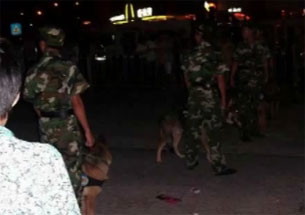
The situation was soon beyond the control of the forces present. Riot police and police dog teams were dispatched at this point. For a time the dogs had some degree of effect on the hecklers, however the rioters immediately clashed with the riot police. Numerous protesters sustained injuries. Ambulances were continually arriving at the scene, ferrying the injured to hospital.
The Minzhi sub-district office chief tried to negotiate with Ms Weng. The sub-district office hoped Ms Weng and her child would first go to hospital for a check-up and then hold bilateral negotiations but these soon broke down and discontent among the crowd broke out once again.
[…] Minzhi sub-district office working committee secretary Liu Bin hastened to the scene. Before he arrived, a man with a head injury had been lying on the street for over ten minutes; he was the fourth member of the crowd to have been injured. “First get him in the ambulance to be treated,” Mr Liu ordered a paramedic. However the police and security officials in front of him were slow to react.
Behind Liu Bin a confrontation broke out between five or six truncheon-wielding riot police, local police, security officials and the rioters. The reporter attempted to record this incident but in the confusion his camera was snatched.
At around 1am calm had been restored and the flow of traffic gradually resumed on Minzhi road.
The article also explains the background to this event:
Minzhi law enforcement department and street sellers “had accumulated grievances”
According to a source within the Minzhi law enforcement department, at the beginning of August, law enforcement teams and the local police station launched a coordinated program to clear out street sellers. By the tenth of August they had already dealt with over a hundred non-compliants [people selling illegally]. Street-sellers who were caught time and again faced fines, and their goods were confiscated. The source stated that a situation where the roads were clear of street sellers was becoming the norm; “at the least you would not see peddlers on the main roads”.
As a result of confiscating goods, law enforcement teams had come across many obstacles: “often some peddlers would lie outside our building pretending to be dead, there were also some female street sellers who as soon as they saw us would begin taking off their clothes.” He also explained that along with the sprucing up of Shenzhen’s Special Economic Zone, Bao’an and Longgang have also been brought into line. Authorities in Bao’an and Longgang have powers to confiscate street vendors’ goods and dispense fines under the “Shenzhen Special Economic Zone City Environment and Appearance Management Regulations”. However the reality of the situation is that every day on the streets, conflicts and embarrassment between law enforcement teams and street sellers are played out.
Read more about chengguan via CDT.
城管没收女摊贩车辆起纠纷 防暴警察出动数人伤
sznews.oeeee.com
2010/09/06 07:
来源:南方网 作者:叶飙 评论
摘要:前晚7时许,宝安区民治执法队在执法过程中与一名女摊贩发生冲突,引起路人围观,致使民治大道横岭综合大楼路段交通瘫痪,现场一度混乱,警方出动特勤人员维护秩序,数名围观者在冲突中受伤。昨日1时左右,民治大道恢复畅通。
为维持事发现场的秩序,宝安警方出动了警犬队。南都记者 霍健斌 摄
前晚7时许,宝安区民治执法队在执法过程中与一名女摊贩发生冲突,引起路人围观,致使民治大道横岭综合大楼路段交通瘫痪,现场一度混乱,警方出动特勤人员维护秩序,数名围观者在冲突中受伤。昨日1时左右,民治大道恢复畅通。
事发:女摊贩上街遇城管执法
前晚10时许,警方封路,从梅龙路驶向民治大道的车辆被劝绕道。在民治横岭综合大楼路段十字路口,路人站到车道上围观。路中央一辆执法车前,翁女士抱着一岁的儿子坐在一张塑胶椅上,不肯离去。
翁女士与城管的冲突是事件的导火索。“他们追着我打,连小孩也打了。”她说,当晚7时多,她抱着一岁的儿子,丈夫推着一辆小贩车,像往日一样选择地段摆摊。一家人在路口遇到了正在开展市容环境整治的执法队。执法队员要没收小贩车,双方发生冲突。
翁女士向南方都市报记者展示了缠着纱布的左膝,其儿子右手有一块红色的疤痕;她说,儿子的额头也被弄得淤青。对于她的说法,民治执法队有关负责人表示有待调查。
“城管打人了,连小孩也打。”围观人群中传播这一说法,有人以此质疑执法人员,民治大道交通由此瘫痪。








 anthropologie du présent