
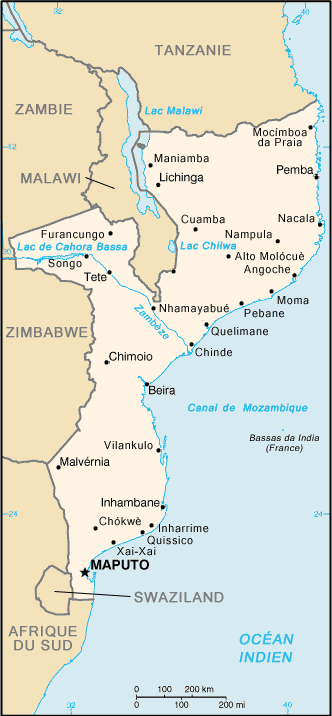
Emeute meurtrière à Chimoio contre la hausse des prix alimentaires – septembre 2010
10 more killed amid Mozambique rioting
telegraph.co.uk
Ten people were killed amid further rioting in Mozambique, as police fired rubber bullets and teargas at demonstrators.
03 Sep 2010
A 30 per cent rise in the price of bread has caused widespread anger in one of the world’s poorest countries, but the government has said it is helpless in the face of soaring global wheat prices.
Drought and fires in Russia, which had been the world’s No. 3 wheat exporter, and a decision by the Russian government to extend a grain export ban until late 2011, have helped to boost benchmark US wheat prices by more than 25 per cent this year.
“Riots in Mozambique may just be a start as drought is expected to worsen in east Africa and dry heat reduces harvests in the U.S. and Russia,” investment bank Fairfax said in a research note.
On the opposite side of Africa, in Cameroon, the government is threatening to close down businesses found breaking price agreements on food staples after consumer groups warned that recent market price hikes could trigger unrest.
After initial calm in Mozambique’s capital Maputo, police said protesters began looting in the city’s outskirts.
Protests also broke out in the central town of Chimoio, 760 km (475 miles) north of Maputo, and at least six people were hurt after police opened fire on protesters, according to reports.
“Two of the wounded are in serious condition,” Teresa Inacio, a nurse at the Chimoio provincial hospital, told Lusa.
The number of deaths in the disturbances that broke out on Wednesday rose to 10 and the number of injuries to 443, according Mozambique’s Health Minister Ivo Garrido.
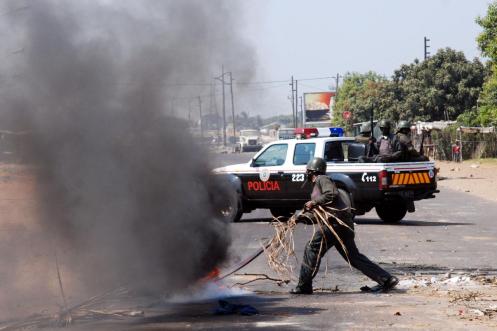
The dead included two children killed when police fired on protesters who blocked streets, set tyres alight and looted stores in the deadliest riots to hit the southern African country of 23 million since 2008.
Police kill three in Chimoio as Mozambique riots continue
rfi.fr
3 09 2010
Three demonstrators have been killed and 27 injured in the Mozambique city of Chimoio, as protests against price rises enter their third day. Police in the capital, Maputo, fired teargas and rubber bullets on a third day of protests against rising prices.
In Chimoio, in the centre of the country, police fired live rounds as well as teargas and rubber bullets, correspondent Orfeu de Lisboa reports.
The city was calm on Friday afternoon.
Riots erupted on Friday after just a few hours of calm and incidents of looting were reported on the outskirts of Maputo.
The riots hit the Benfica and Hulene areas, according to police.
Seven people, including two children, were killed when police used live rounds on Wednesday.
The protests, which continued Thursday, were sparked by a 30 per cent in the price of bread.
Police disperse rioters in new Mozambique protests
Reuters
Fri Sep 3, 2010
MAPUTO (Reuters) – Mozambique police fired rubber bullets and teargas at demonstrators on Friday as rioting flared in the capital following two days of protests over high bread prices that saw seven people killed and hundreds wounded.
After initial calm in the capital Maputo, police said protestors began looting in the city’s outskirts and officers used rubber bullets to disperse the crowds.
« Rioting has resumed on the outskirts of Maputo in Benfica and Hulene. They are trying to carry on looting. Police are firing rubber bullets and teargas to disperse them, » police spokesman Arnaldo Chefo said.
There were no immediate reports of injuries.
Protests also broke out in the central town of Chimoio, 760 km (475 miles) north of Maputo, and at least six people were hurt after police opened fire on protesters, Portugal’s Lusa news agency reported.
« Two of the wounded are in serious condition, » Teresa Inacio, a nurse at the Chimoio provincial hospital, told Lusa.
The deaths in the disturbances which broke out on Wednesday included two children who were killed when police fired on protesters who blocked streets, set tyres alight and looted stores in the deadliest riots to hit the southern African country of 23 million since 2008.
Mozambique’s Trade and Industry Minister Antonio Fernandes estimated damage at around 122 million meticais in the southern African country where 70 percent of the population lives below the poverty line.
UNDERESTIMATED ANGER
Opposition parties and human rights groups have criticised the government, saying it failed to gauge the anger that would be unleashed by the 30 percent bread price increase and hikes in water and electricity tariffs.
« The government underestimated the situation and can’t understand or doesn’t want to understand that this is a protest against the higher cost of living, » Alice Mabota, head of the Mozambican League of Human Rights, told Lusa.
Although Mozambique is one of the fastest growing economies in Africa, it has never fully recovered from one of Africa’s bloodiest civil wars, which ended in 1992, and it has a 54 percent unemployment rate.
« Things are getting back to normal now and we can resume our normal life, » Police Constable Julia Fortes said while queueing for bread in a long line in central Maputo where the situation returned to normal on Friday.
Some Mozambicans said the riots had caused serious damage to the city’s social structure.
The government-imposed price rise took the cost of a bread roll — the bread staple of Mozambicans — to 20 U.S. cents in a country where the average worker earns around $37 a month.
Egyptians also protested over food prices in recent months, and analysts have been warning that riots could follow the jump in food prices in Africa and the Middle East
Mozambicans say they have been hit hard by the rising price of bread and other basic goods, as world wheat prices have soared, but the government said the hikes could not be reversed.
Mozambicans say they have been hit hard by the rising price of bread and other basic goods, as world wheat prices have soared, but the government said the hikes could not be reversed.
Drought and fires in Russia, which had been the world’s No. 3 wheat exporter, and a decision by the Russian government to extend a grain export ban until late 2011, have served to boost benchmark U.S. wheat prices by more than 25 percent this year.
Mozambique also depends heavily on imports from South Africa, which have become more expensive in recent months as the South African rand currency strengthened. Mozambique’s metical has lost around 29 percent against the dollar this year.
The IMF expects 7 percent GDP growth in Mozambique this year. The country’s main exports are aluminium, electric power, coal and farm products, including sugar.
Riots in Mozambique in 2008, also over prices, left at least six dead.





 anthropologie du présent