
Emeutes à Karachi – août 2010

Karachi death toll tops 90
cbc.ca
Ethnic violence triggered by political assassination enters fifth day
Friday, August 6, 2010
Karachi officials issued shoot-on-sight orders as ethnic violence in various parts of the city pushed the death count to more than 90 people.
The casualties rose as 11 more were killed overnight in various parts of the city. Ethnic violence triggered by the assassination of a politician in Pakistan’s southern port city of Karachi entered its fifth day.
Various news outlets estimated the death toll between 90 and 95 people.
Interior Minister Rehman Malik granted permission to law enforcement officers to shoot on sight in a bid to quell the growing wave of targeted killings, and violence that have claimed some 90 lives in the last four days, Pakistan Tribune reported.
« If anyone is found involved or seen, or mentioned in investigations, we are going to take action. So, the best way for them is to either run away from here, stop those activities, or we are going to come to your throat, » Malik told journalists.
Sindh province Home Minister, Zulfiqar Mirza, said 195 people had been arrested in connection with the killings.
The unrest was sparked after Raza Haider, a provincial legislator, was shot dead along with his bodyguard in a mosque while preparing to offer prayers Monday in the Nazimabad area.
Haider was a member of the Muttahida Qaumi Movement, the political party that runs the city and represents mainly descendants of Urdu-speaking migrants from India who settled in Pakistan when it was created in 1947.
The MQM’s main rival is the Awami National Party, a secular nationalist party whose main power centre is in Pakistan’s northwest and whose base is the ethnic Pashtun community living in Karachi.
Within hours of Haider’s assassination, gangs torched buildings in Karachi and gunfire erupted in several parts of the city. Many of the dead were killed in targeted, execution-style attacks, authorities said.
Les affrontements de Karachi ont fait 70 morts en trois jours
Reuters,
04/08/2010
De violents affrontements ont causé la mort de 70 personnes en trois jours à Karachi, la capitale économique du Pakistan, après le meurtre d’un haut responsable politique.
Les violences ont fait plus d’une dizaine de morts pour la seule nuit de mardi à mercredi, ont indiqué la police et des responsables.
Ces affrontements ont relancé les craintes d’un regain d’instabilité dans cette ville de 18 millions d’habitants, siège du premier port du pays, de la banque centrale et de la Bourse.
Les autorités craignent notamment l’arrivée en masse dans la ville de taliban chassés de leurs bases par l’armée et qui trouveraient dans cette mégalopole de nombreux endroits où se cacher.
Les heurts ont, selon la police, fait en outre une centaine de blessés. Des dizaines de véhicules et de boutiques ont été brûlés.
Les violences ont éclaté après la mort, lundi, de Razai Haider, membre du Mouvement Muttahida Qaumi (MQM) à l’assemblée de la province du Sind, tué par balle, ainsi que son garde du corps, alors qu’il assistait à un enterrement.
Le gouvernement impute ce meurtre aux taliban et à l’organisation Sipah-e-Sahaba Pakistan (SSP), un groupe d’activistes interdit.
Le MQM, partenaire de la coalition gouvernementale au niveau fédéral et dans l’assemblée provinciale, a renouvelé son appel en faveur d’une répression contre les activistes.
« Cela fait trois ou quatre ans que nous dénonçons la présence de taliban et d’extrémistes à Karachi et que nous fournissons des preuves« , a dit Wasay Jalil, porte-parole du mouvement. « On se moquait de nous. Mais maintenant, tout le monde reconnaît que les talibans et le SSP sont ici« .
Bien que n’ayant pas de liens avec les violences de lundi, quatre membres du groupe d’activistes interdit Lashkar-e-Jhangvi (LeJ) ont également été appréhendés lors de deux opérations, rapporte la police.
Ils appartiennent à l’organisation de Fazal Mehsud et étaient impliqués dans les attaques contre deux mosquées de la communauté Ahmadi à Lahore en mai, a précisé un haut responsable de la police. « Nous les interrogeons également à propos de différentes opérations violentes à Karachi« , a-t-il ajouté.
Karachi possède une longue histoire de violences à caractère ethnique, religieux ou sectaire. La ville est devenue l’une des cibles d’Al Qaïda lorsque le Pakistan s’est engagé auprès des Etats-Unis dans la guerre contre les activistes après les attentats du 11-Septembre.
Officiellement, près de 200 personnes ont été tuées dans des attaques ciblées depuis le début de l’année mais selon les observateurs et les partis politiques, le nombre exact est bien supérieur.
Sahar Ahmed et Faisal Aziz, Marine Pennetier, Pierre Sérisier et Pascal Liétout pour le service français
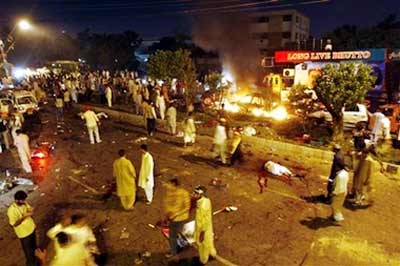
Toll in Karachi riots rises to 73
sify.com
2010-08-05
Karachi: The toll in the violence that broke out in the Pakistani port city of Karachi following the murder of a Muttahida Qaumi Movement (MQM) legislator rose to 73 on Wednesday, with shootouts continuing through the night.
At least 153 injured were brought to various city hospitals in last two days after the riots triggered by the murder of MQM leader and member of Sindh assembly, Raza Haider.
The most violent areas of the city for the third day running were Isa Nagri, Quaidabad, Malir, Machar Colony, Pirabad, Orangi Town and Qasba Colony, amongst others.
Mobs torched more than 50 vehicles and set several shops and fuel stations on fire. The city roads wore a deserted look for the second day Wednesday as the residents remained hesitant to step out. Though educational institutions and offices opened but attendance remained thin.
Federal Urdu University and Karachi University cancelled their scheduled examinations.
Firing and violence were also reported from Hyderabad, Sukhur, Mirpur Khas and other areas of interior Sindh. More than 100 suspects have been taken into custody by law enforcement agencies on various charges.
Police sources suspected the involvement of banned terrorist outfit Jindullah in the killing of Haider. The sketch of the attackers had been finalised with the help of an eyewitness, sources said.
Raza was shot dead by unidentified gunmen Monday in Nazimabad where he had gone to attend a funeral. A ten-member investigation team, headed by DIG Sultan Khwaja, is probing the case and collecting evidence.
Earlier, Interior Minister Rehman Malik had said that banned outfits like Sipah-i-Sahaba and Tehreek-i-Taliban were involved in the incident.
Dunya TV had reported that security agencies were in the know for more than a year that Raza and two other MQM leaders were on the hit list of terrorists.
The MQM leadership has openly held the Awami National Party responsible for Raza’s murder. The charge has been categorically denied by the ANP leadership, which has demanded a thorough probe to bring the culprits to book.
Both parties have remained fiercely engaged in a political tangle spanned over several decades for control over Karachi, which is Pakistan’s largest city and financial hub. Target killings have claimed more than 1,500 lives in the city over the last two years or so.
Des affrontements font 45 morts à Karachi, au Pakistan
lexpress.fr
03/08/2010
De violents affrontements ont causé la mort d’au moins 45 personnes à Karachi, la plus grande ville du Pakistan, après le meurtre d’un haut responsable politique.
Les heurts ont, selon la police, fait en outre une centaine de blessés. Des dizaines de véhicules et de boutiques ont été brûlés.
Les violences ont éclaté après la mort, lundi, de Razai Haider, membre du Mouvement Muttahida Qaumi (MQM) à l’assemblée de la province du Sind, tué par balle, ainsi que son garde du corps, alors qu’il assistait à un enterrement.
Le gouvernement impute ce meurtre aux taliban et à l’organisation Sipah-e-Sahaba Pakistan (SSP), un groupe d’activistes interdit.
Le MQM, partenaire de la coalition gouvernementale au niveau fédéral et dans l’assemblée provinciale, a renouvelé son appel en faveur d’une répression contre les activistes.
« Cela fait trois ou quatre ans que nous dénonçons la présence de taliban et d’extrémistes à Karachi et que nous fournissons des preuves« , a dit Wasay Jalil, porte-parole du mouvement. « On se moquait de nous. Mais maintenant, tout le monde reconnaît que les talibans et le SSP sont ici« .
Vingt personnes ont été arrêtées dans le cadre de ces violences, a annoncé le ministre fédéral de l’Intérieur, Rehman Malik, mardi au Sénat.
Bien que n’ayant pas de liens avec les violences de lundi, quatre membres du groupe d’activistes interdit Lashkar-e-Jhangvi (LeJ) ont également été appréhendés lors de deux opérations, rapporte la police.
Ils appartiennent à l’organisation de Fazal Mehsud et étaient impliqués dans les attaques contre deux mosquées de la communauté Ahmadi à Lahore en mai, a précisé un haut responsable de la police. « Nous les interrogeons également à propos de différentes opérations violentes à Karachi« , a-t-il ajouté.
Policiers et soldats patrouillaient mardi dans les rues désertes de Karachi. Les autres villes de la province du Sind, située dans le sud du pays, étaient la plupart désertes en raison semble-t-il d’un appel du MQM à observer trois jours de deuil.
Karachi possède une longue histoire de violences à caractère ethnique, religieux ou sectaire. La ville est devenue l’une des cibles d’Al Qaïda lorsque le Pakistan s’est engagé auprès des Etats-Unis dans la guerre contre les activistes après les attentats du 11-Septembre.
Officiellement, près de 200 personnes ont été tuées dans des attaques ciblées depuis le début de l’année mais selon les observateurs et les partis politiques, le nombre exact est bien supérieur.
45 die in riots after leader’s assassination
mirror.co.uk
PAKISTAN
Gunmen shot dead at least 45 people in Pakistan yesterday after the killing of a politician sparked a series of revenge attacks.
More than 100 people were also wounded as dozens of vehicles, shops and businesses were set on fire.
Security forces struggled to regain control of Karachi, which has a history of violence and has long been a hideout for al-Qaeda and the Taliban.
The violence erupted after local politician Raza Haider and his bodyguard were shot dead in a mosque.
Mr Haider was a member of the Muttahida Qaumi Movement, the political party that runs the city and represents descendants of Urduspeaking migrants from India.
Its main rival is the secular Awami National Party, whose main power centre is Pakistan’s north west.
Last night, Prime Minister Yousuf Raza Gilani appealed for calm.
Unrest kills 31 in Pakistan’s Karachi: surgeon
AFP
3 08 2010
KARACHI — Outbreaks of violence in Pakistan’s largest city of Karachi killed at least 31 people overnight following the murder of a lawmaker in a drive-by shooting, officials said.
Lawmaker Raza Haider from the Muttahida Qaumi Movement (MQM), a partner in the Sindh provincial ruling coalition led by the Pakistan Peoples Party, was shot dead by gunmen on motorcycles Monday.
His assassination sparked panic in the teeming city of 16 million where markets closed and streets emptied as bursts of gunfire were reported in various parts of the financial capital.
Vehicles, shops and petrol stations were set on fire during the violence.
The unrest comes with Pakistan already battling to contain unprecedented flooding that has killed up to 1,500 people and left 2.5 million affected, largely in the impoverished northwest.
« The city’s hospitals received the bodies of at least 31 people who were victims of gunshots, » said Hamid Parhiar, police surgeon of Sindh province.
« The bodies have been received from different parts of the city. All those were shot dead, » Parhiar told AFP.
Only security officials speaking on condition of anonymity would acknowledge a connection between the outbreaks of violence and the lawmaker’s killing, such are the political and ethnic sensitivities in Karachi.
« Around 30 people have been killed in different incidents of gun attacks in different parts of the city, and they all seemed to be a sequel to the MP’s murder, » one such official told AFP.
Another intelligence official confirmed the same death toll.
Jameel Soomro, spokesman for the Sindh government, said Haider’s killing was part of a broader « conspiracy » to destabilise Karachi which is Pakistan’s « financial engine ».
After the MQM called for a city shutdown to protest against the lawmaker’s killing, the government closed schools and colleges in Karachi and Hyderabad, about 174 kilometres (108 miles) to the east.
Reports from Hyderabad said vehicles and properties had also been set ablaze to protest against the MP’s assassination.
Provincial authorities have already banned public political meetings in Karachi in an effort to control intermittent waves of political killings.
The government has not released exact figures, but security officials say more than 125 people have died in such violence since the beginning of this year.
Karachi has been largely spared the Taliban and Al-Qaeda-linked bomb attacks that have dogged northwest Pakistan, but is plagued by ethnic and sectarian killings, crime and kidnappings.

MQM leader’s murder sparks violence in Pak, 35 killed
thehindu.com
KARACHI, August 3, 2010
Overnight violence in Pakistan’s Sindh province left at least 35 people dead and 80 others injured in incidents of rioting, firing and arson, following the killing of a legislator of the ruling Muthaida Qaumi Movement here.
More than two dozen vehicles, shops, teashops and carts parked on roadsides were set ablaze by rampaging mobs.
Police officials and hospital sources said that since the gunning down of member of the Sindh assembly Raza Haider, 35 people have been killed in incidents of violence in different parts of Karachi and Hyderabad.
This port city was rattled with gunfire, forcing the closure of business centres, shops, petrol pumps and marriage lawns, bringing life to almost a virtual standstill.
Hamid Parihar, police surgeon of the Sindh province said, 31 bodies with gunshot wounds have been received in different hospitals in both the cities. However, the Dawn newspaper said that 35 bodies were received by hospitals.
“We have received around 13 dead bodies and are treating 45 injured people most of them from gunshot wounds,” the medico legal officer of the state—owned Jinnah hospital here told PTI.
Dr. Abbas Rizvi at the Abbasi Shaheed hospital said nine dead bodies were brought to the hospital and dozens were being treated for gunshot wounds and other injuries.
“It is a precarious situation and there is trouble in many parts of the city and we have increased the number of policemen and the para—military Rangers patrolling the city,” city police chief Waseem Ahmed said.
35—year—old Raza Haider, one of the oldest members of the MQM and a member of the Sindh assembly, was shot dead along with his bodyguard, Khalid Khan when they came to a mosque in Nazimabad to attend the funeral prayers of his friend’s mother.
“Four persons riding a motorcycle and in a white car came to the mosque and as Raza Haider was performing ablution they fired at him from close range, it was a clearly a target killing,” a senior police official said.

14 killed, over 50 hurt in Karachi after killing of MQM minister
sify.com
2010-08-03
|

Nine dead in Karachi riots after Raza’s killing
thenews.com.pk
Monday, August 02, 2010
KARACHI: Nine people have been killed in separate incidents of firing following the murder of MQM leader and MPA Raza Haider here Monday evening, police sources said.
Fear and panic spread across the city after the incident of Raza Haider’s killing at a local mosque in Nazimabad, as miscreants went out on a rioting spree of killing people and ransacking private properties.
More than a dozen vehicles were set on fire while several petrol pumps and a furniture market in Gulistan-e-Jauhar were also torched.
Hyderabad is also in the grips of tension where similar incidents of riots are taking place, bringing the entire city to a standstill.





 anthropologie du présent