
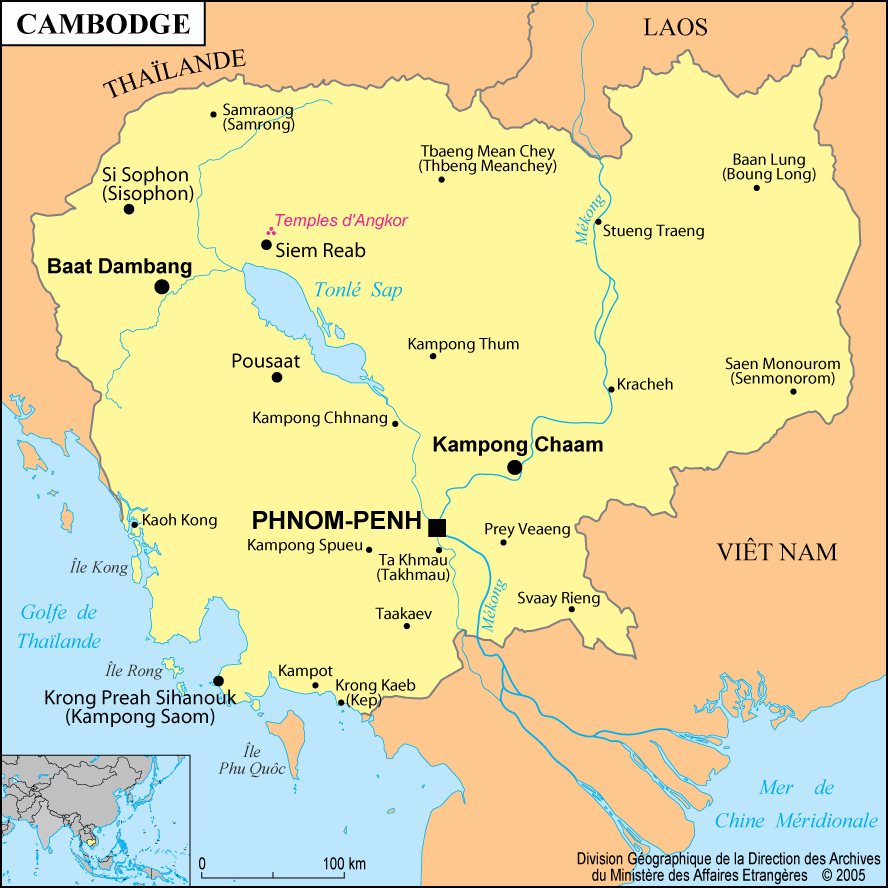
Emeute ouvrière à Phnom Penh – juillet 2010
Striking female workers paid just £1 a day at factory which makes clothes for Gap and Adidas are beaten by riot police
dailymail.co.uk
27th July 2010
Riot police used electric shock batons to beat women sweatshop workers when they stopped producing fashion labels for the UK and other Western nations in Cambodia today.
The image of heavily-armed police in protective clothing using their shields and batons to crush a strike by poverty-stricken women workers will do nothing to improve the tarnished image of designer label companies who run Asian sweatshops.
At least nine women were injured when more than 100 police, more than half in riot gear and armed with assault rifles, tried to force 3,000 women workers back into their factory.
Some women, who earn less than £1 a day, fell to the ground where they were attacked and stunned by police batons.
Workers in Cambodian sweatshops have risen up in recent protests against low pay and harsh working conditions, but today’s walk-out was over the suspension of a local union official.
The factory, on the outskirts of the Cambodian capital, Phnom Penh, is owned by a Malaysian firm and produces garments for the big names of fashion and sport – Gap, Benetton, Adidas and Puma. The factory contributes to Cambodia’s clothing, textiles and shoes exports which were valued at more than £1 billion last year.
All four clothing and sporting companies linked to the factory have come under severe criticism from investigators for the harsh conditions endured and low wages given to their Third World employees.
Reports by charities such as Oxfam have found that the apparel industry, whether for designer labels or for garments that carry the names of big sporting companies such as Adidas, Nike and Puma, uses and abuses sweatshops.
Oxfam points out that workers in developing countries are paid minimal wages and are often forced to endure long hours in harsh and often dangerous conditions producing some of the world’s most expensive and coveted brands.
It is the sportswear and garment industry that employs mostly women – and the demonstration at the Cambodian factory yesterday was evidence of that as by the hundred they poured out of the premises in support of their suspended union official.
Riot police rushed to the factory after a court order was given to them to clear the roads and force the women back to work.
The brutality the women suffered brought an end to their strike and they returned to the factory, part of an estimated 300,000 people who work in the garment manufacturing sector.
When they have saved enough of their meagre wages, they send what they can back to their impoverished rural villages, where people struggle on as little as 50 pence a day.

Cambodian riot police clash with strikers
ft.com
By Tim Johnston in Phnom Penh
July 27 2010
Cambodian police armed with riot shields moved in on Tuesday to break up a week-long strike triggered by the suspension of a union official at a Malaysian-owned garment factory.
Union leaders said nine women were injured when more than 100 police tried to force 3,000 female garment workers back into the PCCS Garment factory in northern Phnom Penh, which exports clothes for international brands such as Gap, Benetton, Adidas and Puma.
Cambodia has a long history of turbulent labour relations as workers try to force wage increases.
“The industrial relations problems in Cambodia have been around for some time, this is not new,” said John Ritchotte, a regional industrial relations specialist with the International Labour Organisation.
However, Mr Ritchotte was optimistic the situation might change. “There has been a general, if slight, trend towards improvement in relations,” he said.
Earlier this month, the government adopted a new minimum wage equivalent to $61 (€47, £40) a month, up from $50, but the settlement was significantly lower than initial union demands for rises of between $20 and $43. The unions, who had called for a three-day general strike in protest against the $11 increase, eventually dropped their plans for industrial action.
Cambodia’s textile industry accounts for some 85 per cent of exports – it is the country’s third-largest source of income after agriculture and tourism – and a little more than a quarter of its industrial employment. A study by the Garment Manufacturers Association of Cambodia in 2008 showed that 62 per cent of factories were of mainland Chinese, Hong Kong and Taiwanese ownership.
Although Cambodia’s textile industry is less developed than China’s, the workforce is better organised. Mr Ritchotte estimated that between 40 and 60 per cent of the labour in the garment sector was unionised and said the number of unions was growing.
“The union movement has been dynamic for some time,” Mr Ritchotte said, adding that there had been “fairly rapid” growth in the number of unions but it is not clear whether that is because of fractures within the movement or if the net number of union members is rising. At the last count, there were 273 garment-sector unions alone.
The number of labour clashes rose rapidly last year, when the global crisis savaged Cambodia’s garment industry, which was less diversified than its competitors in countries such as Vietnam and China. Exports fell by 20 per cent, and many manufacturers abandoned their factories when business dried up, leaving substantial unpaid wage bills.
Copyright The Financial Times Limited 2010. You may share using our article tools. Please don’t cut articles from FT.com and redistribute by email or post to the web.

Cambogia, scontri tra polizia e operaie del tessile, 9 feriti
reuters
martedì 27 luglio 2010
PHNOM PENH (Reuters) – E’ di almeno nove feriti il bilancio degli scontri tra la polizia cambogiana e le operaie di una fabbrica che produce capi d’abbigliamento per grandi gruppi occidentali tra cui Gap, Benetton, Adidas e Puma.
Forze dell’ordine in assetto anti-sommossa hanno cercato di costringere circa 3.000 operaie, in sciopero da una settimana per la sospensione dal lavoro di un rappresentante sindacale, a tornare al lavoro.
Varie operaie sono state spinte al suolo e stordite con bastoni a impulsi elettrici, riferisce un testimone Reuters. Secondo Srey Kimheng, un leader sindacale, almeno nove sono state ferite dai poliziotti, che avevano ricevuto ordine di farle rientrare al lavoro sulla base di un’ordinanza giudiziale.
Secondo il capo della polizia locale, Mok Hong, non ci sono stati invece feriti a seguito degli scontri.
La polizia ha interrotto una manifestazione in cui le operaie chiedevano il reintegro al lavoro del rappresentante sindacale.
L’industria tessile cambogiana, terzo motore della crescita del paese dopo agricoltura e turismo, ha risentito pesantamente della crisi globale e di recente sono aumentate le proteste per le condizioni di lavoro e i livelli retributivi.
Si stima che circa 300.000 cambogiani, su una popolazione di 13,4 milioni di persone, lavorino nella manifattura tessile.
Sul sito http://www.reuters.it le altre notizie Reuters in italiano








 anthropologie du présent