
Kashmir : la « guerre des pierres » – juillet 2010

>>Emeutes à Sopore सोपोर – juin 2010<<
Curfew imposed again in most of Indian Kashmir
AP
By AIJAZ HUSSAIN
16 07 2010
SRINAGAR, India — Authorities re-imposed a rigid curfew throughout most of the Indian portion of Kashmir to prevent street protests after Friday prayers following weeks of unrest that has killed 15 people.
The mostly Muslim region, where resistance to rule by predominantly Hindu India is strong, has been under a rolling curfew for the past three weeks after anti-India street protests and clashes surged.
The tension in the Himalayan region — divided between India and Pakistan and claimed by both — is reminiscent of the late 1980s, when protests against New Delhi’s rule sparked an armed conflict that has killed more than 68,000 people, mostly civilians.
Separatist politicians and militants want to carve out a separate homeland or merge with Pakistan.
On Friday, thousands of police and paramilitary soldiers — dressed in riot gear and armed with assault rifles — patrolled Srinagar, the main city in the Indian-held Kashmir. They asked people to stay at home, said Javaid Ahmed, a local resident.
The government decision followed a call for protests by the All Parties Hurriyat Conference, the region’s main grouping of separatist parties. An earlier curfew had been eased last weekend so that residents could celebrate a Muslim festival.
But on Thursday, the unrest picked up again, when thousands of people held streets protests chanting « We want freedom » and « Go India, go back » in Srinagar.
Clashes erupted as government forces fired tear gas to disperse rock-throwing protesters in Srinagar and some other towns, injuring 16 protesters and 13 troops, a police officer said on condition of anonymity as he was not authorized to talk to reporters.
On Friday, shops, schools and government offices were closed and public buses stayed off the roads in the region.

Rubber bullet hits Baramulla youth; clashes in Batamaloo
risingkashmir.com
Ishfaq Ahmad Shah
Srinagar, July 12: The tough restrictions in old city and parts of Valley coupled with shutdown crippled life across Kashmir on Monday while youth was hit by a rubber bullet during clashes in Baramulla and Batamaloo residentscontinued to stage demonstrations against the recent killings. Meanwhile, District Commissioner Srinagar has said Section 144 will be strictly enforced on Tuesday to foil Hurriyat factions proposed march.
Although curfew was lifted by authorities yesterday but the police and paramilitary CRPF men continued to enforce tougher security restrictions in old city. The residents of Rainawari, Nowhatta, Bohri Kadal, Mallarata, Nawa-Kadal and adjoining areas complained that they were not allowed to venture out of their homes by the cops armed with riot gears and sophisticated weapons.
Some of the people complained that curfew passes issued by the authorities were not entertained by the police and CRPF men. “I had a valid curfew pass but the cops refused to entertain it and asked me to return home,” said Sajjad Ahmad of Jogi Lankar, Rainawari.
In civil lines area, where curfew was lifted and no restrictions were in place, all shops and business establishments remained closed and passenger vehicles were off the roads in response to the shutdown called by Hurriyat Conference (G). However, private vehicle, two-wheelers and three-wheelers were plying on the deserted roads.
Meanwhile, for the second day in succession residents of Batamaloo area came out on roads and staged peaceful demonstration. Chanting slogans like, “We Want freedom,” “Go India Go Back,” and “Punish the guilty troopers”, the protestors, who included women and children, were demanding action against the police and CRPF men involved in killing of three persons including a woman on July 6 in the area.
A top police official, pleading anonymity, acknowledged that tough restrictions were imposed in some areas of the old city to prevent people from taking to roads and staging demonstrations.
No Curfew today
Deputy Commissioner Srinagar Mehraj Ahmad Kakroo said that Section 144 will be strictly enforced in city on Tuesday to foil Hurriyat’s proposed march.
Both the Hurriyat factions have called for “Naqashband Sahib Chalo” on July 13 to commemorate the “Martyrs Day” in Kashmir.
Kakroo ruled out imposition of curfew to foil the separatists march. “Section 144 will remain in effect and will be strictly enforced. The unlawful assembly of people will not be allowed,” he said.
NORTH/SOUTH
The situation in North Kashmir’s Baramulla district remained tense after a youth Sameer Ahmad of Delina was hit by a rubber bullet during clashes between angry youth and policemen in the area this morning.
The injured youth was shifted to a local hospital where doctors have termed his condition as stable.
Meanwhile, complete shutdown was observed in Baramulla and Sopore in response to the Hurriyat (G’s) strike call. Protests were held in the Masjids of the main town and other areas of Sopore.
The life in South Kashmir’s Islamabad, Pulwama and Kulgam districts also remained paralysed due to the shutdown.
The authorities had imposed Section 144 in the main district headquarters. Hundreds of police and CRPF men armed with riot gears were deployed in the district headquarters to thwart any protests.
The curfew in Islamabad town, which was imposed after killing of three youth in police firing, was lifted after 11 days yesterday.
However, defying restrictions youth clashed with police and CRPF men at Sangam and Charsoo areas. They were chased away by the cops.
DC Islamabad, Jaipal Singh said the situation in the district remained calm. “There were no reports of any untoward incident from anywhere in the district,” he said.
Curfew lifts in most of Kashmir, but strike called
AP
11 07 2010
SRINAGAR, India — A rigid curfew was lifted from most of Kashmir on Sunday, but shops and businesses remained shut after separatists called for a strike to protest Indian rule in the Himalayan region.
Curfew-like restrictions were imposed in some areas of Srinagar, the main city in Indian Kashmir, and in two southern towns following clashes late Saturday between anti-India protesters and government forces, a police officer said Sunday, speaking on condition of anonymity as he was not authorized to speak to the media.
The clampdown in Kashmir comes after street protests and clashes surged in the disputed region, and at least 15 people died over the past four weeks in shootings blamed on police and paramilitary soldiers.
The tension in the Himalayan region — divided between India and Pakistan and claimed by both — was reminiscent of the late 1980s, when protests against Indian rule sparked an armed conflict that eventually killed more than 68,000 people, mostly civilians.
The tight curfew that started Wednesday was lifted late Friday for 24 hours to allow residents to celebrate a Muslim festival. It was reimposed after renewed clashes between protesters and troops Saturday.
On Sunday, thousands of government forces in riot gear and carrying assault rifles patrolled Srinagar’s nearly deserted streets and enforced strict restrictions in the city’s densely populated downtown area.
However, in other parts of Kashmir where the curfew was lifted, shops and businesses were closed and public transport was off the roads after the All Parties Hurriyat Conference, the region’s main grouping of separatist parties, declared a strike. Some private vehicles, however, plied the streets.
None of the nearly 60 newspapers published from Srinagar hit the stands for a fourth day on Sunday.
Newspaper editors announced the suspension of their publications to protest against what they called the government’s « curbs and the use of force against media persons, » the Kashmir Press Guild said in a statement Saturday.
India and Pakistan have fought two wars over Kashmir. India accuses Pakistan of sending insurgents over the heavily militarized frontier to stir up trouble in Indian Kashmir and has blamed the current protests on Pakistan-based militants bent on destabilizing India, a charge Islamabad denies.
Kashmiri separatists are demanding independence from India or a merger with Pakistan.
Fresh clashes, curfew back in Valley towns
Tribune News Service
Ehsan Fazili
Srinagar, July 10
Curfew was reimposed in Maisuma locality of Srinagar and Sopore and Pulwama towns today after angry mobs clashed with the security forces.
“Miscreants resorted to stone throwing in Maisuma, Sopore and Pulwama during curfew relaxation. So the restrictions were reimposed at these places,” a senior police officer said.
Barring some localities in the state capital and other major towns, curfew was relaxed in most parts of the valley since last evening to facilitate the celebration of the holy Muslim festival of Shab-e-Meiraj.
The curfew restrictions were lifted in Srinagar at around 8 pm on Friday, 76 hours after they were imposed following massive violence, which saw death of four persons, including a woman, and deployment of the Army.
While fresh incidents of violence were reported from downtown areas of the city, including Nowhatta and Maisuma, after the restrictions were eased, a person was injured in the clashes on Friday evening.
Angry demonstrators clashed with the police and the CRPF at Maisuma, prompting the authorities to clamp curfew again. Demonstrations against the security forces were also held at Qamarwari, Safakadal and Magharmal Bagh areas.
The APHC chairman, Mirwaiz Umar Farooq, who had been under house arrest for the past three days, addressed public gatherings at Jamia Masjid, Nowhatta and Alamgari Bazaar today against the alleged rights violations.
The curfew continued in Sopore town of north Kashmir and Pulwama and Kakapora areas of south Kashmir. The trouble in Pulwama erupted after demonstrators hit the streets following the reports about the death of a person in the clashes that took place in Kakapora area yesterday. When the repeated pleas of the authorities failed to quell the protesters, the former decided to reimpose the curfew.
Meanwhile, soon after the restrictions were lifted last evening, people, who had been forced to stay indoors for the past three days, came out to buy essential items.
According to an official spokesman, thousands of devotees offered Isha prayers at several shrines, mosques and khanqahs across the city on the occasion of Shab-e-Meiraj. (With inputs from Agencies).
Indian troops enforce Kashmir curfew after deaths
AFP
7 juillet 2010
SRINAGAR, India — Thousands of Indian police and paramilitary forces enforced a strict curfew in Kashmir’s summer capital of Srinagar on Wednesday, a day after three protesters were killed.
The two men and one woman died in separate incidents when security forces opened fire to contain angry separatist demonstrations that have been fuelled by the deaths of several protesters over the last month.
The Indian army was put on standby after authorities urged them to assist in enforcing the curfew, which was widely ignored on Tuesday.
« A request has come from the state government. We have forwarded the same to Delhi. We are on stand-by, » Indian army spokesman J.S. Brar told AFP.
Srinagar has been the focus of protests since June 11, when a 17-year-old student died from a police teargas shell.
Indian police and paramilitary forces, who have been struggling to control the wave of protests in the Muslim-majority Kashmir valley, have been accused of killing 15 civilians in less than a month.
Each death has sparked a new cycle of violence despite appeals for calm from state Chief Minister Omar Abdullah.
The insurgency against New Delhi’s rule over Kashmir has claimed tens of thousands of lives, though the recent unrest is the worst for two years.
Nuclear-armed India and Pakistan each hold Kashmir in part but claim it in full. They have fought two of their three wars over the region since partition of the subcontinent in 1947.

Kashmir: Indian Police Fire on Protesters, Killing 3
REUTERS
July 6, 2010
The Indian police fired at hundreds of stone-throwing protesters in Kashmir on Tuesday, killing three civilians in the latest violence in a region at the center of a dispute between India and Pakistan. The deaths of at least 14 people, mostly protesters, in the last three weeks have set off the biggest anti-India demonstrations in two years across the Kashmir Valley, where the majority of residents are Muslim. India’s home minister, Palaniappan Chidambaram, has accused a Pakistan-based militant group, Lashkar-e-Taiba, of inciting the protests, but many local people believe they are mostly spontaneous. The violence could hurt a tentative process begun by India and Pakistan to repair relations after the 2008 Mumbai attacks, for which India blames Lashkar-e-Taiba.
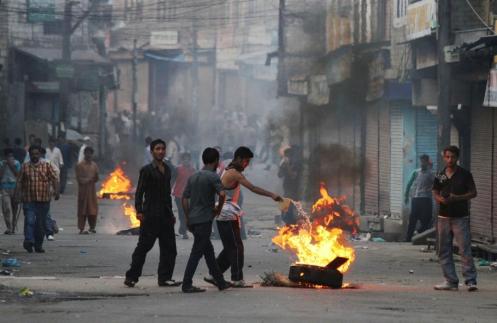
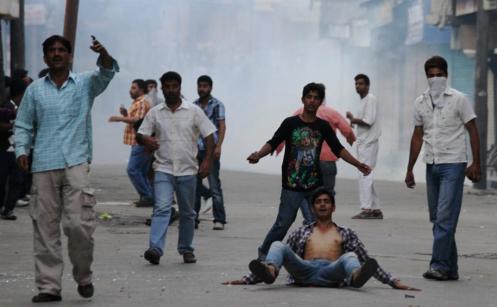
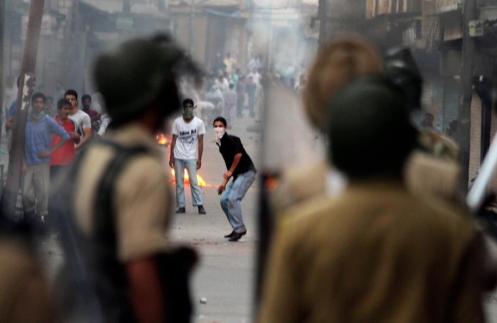


Stone-pelters on Facebook
mid-day.com
2010-07-05
Post ban on SMSes in the Valley, Kashmir agitators recoup on social networking site
The Kashmir government thought SMS was their last resort, but it wasn’t. It only fuelled the fire of an ideology.
The aggressive protestors of the Valley, whose philosophy for every bullet of the troops is that with a stone, have now taken on social networking site to voice their dissent after the government banned the messaging service, thinking it will cut communication among the agitators. However, the state police are too busy to ignore the virtual world of networking
Kaushur Haatyar Kann’e Jung (stone pelting), a community on Facebook, is bringing together young Kashmiris for whom stone-pelting has become a way of expressing their anger at the escalating situation in the Valley as well as targeting the security forces.
The community apart from highlighting the anti-agenda claims to have offices in Nowhatta, Maisuma, Sopore and Islamabad. It also identifies Jammu and Kashmir as « occupied Kashmir » like the various jihadi and Pakistani websites.
Official sources in the Kashmir police admitted that whatever success they had by banning the SMSes, Facebook has nullified it.
Goes a post on the community: « Kasheer Koshur: Kani jang is not a new experience for Kashmir and its people. For more than six decades, stone-pelting had been the ultimate weapon of Kashmiri anger at any point of conflict arising out of intimidation. In real sense resorting to stone throwing as a weapon for defence and defiance is manifestation of volcanic eruptions of extreme dissent. … »
The Inspector of Police, Kashmir zone, Farooq Ahmad said the state police are under extreme duress, especially ever since the recent spate of violence has erupted in the Valley. « We don’t have time for such things, » Ahmad told MiD DAY when asked whether the state police has any mechanism in place to monitor the activities of the stone-pelters in the virtual world.
Jammu and Kashmir Home Secretary Samuel Verghese said, « I don’t talk to mediapersons, I don’t know. »
In the recent months, stone-pelters have emerged as a major headache for the security forces in Kashmir, particularly the Central Reserve Police Force. The protests assumed alarming proportions after two youth were killed during firing by the CRPF personnel while controlling a protest in Baramulla.
Top security expert and former director of Intelligence Bureau (IB) Ajit Doval said the police could actually rein-in these elements, which have turned stones into a potential danger to the gun-wielding security forces, if they would monitor their activities on the Facebook.
« Since SMSes have been banned in the Valley, social networking sites have emerged as a major communication tools for stone-pelters. » « Contrary to the government’s perception that the ring leaders, who manage the stone-pelting protests, are technologically challenged, these people are tech-savvy and know too well to exploit such resources to their benefit. Once the ring leaders are identified, it would become easier to limit their activity to Facebook only, » Doval told MiD DAY.
« I understand the meaning of peaceful protests. And I believe that protesting peacefully is the best (way) of making your point in this democratic age. But the unfortunate story of Kashmir is that we are never given a chance to demonstrate peacefully. Considering all this, I give vent to my anger by pelting stones. So, I do it on the streets and on the Internet as well through Kann’e Jung, » Iqbal Ahmad, a member of the community told MiD DAY over phone from Kashmir.
« I do not do it for fun, and I hate those people who do it for mischief. Our struggle is not for fun. For me stone-pelting is an ideology. It is a fight against forgetfulness (of the authorities towards the plight of the Kashmiri people), » another stone-pelter told MiD DAY, wishing anonymity.

The Stone War
expressindia.com
Jul 04, 2010
A stone is a stone, but when it flies midway between a young boy and a soldier in Kashmir, it becomes a political statement.
It is the pent up anger, frustration, and aspiration of an entire generation that crystallizes into a quarter of a brick, a boulder or a pebble. It is a game – of hide and seek, of attack and retreat, of running away from an almost certain death through narrow lanes blinded by tear-smoke, of confronting plastic pellets and live bullets with sharp edged stones. At times, it is a weapon put in rented hands by politicians and even police officials to create chaos or corner their adversary. It is a visible sign of a transition in the contours of the larger Kashmir conflict where young men pick a piece of brick or a rock and not an AK rifle to confront the state. It’s a tool of resistance: a genuine protest to exhibit frustration against political status quo. It’s also an instrument of a conspiracy: a deliberate mischief to create chaos.
In a narrow lane stones and bricks fly like flocks of birds covering the view of blue sky followed by gun shots and tear smoke canisters fired from automatic rifles, making it medieval fighters against modern warfare. It is young boys ‘waging war against the State’. The spin doctors have even termed it as « agitational terror’’ and « gun less terror’’. In the last three weeks alone, 11 young boys have been killed in Kashmir for stone throwing, and it seems that for each one who is shot, two are ready to take his place. Kashmir is on boil again and curfew is the shivering lid to this boiling cauldron.
Stone pelting or `Kani jung’ is not new to Kashmir. There is historical evidence that the origin of stone throwing as an instrument of protest dates back to the Mughal rule in 16th century. After Mughals successfully invaded Kashmir and dethroned its last independent king Yousuf Shah Chak, Kashmiris would throw stones at the Mughal soldiers walking down from the barracks situated on the Hari Parbat hill top to run daily errands in the old city.
Its recent history, however, goes back to 1930’s when Chief Minister Omar Abdullah’s grandfather Sheikh Mohammad Abdullah lead a popular resistance against the autocratic Dogra rulers of the State. It has remained a popular tool to protest especially in Srinagar’s downtown city all through. Srinagar city used to be divided between Sheikh’s supporters, nicknamed as Sher’s or lions, and the followers of Mirwaiz Umar Farooq’s grand uncle Mirwaiz Mohammad Yousuf Shah ridiculed as Bakra’s or goats. While Sheikh was pro-India, the elder Mirwaiz’s constituency was smaller but entirely pro-Pak. And each time, there was a fight between these arch rival political groups in the city, it would involve stone throwing. There are only two changes now: more people die in police and security force response while the ambit of stone throwing has expanded from the maze of lanes in old city to the towns and villages across Kashmir. During the Amarnath land row, 60 protestors were killed in police firing while more than a thousand were injured, several among them maimed for life.
Ever since the decline of militancy in the valley, stone throwing has become the only expression of anger of a generation of young men who grew up in the conflict of last two decades. How did stone throwing take such a centre stage in Kashmir protests? Who are the stone throwers? What is their motivation? Why is there no other means adopted by the police to halt stone throwers but open fire at them?
For years, stone throwing was limited to the lanes and bylanes around Srinagar’s Jamia Masjid and Maisuma locality, where young boys would throw stones at policemen for few hours after Friday prayers – both parties retrieving later. Maisuma lanes in the vicinity of Lal Chowk, in fact, was dubbed as Kashmir’s Gaza strip because of the frequency with which young boys would pelt stones at a nearby police post here. The policemen would call it a limited day match and there would be pauses for lunch and tea. The stone throwing, however, became an issue in 2008. Militancy was at its lowest ebb and Srinagar city had limped back to calm. In the absence of a political initiative to fill the void, this tranquility soon turned out to be a façade. However, when thousands of people took to streets to protest the Amarnath land transfer, the signs of a changed Kashmir were evident. These were first ever massive and peaceful protests that were taken out in the valley ever since 1990. While thousands of men and women came out shouting slogans and marching on the streets here, men formed human chains around police and security force posts to avoid a confrontation. But once the government decided to put restrictions, erect barricades, spread loops of concertina wire and clamp undeclared curfew to stop the massive protest marches, the slogan shouting congregations were replaced by groups of young men throwing stones. At that time, there was a heated debate within the administration regarding the government’s strategy to tackle the situation. A section of senior police officers were arguing that the government must allow people to protest because the pent up anger can manifest into a more dangerous reaction. Their argument was that after all stones are much better than Kalashnikovs. The situation took an ugly turn on August 11, 2008 when a senior Hurriyat leader was killed in police firing at Chahal on Srinagar-Muzaffarabad road. Sixty young men were killed in the government’s effort to quell the protests against Amarnath land transfer and subsequent economic blockade of the valley in Jammu. The government never allowed public protest ever since.
As stones have literally replaced guns, it has become an intifada and a large section of separatists are now comparing it with Palestine to legitimize stone throwing as a genuine tool of the resistance. There is a strong view that stones and slogans fall in the realm of protests and a legitimate way to vent anger against the State. The debate isn’t however over. Recently former chairman of Hurriyat moderates Molvi Abbas Ansari termed stone pelting as an unislamic act thus again racking the old controversy. The debate was initiated by former SSP Srinagar Ahfad-ul-Mujtaba in January, 2009. Mujtaba quoted a hadith, which suggested that stone throwing was not an acceptable mode of protest in Islam. In fact, separatists also organized a seminar last year to debate the legitimacy of stone throwing as a tool for resistance once chief of Jamiat-i-Ahlihadith, Moulana Showkat Ahmad Shah created a stir by coming out with a fatwa that pelting stones on the armed security personnel was not sanctioned by Islam. Shah too had quoted a hadith. Mirwaiz Umar Farooq also had backed Shah in his interpretation. In fact, Mirwaiz had made a fervent appeal to the youth « not to indulge in stone pelting as it caused inconvenience to the masses and gave the authorities chance to defame the freedom movement’’. The moderates, however, were rebuffed by other separatists including the hardline Hurriyat leadership, who argued that « stone throwing is the outcome of government’s systematic denial to allow protests against the occupation of Kashmir by India’’. They argued that “the deployment of thousands of armed personnel needlessly in populated areas was a provocation in itself and it was natural for youth to react with anger and pelt stones”.
Though stone throwing is immensely uncomforting for the people in general, this time around the debate has shifted in favour of its supporters and the reason is clear. The Machil fake encounter and subsequent killings of young men, including children, in protests has swelled the streets with anger, swinging the pendulum of debate in favour of the stone throwing boys who are seen as victims and not perpetrators of the trouble. Then the freeze in the discussion on the larger Kashmir issue too has strongly hit the legitimacy of the moderate sections of the separatists and helped the hardliners fill the void in the separatist political landscape.
A closer look at the stone throwers exposes a new phenomenon as well. From school dropouts and unemployed youth, its reach has expanded to highly educated young men, who see it an inalienable part of the « struggle’’ especially because protest marches and congregations are disallowed. Even a special application has been created on the social networking site facebook called `Kani Jung’ where one can throw virtual stones to register the protest.
Portrait of a Stone Thrower
Iqbal is 23. And his name is not real. He says he is aware about the consequences to offer his face for cameras or expose his name and address. A post graduate student in Kashmir University, he studies politics. « I read and I understand. That’s why I pelt stones,’’ he says. « Its not for fun. I would love to join peaceful protests. But they don’t let us gather, not even for shouting slogans and expressing our anger’’. Referring to the protest marches of 2008, he recalls the human chains formed by men around security force pickets in Srinagar city. « We were protesting, which I believe is our right. We didn’t show any anger towards police or CRPF. We walked and shouted slogans,’’ he says. « But they put restrictions. They locked us up inside our homes. They put curfew and erected barricades. The government doesn’t have problem with stone pelting – they have problem with everything. They want us to be mute spectators and how can we accept that’’.
Iqbal has a frail frame but you can see the resolve in his eyes. « I have no confusion. The government should shut the colleges and universities in Kashmir if they want us to grow up as conformists,’’ he says. He says he does not support any particular separatist leader or ideology. « I want Kashmir issue to be resolved as per our aspirations. People have died. There are graveyards everywhere. How can they (government) even think we will shut up as if nothing has happened here’’. Iqbal lives in a congested neighbourhood in downtown city and says that his parents don’t know he joins stone throwing. « They do suspect at times though,’’ he says. « Once I returned home in the evening and my eyes were watery because of the tear smoke. I had to come up with an excuse. My mother would freak out if she comes to know,’’ he says. He says that there is no one group of stone throwers but he is never alone. « There are scores of youngsters who are studying professional courses. I think once you are genuinely aware, you become restless in Kashmir. Then you see nothing is changing and it burns you with anger’’. To hide his stone thrower side, Iqbal has made elaborate arrangements. His wardrobe has a hidden drawer where he keeps his Halloween gear – a mask which leaves only his eyes and mouth open. He has shin pads and jogging shoes that he wears whenever he goes for the `match’. Iqbal’s father is a government employee while his mother is a house wife. « I have two younger siblings – a brother and sister,’’ he says.
Iqbal says he was « baptized’’ into stone throwing soon after government restricted public protests in 2008. « Those protests were like carnivals of resistance. I had taken permission at home to go. Everyone participated then. But one evening, I watched a boy’s funeral on local cable television channel. I seethed with anger,’’ he says. « The police officer was justifying his death as if he was a criminal. He had thrown stones at them near Jamia Masjid and the police fired straight at his chest. Later I joined few funerals too’’. He says that at times, he feels very scared. « But then you don’t go out alone. There is always a group and it gives you a sense of security,’’ he says. Has anybody paid you ever for stone throwing? « What do you think? I don’t need to rent myself out for money. I have enough. How can you believe the lies of the government? How can money motivate a man like me to put my life at risk,’’ he says.
Why police and security force men? Iqbal says that they are the state. « The government uses them to stop us forcibly whenever we try to take out a protest. They are the only sign of the state on the roads,’’ he says and admits that the individual policeman or CRPF man has no direct relation with the Kashmir conflict. « I am aware that they are here only because the politicians send them. But then that’s life’’.
J&K first started booking stone-pelters under the Public Safety Act during the 2008 Amarnath land row agitation. Nearly 1,500 CRPF men and three hundred policemen have been injured in stone pelting incidents and around 373 vehicles have been damaged. However, no one has died among the security forces. The Police have been maintaining that stone-pelting sessions are being organized by ring leaders and funded by separatists, insisting that this alone explains as to how such protests start simultaneously at several places across Kashmir. The police even blamed few businessmen for funding the stone pelting and a major investigation was initiated to probe the funding by a group of kerosene dealers in Srinagar city. CM Abdullah had claimed at more than one occasion that the young men are given money to pelt stones even as he agreed that several among them are driven only by ideology. Last year, Abdullah had claimed that a major business house in the valley was providing funds for stone-throwing incidents and revealed that intelligence agencies have also intercepted calls from across the border and SMSs by some separatist leaders, encouraging the youth to throw stones at security forces.
The other side
The story of stone pelting has twists too. The Police say that there are young men, who are directly aligned to various separatist parties. In fact, police has booked several senior separatists leaders under Public Safety Act, blaming them of orchestrating stone throwing incidents to destabilize the situation here. The normal cases for stone throwing have, however, seldom passed the scrutiny of the courts. Even separatist leaders booked under PSA – a law which allows the government to jail a person without trial for upto two years – have been quashed by the courts.
Apart from separatist involvement, stone throwing is not limited to be a tool of protest against the state alone. There are a number of cases, where ruling party politicians have intervened to release ring leaders of stone throwers in Srinagar and Baramulla. The police and other security agencies too have infiltrated their men as stone throwers with an aim to keep tabs.
For example in Baramulla town, the stone throwers are clearly divided between men whose motivation is either ideology or money. Recently, this divide surfaced accidently when J-K Police planned to send a group of stone pelters on an All India tour as part of a rehabilitation package, ostensibly to divert them from « unlawful activities’’. The group was police friendly and had the blessing of a local ruling party leader. A day before the tour was to be flagged off, another group of stone throwers started pelting stones on the houses of those who had enrolled themselves for the All India tour. The police, in fact, had to replace the stone pelters with Special police officials and even regular constables for the tour to escape embarrassment.
Then the story of two main ring leaders in Baramulla exposes how stone throwers enjoy blessings of the ruling party leaders and police. Parvaiz Ahmad Kaloo nicknamed Minakumari (son/of Abdul Ahad Kaloo) of Ganai Hamam Baramulla has a Public Safety Act warrant (no 136/DCB/PSA Dated 8-9-2009) and eight FIR’s mentioned in the grounds of detention put forth by police against him. The cases against Kaloo are FIR No. 116/2008-P/S Baramulla dated 11-8-2008, FIR No 141/2009 P/S Baramulla, FIR No. 168/09–P/S Baramulla, FIR No. 147/09-P/S Baramulla, FIR No. 74/09-P/S Baramulla dated 10-4-2009 U/S 147-148-336-427-132/B RPC, FIR No. 95/09-P/S Baramulla dated 6-5-09 U /S 132/B.147.148.424 FIR No. 141/09-P/S Baramulla dated 29-6-09 U/S 147,148.353.336.332.435,307 RPC, FIR No. 168/09 P/S Baramulla dated 28-7-09-U/S 147,336,341,506,RPC. The warrant has not been executed till date because sources reveal that he is close to both the ruling party and the police.
Then Zahoor Ahmad Mala alias Raju Chorol (S/O Bashir Ahmad Mala) of Mohalla Mir Shahib, Baramulla was booked under Public Safety Act (Warrant No 117/DCB/PSA dated 25-7-2009). Mala has four FIR’s registered against him. The cases against him mentioned in the grounds of detention are FIR No.132/09 P/S Baramulla dated 14-6-2009 U/S 147,148,336,332 RPC, FIR No. 140/09P/S Baramulla dated 19-6-2009.U/S 147,336,353RPC, FIR No. 141/09 P/S Baramulla U/S 435,307,147,148,353,336,332,427 RPC and FIR No. 116-117-206 of 2008 P/S Baramulla. Though his PSA warrant was executed, sources say Mala was soon released because of the intervention of a ruling party leader in Baramulla. Sources reveal that Malla has a group of stone thrower with him, who too have cases for rioting registered against them but Police is reluctant to arrest them.
Instead of an action, the police in the past has been helping Malla and his other relative Kaloo to illegally construct shops on a highly valuable piece of government land at SRTC Bridge in Baramulla town. And when former Deputy Commissioner Baramulla Lateef- U-Zaman Deva ordered demolition of these illegal shops, sources reveal that the police didn’t even provide protection to the district adminstration’s own demolition squad.
Two weeks ago, when shopkeepers of Tehsil road Baramulla protested against Malla and his group and even thrashed one of his stone pelters, the shopkeepers had to face the wrath of the group while police didn’t intervene. Malla’s group even pelted stones on the house of Baramulla Auqaf President, Abdul Rehman Shalla when he criticized them for pelting stones on every strike day, especially on Friday.
The investigations into the stories of stone throwers across Kashmir, however, reveal that only a small fraction of the young men get involved in stone throwing for monitory or other benefits from either side of the divide. There are few, especially children and teenagers, who join for fun or under peer pressure. A majority of the Kashmiri young men, however, use stone throwing as a tool to give vent to their anger or are ideologically convinced that it is a legitimate instrument of resistance against the state.
« Bullet for Stone’’
Even as a year has passed since J-K Chief Minister Omar Abdullah said that his government is approaching foreign governments to help train special police contingents in modern crowd control techniques, the government is yet to make a move.
And in absence of the specially-trained riot control police force, the toll in the valley rises because J-K Police and Central Reserve Police Force (CRPF) only respond to stone pelting with bullets. And even as the government has procured tear smoke canisters and rubber bullets to halt causalities among protestors, both the forces lack proper training. Tear smoke shells and rubber bullets are often fired straight, targeting the youth above waist especially their neck and head. This has been a reason for several deaths now. The case of 17-year old student Tufail Ahmad Matoo who died after a policeman fired a plastic pellet straight at his head from a close range is a glaring example. Matoo’s killing, in fact, was responsible to provoke this latest round of protests in which ten other young men including children were killed in police and CRPF firing.
After a string of killings during protests last year, Chief Minister Abdullah had showed his concern and emphasized that his government was looking for a permanent solution to end the “bullet-for-stone” strategy of the police and security forces to curb the unarmed protests in the valley. The government had even approached United Kingdom for help because their police force has done substantial research in modern crowd control policing.
“I am concerned about these killings,” Abdullah had told The Indian Express in February last year. “We are planning to approach foreign governments including the United Kingdom for help. We want special contingents of our police force to get trained in crowd control, without loss of human life”.
In fact, when Omar Abdullah had expressed his concern over the killings, the protests were only confined to some pockets of the old city – Nowhatta, Rajouri Kadal and Bohri Kadal. Now the protests have spread across Kashmir valley with hundreds of angry young men taking to streets in Sopore, Baramulla and other parts of the valley every week.
The government had also promised that they were planning to introduce ‘Skunk’ – a specially developed spray that drenches protestors with a foul-smelling liquid – and ‘Scream’, a noise machine that makes the protestors giddy and helps the police to disperse crowds without causing injury to them.
The government, however, is yet to make any effort on either front. In fact, the government abandoned its plan to seek UK help even after the officials at British embassy had made significant headway to bring in experts to provide special crowd control training to J-K police. The government has not even introduced Taser guns for safe crowd control.
The only crowd control machine available with the J-K government is a water canon that is rarely used to disperse the protestors. In absence of these crowd control equipments, the J-K Police and CRPF that was conditioned to fight Kalashnikov-wielding militants during past two decades had been reacting with extreme force whenever they encounter protests. And this has resulted in killing and maiming of scores of protestors.
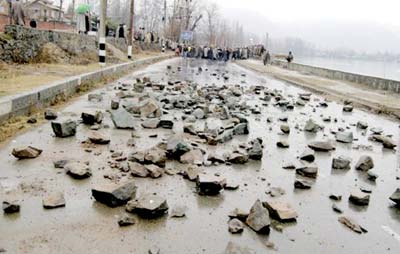
Kashmir stone throwers risk bullets
thenational.ae
Anuj Chopra, Foreign Correspondent
July 04. 2010
C CHINKIPORA, INDIA // Covering their faces with green scarves, a dozen protesters blocked an arterial road leading up to this village in north Kashmir with large boulders.
Policemen in riot gear assembled on the other side. Amid slogans of “Azaadi, Azaadi”, or freedom, the crowd soon began aiming rocks at the policemen, who hit back with tear gas shells. After a lull, the rattle of gunfire rang in the air.
Scenes like this one in March are now increasingly common in Kashmir. Until some years ago, stray incidents of stone pelting were limited to Srinagar’s Jamia mosque, usually occurring for brief spells after Friday prayers. But in recent months, kann’e jang – stone pelting – has emerged as a potent form of resistance, especially among Kashmiri youth, spreading to the restive valley’s towns and villages.
Last month, the killing of Tufail Ahmad Matoo, 17, a student from Srinagar, in a stone pelting protest triggered violent clashes – the worst in two years – in parts of north and south Kashmir, claiming 10 lives.
Kashmiri human rights groups are questioning the harsh techniques employed by the Indian government to quash stone pelting.
Stone pelting here – unlike anywhere else in India – is often met with live bullets. Kashmir’s police are also blamed for firing tear gas shells straight at the chests of protesters, often with lethal results, instead of firing at a parabolic trajectory, which is the norm.
Such violations, observers say, are rousing bigger and angrier crowds to take up stone pelting.
“Stone pelting is an expression of rage by a subjugated people whose political means of expression and demands are systematically limited,” the International People’s Tribunal on Human Rights and Justice, a Srinagar-based rights group, said in a statement.
In 2008, mass protests and demonstrations erupted in Kashmir, sparked by the state government’s promise to lease forest land to a board that runs a Hindu shrine. The deal would have promised guestrooms for nearly half a million Hindu pilgrims who make the trek to the holy Amarnath caves each year. The protests, largely peaceful, were met with a heavy military response. Security personnel opened fire at protesting crowds, killing 60 Kashmiris.
“Stone throwing is the outcome of the government’s systematic denial to allow Kashmiris the legitimate right to protest – even peacefully,” a Srinigar-based commentator who requested anonymity, said. “Why is there no space for political dissent in Kashmir?”
Omar Abdullah, the state’s chief minister, admits that security personnel are ill-trained to handle the surge in this new form of protest without inflicting casualties. He says his government has approached the UK police to train a Kashmir police contingent in crowd-control techniques.
Altaf Khan, the superintendent of police of the southern town of Sopore, said stone pelting is a “wicked” ploy by militants, aimed at maximising violence in Kashmir. During several such stone pelting protests, he said, militants had emerged from the crowds to open fire at soldiers and then melted back into the crowds. Some of the ring leaders who mobilise the crowds are on the payroll of Kashmir’s separatist leaders, he claimed. Syed Ali Geelani, the leader of the All Parties Hurriyat Conference, a conglomeration of Kashmiri separatist political groups, vehemently denies the charge.
“Peaceful solutions or talks have little relevance in Kashmir today,” he said, insisting that stone protests are the product of genuine grievances of Kashmiris.
“Stone protesters are not impoverished, jobless men,” said a 28-year-old stone pelter, a research graduate from Kashmir university. “We are not hoodlums greedy for money and neither are we anti-social elements.”
The young protester did not wish to be named, fearing he could be booked under the Public Safety Act, under which citizens can be detained for up to two years without charges.
He is not fearful of protesting, he explained, despite the risks. Some of the protesters are as young as 6. Over the past year, he has learned to deal with threats like teargas shells – he burns tyres whenever a shell drops as its fumes neutralise the effect of tear gas.
“Our land is under occupation,” he said. “If we don’t throw stones to protest, should we pick up guns?”
HINKIPORA, INDIA // Covering their faces with green scarves, a dozen protesters blocked an arterial road leading up to this village in north Kashmir with large boulders.
Policemen in riot gear assembled on the other side. Amid slogans of “Azaadi, Azaadi”, or freedom, the crowd soon began aiming rocks at the policemen, who hit back with tear gas shells. After a lull, the rattle of gunfire rang in the air.
Scenes like this one in March are now increasingly common in Kashmir. Until some years ago, stray incidents of stone pelting were limited to Srinagar’s Jamia mosque, usually occurring for brief spells after Friday prayers. But in recent months, kann’e jang – stone pelting – has emerged as a potent form of resistance, especially among Kashmiri youth, spreading to the restive valley’s towns and villages.
Last month, the killing of Tufail Ahmad Matoo, 17, a student from Srinagar, in a stone pelting protest triggered violent clashes – the worst in two years – in parts of north and south Kashmir, claiming 10 lives.
Kashmiri human rights groups are questioning the harsh techniques employed by the Indian government to quash stone pelting.
Stone pelting here – unlike anywhere else in India – is often met with live bullets. Kashmir’s police are also blamed for firing tear gas shells straight at the chests of protesters, often with lethal results, instead of firing at a parabolic trajectory, which is the norm.
Such violations, observers say, are rousing bigger and angrier crowds to take up stone pelting.
“Stone pelting is an expression of rage by a subjugated people whose political means of expression and demands are systematically limited,” the International People’s Tribunal on Human Rights and Justice, a Srinagar-based rights group, said in a statement.
In 2008, mass protests and demonstrations erupted in Kashmir, sparked by the state government’s promise to lease forest land to a board that runs a Hindu shrine. The deal would have promised guestrooms for nearly half a million Hindu pilgrims who make the trek to the holy Amarnath caves each year. The protests, largely peaceful, were met with a heavy military response. Security personnel opened fire at protesting crowds, killing 60 Kashmiris.
“Stone throwing is the outcome of the government’s systematic denial to allow Kashmiris the legitimate right to protest – even peacefully,” a Srinigar-based commentator who requested anonymity, said. “Why is there no space for political dissent in Kashmir?”
Omar Abdullah, the state’s chief minister, admits that security personnel are ill-trained to handle the surge in this new form of protest without inflicting casualties. He says his government has approached the UK police to train a Kashmir police contingent in crowd-control techniques.
Altaf Khan, the superintendent of police of the southern town of Sopore, said stone pelting is a “wicked” ploy by militants, aimed at maximising violence in Kashmir. During several such stone pelting protests, he said, militants had emerged from the crowds to open fire at soldiers and then melted back into the crowds. Some of the ring leaders who mobilise the crowds are on the payroll of Kashmir’s separatist leaders, he claimed. Syed Ali Geelani, the leader of the All Parties Hurriyat Conference, a conglomeration of Kashmiri separatist political groups, vehemently denies the charge.
“Peaceful solutions or talks have little relevance in Kashmir today,” he said, insisting that stone protests are the product of genuine grievances of Kashmiris.
“Stone protesters are not impoverished, jobless men,” said a 28-year-old stone pelter, a research graduate from Kashmir university. “We are not hoodlums greedy for money and neither are we anti-social elements.”
The young protester did not wish to be named, fearing he could be booked under the Public Safety Act, under which citizens can be detained for up to two years without charges.
He is not fearful of protesting, he explained, despite the risks. Some of the protesters are as young as 6. Over the past year, he has learned to deal with threats like teargas shells – he burns tyres whenever a shell drops as its fumes neutralise the effect of tear gas.
“Our land is under occupation,” he said. “If we don’t throw stones to protest, should we pick up guns?”

India extends curfew in Kashmir
presstv.ir
Wed, 30 Jun 20
Police in Indian-controlled Kashmir impose curfews on more towns and ban mobile phones as simmering violence and unrest grips the region.
Clashes with security forces have continued over the past fortnight, sharply escalating on Monday. The federal government has mulled over deploying the army in case unrest further intensifies.
Shops, businesses and government offices have remained closed in the state’s summer capital, Srinagar, for the second consecutive day. Assembly of five people and more has been banned.
Thousands of police in riot gear are patrolling the city’s streets. Paramilitary units have erected steel barricades and laid razor wire across main roads to prevent public gatherings.
The seemingly endless cycle of violence erupted on June 11 when a 17-year-old student died after being hit by a police teargas shell during an anti-India demonstration in Srinagar.
Tensions got for the worse on Friday in the town of Sapore, 50 kilometers north of Kashmir’s summer capital Srinagar, after two young men were killed by police fire.
Police have used tear gas as well as rubber and metallic bullets to disperse the protesters and have taken many into custody.




 anthropologie du présent