
Emeute ouvrière à Ashulia – juin 2010

Bangladesh re-opens factories after rioting
AFP
23 06 2010
ASHULIA, Bangladesh — Hundreds of factories in Bangladesh that make clothes for Western brands reopened on Wednesday under a heavy police presence after riots by workers forced their closure.
Tens of thousands of people who stitch garments for the leading names in US and European retail have been on strike since Saturday to protest their pay in a major industrial zone outside Dhaka.
Violence and vandalism flared on Tuesday, with police firing rubber bullets and tear gas after dozens of the estimated 700 factories in the area were attacked.
« It is very volatile. We can’t predict if things will flare up again, but we have enough security to handle it today, » police deputy inspector Ayub Khan, who was at one of the worst-affected factories, told AFP.
Nearly a thousand riot police were in the area where up to 80,000 people are employed by subcontractors working on behalf of global retailers such as Wal-Mart, Tesco and H & M.
The workers are demanding wages of at least 5,000 taka (70 dollars) per month. The current minimum wage, set in 2006, is 25 dollars.
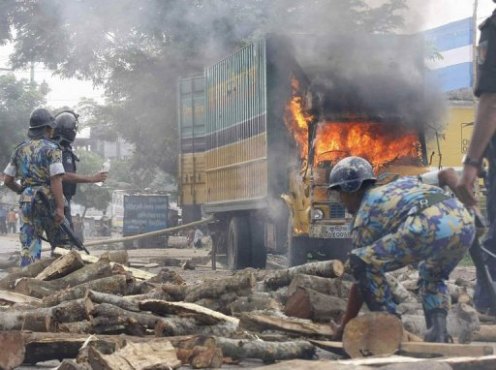
« The workers have gone to their shifts on time, there were no problems. We have nearly a thousand riot police here and we have water canon in case trouble breaks out, » added Khan.
Industry group Bangladesh Garment Manufacturers and Exporters Association (BGMEA) announced the closure of all factories in the area on Tuesday. It said the decision to reopen followed a government pledge to ensure law and order.
« We have been assured by the government that they would ensure adequate security to protect the factories from vandalism, » BGMEA president Abdus Salam Murshedy told AFP.
Garments accounted for nearly 80 percent of Bangladesh’s 15.56 billion dollars of exports last year. The factories employ around 40 percent of the industrial workforce.
« All our windows were smashed, our computers and furniture destroyed, » said M.A Hamid, manager of the Scandex factory which was working on an order of polo shirts for American retail giant Wal-Mart.
« Our shipment has been delayed as the factory was closed for three days, we’ve suspended 14 workers and are gradually reopening, » he said, adding that the minimum wage in his factory was 2,000 taka.

200 Injured As Apparel Workers Clash With Police In Bangladesh
allheadlinenews.com
June 21, 2010
Read more: http://www.allheadlinenews.com/articles/7019059109#ixzz0rYdtXsDq
Siddique Islam – AHN News Correspondent
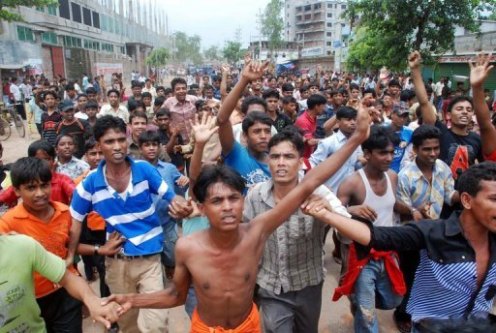
Dhaka, Bangladesh (AHN) – More than 200 people including 20 policemen were injured in clashes Monday as several thousand garment workers blockaded roads and vandalized vehicles at an industrial area outside the capital Dhaka.
The clashes erupted Monday morning when police used force to disperse several thousand demonstrating apparel workers as they ransacked factories and blockaded the roads in Ashulia.
The disturbances broke out after management at one of the factories rejected demands for a monthly minimum wage of US$72.08 (BDT 5,000), police and witnesses said.
At least 800,000 people work at more than 1,000 factories in Ashulia, which is situated 20 miles north of the Dhaka.
The workers have also urged the government’s newly established minimum wage board to implement the hike as soon as possible.
Garment workers, especially the entry level laborers, get $24 (BDT 1,662.50) as a minimum monthly wage following a tripartite deal in 2006 among the government, unions and the owners.
Law enforcement officers were forced to use batons and water cannons, fire rubber bullets and tear gas shells to break up the workers, a police official confirmed.
Meanwhile, garment manufacturers and exporters on Monday expressed concern over the current spell of labor unrest that has been taking a heavy toll of the country’s prime export earning apparel industry.
They also fear orders from international buyers may shift to alternative destinations following continued labor unrest, the Bangladesh Garment Manufacturers and Exporters Association said in a statement.
Apparel made up 80 percent of Bangladesh’s $15.56 billion in exports last year. The country’s more than 4,500 factories employ some 3.5 million workers–most of them women
Clashes as 50,000 garment workers protest in Bangladesh
AFP
19 06 2010
DHAKA — Dozens of people were injured on Saturday as police fired rubber bullets and tear gas at tens of thousands of garment workers demanding higher salaries just outside the Bangladeshi capital.
Several factories were ransacked at Ashulia industrial area, 30 kilometres (20 miles) north of Dhaka, as workers abandoned their jobs to join protests for a three-fold wage hike, said local police chief Sirajul Islam.
Protesters fired live rounds and pelted police with rocks, he said, adding a key highway was blocked for about two hours.
« Around 50,000 workers joined the protests for wage hike. They were demanding minimum monthly salaries of 5,000 taka (70 dollars), » he told AFP.
Garment workers are currently paid a minimum 1,662 taka following a 2006 agreement among manufacturers, unions and the government.
« We fired rubber bullets, lobbed tear gas shells and used water canons to disperse the unruly workers. Some workers retaliated by firing live rounds, which injured one policeman, » he said.
The situation was brought under control after nearly three hours, Islam said, adding 40 policemen were injured in the clashes. He would not comment on how many workers were hurt.
But Mosherafa Mishu, of left-leaning Garment Workers Unity Forum, said more than 100 workers were injured, including one who was hit by a bullet.
The violent protest follows a series of labour troubles at Ashulia and Kanchpur — the country’s two main apparel hubs — where factories which make clothing for global retailers like Wal-Mart, Tesco and H&M are located.
The government has proposed increasing the minimum wage for apparel workers but it has faced opposition from the Bangladesh Garment Manufacturers and Exporters Association (BGMEA), which represents more than 4,500 factories.
« We won’t accept any salaries less than 5,000. The amount is basic minimum to maintain a decent living, » Mishu said.
BGMEA chief Abdus Salam Murshedy said at least 76 factories were « compelled to close down » for the day on Saturday due to the protests.
« Labour unrest is giving a bad name to Bangladesh. It has harmed our reputation and may scare away top global buyers, » he said.
Garments accounted for nearly 80 percent of Bangladesh’s 15.56 billion dollars of exports last year. The apparel factories employ around 40 percent of the industrial workforce, most of them women.
Major western retailers including Wal-Mart, H&M, French giant Carrefour and Levi Strauss in January wrote to the prime minister requesting across-the-board wage increases.
Current wages are « below the poverty line » and have « contributed to unrest » among workers, the letter said.
76 factories closed, 100 injured in police-workers clash in Ashulia
thefinancialexpress-bd.com
19 06 2010
At least 76 factories were shut down and more than 100 were injured Saturday after tens of thousands of apparel workers battled with police over wage-hike at Ashulia industrial area, police said.
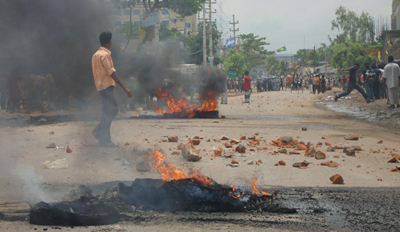
Owners said the factories were forced to draw shutters for the day after thousands of workers went on the rampage ransacking several plants, putting up barricades and burning tyres on the busy Dhaka-Tangail highway.
Police said law-enforcers fired rubber bullets, lobbed tear gas shells and used water canons to disperse unruly workers. They brought the situation under control after three hours of sporadic street battles.
« Tens of thousands of workers joined the protests demanding minimum monthly wage of 5,000 taka. They became extremely unruly, forcing police to fire from shot guns to disperse the workers, » Ashulia police chief Sirajul Islam said.
Islam said at least 10 policemen were injured including one who was hit by a bullet allegedly fired by workers. He would not comment how many workers were injured in police action.
Union representatives said more than 100 workers were also injured, some being rushed to hospitals in Savar and Gazipur. « One of the workers had a bullet wound, » a union leader said.
Police said the troubles began at a factory of Nassa Group, one of the country’s top five garment exporters with plants spread all over the country.
Some 7,000 workers demonstrated at the factory demanding minimum monthly wages of 5,000 taka. They soon spilled onto the streets, putting up blockades and burning tyres and woods.
They pelted police with rocks and stones as the law-enforcers tried to remove the road barricades to ensure smooth traffic between Dhaka and the country’s northern districts.
The clashes became fiercer as workers of top groups including Hameem and Sharmin joined the protests, turning the area into a battlefield and forcing manufacturers to declare holiday in a bid to stave off further troubles.
The unruly workers vandalised a number of factories and damaged cars and motor vehicles, creating panic at Ashulia and its adjoining Norshinghapur and Zamgora.
Abdus Salam Murshedy, president of the Bangladesh Garment Manufactures and Exporters Association (BGMEA), said at least 76 factories were closed down on Saturday.
« There is no way we can operate in this violent environment. The labour unrest is also creating panic among global buyers, » he told the FE.
BGMEA has blamed « a vested quarter » for the unrest and sought increased security to protect billions of dollars of investment.
« It’s not a protest. It’s pre-planned violence aimed at destroying our main industry, » Murshedy said.
Garment makers alleged that the workers became unruly in recent weeks after they were provoked by union leaders and non-governmental organisations.
Ashulia — home to some of the top apparel makers — had witnessed several violent protests in the past two weeks that forced closure of at least 12 plants.
Union leaders said the manufacturers’ proposal to hike minimum monthly salaries by a paltry amount angered workers, sparking protests in main apparel hubs at Kanchpur, Ashulia and Mirpur.
According to a leaked report, the BGMEA has sought to hike the salaries by around 300 taka from its existing rate of 1662.50 taka per month. The unions have said they won’t accept anything less than 5,000 taka.
The government’s minimum wage board has not made any decision yet despite holding at least eight meetings with unions and manufacturers.
100 injured in cops-RMG workers clash in Ashulia
Star Online
19 06 2010
Over 100 garment workers and policemen were injured, including two by bullets, in a series of clashes between readymade garment workers and law enforcers at Ashulia in Savar Saturday morning.
The authorities of at least 50 garment factories located at Nishchintapur, Norashinghpur and Zamgara shut down their productions fearing attack.
Witnesses said the problem erupted at about 8:30am as about 7,000 workers of Nasa Group started demonstration inside the factory at Nishchintapur demanding a minimum wage of Tk 5,000.
They vandalised at least five factories of Nasa Group during the demonstration.
Being resisted by the police, the workers took to the street at about 10:00am and put barricade on the Dhaka-Tangail Highway, halting traffic movement for nearly three hours.
Meanwhile, another group of workers of Hamim and Sharmin Groups attacked and vandalised at least 10 factories of their respective groups at Norashinghpur and Zamgara.
On information police rushed to the spot and fired rubber bullet and tear gas shells and also charged truncheons on the agitated workers to disperse them. In reply, the garment workers pelted brick chips, turning the entire area into a battlefield that left 100, including 10 policemen, injured.
Police had to use water cannons to bring the situation under control.
A tense like situation has been prevailing in the area. Additional police forces have been deployed in and around the area to stave-off further trouble.
Informations
Ashulia is a suburban area near Dhaka, the capital city of Bangladesh. Nearby areas are Savar and Tongi. The attractive view of Ashulia lake and vast paddy fields of Ashulia makes it a popular tourist spot[1]. Two major theme parks of Bangladesh namely Fantasy Kingdom and Nandan are also located at Ashulia.








 anthropologie du présent