
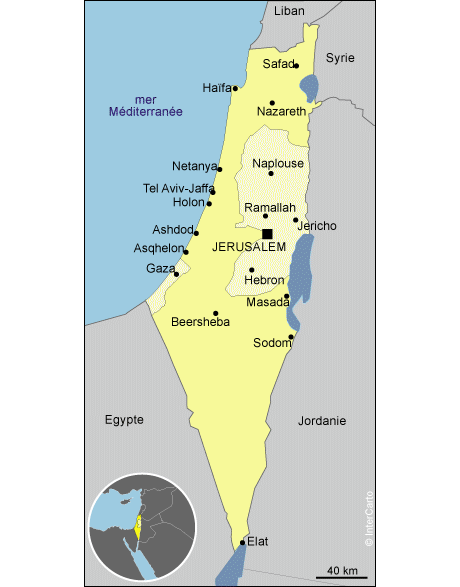
Emeute religieuse à Jérusalem – 16 mai 2010
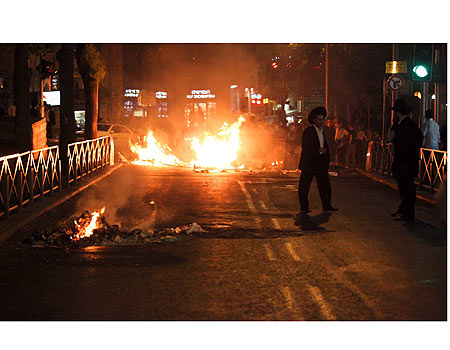
Haredim: Extreme protestors causing damage
Israel News
05.17.10
Senior ultra-Orthodox officials criticize leaders of struggle against removal of graves from Ashkelon hospital, following Jerusalem Municipality’s decision to halt service to haredi neighborhoods. ‘They’ve made us lose our power of deterrence,’ one of them says
After a day of riots following the removal of graves from the Barzilai Medical Center in Ashkelon, which ended with a Jerusalem Municipality decision to halt service to the capital’s haredi neighborhoods, the ultra-Orthodox on Sunday night attempted to reduce the tensions and pointed a finger at the leaders of the struggle.
During Sunday’s demonstrations at the Shabbat Square and on Bar-Ilan Street, haredim hurled stones and glass bottles at the road and set fire to dustbins. One of the stones hit a police officer in the head.
The protests began in the morning hours in Ashkelon, where 47 people were arrested throughout the day. Another 40 haredim were arrested near Jaffa’s Andromeda Hill. In the evening, the riots spread to Jerusalem, where several municipality workers were attacked. As a result, the municipality ordered its workers to leave all the haredi neighborhoods « till the danger has passed, » according to Mayor Nir Barkat.
« The extreme protestors are definitely causing damage, » Knesset Member Uri Maklev (United Torah Judaism) told Ynet. « They are dragging people to the margins and are unable to tell right from wrong. We are living in a democratic country and every person has the right to protest, but we are against rioting and any type of violence. »
Maklev added that haredi public was hurt by the decision to relocate the graves in Ashkelon. « The graves of our biblical fathers are crying out from the ground, the damage is alive and kicking. We think a reckless and irresponsible decision was made, aimed at serving personal interests and showing that the prime minister is determined. »
According to the MK, the rabbis did not call on the public to protest and those suffering from the police’s conduct were the residents on the streets.
‘Police thought it was Gush Katif’
Yehuda Meshi-Zahav, director of the ZAKA humanitarian voluntary organization and the former operations officer of the Eda Haredit faction, said that « the battle for the graves was not lost today – it was lost at Intel. »
Meshi-Zahav, who was once in charge of the haredi sector’s greatest battles, said that a minority of dozens of young people were running the protests and damaging the haredi power of deterrence.
« It’s anarchy with them. They don’t care about anyone and claim to lead the haredi public. It’s like a ‘crying wolf’ story. You can’t threaten everyone with a world war, » he stated.
« At Karta and Safra (parking lots) and Intel, the protests were conducted by a number of bored hooligan children. At the moment, the haredim have lost their power of deterrence and will remember what happened over the past week for a long time, » Meshi-Zahav argued, adding that there was a great amount of internal criticism within the sector.
He also criticized the police: « If this is how the police system treats more serious things too, it’s bad. They sent 700 policemen to the haredi neighborhood as if it were Gush Katif. This is the joke of the week, they have no idea. »
A senior haredi journalist also spoke about a disagreement among the haredim. « The protestors are fanatic and mad extremists. We are talking about a few hundreds of people, who are leading to a generalization of the entire haredi public. If they hadn’t existed, the incitement against us would drop by 50%. I know haredim who are afraid of walking on the street because of the incitement against the haredim. »
Doctor: Day ended peacefully
Although Deputy Health Minister Yakov Litzman has forbidden them to give interviews, one of the doctors at the Barzilai Medical Center related a little about what the medical team had undergone on Sunday.
« From our point of view, work and life went on as normal, » the doctor said about the first (and probably the last) day of relocation of the graves in the Ashkelon hospital premises. « We were concerned that there would be violence, but it wasn’t like that. In the end, it went peacefully.
« Due to guidance and security, there was almost no physical contact between us and the demonstrators, » he continued. « Here and there the haredim flung a curse at someone walking by. If tens of thousands of demonstrators had come, it may have looked completely different. The government decision to build in the original pace was a victory for common sense. Any other decision would have been stupid. We hope that the continuation of the construction will be as planned, because this hospital has suffered (the lack of the premises) for many years. »
Officials at the police national headquarters said on Sunday that there had been a number of focal points to the demonstrations. Ashkelon was the focus in the morning, Jerusalem in the evening, and there were also disturbances in Beersheba, Jaffa and Bnei Brak. Police Commander Nissim Mor said that all incidents were dealt with by police forces on the ground.
|
|

The police prepared well in advance and took every scenario into account, Mor said. For that reason, thousands of policemen and mounted policemen were deployed with air support and water hoses, as well as the marine police. The national traffic police was also brought in, blocking all haredi attempts to get to the hospital. These efforts will continue in the coming days because, the police say, the danger of disturbances is not yet over.
Ultra-Orthodox Jews lose grave battle in Israel
Reuters
16 05 2010
A heavily guarded operation to dig up ancient graves to make way for a new hospital emergency room on Sunday stirred up traditional tensions between Israel’s Jewish secular majority and ultra-Orthodox minority.
Police ,said they arrested 15 religious protesters outside Barzilai hospital in the coastal town of Ashkelon, where plans to build a treatment facility that could withstand rocket attack from the Gaza Strip turned into a political battle in Israel.
After dark in Jerusalem, ultra-Orthodox protesters hurled rocks and forced the temporary closure of a main traffic artery. Police deployed a water canon and arrested three men as tensions remained high, police spokesman Micky Rosenfeld said.
Prime Minister Benjamin Netanyahu’s government originally decided to move the location of the planned emergency room after the graves were discovered at the site and an ultra-Orthodox coalition partner contended the remains were those of Jews.
It reversed that decision last month after a public outcry over the high cost of redrawing the plans and what critics alleged was its surrender to religious pressure.
Archaeologists said the bones might be pagan. As police blocked off the entrances to Ashkelon and the hospital to try to prevent ultra-Orthodox protests, archaeological teams moved in to exhume the remains, which will be reburied elsewhere.
The controversy was the latest example of a deep religious divide in a Jewish state where the secular and Orthodox have co-existed under a fragile « status quo » set of rules governing everyday life.
Under such guidelines, non-kosher restaurants flourish in Tel Aviv but there is no public bus service in the free-wheeling city on Saturday, the Jewish sabbath, in accordance with a ritual ban on vehicular travel.
Emotions were running high over the grave affair.

Deputy Health Minister Yaakov Litzman, an ultra-Orthodox Jew who had pushed for the emergency room to be moved, said Jews would have cried « anti-Semites » if a foreign government had decided to build on ancient Jewish graves.
On the other side of the debate, Nahum Barnea, a popular columnist, suggested in the newspaper Yedioth Ahronoth that Netanyahu had made the right political decision in opting in the end to go ahead with the project.
« The majority of the Israeli public would not have been able to comprehend a government that favors dead pagans over live patients, » he wrote.

Ultra-orthodox fury at removal of ancient remains from hospital
AFP/GETTY
Construction of bombproof emergency unit in Israeli city sparks exhumation protests
By Donald Macintyre in Jerusalem
Monday, 17 May 2010
At least 30 ultra-orthodox Jewish demonstrators have been arrested in angry protests at the removal of ancient burial remains to make way for construction of a bombproof hospital emergency room in the southern Israeli city of Ashkelon.
Protesters tried to climb perimeter fences at the main Barzilai hospital yesterday in the hope of halting the excavation, described by the ultra-orthodox deputy education minister Meir Porush as an « embarrassment and a disgrace ». On Saturday night, demonstrators burned rubbish bins and blocked roads in ultra-orthodox neighbourhoods of Jerusalem as the exhumation started.
Ashkelon is within range of rockets from Gaza and the medical authorities had decided that a bomb-proof emergency room within the hospital was essential for the welfare of patients.
Originally, a divided Israeli cabinet decided – with the support of Prime Minister Benjamin Netanyahu – to appease the ultra-orthodox community by relocating the site at an additional cost of several million dollars. The decision was seen by secular critics as a new high point for the political power wielded in the government coalition by an increasingly assertive ultra-orthodox community. There followed a massive public outcry at the increased costs, and the director general of the health ministry, Dr Eitan Chai-Am, announced he was resigning in protest at the decision. Prime Minister Netanyahu performed a swift U-turn.
Yesterday, during the weekly cabinet meeting, he said: « After the second Lebanon war, we made a decision to erect a new emergency room next to Barzilai medical centre. There is an important ultra-orthodox public that is offended by this. We reached a decision to implement [the plan], and the general public’s interest is the deciding factor. »
On a visit to Ashkelon yesterday, Mr Porush said angrily: « It was possible to find alternatives to digging up graves that may be Jewish. It would have been preferable to have found a compromise. »
But Mr Netanyahu’s revised stance was bolstered yesterday by the Israel Antiquities Authority, which said that the preliminary findings from the excavation showed that the remains were not Jewish but Byzantine. The exhumations could be seen in real time on the website of the IAA, which said it was streaming the work as a « neutral entity » and for « transparency ».
In Yedioth Ahronoth, Nahum Barnea, a popular columnist, backed Mr Netanyahu’s change of heart. « The majority of the Israeli public would not have been able to comprehend a government that favours dead pagans over live patients. » And responding to Mr Porush’s objections, the head of the Ashkelon municipal council, Benny Vaknin, said: « The real shame is with the people who delayed construction of the bombproof emergency room, while during Operation Cast Lead [Israel’s 2008-09 military onslaught on Gaza during which Palestinian militants fired a barrage of rockets at Ashkelon] people could have died… That is the biggest disgrace. »
There was a heavy police presence in Ashkelon and surrounding districts, to prevent any disruption. Police also deployed in force along main roads in Jerusalem. In the old ultra-orthodox inner Jerusalem neighbourhood of Mea Sharim, demonstrators called for « the prevention of any possibility to desecrate the graves », and leaflets were distributed in the city calling for « the land of Israel to go to war ».
Haaretz quoted police sources as saying say that due to the thin presence of the Eda Haredit, the extreme religious sect in the forefront of violent demonstrations against the authorities (including against the opening of a city centre park on the Sabbath in Jerusalem) they did not expect serious clashes in Ashkelon. Senior figures of the important Hasidic sect in Ashdod had indicated they not intend to take part in the unrest, it reported.
Dr Leonid Eidelman, chairman of the Israeli Medical Association, who visited Barzilai, warned police medical staff could be targeted by violent protesters. But he added: « The bombproof emergency room is critical for the residents of the south, and we are hopeful its construction will be completed quickly ».





 anthropologie du présent