
Affrontements meurtriers à Bangkok – mai 2010

Clashes continue in Bangkok, curfew extended
Xinhua
BANGKOK, mai 20, 2010
The government’s acting spokesman Panithan Watanayakorn said Thursday morning that the curfew will still be place in Bangkok for another day.
He said the curfew is still needed to facilitate the operations of security forces as armed protesters are still fighting against the authorities.
The Centre for the Resolution of Emergency Situation (CRES) issued a curfew order Wendesday afternoon in Bangkok and more than 20 other provinces, forbidding the public to go outdoors from 8 p. m. Wednesday to 6 a.m. Thursday.
The curfew came after some “red-shirts” refused to heed their leaders’ resolution to end the rally and launched attacks and arson across Bangkok and some other areas.
The “red—shirts” leaders early Wednesday afternoon announced the end of their two-month-odd rally in Ratchaprasong, downtown Bangkok, and turned themselves in to the police.
Arson attacks continue
More arsons were reported Thursday morning in Bangkok where a curfew was imposed overnight though the “red—shirts” protest was officially called an end Wednesday noon.
The Big C supermarket on Rajdamri Road across from the Central World shopping centre and near the “red—shirts” rally site Ratchaprasong, was torched early Thursday morning. The flame has spread to the second floor and has yet to be contained so far.
Flame in the Central World, a high—end shopping complex, is dying down after more than eight hours’ burning.
The Bangkok Metropolitan Administration said 35 arson attacks happened in the capital from Wednesday’s afternoon to Thursday morning.
Shots fired in Bangkok after day of violence
Reuters
By Jason Szep and Damir Sagolj
Thursday May 20, 2010
BANGKOK – Thai soldiers fired into the air on Thursday as they approached a temple in Bangkok where several hundred anti-government protesters sought shelter after troops dispersed them a day before and their leaders surrendered.
A Reuters reporter said there were at least six bodies at the site, which appeared to have been there some time.
Fires were still burning in central Bangkok after an overnight curfew that followed a day of riots and arson by the « red shirt » protesters in which health officials said at least seven other people were killed. Local television channels, under government orders, were showing only approved programmes.
The Erawan Emergency Medical Centre said 81 people were wounded in the fighting at the protesters’ main camp in the commercial heart of the capital and in skirmishes around the city of 15 million. The mostly rural protesters had taken over parts of Bangkok over two months ago.
It was uncertain whether Wednesday’s rioting represented a final outpouring of protesters’ anger or whether it would intensify in days ahead, as there remains no political solution to the long running divisions in Thai society.
« We can immediately fix the roads but we do not know how long it will take to fix the wounded hearts and minds of the people, » Bangkok Governor Sukhumbhand Paribatra told local television.
For a Reuters Insider report on Thai crisis, click http://link.reuters.com/cuq74k
For a live blog, click http://link.reuters.com/hyr54k
For a graphic related to the story, click http://graphics.thomsonreuters.com/RNGS/2010/MAY/THAI5.jpg
The red shirts want fresh elections, saying Prime Minister Abhisit Vejjajiva lacks a proper mandate after coming to power in a controversial parliamentary vote in 2006 with tacit military support. Abhisit last week withdrew an offer of fresh elections.
Some political analysts said Thailand’s future stability now rested squarely with Abhisit — he must set a timetable for elections, release some moderate protest leaders and reach out to disaffected rural people in the country’s north.
« He will have to take risks that threaten his interests and that of the key elite constituencies that support him. A much harder line over the next few months will satisfy his core base, but worsen the political outlook, » said Roberto Herrera-Lim, Asia director of the Washington-based Eurasia Group.
RAN IN FRIGHT
A Reuters photographer said the protesters at the temple, including many women and children, ran in fright at the sound of the gunshots.
An Erawan official said she was aware of nine bodies reported to be in a temple inside the protest site, but rescue workers had so far been unable to get there.
The authorities said late on Wednesday that 27 buildings were set on fire by protesters, including Central World, Southeast Asia’s second-biggest department store complex, which was gutted and looked close to collapse.
A spokesman for Bangkok’s governor reported 31 fires burning around the city on Thursday morning, around half at banks but also at a mall in the protest camp area, where a blaze had been started around midnight, after the curfew started at 8 p.m. (1300 GMT).
A small fire was started in the stock exchange on Wednesday. The market will be closed on Thursday and Friday and the Bank of Thailand said banks around the country would also stay shut. The whole week has been declared a public holiday in an effort to keep people out of central Bangkok.
The curfew in the capital, in the grip of protests by « red shirt » activists for weeks, was lifted at 6 a.m. (2300 GMT on Wednesday). Buses began running but it was unclear if the mass transit rail system would be reopened.
Television channels have been ordered to only air sanctioned programmes, broadcasting images of bulldozers pushed aside tyre and bamboo barricades as workers in trucks, under the protection of troops, cleaned up the protest camp site.
A single « red shirt » flag in the rubble flew limply in the morning breeze until it was crushed by a bulldozer.
Authorities imposed the curfew on 24 provinces — about a third of the total — after outbursts of unrest in seven regions, particularly in the north, a « red shirt » stronghold. Town halls were set alight in three northern areas.
The « red shirt » protesters are mostly drawn from the rural and urban poor and largely back former Prime Minister Thaksin Shinawatra, a populist tycoon who was ousted in a 2006 coup and now lives in self-imposed exile to avoid a jail term for graft.
They started demonstrating in mid-March, demanding that the government step down and new elections be held. More than 70 people have been killed and nearly 2,000 wounded since then.
Thaksin said the crackdown could spawn guerrilla warfare.
« There is a theory saying a military crackdown can spread resentment and these resentful people will become guerrillas, » he told Reuters by telephone from an undisclosed location.
Early this month, Abhisit offered an election in November, just over a year before he needed to call one, but talks foundered and that offer is now off the table.
« In many places, armed elements have prevented officials from helping the people, » Abhisit said in a televised statement late on Wednesday, adding he was determined to end the unrest and « return the country to peace and order once again ».
(Additional reporting by Ambika Ahuja and Nopporn Wong-Anan; Writing by Michael Perry; Editing by Raju Gopalakrishnan)
Copyright © 2010 Reuters
Crackdown in Bangkok sets off riots nationwide
journalnow.com
20 05 2010
BANGKOK — A bloody crackdown in Bangkok by the Thai military set off rioting and arson attacks yesterday in several places across Thailand.
Arsonists set fire to almost 30 buildings, the government said, including the country’s stock exchange, a shopping mall, two banks, a movie theater and a TV station.
Unrest spread to northern parts of Thailand. At least six people were killed in clashes that followed the army’s storming of the protest camp yesterday.
Thai Army Launches Crackdown On Redshirt Protesters Causing Widespread Riots
timesnewsline.com
19 May, 2010
The army crackdown on antigovernment protesters in Thailand today degenerated into riots, firebombing attacks; looting and street battles after militants joined hands with the antigovernment protesters and tried to stop army from dispersing them by using grenades and assault weapons.
Many of the red shirt movement leaders surrendered, but some leaders are still rampaging on the streets of Bangkok. The protesters set fire to almost 30 buildings, including country’s stock exchange, a massive shopping mall, two banks, a movie theater and a television station, the government said.
The government warned that the protesters might launch fresh acts of violence into the night and threatened to shoot looters and arsonists. So far five people — including an Italian news photographer had been killed and around 52 suffered injuries.
The central part of Bangkok has turned into a militarized zone, with troops lining many streets and armored personnel carriers are patrolling the streets. The government ordered a curfew for tonight and the subway has been closed.
The red shirts are demanding the dissolution of the government and calling for fresh elections.
Les affrontements en Thaïlande
Nouvelobs.com
Mercredi 19 mai
17h50 – Bangkok Le Premier ministre thaïlandais Abhisit Vejjajiva a promis de ramener la paix dans le pays. « Mon gouvernement et tous les responsables ont la ferme intention de dépasser cette crise », a-t-il déclaré.
17h15 – Rome La classe politique italienne a rendu hommage au photographe Fabio Polenghi, tué dans la matinée au cours d’affrontements entre manifestants et militaires dans le camp retranché des « chemises rouges » à Bangkok.
16h40 – Bruxelles Le président du Parlement européen, Jerzy Buzek, a condamné « les heurts et les tirs entre manifestants et forces militaires » en Thaïlande, estimant que la réconciliation nationale était désormais « obligatoire ».
15h30 – Bangkok Quelque 900 soldats et policiers escortent les pompiers dans le centre de Bangkok en proie à des émeutes, pour leur permettre d’éteindre l’incendie qui ravage l’un des plus gros centres commerciaux d’Asie du sud-est.
15h20 – Bangkok Début du couvre-feu imposé par les autorités pour la ville de Bangkok et 23 provinces voisines. Celui-ci court jusqu’à 6h jeudi. Quiconque violerait ce cessez-le-feu est passible d’une peine de deux ans de prison maximum ou d’une amende de 40.000 baht (environ 1.200 dollars).
15h05 – Bangkok La centaine d’employés de la chaîne de télévision Channel 3 pris au piège par un incendie, ont été évacués sains et saufs, rapportent les pompiers.
15h05 – Bangkok Le gouvernement thaïlandais a annoncé avoir étendu l’état d’urgence, décrété à Bangkok et à ses environs puis à 15 provinces, à deux autres provinces du Nord-Est du pays, bastion du mouvement des « chemises rouges ».
13h35 – Bangkok Les violences à Bangkok ont fait six morts et 58 blessés après l’opération de l’armée, selon les secours. Parmi les six morts figure un photo-journaliste italien de 48 ans touché mortellement à l’abdomen. Au moins deux autres reporters (un Néerlandais et un Canadien) ont été blessés.
12h35 – Bangkok Les manifestants antigouvernementaux ont mis le feu aux locaux d’une chaîne de télévision, Channel 3, à Bangkok et une centaine de personnes sont prises au piège dans le bâtiment.
12h30 – Bangkok Une vingtaine de bâtiments incendiés, dont des centres commerciaux, rapportent les pompiers.
12h25 – Bangkok Le gouvernement lance un ultimatum aux pillards et émeutiers.
12h25 – Bangkok La Bourse de Bangkok fermera jeudi et vendredi à cause des violences, ont annoncé les autorités.
12h20 – Bangkok Le gouvernement ordonne des programmes spéciaux sur les télévisions.
12h20 – Bangkok Une partie de la ville n’est pas encore sous contrôle, estime le gouvernement.
11h50 – Bangkok Les manifestants antigouvernementaux ont incendiés les locaux d’une chaîne de télévision, Channel 3. Une centaine de personnes est prises au piège dans le bâtiment.
10h40 – Bangkok La Bourse de Bangkok et plusieurs centres commerciaux sont en feu.
9h25 – Bangkok Des milliers de manifestants « rouges » antigouvernementaux incendient le siège d’un gouvernement dans une province du nord-est.
9h20 – Bangkok Le ministère de la Défense indique qu’un couvre-feu sera imposé mercredi soir dans la ville de Bangkok.
9h05 – Bangkok L’armée annonce qu’elle met fin à l’opération lancée dans la matinée pour évacuer le quartier de Bangkok occupé par les « chemises rouges », qui est désormais sous son contrôle.
8h50 – Bangkok Les leaders « rouges » se rendent à la police.
8h35 – Bangkok Les leaders des « chemises rouges » appellent à la dispersion de leur manifestation entamée à la mi-mars à Bangkok.
8h30 – Bangkok Les leaders des « chemises rouges » annoncent devant des milliers de partisans, qu’ils vont se rendre à la police.
7h55 – Bangkok Les leaders des « chemises rouges » vont se rendre dans la journée, indique un sénateur thaïlandais en contact avec eux.
7h30 – Bangkok L’armée est autorisée à « tirer immédiatement » en cas d’émeute.
7h10 – Bangkok La police qu’au moins cinq personnes, dont un journaliste italien, ont été tuées au cours des affrontements.
6h50 – Bangkok Un leader des manifestants antigouvernementaux appelle au « calme » les milliers de « chemises rouges » rassemblées au cœur de leur camp retranché.
6h45 – Bangkok Les secours annoncent qu’un journaliste italien a été tué au cours des affrontements.
6h30 – Bangkok Deux manifestants ont été tués dans le camp retranché des « chemises rouges ».
5h50 – Bangkok Des combats éclatent dans le camp retranché des « chemises rouges » antigouvernementales, où ont pénétré les soldats après avoir enfoncé des barricades.
5h30 – Bangkok Des blindés de l’armée thaïlandaise et des soldats ont pénétré dans le camp retranché des « chemises rouges » antigouvernementales après avoir ouvert une brèche dans une barricade.
4h40 – Bangkok Le porte-parole du gouvernement annonce que l’opération lancée par l’armée thaïlandaise contre les manifestants antigouvernementaux va se poursuivre « toute la journée ».
3h50 – Bangkok Des blindés de l’armée thaïlandaise enfoncent des barricades érigées par les manifestants antigouvernementaux autour du quartier qu’ils occupent depuis début avril.
3h30 – Bangkok Le ministre thaïlandais de la Défense indique que l’opération lancée par l’armée dans le centre de Bangkok vise à assurer le blocage « à 100% » du quartier occupé par les manifestants antigouvernementaux.
2h35 – Bangkok U n sénateur thaïlandais annonce que le gouvernement thaïlandais est en train de prendre des « actions décisives » contre les « chemises rouges » antigouvernementales, après l’échec de négociations de dernière minute.
00h20 – Bangkok Des soldats thaïlandais et des véhicules de transport de troupes sont massés devant le quartier contrôlé par les « chemises rouges » antigouvernementales.
2 « red-shirts » killed at rally site in central Bangkok
Xinhua
BANGKOK, May 19 — Two anti-government « red-shirts » were killed at a rally site on the Saladaeng Intersection in central Bangkok, a Xinhua journalist reported from the scene.
As the Xinhua journalist was reporting from the scene at about 11:00 a.m., local time, gunshots had been heard at the Saladaeng Intersection, which is located next to the Silom Road — the main business area in capital Bangkok.
Related:
Dispersion operation begins as armored vehicles crush red-shirts’ blockade at Lumpini
BANGKOK, May 19 (Xinhua) — The armored vehicles broke through the blockade of the red-shirt at Lumpini Park area in downtown Bangkok at about 8 a.m. Wednesday as the troops’ dispersion operation kicked off.
At least 1 red-shirt was shot in the clashes in Lumpini Park, south of the sealed-off protest zone, as the troops are trying to moving forward. Full story
Thai gov’t wants anti-gov’t rally to end quickly
BANGKOK, May 19 (Xinhua) — Thailand’s government wants the anti-government rally to end now, secretary-general to the Prime Minister Korbsak Sabhavasu told the Thai PBS Television on Wednesday, at about 08:15 a.m. local time.
« If the rally ends quickly, it will be the best solution, » Korbsak said. Full story
Thai troops fire tear gas to disperse red-shirts, gunshots heard
BANGKOK, May 19 (Xinhua) — The helicopters hovering above the Ratchaprasong area in Bangkok dropped tear gas to disperse « red- shirts » and gunshots were heard as the troops massed at several locations in the capital Wednesday morning.
According to live report by Thai TV channel 3, one building at Silom street were on fire and more tyres were burnt at Kholong Toei area, southeast of the protest zone that has been sealed off by the troops since May 13.
Thai troops order protestors to leave site
BANGKOK, May 19 (Xinhua) — Thai troops fired warning shots and ordered protestors to leave Bangkok’s main business district, local television reported Wednesday.
« Please leave the site immediately. Officials are about to conduct an operation, » the military said on a loudspeaker, according to the Channel 9 television. Full story
Peace talks with Thai anti-gov’t core leaders ruled out
BANGKOK, May 19 (Xinhua) — Peace talks between the Thai government and the anti-government group, which was planned to be mediated by Senate Speaker Prasobsuk Boondej, has been completely ruled out, secretary-general to the Prime Minister Korbsak Sabhavasu told local media Wednesday.
The Thai government is determined to disperse the anti-government rally on Wednesday, Korbsak said in a television interview, the Bangkok Post’s website reported. Full story
Thai troops mobilizing to disperse red-shirts in Bangkok
BANGKOK, May 19 (Xinhua) — The troops are building up in several locations in Bangkok at about 6:30 a.m. Wednesday, ready to disperse the red-shirts who have been rallying at the downtown Ratchaprasong area since early April and defied a deadline to leave.
The live TV reports show that armored personnel carriers (APCs) with machine guns mounted on top came up at the Silom business district, south part of the sealed-off zone by the troops. Several trucks dropped off troops wearing balaclavas and carrying weapons and riot shields, and the soldiers shot in the air to urge the protestors to leave the rally sites. Full story
Thai gov’t orders 37 more persons not to make financial transaction
BANGKOK, May 18 (Xinhua) — The Thai government’s Center for Resolution of Emergency Situation (CRES) Tuesday ordered 37 more persons not to make any financial transaction.
These 37 persons, included General Chavalit Yongchaiyudh, chairman of Thailand’s leading opposition Pheu Thai Party and anti- government core leader Jatuporn Prompan, Thai News Agency reported. Full story
Thai police seize tyres from shops to prevent misuse
BANGKOK, May 18 (Xinhua) — All police stations in Thailand’s capital Bangkok Tuesday are ordered to seize used and spare tyres from warehouses and shops after the anti-government protesters burned tyres on streets during clashes with troops.
Distributors must seek permission from superintendents of police stations in their areas prior to selling tyres, said Metropolitan Police Commissioner Pol-Lt General Santhan Chayanon, the National News Bureau of Thailand reported. Full story

Armored vehicles break through barricades in Bangkok
stuff.co.nz
19 05 2010
Thai soldiers with armored vehicles stormed into a fortified anti-government encampment in central Bangkok, breaking through bamboo barricades and killing at least two protesters in a crackdown after weeks of clashes that have killed dozens.
It is part of a « final offensive » to evict thousands of anti-government protesters from their fortified camp in central Bangkok, witnesses said.
Troops fired tear gas and automatic rifles at the red-shirted protesters, as armored vehicles advanced from the business district through a barricaded intersection and stopped before closing in on an area where an estimated 3,000 demonstrators were rallying and refused to leave.
A police hospital said at least eight people had been wounded.
An Associated Press reporter who followed the troops into the protest camp saw the bodies of two men sprawled on the ground, one with a head wound and other apparently shot in the upper body.
They were the first known casualties in the assault that began before dawn today on a one-square kilometer (3-square kilometer) stretch of downtown Bangkok that protesters have occupied for weeks.
Some troops were seen firing from an overpass as army officials blocked journalists from entering the area.
Protesters ignited walls of tires as the troops arrived, causing thick black smoke to billow high over skyscrapers and camouflaging thousands of demonstrators who have occupied the heart of Bangkok’s commercial district for more than six weeks.
Troops earlier used bullhorns and loudspeakers to urge protesters and civilians to leave, as military helicopters circled overhead.
« Please leave the site immediately. Officials are about to conduct an operation, » a soldier said over a loudspeaker.
The military offensive came a day after the collapse of a proposal for talks aimed at ending five days of chaotic street fighting that descended into urban warfare, which killed 39 people and wounded more than 300.
« I have no plan to flee, » said 54-year-old protester Saman Niyakul from Ubon Ratchathani province as he prepared a homemade rocket to launch at the troops. « I am here to fight for better Thailand. I don’t mind dying for my country. »
TIGHTENING CORDON
Leaders called on protesters not to panic and not to break into nearby buildings. « We must not start the violence. We will stay here together and fight together, » a protest leader, Nattawut Saikua, said on a stage at the main encampment.
Government spokesman Panitan Wattanayagorn said the aim of the operation was to tighten a security cordon around the encampment, and in « several locations in Bangkok » which would take the rest of the day.
His comments seem to indicate that the military was not yet ready to evict the protesters from the encampment in what many believe would incur heavy casualties on both sides.
The crackdown has raised concerns that it could unleash unrest in other parts of the capital and outside Bangkok.
Two buildings were on fire on the periphery of the protest encampment, a bank and a government building.
The mostly rural and urban poor protestors broadly support former premier Thaksin Shinawatra, a graft-convicted populist billionaire ousted in a 2006 coup and living in self-imposed exile to avoid jail.
« The protest must end immediately and leaders must surrender and stop the violence, » Korbsak Sabhavasau, an advisor to Thailand’s prime minister, told Channel 3 television.
Protest leader Nattawut Saikua urged supporters to fight. « But if they come, we will let it happen and fight on from here. »
Soon after he spoke, protest leaders broke into songs, as people danced around the protest stage, and in a surreal sight, comedy skits were performed on the stage.
The red shirts accuse the British-born, Oxford-educated Prime Minister Abhisit Vejjajiva of lacking a popular mandate after coming to power in a controversial parliamentary vote in 2008 with tacit backing from the military.
They have demanded immediate elections.
Troops had over the past few days had thrown a cordon around the protest site, a « tent city » at the Rachaprasong intersection, paralyzing the heart of Bangkok. Hundreds of women and children have taken refuge in a temple inside the protest area.
Deputy Prime Minister Suthep Thuagsuban has said evicting people from the encampment had to be « a last resort. »
Protesters have stockpiled food, water, and supplies in the encampment since Thursday when the assassination of a major-general allied to the red shirts, and an army operation to pressure them, sparked the latest wave of violence that has killed 68 people and wounded more than 1,700 since the demonstrations began in mid-March.
The violence in Bangkok, one of the world’s most popular city tourism destinations, has killed nearly 70 people and wounded more than 1,700 since the protests began in mid-March, raising concerns about the stability of the Southeast Asian nation.
The BBC reported the Thai government had accusesed hard-line protesters within the red camp of using women and children as shields.
At a news conference yesterday, the military showed footage a protester allegedly holding a baby over a barricade.
– Reuters and Associated Press
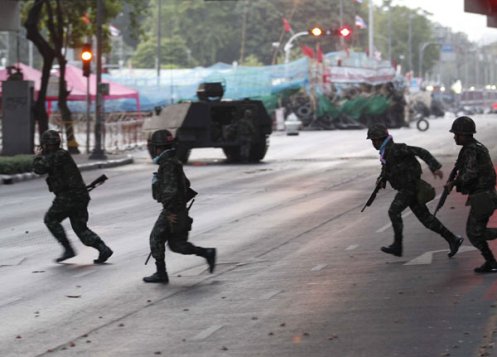
Thailand: Crackdown on protesters to last entire day
Associated Press
Wednesday May 19, 2010, Bangkok
The Thai government says an operation launched at daybreak to clear some 3000 protesters from their barricaded encampment in downtown Bangkok, which they have occupied for weeks, will last throughout the day.
Government spokesman Panitan Wattanayagorn said Wednesday’s operation is designed « to secure the parameter in several locations in Bangkok. »
Panitan appeared on television several hours after the crackdown started.
Armored vehicles and soldiers converged on the protest encampment. Bamboo spears splintered and tires scattered as the army vehicles repeatedly rammed the barricade.
The vehicles made no attempt to drive through the large holes punched by their operation, and troops stayed outside. Continuous gunfire is being heard from the area.
At least 39 people have been killed and more than 300 people wounded in seven days of clashes in Bangkok.
« Thaksin’s Vendetta Is Wrecking The Country »
pattayadailynews.com
by Wall Street » 18 May 2010
Thaksin’s vendetta is wrecking the country
The Nation
BANGKOK: — After a few days of armed skirmishes between rioters, terrorists and government troops in areas around Rajprasong, an end to the trouble remains elusive, despite the deadline given for the red shirts to disperse by 3pm yesterday afternoon.
Some more military action could ensue now that the crowd in front of the stage is thinning out. Only a few thousand are left to serve as shields for the red-shirt ringleaders, who have vowed to fight to the end.
But that sounds like empty bravado. Several have already left the stage for safety, especially the key leader Veera Musigapong, who opted out as if knowing that further persistence would lead to an unpleasant end.
It has been proven beyond any doubt that the red shirts, who serve as the political wing for the campaign to oust the government by Thaksin Shinawatra, have comrades in arms in the true sense of the word. They periodically fire grenades at troops and other targets during the running battles.
The number of grenades at their disposal has been amazing. The M-79 grenade launchers have become a key weapon of the unidentified, hooded men who look mean and lethal. The troops have not been able to capture any of them, either dead or alive. Only video clips of their actions have been shown.
The red-shirt leaders have not denied that they are allies of those forces. Since the beginning of the rally, they have elevated their campaign from a claim of peaceful protest and ahimsa to harassment and terror for Bangkok residents.
Now, they have realised that the punishment they deserve for their crimes is too serious for them to surrender to the authorities. Their options remain the same – flee, go to jail, or be killed if they resist the final crackdown.
Thaksin Shinawatra no longer remains silent, though he does not show himself for public view. Through messages and tapes, he tries to drag international organisations, including the UN, into participating in truce talks despite his status as a fugitive criminal fleeing a two-year jail term.
His whereabouts and the condition of his health remain vague, despite reports that he has been battling prostate cancer. Always on the move to avoid being tracked by the Thai authorities, Thaksin has become an international fugitive and is always causing trouble to the Abhisit government through his cronies in and outside the House.
The riots at various spots in Bangkok have claimed more than 30 lives. They include thugs, rioters and innocent by-standers. Among the casualties are foreigners and a medic who were shot by unidentified gunmen.
It is not a civil war, but the government is trying to suppress rioting, store looting, armed attacks and terrorism. Sporadic gunfire and grenade explosions are heard around the battle zones. Bangkok is virtually at war with Thaksin, who is at the core of the crisis.
His vendetta, financed by billions of baht paid to red-shirt protesters and armed men, is taking a heavy toll on the country’s political, economic and social structure.
No matter how the crisis ends, the country will not be the same. It will be ridden with deep-seated division and conflict, even with or without Thaksin being around.
After two months of tolerating illegal rallies and terror, the government only began to take real action in the past few days with the blockade of Rajprasong to deprive the crowd of sufficient food and support. Persuasion will cut down the size of the crowd to just a few thousand before a further crackdown, if the government decides that such action becomes inevitable.
A bold move was taken on Sunday when the government prevented financial transactions by 106 corporate entities and individuals with Thaksin connections. Starting right from Thaksin’s ex-wife and his siblings, the list includes all sorts of business and political cronies, as well as classmates from his days in the pre-cadet school.
The big names will not be allowed to engage in financial activities, and the measures are designed to cut funding for the rallies and mobilisation of supporters from upcountry.
The final death toll and number of injuries will depend on what actions are taken to flush out red shirts from their rally sites. The ultimate cost will be high in financial terms as well as human tragedy.
By now, Thailand and the world knows that Thaksin has unlimited potential to destabilise his homeland, from which his family has amassed wealth through political power and corruption.
One man like Thaksin is more than enough in the long history of this country.
Thai street battles escalate with 35 killed
FT.COM
By Tim Johnston in Bangkok
May 16 2010
Thailand’s anti-government protests spread across the capital Bangkok over the weekend, in spite of a heavy-handed crackdown by security forces, which has killed at least 35 people and injured more than 240 in the past three days.
The authorities extended a state of emergency to five more provinces on Sunday, bringing the total to 22. Although troops have surrounded and largely isolated the main protest area in the city, new rallying points were springing up elsewhere, sparking violent confrontations.
One man was confirmed killed as soldiers with automatic weapons and shotguns faced protesters mostly armed with slingshots and homemade rockets, although there was evidence that a small number had assault rifles. Television pictures showed soldiers firing seemingly at random through a park that bordered the main protest where about 5,000 demonstrators have defied the government for more than a month.
So far all the dead have been either protesters or ordinary civilians caught up in the crossfire but Abhisit Vejjajiva, the prime minister seems undeterred by the rising casualties.
“We still have to move forward. We cannot retreat now,” Mr Abhisit said in a televised address on Saturday night.
But the red-shirted protesters, encamped in what is in more normal times the city’s main shopping and hotel district, remained defiant, insisting that they would continue to fight until their demands were met.
“They have heard that the army will come and kill them so they are preparing to fight back with everything they have got,” Karkaew Pikulthong, a protest leader, said on Sunday. “This has become like a civil war because people are standing up to fight back.”
For nine weeks the protesters have been campaigning for Mr Abhisit’s resignation. Many of them remain loyal to Thaksin Shinawatra, the former prime minister who was removed in a military coup four years ago and is living in exile in the Gulf. He mobilised Thailand’s rural poor and created a movement that has pitted them against an entrenched elite.
The government declared two parts of the capital “live firing zones” on Saturday, provoking a sharp response from human rights groups.
“By setting out these ‘live fire zones’, the Thai authorities are on a slippery slope towards serious abuses,” said Brad Adams, Asia director at Human Rights Watch, a US-based advocacy group. “It’s a small step for soldiers to think ‘live fire zone’ means ‘free fire zone’, especially as violence escalates.”
A central plank of the government’s policy is to cordon off the sprawling main protest site and prevent reinforcements arriving from other parts of the country by setting up checkpoints on key roads into the city.
However, so many people were being stopped that the checkpoints have rapidly metamorphosed into impromptu mini-rallies, multiplying the government’s headache. The authorities fear that the protests could spread across the country: anti-government protesters held a rally and burned tyres on Saturday in the city of Ubon Ratchatani, deep in the movement’s heartland in the country’s northeast.
There are growing calls for King Bhumibol Adulyadej , the country’s ailing but revered monarch, to step to end the violence.
“Why doesn’t the king say make it stop?” asked one protester, who requested that his name not be used because he believed such a comment could be construed as insulting the monarchy: that crime carries a penalty of up to 15 years in Thailand and the laws also apply to foreign media.
Schools across the city were due to start a new term on Monday but the government ordered them to remain closed for at least another week, and it declared Monday and Tuesday bank holidays, although the Stock Exchange of Thailand will open on Monday for a shortened trading day.
Mr Abhisit has refused to yield to the pressure of the mob. Two weeks ago, he made an offer to hold elections in November, more than a year before his term officially ends but the offer was withdrawn after the demonstrators put forward more demands.
Copyright The Financial Times Limited 2010. You may share using our article tools. Please don’t cut articles from FT.com and redistribute by email or post to the web.
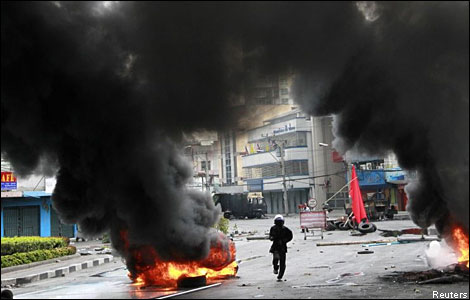
22 killed in Thailand riots since Thursday
haaretz.com
16 05 2010
The Foreign Ministry upgraded the travel warning for Thailand yesterday, advising Israelis not to travel to the capital, Bangkok. But while the British and U.S. embassies were shut down the Israeli embassy remained open. Ambassador Itzhak Shoham told Haaretz that the Bangkok government is still in control. El Al flights to and from Thailand are also operating normally.
The Foreign Ministry said Israelis in Thailand should take every possible precaution, and if they cannot avoid going to Bangkok they should avoid the areas of the city that have seen demonstrations and clashes between protesters and security forces.
Several thousand Israelis are known to be in Thailand, but only a few have contacted the embassy.
The embassy, located at some distance from the area of the riots, is on emergency footing, providing services 24 hours a day.
Shoham said that while the violence had not spread to other areas of the city, local and Israeli employees not living in the immediate vicinity of the embassy were asked to stay home to avoid unnecessary risks. « The authorities are trying to prevent the situation from deteriorating, and have a good chance of succeeding, » Shoham said.
Meanwhile, Thailand’s leader defended the deadly army crackdown on protesters in the capital yesterday, saying the country’s very future was at stake. Protesters dragged the bodies of three people from sidewalks – shot by army snipers, they claim – as soldiers blocked major roads and posted notices of a Live Firing Zone.
« I insist that what we are doing is necessary, » Prime Minister Abhisit Vejjajiva said in a defiant broadcast on national television.
Protesters yesterday launched a steady stream of rudimentary missiles at troops who fired back with live ammunition in several areas around a key commercial district of Bangkok.
The spiraling violence has raised concerns of sustained, widespread chaos in Thailand, a key U.S. ally and Southeast Asia’s most popular tourist destination.
The situation is getting closer to civil war each minute, Jatuporn Prompan, a protest leader, told reporters. « Please don’t ask us how we are going to end this situation, because we are the ones being killed, » he said.
Since Thursday, the once-bustling commercial and shopping district has become a war zone with Red Shirt protesters firing weapons, throwing homemade explosives and hurling rocks at troops firing live ammunition and rubber bullets. The violence ignited after the army started forming a cordon around the protesters’ encampment and a sniper shot and gravely wounded a rogue general reputed to be the Red Shirts’ military adviser.
At least 22 people have been killed and more than 194 wounded since Thursday. The protesters have occupied a tire-and-bamboo-spike barricaded, 1-square-mile (3-square-kilometer ) zone in one of the capital’s ritziest areas, Rajprasong, for about two months to push their demands for Abhisit to resign immediately, dissolve Parliament and call new elections. The crisis had appeared to be near a resolution last week when Abhisit offered to hold elections in November, a year early. But the hopes were dashed after Red Shirt leaders made more demands. The political uncertainty has spooked foreign investors and damaged the vital tourism industry, which accounts for 6 percent of the economy, Southeast Asia’s second largest. .The Red Shirts, drawn mostly from the rural and urban poor, say Abhisit’s coalition government came to power through manipulation of the courts and the backing of the powerful military, and that it symbolizes a national elite indifferent to the poor. The army said its cordon has been effective, and the number of protesters at the encampment has dwindled by half. Water and power also were cut off to the area Thursday. About 5,000 hard-core demonstrators held their ground under threat of military operations to oust them, down from about 10,000 days earlier, army spokesman Col. Sansern Kaewkamnerd said. If the protesters will not end the situation, we will have to enter the encampment, Sansern said.

Les affrontements se sont poursuivis samedi à Bangkok
AP
14 05 2010
BANGKOK (AP) — Les affrontement entre soldats et manifestants anti-gouvernementaux se sont poursuivis samedi matin dans le centre de Bangkok, alors que le secrétaire général des Nations Unies, Ban Ki-moon a appelé à la fin des violences qui ont fait 16 morts et au moins 157 blessés, dont un journaliste canadien, depuis jeudi soir.
Les violences ont éclaté après la décision jeudi de l’armée de boucler le camp des opposants, qui recouvre une surface de trois kilomètres carrés dans le quartier commercial de Rajprasong, où quelque 10.000 manifestants des « Chemises rouges », dont des femmes et enfants, s’entassent depuis le 3 avril.
Elles ont connu une escalade après un tir contre un général renégat, considéré comme un conseiller militaire des protestataires. Khattiya Sawasdiphol a été grièvement blessé par balle à la tête et se trouvait encore vendredi dans le coma. Il pourrait « mourir à tout moment », a estimé un médecin.
Dans la nuit de vendredi à samedi, des explosions et des coups de feu ont retenti aux principaux carrefours du quartier de Rajprasong. Selon la télévision locale, des grenades ont touché un centre commercial et une station de train aérien. De la fumée s’élevait des pneus en feu jonchant les rues désertes du quartier.
Dans un message adressé depuis New York, le secrétaire général de l’ONU, Ban Ki-moon, a appelé les deux parties à « faire tout ce qui est en leur pouvoir pour éviter de nouvelles violences et pertes de vies humaines ».
D’abord circonscrites à une petite zone abritant plusieurs ambassades, les émeutes s’étaient étendues vendredi après-midi à plusieurs secteurs alentour. Dans l’une des zones d’affrontements, des soldats accroupis derrière un parapet tiraient à balles réelles et lançaient des gaz lacrymogènes. Des véhicules de l’armée sillonnaient à vive allure des rues désertes jonchées de pierres et de débris. Des protestataires reculaient, lançant pierres et insultes.
« Nous sommes encerclés. Nous sommes écrasés. Les soldats sont en train de nous cerner. Ce n’est pas encore la guerre civile, mais c’est très, très cruel », a déclaré à l’Associated Press Weng Tojirakarn, un des responsables des « Chemises rouges ».
« Je n’ai jamais rien vu de tel », ajoutait pour sa part Kornvika Klinpraneat, qui travaille dans un supermarché du quartier. « C’est comme une guerre civile. La bataille a lieu au milieu de la ville et des personnes innocentes sont blessées et tuées ».
« Notre politique n’est pas de disperser les manifestants », a déclaré vendredi soir le porte-parole du gouvernement Panitan Wattanayagorn. « Notre mission est de mettre en place des points de contrôle et de resserrer » la zone autour de la protestation, mais « il y a eu des tentatives pour agiter les officiers », a-t-il ajouté.
Le porte-parole a précisé à la télévision thaïlandaise que les forces de sécurité n’étaient pas entrée dans le campement des « Chemises rouges », mais avaient été attaquées et forcées de se défendre. Les efforts sécuritaires seront accrus dans les prochains jours et « de nombreux lieux seront bientôt sous contrôle », a-t-il affirmé.
Parmi les victimes se trouvaient notamment un cameraman et un photographe thaïlandais. Un correspondant canadien anglophone de la chaîne internationale française France 24, Nelson Rand, a été touché de trois balles mais se trouvait hors de danger après avoir subi une opération, a précisé France 24. Le ministère français des Affaires étrangères a déploré cet incident « grave ».
Nelson Rand a subi « une très très longue opération chirurgicale qui a duré plus de quatre heures. Il a été très très lourdement touché, à la jambe, à l’abdomen et aussi au bras. (…) Selon les chirurgiens, sa vie n’est pas en danger pour autant. Il a été grièvement blessé par trois balles de fusil d’assaut M16 », a raconté son collègue présent sur place, Cyril Payen.
Depuis le début du mouvement de contestation, le 12 mars, les violences ont fait 43 morts et plus de 1.400 blessés. Ces deux journées de violence sont les plus meurtrières depuis celle du 10 avril, où 25 personnes avaient été tuées et 800 autres blessées.
Les « Chemises rouges », pour la plupart des Thaïlandais pauvres venant des campagnes, se sont élevés contre le gouvernement pour tenter d’obtenir la dissolution du Parlement et la convocation de législatives anticipées. Ils accusent le gouvernement de coalition d’être arrivé illégalement au pouvoir avec le soutien de l’armée à l’origine du coup d’Etat de 2006 qui a renversé l’ex-Premier ministre Thaksin Shinawatra, chef de file des « Chemises rouges ».
Le 3 mai, le chef du gouvernement Abhisit Vejjajiva a proposé des élections pour le 14 novembre. Mais de nouvelles revendications des dirigeants du mouvement sont venues doucher l’espoir de compromis et de résolution pacifique de la crise. AP
Situation explosive à Bangkok entre soldats et manifestants
Reuters
14/05/2010
La situation est explosive dans le centre de Bangkok après une nuit d’affrontements entre soldats et manifestants antigouvernementaux qui ont fait un mort et neuf blessés, dont un chef militaire des « chemises rouges ».
Un calme précaire prévaut dans la matinée dans le quartier d’affaires traditionnellement animé qui jouxte Lumpini Park.
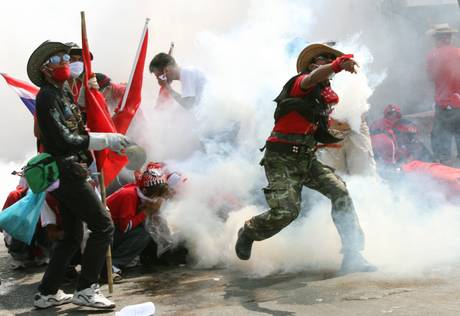
Des tirs et des explosions ont été entendus dans la nuit en plusieurs endroits de la capitale thaïlandaise. La police dit avoir tiré en l’air pour effrayer les milliers de manifestants retranchés dans leur camp fortifié, qui continuent de réclamer la démission du Premier ministre Abhisit Vejjajiva et la convocation d’élections anticipées.
« Ils resserrent le noeud autour de nous mais nous lutterons jusqu’au bout, mes frères et soeurs », a déclaré Nattawut Saikua, un des leaders du mouvement, à ses partisans.
Les autorités ont décidé jeudi de prendre des mesures musclées pour reprendre le contrôle du quartier commerçant de Bangkok occupé depuis deux mois par les manifestants après l’échec du plan de réconciliation présenté la semaine dernière par Abhisit.
« La ville est quasiment à l’arrêt. Tout le monde est sur les nerfs et la tension est à son paroxysme », souligne Kiatkong Decho, analyste chez CIMB Securities. « A ce stade, je pense qu’il ne reste pas d’autres options à Abhisit que de déloger les manifestants par la force. »
Jeudi soir, le « conseiller » militaire des « chemises rouges », Khattiya Sawasdipol, a été blessé d’une balle en pleine tête alors qu’il discutait avec des journalistes.
DES AMBASSADES FERMÉES
Surnommé le « commandant rouge », Khattiya est un général renégat tenu par le gouvernement pour un « terroriste » responsable d’une mystérieuse vague d’attentats à la grenade qui ont fait une centaine de blessés, mais il est vénéré par une bonne partie des « chemises rouges ». Il a subi une opération du cerveau et se trouve dans un état stable.
L’incident a provoqué une demi-douzaine d’affrontements entre les forces de sécurité et les manifestants. L’armée a encerclé le camp retranché des « chemises rouges », grand de trois kilomètres carré et entouré de barricades faites de pneus et de bambous aspergés d’essence et de fils barbelés.
Des « chemises rouges » ont lancé des pierres et des soldats ont riposté en ouvrant le feu. Un manifestant a été touché par balle à un oeil et a succombé à ses blessures, rapportent des témoins.
Vendredi matin, le bilan s’élevait à un mort et neuf blessés, selon le centre médical Erawan. L’armée a coupé le courant électrique dans certains secteurs et brouillé les services de téléphonie mobile.
La plupart des entreprises et ambassades situées dans le secteur ont évacué leur personnel et ont été fermées pour la journée.
Abhisit fait face à une pression de plus en plus forte pour sortir le pays de cette crise sans précédent depuis 20 ans, dont les débordements ont déjà fait une trentaine de morts et plus de 1.400 blessés, minant la confiance des investisseurs et des consommateurs.
Les opposants, qui reprochent à Abhisit la légitimité douteuse de son élection il y a 17 mois avec le soutien de l’armée, tiennent son vice-Premier ministre Suthep Thaugsuban pour responsable des affrontements qui ont fait 25 morts le 10 avril et exigent, pour mettre fin à leur mouvement, qu’il soit traduit en justice.
La crise, qui paralyse une partie de la capitale, nuit aussi grandement à l’industrie du tourisme et fait fuir les investisseurs étrangers, qui ont revendu pour près de 600 millions de dollars d’actions thaïlandaises lors des six dernières séances.
Avec Ploy Ten Kate, Chalathip Thirasoonthrakul et Damir Sagolj, Clément Dossin pour le service français.
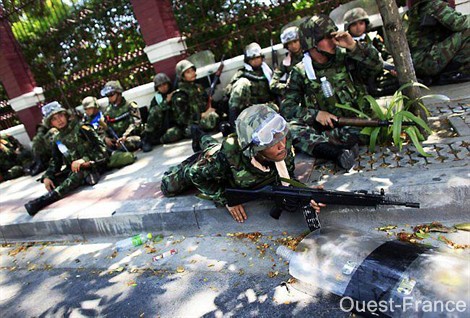
Sept morts et 101 blessés vendredi à Bangkok
Reuters
14/05/2010
Les affrontements dans le centre de Bangkok entre l’armée thaïlandaise et les « chemises rouges » ont fait sept morts et 101 blessés vendredi, a-t-on appris auprès du centre médical Erawan.
Les affrontements qui ont éclaté en début de journée lorsque des manifestants ont tenté d’empêcher la progression des soldats venus les déloger de leur campement fortifié qu’ils occupent depuis plus de cinq semaines, se poursuivaient dans la nuit.
Au total, huit personnes sont mortes depuis le début des troubles jeudi soir, qui ont fait en outre 112 blessés.

Heurts à Bangkok: un mort et plusieurs blessés dont un général pro-rouge
AFP
14 05 2010
BANGKOK — Des heurts entre armée et manifestants ont fait un mort et au moins huit blessés jeudi à Bangkok, dont un général thaïlandais renégat favorable aux « chemises rouges », victime d’une attaque par balle alors que le pouvoir a décidé de boucler la zone où sont retranchés les manifestants.
Khattiya Sawasdipol, alias Seh Daeng, très populaire parmi les « rouges » et de facto chargé des opérations de sécurité dans leur campement, a reçu une balle dans la tempe.
« Il est en train de subir une intervention chirurgicale à l’unité de soins intensifs de l’hôpital Hua Chiew », a précisé un porte-parole du service des secours de la capitale.
Le général Khattiya, 58 ans, n’avait pas caché ces derniers jours qu’il n’acceptait pas le plan de sortie de crise du gouvernement. Il a toujours assumé son lien étroit avec Thaksin Shinawatra, ex-Premier ministre en exil renversé en 2006 par un putsch, et dont se réclament de nombreux manifestants.
Un de ses aides de camp a affirmé à l’AFP qu’il avait été la cible d’un tireur embusqué.
« Le bouclage total (de la zone) a été mis en place depuis hier soir », a de son côté annoncé le porte-parole de l’armée, le colonel Sunsern Kaewkumnerd.
« Les responsables du réseau de la ville ont coupé l’électricité autour de l’intersection de Ratchaprasong la nuit dernière », a-t-il ajouté.
Selon la police, par ailleurs, cinq grenades M-79 ont été tirées devant le quartier de la finance de Bangkok où manifestants et forces de l’ordre se sont affrontés pendant environ deux heures.
L’armée a finalement ouvert le feu pour repousser des manifestants qui chargeaient, a témoigné un caméraman de l’AFP. Au total, sur l’ensemble de la soirée, un manifestant a été tué et au moins huit ont été blessés.
L’état d’urgence, décrété à Bangkok début avril, a été étendu à 15 autres provinces du Nord et du Nord-Est du pays, bastion des « rouges ». Une mesure qui ne faisait que confirmer combien le plan de sortie de crise du Premier ministre Abhisit Vejjajiva était désormais moribond.
Devant la détérioration de la situation, les Etats-Unis ont fermé leur leur ambassade. « Nous somme très préoccupés, nous surveillons très attentivement » la situation, a déclaré à Washington le porte-parole du département d’Etat, Philip Crowley, annonçant la fermeture de l’ambassade.
Peu après, le Royaume-Uni a lui aussi annoncé qu’il fermait sa mission diplomatique à Bangkok. « L’ambassade sera fermée demain », a déclaré à l’AFP à Londres une porte-parole du ministère britannique des Affaires étrangères.
Les « chemises rouges » ont exigé cette semaine, avant de se disperser, l’inculpation du numéro deux du gouvernement, Suthep Thaugsuban, qu’ils jugent responsable des violences du 10 avril (25 morts, plus de 800 blessés). Depuis, la situation ne cesse de s’aggraver.
Abhisit a annulé les élections anticipées qu’il avait proposées en novembre en échange de la fin du mouvement. Et l’armée a fait état de sa volonté d’envoyer des blindés pour prendre position autour du quartier, afin d’étrangler les « rouges ».
Le colonel Sunsern Kaewkumnerd, porte-parole militaire, avait averti que des « tireurs embusqués (seraient) déployés » et que l’usage de balles réelles serait autorisé en cas de menaces et contre des « terroristes armés ».
Officiellement, il ne s’agissait pourtant pas d’une dispersion par la force des manifestants, une opération très délicate dans ce quartier protégé par des barricades de bambous, de pneus et de barbelés tranchants, et dans lequel vivent des femmes et des enfants.
Les « chemises rouges » ont de leur côté lancé des appels au sacrifice.
« Si vous pensez que tirer sur Seh Daeng va nous faire peur (…), vous avez tort », a proclamé Jatuporn Prompan, l’un des principaux leaders. « Peu importe qui a les armes, cela ne signifie rien pour les militants de la démocratie comme nous. Nous ne partirons pas ».
« Nous nous battrons à mains nues contre des blindés et des armes automatiques », a-t-il ajouté, invitant les manifestants à utiliser leurs téléphones portables, pendant qu’il était encore temps, pour appeler du renfort.
La crise, la pire dans le royaume depuis 1992, a déjà fait 30 morts et près de 1.000 blessés depuis la mi-mars.






 anthropologie du présent
