
Deux morts à Bangkok – 7 mai 2010
Violence in Thailand kills 2, injures 8
CNN
May 8, 2010
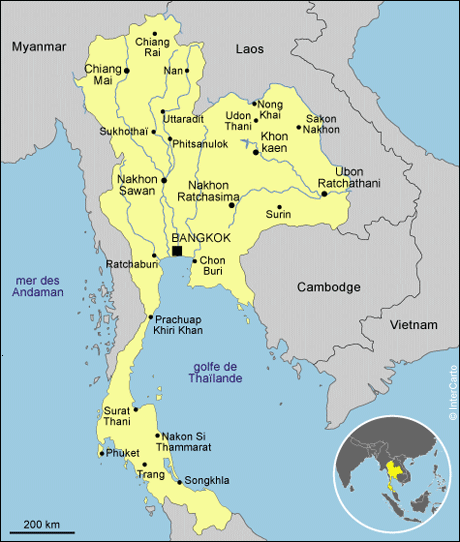
Bangkok, Thailand — Two Thai police officers were killed and eight people injured in overnight violence that lasted into early Saturday in areas where anti-government protesters are camped out.
The first attack — a drive-by shooting — killed two police officers. It occurred in an area guarded by riot police in Bangkok’s business district, the government’s Erawan Emergency Center said.
Later, early Saturday, several grenades were launched toward police and military guarding an area where protesters were camping in the capital, according to the emergency center. That attack injured eight, the center said.
Thousands of anti-government protesters have brought the center of Thailand’s capital to a standstill for a month as they seek to unseat Prime Minister Abhisit Vejjajiva’s government, which they say is illegitimate and undemocratic. Abhisit has called the accusations « unfounded. »
The demonstrators — known as « Red Shirts » because of their clothing — support Thaksin Shinawatra, who was prime minister from 2001 to 2006 before he was ousted in a bloodless coup.
Leaders of the anti-government protesters announced Tuesday that they had reached a deal with the government but said they would not end their demonstrations until the prime minister announces when he will dissolve parliament.
More than two dozen civilians and military personnel have died since protesters began occupying key tourism and shopping areas in Thailand’s capital.

Unknown assailants kill two policemen in Bangkok
Thehindu.com
BANGKOK, mai 8, 2010
Unknown assailants attacked policemen guarding an area occupied by an anti—government demonstration, killing two officers and wounding nine other people, police said on Saturday.
In the first attack, occurring about 10:45 pm on Friday (1545 GMT), men on a motorcycle fired on police and pro—government counter demonstrators on Silom Road, killing Police Sergeant Pannupat Lertkanpen with a bullet to the stomach, said Metropolitan Police Commissioner Lieutenant General Santan Chayanol.
The attack also wounded three other policemen and two civilians.
A second attack occurred at 1:30 am on Saturday, in which three grenades were fired at policemen stationed outside the U—Chuliang Building across the road from Lumpini park, an area occupied by the protestors.
Police Sergeant Wittaya Phomsalee died from a chest wound he sustained in the attack. Four other policemen were wounded.
“It’s too early to say who was behind these attacks,” Lieutenant General Santan said.
“I believe it was a group of people who want to create chaos.” The fresh violence comes at a bad time for Bangkok, where a nearly two—month—old anti—government protest has already sparked clashes that have claimed 27 lives, including six soldiers, and wounded more than 900. Negotiations are underway to end the costly demonstration, which has seized the heart of Bangkok’s main commercial district, and cost the country millions of dollars in lost tourism revenues.
The United Front for Democracy against Dictatorship (UDD), better known as the red shirts, started its protest on March 12 in a bid to force Prime Minister Abhisit Vejjajiva to dissolve parliament and hold new elections.
In what was hailed as a major breakthrough, Mr. Abhisit on Monday announced plans to hold an election on November 14, which would require dissolving parliament between September 15 and 30.
He also laid out a five—point road map to be followed in the coming months to deal with some of the political issues that have deeply divided the country over the past four years.
The UDD has accepted the road map in principle, but has yet to leave its protest site in the middle of the city, which it has occupied with thousands of followers since April 3.
Although the red shirt protest began peacefully, it adopted more aggressive tactics in April after failing to force Mr. Abhisit to meet their demand for an immediate dissolution of parliament.
Mr. Abhisit placed the capital under emergency decree on April 7. An attempt to clear protestors from their previous demonstration site at Phan Fa Bridge, in the old part of Bangkok, led to a bloody street battle that left 25 dead, including five soldiers, and wounded more than 800.
Grenade attacks, also on Silom Road, on April 22 killed one woman and injured about 80 civilians. A showdown between troops and UDD protestors near Don Mueang Airport on April 28 left one soldier dead and about 20 people wounded.
The UDD protest has been accompanied by an unprecedented number of attacks on government and army installations by unknown assailants armed with military weapons.
People similarly armed assisted the UDD in fighting off the troops at Phan Fa Bridge. Mr. Abhisit has labelled the militants “terrorists,” operating among the innocent protestors.
At least nine UDD leaders face terrorist charges.
To date the government has not said who the militants working in tandem with the UDD are. An impartial investigation into the April 10 event is one of the five steps on Mr. Abhisit’s proposed road map.
New Thai violence kills 2, mars compromise moves
AP
By DENIS D. GRAY – 8 05 2010
BANGKOK — Hopes for an end to Thailand’s political crisis diminished Saturday following a new eruption of violence that killed two policemen and wounded 13 people in double nighttime attacks.
The attacks came after the so-called Red Shirt movement signaled that they were in general agreement with a government reconciliation plan and might soon end the protracted demonstrations that have shut down much of Bangkok’s commercial district.
The protest movement denied involvement in the latest attacks and indicated that its occupation would continue while it sought a deal with the government, saying the two were not mutually exclusive.
« No matter who and whatever is trying to obstruct us, we will carry on our protest (in central Bangkok), » Weng Tojirakarn, a protest leader, said Saturday.
The protesters say they agree in principle with a proposal by Prime Minister Abhisit Vejjajiva to dissolve Parliament and hold new polls — their key demands — but want more specific details and assurance that Abhisit has the full support of his coalition partners and other political actors.
« One mouth speaks of reconciliation while the other 99 mouths keep talking about cracking down, » Weng said.
He called on the government to revoke emergency decrees that give the military powers to restore order and that ban public gatherings.
As Weng spoke, a long column of pickup trucks loaded with protesters arrived from northeastern Thailand to reinforce the Red Shirt « occupation zone. »
Late Friday night, the sense of relative calm that had prevailed for several days was broken by a mysterious incident near where grenades exploded on April 22, killing one person and wounding several others. The area, close to an encampment of the protesters, is guarded by many police and soldiers.
A witness, Decha Phoonpanang, said either a small explosive or gunshots whizzed past him, shattering the glass storefront of a bank and hitting two policemen — one in the stomach — and a man in the leg.
Slightly more than two hours later, about three explosions could be heard in an adjacent street that fronts a park, with police officers saying they believed them to be grenades.
The official Erawan Emergency Center on Saturday said two policemen were killed in the two incidents. Most of those wounded were believed to be police.
Red Shirt leaders denied involvement in the attacks and urged that security forces be withdrawn from the streets since they only served as « lightning rods » for those trying to provoke violence.
Other activists who oppose the Red Shirts have denounced the government’s peace offering as a capitulation and demanded that Abhisit clear their encampments or step down.
Some factions on all sides oppose a settlement, making it difficult to pinpoint an obvious suspect in the new violence.
The nearly two-month standoff in Bangkok has hammered the economy, decimated the tourist industry and ground government machinery to a near halt. Clashes with soldiers and other violence have killed 29 people and wounded nearly 1,000.
Abhisit unveiled a proposal that included new elections on Nov. 14 — about a year before his term would end — if the protesters left their encampment in the heart of the Thai capital. The Parliament must be dissolved at least 45 days before the elections.
The plan includes respect for the monarchy, reforms to resolve economic injustice, media reforms, independent investigations of violence connected with the protests, and amending the constitution to be more fair to all political parties.
But the date of the dissolution of Parliament has since become a sticking point, with the Red Shirts insisting it be specified and Abhisit saying only it would happen in time for the November election, but possibly as early as September. No date would be fixed if the Red Shirts did not agree to the plan, the prime minister has said.
The timing is a crucial issue because a key reshuffle of top military posts is scheduled for September, and the protesters don’t want Abhisit at the helm then. It’s not clear if a caretaker government, which would run the country after Parliament is dissolved, would be allowed to make the appointments.
The military holds tremendous power in Thailand, and the Red Shirts, who draw most of their supporters from the rural and urban poor, view Abhisit’s government as the illegitimate product of back-room deals and military pressure on legislators.
The protest group includes supporters of former Prime Minister Thaksin Shinawatra who was ousted in a 2006 military coup following accusations of corruption and abuse of power.





 anthropologie du présent
Given that people have different lifestyles and levels of fitness, there are many programs where“experts” give general rules about what to do
in the gym to gain muscle or just fitness in general.
When creating a slogan, aim for the heart by playing up the emotional effect.
You need to find a way to change the way you think about food, in order to avoid
the bad habit of overeating.