
Affrontements au Népal – mai 2010
Clashes in Nepal despite end of Maoist strike
AFP
9 5 2010
KATHMANDU — Riot police in the Nepalese capital Kathmandu fired tear gas on Sunday to quell Maoist protesters who have staged a week of street rallies in the city demanding the government step down.
The Maoists had enforced a general strike closing all shops and offices across the country, but they abandoned the tactic on Friday amid public fury at the restrictions.
Thousands of left-wing protesters remain in Kathmandu as pressure builds on the coalition government ahead of an end-of-May deadline for a new constitution seen as crucial to ensuring lasting peace in Nepal.
« Twelve policemen have been injured in scuffles, and dozens have also been injured on the Maoist side, » police spokesman Bigyan Raj Sharma told AFP.
« Police went in to rescue an alleged infiltrator who was being beaten up by Maoist protesters, » he said, adding that police had been attacked with stones and sticks.
Maoist protesters on Sunday encircled the Singha Durbar — the official administrative hub of the capital — as part of their campaign against the embattled government.
The Maoists fought a bloody civil war against the state for 10 years before a peace agreement was signed in 2006, and they won elections in 2008 before falling from power last year.
Lawmakers have until May 28 to complete a new constitution, but few analysts expect the deadline to be met.
The Maoist party, which has the largest number of seats in parliament, have vowed to continue protests until the prime minister resigns and is replaced by a Maoist-led national unity government.
Prime Minister Madhav Kumar Nepal has said he was willing to seek consensus with the left-wingers but would not consent to pre-conditions.
In a regular report on the peace process, UN chief Ban Ki-moon last week appealed to the government and opposition parties to resolve « political impediments » that were undermining the national interest.
The report said « no substantive forward movement » was being made over the two main issues — the drafting of a new constitution, and the integration of 20,000 former Maoist rebel fighters who are living in UN-monitored camps.
Maoist leader Pushpa Kamal Dahal, often known by his nom-de-guerre Prachanda, led the rebels during the decade of fighting in which at least 16,000 people were killed.
He was prime minister until May last year when his Maoist-led government collapsed after the president overruled its decision to sack the head of the army.

Police, Maoists clash in Nepal, several injured
AP
9 05 2010
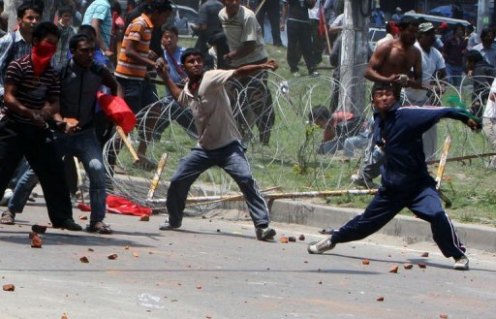
KATMANDU, Nepal — Riot police clashed with thousands of communists demonstrating outside the government’s main offices in the Nepalese capital on Sunday, injuring several protesters and police officers.
Police fired tear gas to disperse the demonstrators who gathered to block the complex housing key offices, including the prime minister’s, in an attempt to shut down government machinations. Thousands of police had been deployed early Sunday to guard the complex.
The Maoists, former rebels who fought a bloody 10-year war that killed an estimated 13,000 people, have demanded that Prime Minister Madhav Kumar Nepal step down and hand over power to a national communist-led government.
The crisis — which included a paralyzing six-day general strike last week called by the communists — has raised fears of renewed violence after the Maoists joined the political process in 2006 under a peace deal.
Protesters pelted police with stones Sunday, beat up pedestrians and television cameramen, and set government vehicles on fire. Both police and demonstrators were injured in the street battles.
Some 125,000 Maoists gathered in the capital Katmandu on May 1 for protest rallies. The Maoists on Friday had ended the crippling strike that shut down transportation, markets and schools, bowing to pressure from angry citizens, Western diplomats and business groups.
The Maoists traditionally back strike calls with the threat of violence against those who defy them, and security forces have been deployed in large numbers to mitigate unrest.
The communists won the country’s most recent elections and briefly led a coalition government. A dispute split their coalition and the Maoist leader resigned as prime minister, allowing the current government to come to power. The Maoists now want power back, but the government has refused to step aside.
The unrest comes as Nepal’s Constituent Assembly, elected to draw up a new constitution, struggles to draft the charter before its term expires May 28.

Clashes in Nepal on Day 5 of Red strike
Hindustan Times
Kathmandu, May 07, 2010
Patience is running out and tempers are flaring as the indefinite strike called by opposition Maoists in Nepal to oust the government continued for the fifth day on Thursday.
Though the strike was largely peaceful the first three days, growing frustration due to continuing deadlock that has brought Nepal to a halt led to several violent incidents on Wednesday and Thursday.
One youth was killed and dozen others injured at Makwanpur in a clash between groups for and against the strike. A child was injured following clashes between locals and Maoists at Budhanilkantha in Kathmandu.
Maoist demonstrators allegedly looted a bank at Baratpur and left with computers and a telephone set. Shopkeepers and commoners were also beaten up at several places and property and vehicles damaged.
The border town of Birganj remained tense as a dozen people were injured in a clash between Maoists and supporters of a Hindu outfit opposing the strike. Curfew has been imposed to fervent further violence.

Curfew in Dhankuta, Parbat and Simikot following violent clashes
nepalnews.com
Thursday, 06 May 2010
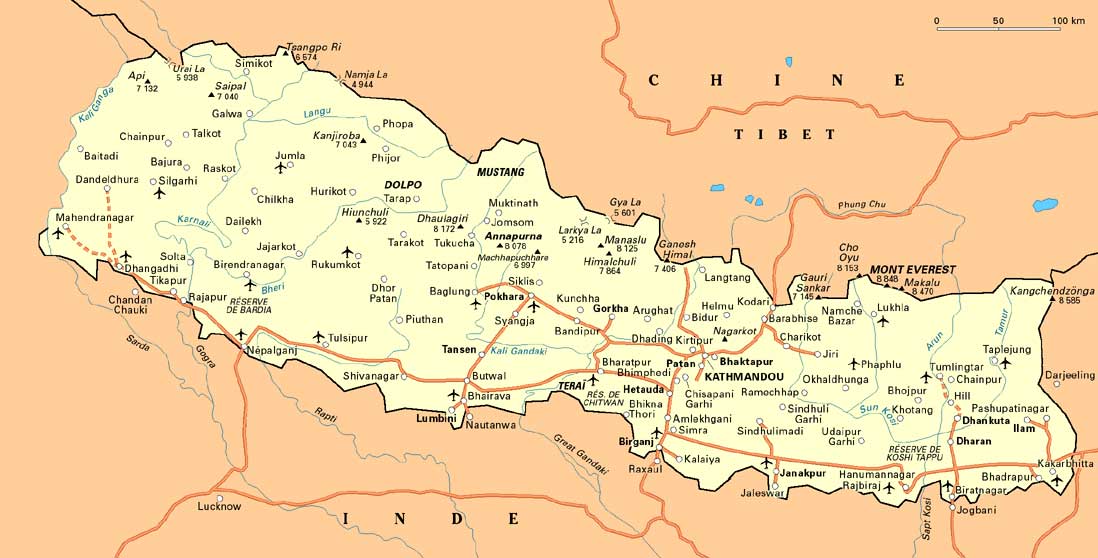
The local administrations of Parbat, Humla and Dhaunkuta districts have declared curfew orders in the respective district headquarters to avert further clashes between the agitating Maoists cadres and those defying the Maoist general strike.
The district administration office (DAO) of Dhankuta has clamped indefinite curfew in Dhankuta Bazaar starting 7:30 pm in view of more clashes between the cadres of the Young Communist League (YCL) and the UML-aligned Youth Force who were on the streets to resist the Maoist bandh. There were clashes between the two sides in the afternoon.
Likewise, the Parbat DAO imposed curfew in Kusma Bazaar from 8 pm to 7:30 am tomorrow in view of fresh violence between the protesting Maoists and cadres of UML, Nepal Congress and the local residents. There were sporadic clashes between the two sides around Kusma Bazaar in the afternoon.
Similarly, Humla DAO imposed curfew in the district headquarters Simikot from 8 pm Thursday to 6 am Friday.
There were sporadic clashes in Simikot between the agitating Maoists and the cadres of the two main ruling parties, Nepali Congress and UML, who staged rallies, opposing the general strike called by the Maoists.
Situation has now come under control in Simikot now after the deployment of more security personnel and declaration of the curfew, reports said. nepalnews.com
Clashes leave over 40 injured in Birgunj
thehimalayantimes.com/
2010-05-06
BIRGUNJ: Birgunj remained tense after the Maoists and locals clashed in Ghantaghar, Ghadiarwa and adjoin areas on Thursday.
At least 35 persons including two dozen Maoist cadres, 11 locals and 5 policemen were injured in the clashes, police said.
Clashes ensued as locals retaliated after Maoists tried to close shops in Ghadiarwa Chowk on the 5th day of their general strike at 7 am. Five Maoist cadres sustained minor injuries in the clash.
While, the police charged batons after Maoists and locals clashed in front of Satya Movie Hall at Ghadiarwa Chowk at 9 am.
Locals staged demonstrations against the Maoists who gathered in front of the building of Dabur Nepal. Locals set fire to the tents that were erected by the Maoists in the northern part of Ghantaghar Chowk at 11 am and damaged the food materials there. Police doused the fire. Similarly, locals smashed windscreen two vehicles belonging to the Maoists at Gopal Mandali Gharmashala. When the situation was out of control, police fired five shells of tear gas to disperse the Maoists and locals.
The locals set fire on a jeep which the Maoists hired for the purpose of ferrying food materials at Adarsha Nagar Chowk.
Maoist CA members Prabhu Sah and Shiv Chandra Kushbaha, Bhojpura Rajya Samiti secretary Anjana Bishankhe and cadre Bal Krishna Shresha were injured in the clash at Ghantaghar Chowk.
20 injured returned home undergoing treatment in Birgunj-based Narayani Sub-Regional Hospital while Sah, Kushbaha, Bishankhe and Shrestha who were critically injured are undergoing treatment in the hospital.
There was a rumor of the local administration of imposing curfew from 1 pm, however, a meeting of District Security Committee decided not impose curfew in the city.
Clashes in Nepal as frustration grows at shutdown
AFP
6 5 2010
By Sophia Tamot
KATHMANDU — Maoist protesters clashed with residents in the Nepalese capital Kathmandu on Thursday as anger grew over a strike that has shut down much of the country for five days.
The Maoist party, which has the largest number of seats in parliament, is enforcing the general strike in an attempt to oust the ruling coalition government in a tactic that threatens to derail Nepal’s fragile peace process.
« There have been some minor clashes between anti-Maoist demonstrators and Maoists, » police spokesman Bigyan Raj Sharma told AFP on Thursday. « Police resorted to minimum use of force to bring the situation under control. »
Furious locals in Budanilkantha, in the north of the city, tried to defy the Maoists, who have ordered private and commercial vehicles off the streets and for all shops, offices and businesses to remain closed.
Police said they used tear gas to break up the fighting as Maoist supporters beat up locals frustrated at the shutdown.
The National Human Rights Commission, an autonomous official body, expressed concern over the increasing problems facing the public as talks between Maoists and the government failed to make progress.
« Medical care has been badly affected. We have had reports of patients being transported back to their homes in wheelchairs, » commission spokesman Gauri Pradhan told AFP.
« Pregnant women have difficulty getting to hospital. Remote areas are facing acute shortage of essential drugs because transport is affected, » she said.
Many hospitals have kept only their emergency wards open as doctors struggle to get to work.
« Two doctors are working 24-hours and a few nurses are working double shifts, » Philip Shyam Ranjit, a doctor at B&B Hospital’s emergency department, told AFP. « A lot of people have no access to medical attention. »
The Maoists have launched their challenge to the government — a loose coalition of 20 parties — ahead of May 28 by when a new national constitution should have been drafted.
But lawmakers are expected to miss the deadline, leading to a possible political crisis.
« The prime minister needs to step down, and all parties must reach an agreement on how to move forward, » Lok Raj Baral, chairman of the Nepal Centre of Contemporary Studies, a pro-democracy think-tank, told AFP.
« They must not forget that the constitution still needs to be written and the peace process brought back on track. »
Maoist guerrillas fought a bloody insurgency against the state for 10 years before a peace deal was signed in 2006. The left-wing former rebels then won elections in 2008 before falling from power last year.
A second major obstacle facing the country is how to integrate nearly 20,000 former Maoist fighters who are living in UN-monitored camps around the country.





 anthropologie du présent