
1 Mai : affrontements en Grèce

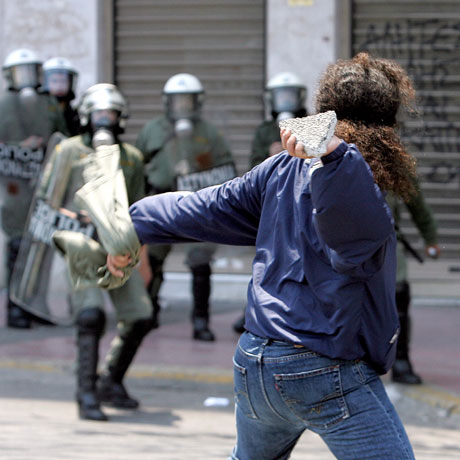
Hundreds of youths riot in Greek capital, throwing petrol bombs and stones at police
AP
May 01, 2010
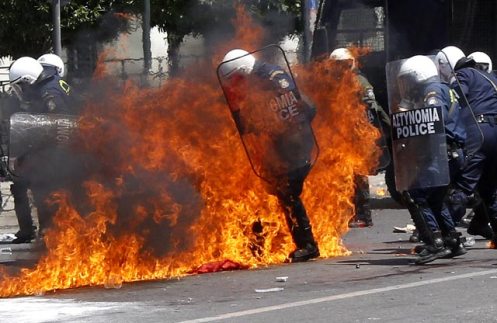
ATHENS, Greece – Hundreds of youths have rioted in Athens, throwing petrol bombs and stones at police who responded with tear gas at a large May Day rally against expected harsh austerity measures needed to secure loans for near-bankrupt Greece.
Responding to calls from the country’s two main labor unions, several thousand people marched in major Greek cities Saturday, in an outburst of rage against further anticipated spending cuts and consumer tax hikes.
In Athens, groups of black-clad anarchists in hoods and motorcycle helmets moved out of the main demonstration and burnt a TV van, smashed windows and set up street barricades of burning bins. Some 17,000 people took part in the march, according to police estimates.
Police said 10 suspected rioters were arrested.
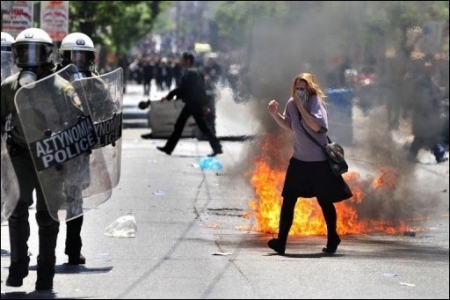
Thousands of angry Greeks march against austerity
Reuters
1 05 2010
Angry protesters set fire to garbage cans and two TV outside broadcast vans in Athens as thousands of Greeks marched through the capital on May Day to protest against austerity measures they say only hurt the poor.
At one rally, police fired two or three rounds of tear gas against 20 protesters trying to reach parliament. The protesters retreated and the march, which was otherwise largely peaceful, continued, a Reuters witness said.
Shops were closed, ships stayed docked and the streets of the capital were unusually empty except for protesters marching toward parliament, meters away from the Finance Ministry where EU and IMF officials have been meeting for days to agree a new set of austerity measures.
« No to the IMF’s junta! » protesters chanted, referring to the military dictatorship which ruled Greece from 1967 to 1974.
« Hands off our rights! IMF and EU Commission out!, » the protesters shouted as they marched to parliament.
A common call among many of those interviewed in the unusually empty streets of Athens was for punishment of those responsible for Greece’s biggest crisis in decades, in a country where corruption scandals and tax evasion are widespread.
« We should throw all the crooks into the sea, all the people and politicians who are responsible for this crisis, » said 58-year old insurance worker Sotiris Oikonomou.
With initial police estimates at around 17,000 protesters, participation in the march seemed to be around the same level as previous anti-austerity protests. Some were resigned to the fact that the government would move ahead with reforms anyhow.
« I don’t expect anything to change with this march. We just fight for our dignity, » Oikonomou said.
Greece, whose 240 billion euro economy plunged into recession last year, is preparing more than 20 billion euros ($26.64 billion) in budget cuts over the next two years to secure access to an EU/IMF aid package of up to 120 billion.
« SOCIAL BATTLE? »
The aid package is aimed at pulling Greece out of a severe debt crisis, which has hit the euro and shaken markets worldwide, and avoid contagion to other euro zone countries.
Euro zone finance ministers are due to discuss the deal on Sunday. French Economy Minister Christine Lagarde said she expected agreement could be reached by the end of Sunday.
Analysts say social protests may increase after the summer once the impact of the austerity measures kicks in, and investors are worried this may hamper reforms.
Rating agencies have warned they could cut the country’s rating further if the government lost public support.
The government has already agreed three sets of austerity measures including tax hikes and pension freeze over the last six months, and many fear the EU/IMF plan will hurt their livelihood further, in a country where one in five lives below the poverty threshold, according to EU data.
« We will not permit the destruction of our rights, we will block their plans, » said public sector umbrella union ADEDY. « It’s time for our biggest social battle. »
Union officials said Greece is asked to slash its deficit by 10 percent of GDP in 2010-2011 by raising VAT tax, scrapping public sector bonuses amounting to two extra months pay, and freezing civil servants’ wages in exchange of getting the aid.
A poll by ALCO pollster for the newspaper Proto Thema showed that 51.3 percent of Greeks would take to the streets if these new measures were agreed.
Polls show that although most Greeks disagree with the austerity plans, Prime Minister George Papandreou is still the country’s most popular politician and his party leads in polls.
(Writing by Ingrid Melander; Editing by Maria Golovnina)
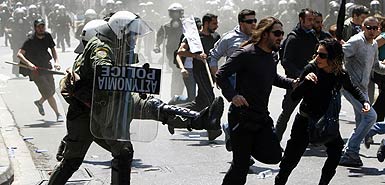
Grèce: 1er mai émaillé d’incidents dans l’attente du plan de sauvetage
AFP
01.05.2010
ATHÈNES – Des incidents ont éclaté samedi en Grèce lors des manifestations du 1er mai, qui ont mobilisé des milliers de personnes lors d’une journée sous haute tension, à la veille de l’annonce d’un plan de sauvetage financier imposant à ce pays une cure d’austérité sans précédent.
L’accord négocié par l’Union européenne, le Fonds monétaire international et la Grèce, permettant le déblocage de 100 à 120 milliards d’euros sur trois ans pour aider le pays à faire face à une dette colossale, doit être annoncé dimanche à Athènes.
Mais ce plan exige en contrepartie du gouvernement grec de nouvelles mesures d’économie draconiennes, par avance dénoncées par les syndicats, qui voulaient faire de ce 1er mai un premier test des résistances sociales avant une grève générale le 5 mai dans le public et le privé.
Des incidents ont éclaté entre jeunes et forces anti-émeutes en marge des défilés à Athènes ainsi qu’à Salonique, la grande ville du nord, où environ 20.000 personnes au total ont manifesté, selon la police.
« C’est l’attaque la plus grave contre les travailleurs depuis des siècles. Ils veulent un retour au 19ème siècle », s’indignait Ericos Finalis, un imprimeur venu manifester. « Cela ne va pas être une bataille mais une guerre qui va durer pendant des mois, ou même des années ».
« Aucun sacrifice, la ploutocratie doit payer pour la crise », proclamait une banderole du front syndical communiste (Pame), dont plusieurs milliers de militants, sous des drapeaux et ballons rouges, étaient rassemblés sur la place Syntagma, dans le centre d’Athènes.
A Salonique, la police a tiré des gaz lacrymogènes pour repousser des groupes de jeunes qui s’en prenaient à des vitrines de banques et commerces. Des scènes semblables se sont produites à Athènes, où le gros des manifestants s’est dispersé en début d’après-midi.
Face à la gravité de la crise, à la menace d’une contagion à d’autres pays faibles de la zone euro et au risque d’un défaut de paiement de la Grèce, le président français Nicolas Sarkozy et la chancelière allemande Angela Merkel ont réaffirmé samedi leur détermination commune à « agir vite » pour mettre en oeuvre le plan de soutien financier à Athènes.
Ce plan prévoit le déblocage de 45 milliards d’euros la première année. Selon la ministre française de l’Economie Christine Lagarde, il atteint 100 à 120 milliards d’euros sur trois ans.
L’accord Grèce-UE-FMI doit être annoncé dimanche, « probablement le matin », en Conseil des ministres, selon une source gouvernementale grecque.
Selon des syndicalistes, les économies exigées pourraient atteindre 25 milliards d’euros en deux ans, pour ramener le déficit public des bas-fonds qu’il a atteints l’an dernier, autour de 14% du produit intérieur brut (PIB), à environ 4% fin 2011. Il s’agirait d’un effort de rigueur sans équivalent dans la zone euro.
Les syndicats se sont dits prêts à batailler contre cette thérapie de choc, notamment contre les coupes salariales envisagées, dont la suppression des 13e et 14e mois de salaire, et la réforme annoncée des retraites.
Le Premier ministre Georges Papandréou a invoqué vendredi la « survie de la nation » pour justifier des économies « nécessaires » et tenter de faire accepter à ses concitoyens de nouveaux sacrifices.
Selon un sondage publié samedi, 51,3% des Grecs sont désormais décidés « à descendre dans la rue ». Mais, signe de la volatilité de l’opinion, un autre sondage montrait au même moment que 62% sont hostiles aux mobilisations organisées ces derniers mois par les syndicats.
Le plan d’aide à la Grèce sera discuté dimanche à Bruxelles lors d’une réunion des ministres des Finances de la zone euro convoquée à 14H00 GMT par leur chef de file, Jean-Claude Juncker.
Une fois validé par les ministres, le déclenchement de l’aide doit en principe être autorisé par les chefs d’Etat et de gouvernement de la zone euro, probablement lors d’un sommet le 7 ou le 8 mai.
L’aide à la Grèce prévoit pour la première année 45 milliards d’euros, sous forme de prêts bilatéraux des pays de la zone euro (30 milliards) et d’un soutien du FMI (15 milliards).
Plus gros contributeur du plan d’aide européen (8,4 milliards la première année), l’Allemagne, encore réticente il y a quelques jours, devrait décider du déblocage des fonds vendredi prochain, une fois que son Parlement aura donné son aval.
Paniqués en début de semaine par un risque de défaut de paiement de la Grèce et, surtout, par la menace d’une contagion de la crise à d’autres maillons faibles de la zone euro, comme le Portugal ou l’Espagne, les marchés se sont calmés ces derniers jours. Et l’euro a retrouvé quelques couleurs.
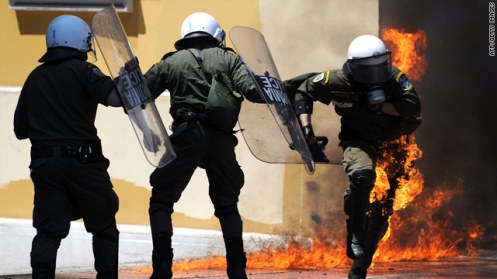
A Greek riot policeman runs away from a fire after a group set fire with a molotov cocktail, during a May day demonstration in Athens on May 1, 2010. Greek police fired tear gas on youths as marchers swarmed through central Athens to protest unprecedented austerity cuts needed for an EU and IMF loans worth as much as 120 billion euros. AFP PHOTO / DIMITAR DILKOFF
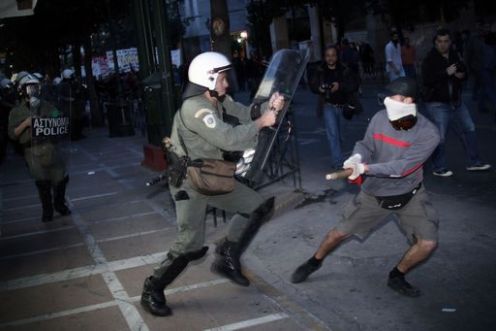
Clashes at Greek May Day rally
CNN
May 1, 2010
Athens, Greece (CNN) — Greek protesters clashed with police who fired tear gas during the annual May Day rally on Saturday in Athens, where thousands of people were on the streets.
Waving red flags, the crowd at times surged toward the line of police, who wore helmets and carried riot shields. The police pushed them back each time.
Protesters threw objects toward police, and scattered fires were burning on the streets. A van belonging to state broadcaster ERT was set on fire, and 19 people were taken in for questioning, a spokesman for the Greek national police told CNN.
About 12,000 people were protesting in Athens, and rallies were also taking place in the northern city of Thessaloniki, the spokesman said. Protesters there smashed two ATMs, the glass frontage of a bank, and a car, but no one was arrested or being questioned, the spokesman said.
The annual May Day rally has taken on an angry tone this year as the Greek government prepares to enact austerity measures to cap its large deficit and massive debt.
The package of measures was expected to be revealed Sunday. It is likely to include cuts in civil servants’ salaries, pay freezes, reductions in pension payments, changes to tax rates, and increases in the value-added tax consumers pay on purchases, Ilias Iliopoulos, the general secretary of the public sector union ADEDY said Thursday.
The International Monetary Fund and the European Union are discussing a bailout for Greece, whose economic problems threaten the stability of the common European currency, the euro.
The amount of the aid package being negotiated was not clear, but the IMF and EU are likely to demand the austerity measures as a price for a bailout.
Greece’s national debt of 300 billion euros ($394 billion) is bigger than the country’s economy, and some estimates predict it will reach 120 percent of gross domestic product in 2010.
Standard & Poor’s this week downgraded Greece’s sovereign credit rating to junk status, making Greece the first European country to fall below investment grade.
The downgrade makes it harder and more expensive for Greece to borrow money to pay back its debts. That makes the prospect of a bailout more crucial for Athens.
Also this week, Moody’s Investors Service downgraded nine Greek banks, including the National Bank of Greece, citing their weakened financial strength and the country’s « challenged » economic prospects.
Grecia, violenti scontri ad Atene
tgcom.mediaset.it
1 05 2010
Ministero Esteri, lacrimogeni a giovani
La polizia ha lanciato gas lacrimogeni contro decine di giovani incappucciati davanti al ministero degli Esteri, nel centro di Atene. I giovani, verosimilmente appartenenti al movimento anarchico, avevano aggredito con bombe molotov gli agenti, uno dei quali è caduto a terra ma senza rimanere ferito. Questi incidenti sono legati alle manifestazioni contro il nuovo piano di austerità lanciato dal governo.
Le organizzazioni di protesta sono state organizzate in occasione della ricorrenza del Primo Maggio e quindi della celebrazione della Festa del lavoro. E questi incidenti seguono quelli già avvenuti nell’adiacente piazza Syntagma e davanti al ministero delle Finanze. Gli scontri sono poi continuati dopo che il corteo dei manifestanti aveva lasciato la piazza Syntagma. Decine di incappucciati hanno dato fuoco a cassonetti dell’immondizia e lanciato bombe molotov e grossi petardi contro gli agenti. Le forze dell’ordine hanno risposto caricando i manifestatni e sporadicamente ricorrendo ai gas lacrimogeni. Non sono per il momento segnalati feriti.




 anthropologie du présent