
Incidents à Athènes – 30 avril 2010

[Youtube=http://www.youtube.com/watch?v=ORJ5Floyj1w]
Protesters in Athens clashed with police as a group tried to force its way into the Greek finance ministry.
bbc.co.uk
30 04 2010
Police fired tear gas to disperse the crowd as the unrest flared over austerity measures that may be taken in return for a massive bailout deal.
The European Union (EU) has said it is close to approving the details of an emergency plan to help tackle Greece crippling debt.
EU commission chief Jose Manuel Barroso said « rapid progress » was being made.
Deal deadline
« I’m confident that the talks will be concluded soon, meaning in the next days, » Mr Barroso told a news conference following the clashes.
« We believe that these solutions will be conducive to our actions and will prevent further possible effects of the contagion. »
Officials from the EU, the International Monetary Fund, and European Central Bank are in Athens to negotiate the bailout.
The Greek government says it needs a deal by 19 May to avoid a devastating debt default.
Police fired tear gas at hundreds of demonstrators, after some tried to break through a police cordon guarding the Greek finance ministry.
The outbreaks came after Greece began talks over extra budget cuts as conditions for the bailout loans.
These cuts would be in addition to an already mooted austerity drive aimed at reducing the nation’s public deficit, which is more than four times bigger than the EU limit.
Union officials say the IMF wants Athens to raise sales taxes, scrap bonuses amounting to two extra months of pay in the public sector and accept a three-year pay freeze.
The union officials also claim that by next year, the IMF and the EU want Greece to shed 10 percentage points from the public deficit that reached 13.6% of output in 2009.
In addition, they say Athens has been asked to get rid of 13th and 14th month bonuses for public sector workers and pensioners.
It was also reported in the Financial Times in London on Friday that another measure would include raising the retirement age from an average of 53 to 67.
« Have you understood that these measures that are being recommended to you are measures of destruction? » the head of the Left Coalition Syriza, a small left-wing party, Alexis Tsipras, told Greek Prime Minister George Papandreou and fellow lawmakers.
« There is no other choice, ask for the verdict of the Greek people, call a referendum, » he added.
In the face of mounting opposition to the budget cuts, Mr Papandreou insisted that the poor must not suffer disproportionately because of the austerity drive.
« We are holding tough negotiations to protect what we can for the weak and the middle class in our country, » he said.
He said spending on healthcare would continue, but that corruption in the sector would be tackled.
‘Harsh package’
Negotiations about the terms of the Greek loan come as the country prepares for annual 1 May celebrations, with three demonstrations expected against the measures.
Meanwhile, there were also reports of further clashes outside the parliament building in Athens on Thursday night.
The latest protests followed a meeting between Prime Minister George Papandreou and trade union leaders, who reacted angrily to his planned austerity measures.
« We got a flavour of a very harsh package of measures, measures that will lead to recession, » Yiannis Panagopoulos, head of the powerful GSEE umbrella trade union, was quoted by AP news agency as saying.
The unions have now called a general strike for 5 May.
The BBC’s Gavin Hewitt in Athens says the mood is increasingly against any bailout and the Greek prime minister has said the country is in a battle for survival.
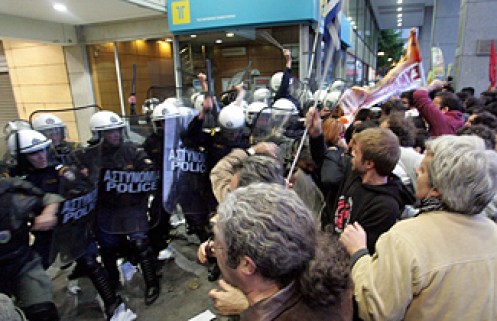
Clashes erupt as Greek bailout deal nears
news.smh.com.au
JOHN HADOULIS
April 30, 2010 –
Greek police clashed with protesters Thursday as the troubled nation came under intense pressure to force through extra cuts in return for a giant bailout deal said to be just days away.
Police fired tear gas at hundreds of demonstrators trying to approach the finance ministry in Athens in protest at austerity cuts aimed at reducing Greece’s budget deficit, which has ignited Europe-wide fears.
« Around 500 people were demonstrating and some of them tried to break through a police cordon guarding the ministry, » a police source told AFP. Further clashes erupted outside parliament, an AFP photographer said.
Greece is bracing for a wave of strikes and work stoppages in the coming days as talks on a bailout from Europe and the International Monetary Fund come to a head, including a general strike on May 5.
Prime Minister George Papandreou meanwhile warned Greece was in « a battle for survival » and would complete talks on getting tens of billions of euros (US dollars) from the EU and IMF « in coming days. »
« We will do whatever it takes to save the country, » he said.
The bailout is deeply unpopular in Greece because of the harsh conditions that many believe will be imposed on ordinary people. But the government says it needs the money by May 19 in order to avoid a devastating debt default.
Investors for their part have given Greece some respite on the financial markets after the EU’s commissioner for economic and monetary affairs, Olli Rehn, said the marathon talks with Greece were « about to conclude. »
New signs that Germany could back the deal also helped global stocks and the euro stabilise after days of losses caused by the demotion of Greek debt to « junk » status and the downgrading of Portugal and Spain’s credit ratings.
Greek shares jumped 7.14 percent by the close of trading and the interest rate that Greece has to pay to sell new debt fell back to below 10 percent, although yields on a two-year bond were still high at more than 12 percent.
US President Barack Obama and German Chancellor Angela Merkel earlier urged action by Greece to control spending as well as international support, as officials warned the Greek drama could spark a wider global conflagration.
Greece has asked the EU and IMF to activate a three-year rescue package worth 45 billion euros (60 billion US dollars) this year alone as it faces a May 19 deadline to repay nine billion euros in old debts.
Germany has balked at has balked at leading Europe’s rescue effort, with Merkel facing a key regional election on May 9 and bailing out Greece hugely unpopular in Europe’s biggest economy.
Greek trade union officials voiced outrage at the conditions for the loans after a meeting with Papandreou, saying the EU and IMF had asked Greece to save 25 billion euros in the next two years in return for the loans.
The IMF and the EU have demanded that Greece shave off by next year 10 percentage points from a public deficit that reached 13.6 percent of output in 2009, a top union official said on condition of anonymity.
Athens was also asked to get rid of 13th and 14th month bonuses for public sector workers and pensioners and raise the value-added tax, the official said.
Ilias Iliopoulos, secretary general of the ADEDY public workers union, said the conditions being demanded for the money constituted « extremely rough measures which go against development and will lead to recession. »
The unions have called a new general strike for Wednesday in protest.
The EU’s Rehn, however, insisted that the EU aid would be conditional on « implementing the decisions required at every stage to meet the conditions of fiscal consolidation and structural reforms. »
French President Nicolas Sarkozy pledged solid backing for Athens.
« France is fully determined to support the euro, and to support Greece, » Sarkozy told AFP and French newspaper Le Parisien.
German central bank chief Axel Weber said Greece must be rescued to stop the debt crisis spreading to other parts of the euro area with « extremely negative consequences, » Weber told the Bild daily.
Weber said the effects of letting Greece default were « incalculable. »
Following talks with the IMF also on Wednesday, two German lawmakers said the total loans could run up to 120 billion euros over three years.

Incidents lors d’une manifestation à Athènes
AP
29/04/10
ATHENES— De brefs incidents ont opposé des policiers à des enseignants qui manifestaient jeudi à Athènes devant le ministère grec des Finances, à l’heure où le pays tente de sortir une grave crise financière.
Des policiers anti-émeutes ont dispersé plusieurs dizaines de protestataires impliqués dans les heurts.
Plusieurs syndicats, craignant la perspective de nouvelles mesures d’austérité pour faire face à la crise, appellent à une grève générale le 5 mai. AP








 anthropologie du présent