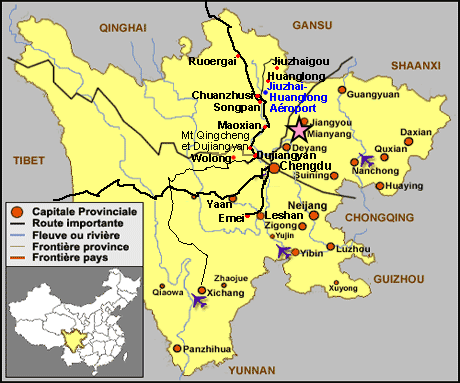
Violente resistance au barrage de Pubugou 瀑布沟大坝 dans le Sichuan 四川 – avril 2010
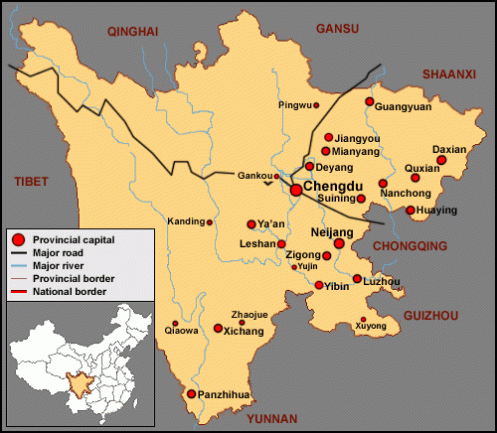 瀑布沟大坝
瀑布沟大坝

四川
Violence erupts at Chinese dam: Exclusive Report from Probe International
ProbeInternational.org
Monday, April 26, 2010
Violence erupts at Pubugou dam in China’s Sichuan province as authorities try to move people; homeowners threatened to blow themselves up if police move in to demolish homes.
In a last ditch effort to fill the controversial Pubugou dam reservoir in China’s Sichuan province, armed police and firefighters, riot vehicles and excavators were called to the scene in Hanyuan County to force holdout homeowners to evacuate houses slated for demolition.
According to first hand reports, on the evening of April 24, a large number of police arrived and surrounded homes owned by Luo Qihui and two other households. The owners of the houses refused to leave and issued desperate threats they would ignite gas cylinders and blow themselves and their homes up if forced out. Hundreds of villagers gathered to show their support, shouting in protest, insisting that the government should deal with their neighbours justly.
The confrontation between villagers and the police lasted until 6 a.m. the next day, April 25. The houses owned by Luo Qihui and two other households were dismantled. Mr. Luo was detained and charged with « violence against the law. » Three other families involved in the stand-off were sent to Liping village for resettlement.
One day earlier, in another incident, Yang Sijiang, a villager from nearby Maiping Village, shut the door of his home when demolition officials and police from a local authority arrived, and then retreated to his roof, carrying a gas tank. Yang Sijiang warned authorities he would ignite the gas if anyone dared touch his house.
According to local villagers, homeowners have had no choice but to respond with drastic measures to the coercive demolition of their life’s belongings by the authorities. Some migrants were also injured after violent clashes with police as a result of these incidents, and several villagers remain hospitalized.
Since the beginning of this year, forced migrants unhappy with the compensation offered for their homes, have refused to move. Nevertheless, the demolition of houses has escalated, leaving hundreds of people displaced.
The Pubugou dam has been the scene of violent public opposition from the get-go. In 2004, a 10,000-strong demonstration against the dam was brought to a halt by the People’s Liberation Army after protesters were fired on. Many protesters were arrested and one executed.
Due to the level of resistance, and in an attempt to fill the Pubugou Reservoir to its normal level of 850 metres above sea level, Hanyuan County authorities in Sichuan Province have resorted to more and more coercive measures in an effort to force those remaining from their homes.
The Pubugou dam is on the Dadu River, a Yangtze tributary. The dam stands 186 meters tall, boasts a storage capacity of 5.39 billion cubic meters and an installed capacity of 3.3 million kilowatts. The dam reservoir’s normal water level of 850 meters above sea level and maximum water depth of 180 metres, marks the Pubugou as the largest hydro dam in a roster of 24 forming a cascade along the Dadu valley. The Pubugou will flood 15 towns or townships, 48 villages, including the county seat of Hanyuan, 50,000 mu (1 mu=1/15 ha) of farmland, and more than 100,000 people from their homes.
The area upstream of the dam that is being flooded is not only good farmland, but also contains numerous Paleolithic cultural sites, known as « Fulin Culture, » discovered in the 1960s. Other sites of significant archeological value unearthed in recent years will also be flooded, including Neolithic cultural sites at Maiping Village, Majiashan, among others. Both experts and local people have called on authorities to protect these precious cultural relics.
China is seeing more and more in the way of desperate standoffs between citizens and authorities, as public and private developers—using corrupt means, and the absence of property rights and the rule of law—eject people from their homes. According to a 2008 report in the Chinese news weekly magazine Outlook Weekly, social mass incidents, such as the standoff at Pubugou, have risen from 8,700 in 1993, to 87,000 in 2005, to more than 90,000 in 2006. “And the number keeps climbing, » says the magazine.
The filling of the Pubugou dam reservoir began in 2009 and reached 790 metres above sea level by the end of last year, powering two generating units. Authorities planned to fill the reservoir to its normal water level of 850 meters and put all of its generating units into operation this year.

Nail house families move after showdown
GlobalTimes.cn
April 27 2010]
By Deng Jingyin
After trying for several years to force a local government in Sichuan Province to leave his family’s home alone, Luo Qihui, 36, poured gasoline all over his body Saturday and threatened to light himself on fire soon after construction workers arrived to demolish his property.
Luo, his two brothers and other family members wanted to stop the Pubugou Hydropower Station from passing through their home. The water level is expected to reach 850 meters this year and part of Dashu township in Ya’an may be flooded.
Luo’s brother, Luo Qidian, 41, plus the eight other family members, were asked to follow about 100,000 other villagers out in 2008 to make way for the project.
They declined. At 9 am Saturday, trucks and excavators surrounded their home.
The three brothers hung several bottles of gasoline outside their home, and placed gas tanks on the roof, according to Luo’s older brother.
One of the three went an extra step.
« My youngest brother held a bottle and poured the gasoline over his body to warn the police to go away from us. We had no choice but to resist with our life and even death, » Luo Qidian told the Global Times Monday.
The younger brother was later detained.
At about 5 am Sunday, both sides reached an agreement. The authorities promised to pay a total of 90,000 yuan ($13,181), much more than the 3,000 yuan ($439) they offered to pay each of the three families. They originally asked for 150,000 yuan ($21,969) for each family.
In addition, each of the three brothers got an apartment in Jiuxiang township. And each person was allocated 1/4 acre of land, much less than the land they had before.
Li Hong, the township chief, said the protestor was detained because he broke a law.
« They were not satisfied with the compensation, but now we have reached a consensus and they agreed to move, » Li told the Global Times Sunday.
The family still held mixed views Monday because they would not be able to earn the same living through farming near their new homes.
The new home sits at an elevated level and is not so suitable for rice, garlic, or peppers, which they grow and sell at local markets.
The project began in 2004 and was halted a year later due to protests from local residents.
After the government promised to compensate them, things moved along in 2006.
After stalling for two years, the Luo family finally moved on Sunday. But they became popular for their brave attitude as hundreds of villagers gathered to watch police and workers surround the family.
A local resident, who refused to be identified, told the Global Times that other villagers were surprised at night.
« Many demolitions were carried out that way and some people got injured in the conflict, » the villager said.
The national government has introduced regulations and rules to curb aggressive demolitions that have led to unrest and even deaths. However, some local governments found themselves in a dilemma because some government projects to boost economic development sometimes left local residents no choice but to abandon their longtime homes.
According to Li, the township chief, the hydropower project is listed as a national key project, with the largest storage capacity and maximum power generation capacity along the Dadu River. However, 15 townships, 48 villages and Hanyuan county were affected by the project.
« Many people couldn’t understand the policy or even misunderstood it, which increased the difficulty in carrying out our work, » Li said, declining to confirm the villager’s allegation about the forced demolition.
Informations
The Pubugou Dam is a large hydroelectric dam on the Dadu River, a tributary of the Yangtze River in Sichuan Province (located in southwestern China). The total generating capacity of the project is 3,300 MW. Construction started on March 30, 2004 and is scheduled for completion in 2010.[1] In 2004, the construction site was overrun by up to 100,000 protesters, though the only eventual result was the delay of construction by one year. The protests were about evictions stemming from planned flooding.
Rappel 2004
Violentes émeutes dans la campagne chinoise
Liberation.fr
08/11/2004
Plusieurs morts dans le Sichuan, où des milliers de paysans sont opposés à la construction d’un barrage.
Le chef du Parti communiste chinois dans la province du Sichuan, Zhang Xuezhong, a senti de près le souffle de la révolte paysanne. Le plus haut dirigeant de cette province de 100 millions d’habitants, dans le sud-ouest de la Chine, a été retenu en otage vendredi par des milliers de paysans qui protestaient contre la construction d’un barrage hydroélectrique et demandaient de plus fortes indemnisations. Des affrontements avec des policiers armés auraient fait plusieurs morts, selon des informations publiées dans la presse de Hongkong, mais totalement passées sous silence en Chine continentale.
Service d’ordre. De tels incidents sont fréquents dans les campagnes chinoises, plus souvent du domaine de la jacquerie que de la révolte ; mais c’est la première fois depuis de longues années, semble-t-il, qu’un cadre communiste aussi haut placé doit subir la colère de la foule. Un secrétaire provincial du PCC ne se déplace pas sans un important service d’ordre et un rituel quasi impérial, rendant d’ordinaire peu probables les protestations sur son passage.
La colère des paysans de la région de Hanyuan dure depuis plusieurs mois et s’est exacerbée, ces derniers jours, avec la perspective de la mise en eau du barrage de Pubugou. Selon la presse de Hongkong, les manifestations ont rassemblé des dizaines de milliers de personnes. Les protestataires réclament l’intervention de Pékin pour obtenir de meilleures conditions d’indemnisation, une demande classique en Chine, où le «centre» est considéré comme l’arbitre des conflits locaux.
«Le gouvernement n’a pas su tirer les leçons du barrage des Trois Gorges», souligne un expert des questions sociales. Comme dans la région du plus grand barrage du monde, en effet, des dizaines de milliers de paysans doivent céder leurs terres mais s’estiment d’autant moins bien traités qu’une partie des sommes qui leur sont destinées disparaissent dans la corruption des cadres. Une récente étude concluait que près des deux tiers des 16 millions de paysans déplacés ces dernières décennies dans le cadre du gigantesque programme hydroélectrique chinois ont été réduits à la pauvreté.
Virulence. La nouveauté, cette fois, tient à l’ampleur et à la virulence de la révolte. Elle montre à quel point la question de la confiscation des terres, à la campagne ou dans les villes, constitue une source considérable de mécontentement. De très nombreuses manifestations accompagnent les saisies de terres pour des projets d’infrastructures ou immobiliers. Des saisies bien souvent abusives et spéculatives, comme l’a montré un énorme scandale à Shanghai, qui a entraîné la condamnation à une peine de prison du plus grand promoteur immobilier de la métropole.
Dans les campagnes, le mécontentement est d’autant plus vif que le niveau de vie a stagné, voire régressé certaines années, quand celui des villes grimpait en flèche. Le vice-ministre chinois de la Santé a reconnu, la semaine dernière, que la moitié des 750 à 800 millions de paysans chinois étaient privés d’accès à des soins médicaux, faute d’argent.
Avertissement. Une semaine après les violents affrontements communautaires du Henan, entre paysans musulmans et Han (majoritaires dans la province), la révolte du Sichuan constitue un avertissement à un pouvoir soucieux de stabilité. Pour les lointains héritiers de Mao, le spectre du soulèvement des campagnes est lourd de sens. Au moins, avec le témoignage du secrétaire du parti du Sichuan, disposera-t-il d’un écho direct de l’état d’esprit du monde rural aujourd’hui…








 anthropologie du présent