
Emeute à Jakarta – avril 2010

Protesters Rally in Indonesia After Deadly Clash
ASSOCIATED PRESS
April 15, 2010
JAKARTA, Indonesia (AP) — Hundreds of demonstrators descended Thursday on Jakarta’s City Hall to demand that the city’s public security force be disbanded following bloody clashes over a Muslim tomb that left two dead and 156 wounded near the Indonesian capital’s main seaport.
The protesters chanted »God is Great » and some threw rocks at a billboard bearing the photo of Jakarta’s governor. More than 1,000 police were deployed to the area, which is near the U.S. Embassy in central Jakarta, city spokesman Cucu Kurnia said.
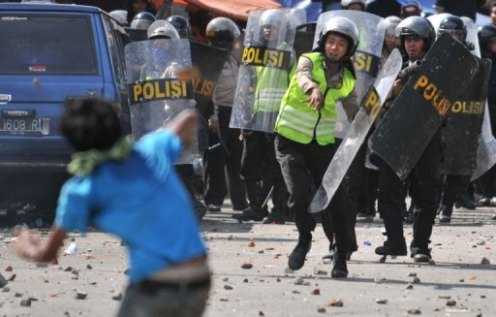
On Wednesday, protesters wielding machetes, sticks and petrol bombs clashed with city security officers and riot police in running battles near the port outside the city the center. Police used tear gas, rubber bullets, water cannons and batons to beat back the demonstrators.
The protesters believed the city security officers were trying to remove the tomb of an Arab cleric who helped spread Islam in North Jakarta in the 18th century. The tomb is on land owned by the state-run seaports operator Pelindo II, and the area is home to many squatters.
The fighting left the port area looking like a war zone, with blood and broken glass on the streets and dozens of vehicles burning. It was Jakarta’s worst civil unrest in years.
Two people were killed and 156 were wounded, according to Jakarta police spokesman Col. Boy Rafli Amar. Some of the injuries were severe, including an officer who had his stomach slashed and another whose hand was chopped off.
»We did not intend to demolish the tomb, but we want to evict the illegal settlers. In fact, the local government wanted to preserve or restore the tomb, » Kurnia said.
The protesters believed otherwise and attacked the city security officers, sparking running battles that lasted several hours. A second round of intense fighting that also involved the national police broke out hours later outside the hospital where the wounded had been taken. By nightfall the clashes had largely stopped, but the protesters still controlled the area.
City security officers differ from the national police in that they don’t carry guns and don’t have as many powers. They are often poorly paid and poorly trained and are regularly accused by rights groups of abuses against minorities and the poor.
The area remained tense Thursday, and customs officials said the main international container terminal would remain closed until the situation returned to normal.
»We had to defend ourselves and the legacy of our history, the grave of our Islamic hero, and casualties could not be avoided, » Abdul Qadir Assegaf, a religious leader in the port community, said Thursday. »We will continue to protect the tomb and our rights until our last blood. »
He accused the city officials of using excessive force and said their actions »showed us how arrogant city security officers can be in enforcing unpopular rule. »
Kurnia said authorities were surprised by the response of those living near the tomb.
»The mass anger was horrible and beyond our expectation for what was a simple case, » he said.
Kurnia said members of a hard-line Muslim group were involved in the fighting and that they far outnumbered local protesters, but declined to name the group. He may have been referring to the Islamic Defenders Front, an organization with a long history of vandalizing nightspots, hurling stones at Western embassies, and torching buildings belonging to rival groups or sects it considers heretical.
President Susilo Bambang Yudhoyono expressed concern and regret over the clashes and ordered an investigation. He also called on Jakarta’s governor to meet all parties involved and put any evictions in the area on hold until a solution can be reached.
 Two killed, dozens injured in clashes in Indonesia
AFP
15 04 2010
JAKARTA — Two people were killed and dozens injured in clashes in Jakarta on Wednesday between security forces and people protesting at the bulldozing of a cemetery containing the remains of a Muslim scholar.
Police fired tear gas, pepper bullets and water cannon to disperse dozens of men armed with machetes and sticks who had massed in the clashes that lasted all day, witnesses said.
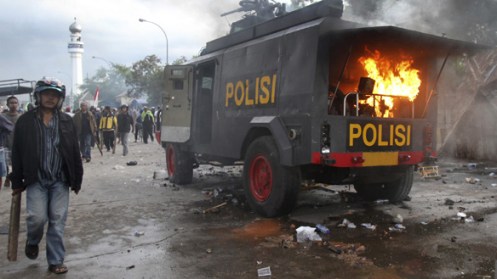
It left the area near Jakarta’s international port looking like a war zone, with blood-stained streets and burning police vehicles sending black smoke into the sky.
« Two people died and more than 50 were injured… the number may rise, » national police spokesman Zainuri Lubis told reporters.
City spokesman Cucu Ahmad Kurnia earlier gave a higher injured toll.
« Seven people have been critically injured… one (security officer) had his hand cut off and another had his stomach ripped out with a machete, » Kurnia told AFP.
« Another 83 people had serious and light injuries, mostly head injuries from being pelted with rocks, » he added.
Most of the injured were members of the security forces, he added.
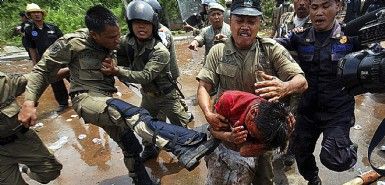
An AFP photographer saw members of the public order force — which is different from the regular police — beating, clubbing, kicking and stomping on injured protesters.
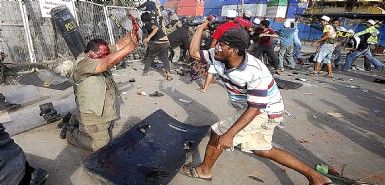
Demonstrators were also seen hitting security officers with sticks and stamping on those who fell.
Kurnia described the situation as « anarchic » and promised to negotiate with local residents about changes to the cemetery.
« They’ve misunderstood… we’re not removing the tomb but only the old buildings and gate, » he said.
« We’ve stopped the demolition and will resume negotiations with demonstrators another time. »
Protesters say the revered Habib Hasan bin Muhammad Al Hadad, also known as Mbah Priok, helped spread Islam in North Jakarta in the 18th century, according to the Jakarta Globe newspaper.
Visitors to his tomb believe their wishes will be granted if they pray there.


Two dead in worst Indonesian violence for years
Timesonline.com
April 15, 2010
Hundreds of rioters armed with machetes, clubs and petrol bombs have clashed with riot police over a sacred Muslim cleric’s tomb in Indonesia, killing two policemen and leaving at least 145 wounded, some critically.
Indonesian president Susilo Bambang Yudhoyono immediately ordered an investigation into the worst civil unrest for decades in Jakarta, the Indonesian capital, which left one police officer with his hand sliced off.
The riots began over an apparent misunderstanding over the fate of the tomb of Habib Hasan bin Muhammed Al Hadad, a revered 18th century Arab cleric known to Indonesians as Mbah Priok.
Shortly after dawn members of the public order branch of the police, known as Satpol, arrived to evict squatters and remove illegal buildings on the land surrounding the tomb. But residents of Tanjung Priok port, where the tomb is located, believed the police and city officials were there to tear it down and attacked them, spurring running battles that lasted for several hours.
Around 2,600 police and security forces used tear gas, rubber bullets, water cannons and batons to beat back the protesters who retaliated with rocks and petrol bombs.
Television footage showed chaotic scenes. Satpol officers armed with shields and batons were filmed repeatedly beating a resident, while other images showed residents kicking and throwing rocks at an injured police officer lying on the ground.
A reporter said he saw several protesters, including teenagers, being beaten by police and dragged away bleeding.
By nightfall the situation was so tense that 500 security forces had to be evacuated to a nearby police station because leaving by road was seen to be too dangerous. Just after midnight, with the rioters’ numbers swollen to 1000, they attacked and set fire to five police cars parked outside a hospital where the injured had been taken, and patrolled the surrounding hills searching for wounded policemen.
“The mass anger was horrible and beyond our expectation for what was a simple case,” said Jakarta city spokesman Cucu Kurnia. He said seven of the 130 wounded were in critical condition, including a security officer who had his stomach slashed open with a machete and another whose hand was cut off.
Mr Kurnia insisted the officials and police were not there to destroy the tomb.”We did not intend to demolish the tomb, but we want to evict the illegal settlers,” he said.
Both sides blamed the other for the violence. Demonstrators claimed that Satpol officers targeted two teenagers who broke from their ranks, while police claimed the protesters attacked first.
But officals joined protesters in accusing Satpol of excessive violence. Last week, a number of organisations had demanded that the controversial force be disbanded, blaming it for repeated human rights violations.
Mr Kurnia told a news conference that Satpol officers could not restrain themselves after they were attacked. Wanda Hamida, a member of the Jakarta Provincial Legislative council, said that Satpol officers were out of control, even attacking city officials. “If a (council) member can get punched by Satpol, how about the people? Satpol was just so brutal,” Ms Hamida told the Jakarta Globe newspaper.
Local resident Amin told the newspaper he and his father and brother were delivering water to friends guarding the tomb site when they were attacked by police officers. He said first his father was punched and when he tried to protect him he too was attacked. “They pulled off my clothes until I was almost naked. Then they tied a rope around my hands so I could not do anything while they kicked and punched me,” he said.
But other rioters, armed with wooden sticks, beat any wounded police officers they could find in the streets while others searched cars in the area for fugitive police, ordering motorists to show their identity cards.
By early this morning, relative calm had settled over the area.
Mr Yudhoyono has ordered Jakarta’s governor to meet all parties involved and put any evictions on hold until a solution can be reached
Indonésie: deux morts dans une manifestation à Djakarta
ASSOCIATED PRESS
15 04 2010
DJAKARTA, Indonésie — Des manifestants armés de machettes, de bâtons et de cocktails molotov ont affronté la police anti-émeute indonésienne mercredi sur la tombe d’un dignitaire musulman, située près du port de la capitale Djakarta, faisant deux morts et 130 blessés.
Le bilan des victimes pourrait augmenter, a estimé le porte-parole de la police nationale, le colonel Zaenuri Lubis. Ce sont les affrontements les plus violents de ces dernières années.
Parmi les 130 blessés, dont certains seraient dans un état critique, se trouvent 79 membres de la sécurité, a déclaré le chef de la police de Djakarta, le général Wahyono.
Quelque 2.000 officiers de sécurité municipaux et 600 policiers ont tenté de repousser avec des gaz lacrymogènes, des balles en caoutchouc, des canons à eau et des matraques les manifestants réunis près du port de Tanjung Priok dans le nord de Djakarta, a déclaré le porte-parole de la ville Cucu Kurnia. Cinq cents manifestants étaient présents selon la police.
Les manifestants se sont réunis quand ils ont vu des centaines d’officiers de sécurité approcher, avec des pelleteuses, de la tombe d’un dignitaire arabe ayant contribué à la diffusion de l’Islam dans le nord de Djakarta au XVIIIe siècle.
Les manifestants soupçonnent les responsables de la municipalité de vouloir déplacer la tombe, qui est située sur des terres appartenant à l’opérateur portuaire Pelindo II.
« Nous n’avons pas voulu démolir la tombe, mais nous voulons expulser les squatters. En fait, le gouvernement souhaitait préserver ou restaurer la tombe », a répondu le porte-parole de la municipalité.
Le président indonésien Susilo Bambang Yudhoyono a exprimé son inquiétude et son regret face aux affrontements et a ordonné l’ouverture d’une enquête.
Hard Lessons From Tanjung Priok Riot
Thejakartaglobe.com
April 14, 2010
Land ownership is often complicated, legally convoluted and an emotionally stressful issue in Indonesia, especially if the land in question is in dispute. Throw historical and religious significance into the equation and you have the recipe for an explosive cocktail.
It should then come as no surprise that the attempt by public order officials — already coming under mounting criticism for the violence they are often linked with — to curb illegal buildings on a piece of land in North Jakarta led to one of the worst cases of mob violence seen in the capital in recent years. But there can be no excuse for public violence, no matter how sensitive the issue.
The clash between hundreds of residents guarding the tomb of an 18th century Muslim leader — which they wrongly believed authorities were there to excavate — and several hundred officials left 144 people injured. The City Council has accepted some of blame for the clashes, saying its officials were unreasonably harsh in efforts to clear the area.
There are lessons for both sides from this episode. Public order officials have to learn to be more sensitive when dealing with residents of the city. The police, in fact, have over the years learned how to deal with such situations in a firm but humane way. The city administration should follow the example of the police by negotiating and talking calmly before resorting to force as the final option.
On the other hand, the public must learn to respect the law. The land in question had been transferred to the state in 2007 and the heirs of the deceased had been adequately compensated. They had in fact ignored three warning letters in February and March to vacate the land but ignored the notices. If they have a valid grievance, they should seek justice in the courts.
Public disorder should not be tolerated, while officials must learn to deal with any dispute fairly but firmly. Often violence can be averted if everyone keeps their emotions in check, which unfortunately in the Tanjung Priok case did not happen. It is important that the officials quickly diffuse the situation by being rational. If mistakes have been made and if officers have crossed the line, the city administration should apologize and take remedial measures.
Civilians who took matters into their own hands and provoked the emotional outburst should also be punished. If they broke the law and attacked police and public order officials, they must be arrested and brought to trial.
To avoid future similar incidents, the city administration must draw up clear guidelines for its officers when faced with possible violence on the ground. The officers must be taught how to act firmly but with restraint unless provoked or attacked. Hopefully calmer heads will rule in the future.






 anthropologie du présent