
Affrontements au Caire – avril 2010
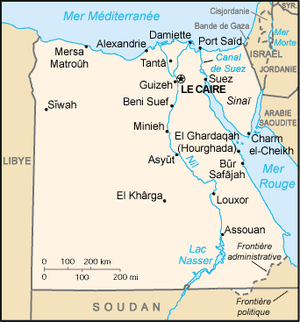
Egypt police violently disperse pro-reform protest
AP
By PAUL SCHEMM
6 04 2010
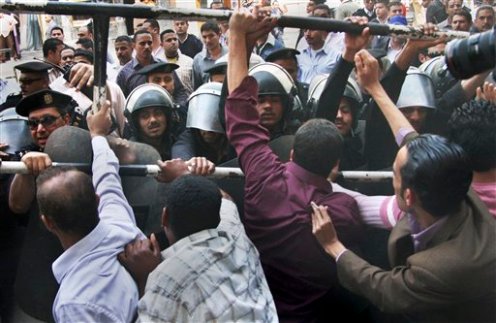
CAIRO — Egyptian police on Tuesday beat and dragged off protesters to disperse a gathering of a few dozen in downtown Cairo calling for constitutional reforms and fairer presidential elections.
Several dozen protesters managed to briefly assemble in front of the upper house of parliament chanting « freedom » and calling for changes in the constitution before plainclothes police and anti-riot squads attacked them.
Plainclothes officers dragged demonstrators out of the crowd and threw them into waiting trucks. Young women among the protesters collapsed on the ground, weeping after they were attacked and their friends were taken away.
Police later pursued smaller groups of protesters through Cairo streets, knocking them down and arresting them if they attempted to chant. A security official, speaking on condition of anonymity because he was not allowed to talk to the media, said around 60 people were detained.
Demonstrations are illegal under Egypt’s three-decade old emergency law. Media crews were also attacked and photographers’ cameras were confiscated.
« It is an insulting image for Egypt, » opposition politician Ayman Nour said about the heavy security presence ahead of the rally. « Hundreds of soldiers are denying the right of a few dozen citizens trying to express their desire to amend the constitution. »
When Nour tried to leave his downtown office to join the demonstration, riot police stopped him and arrested several of his supporters. Nour, who came a distant second in 2005 elections to President Hosni Mubarak, recently announced his campaign program for the 2011 presidential race.
Nour is not actually eligible to run this time around, because he was convicted of forging party documents after the last election — charges he says were trumped up.
Tuesday » he protest was organized by the April 6 youth movement that calls for political reforms and backs the unofficial candidacy of former U.N. nuclear watchdog chief and Nobel Peace Prize laureate Mohammed ElBaradei. He did not attend Tuesday’s protest.
ElBaradei has made constitutional changes to allow fairer elections the centerpiece of his recently announced reform movement. His return to Egypt and his call for an open political process has galvanized the country’s scattered and divided opposition. ElBaradei is also not eligible to run for president under the current constitution.
Mubarak has ruled Egypt since 1981 and only introduced multi-candidate presidential elections in 2005. His ruling party has kept a stranglehold on the country’s politics.
The government had banned the Tuesday protest, warning in a written notice against disturbing traffic and peace.
Security forces were especially sensitive to members of the media attempting to record the demonstration and went after them. Several heavyset plainclothes policemen tackled and beat an American freelance photographer when he tried to take pictures of the rally, taking his camera and briefly detaining him when he asked for it back.
Plainclothes officers also converged on a man filming the events and when he wouldn’t surrender his video camera, hauled him over an iron traffic barrier and slammed him to the ground.
The April 6 youth movement was formed through online social networking sites such as Facebook, taking its name from a general strike it organized in 2008. It periodically organizes pro-reform protests.
Egypt is to hold parliamentary elections this year and presidential elections in 2011. Amendments to the constitution passed in 2007 restrict candidates to the presidential election to only a few members of approved political parties.
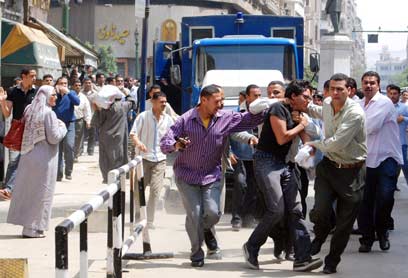
Dozens beaten, arrested in protests against Mubarak
Reuters
06. 04. 10
Hundreds of riot police deployed in Cairo during rare pro-reform demonstration in lead-up to Egypt elections
Egyptian protesters demanding an end to President Hosni Mubarak’s 30-year rule scuffled with security forces on Tuesday and dozens were detained, witnesses and security sources said.
« Down, down, Hosni Mubarak, » a group of more than 200 chanted as they tried to gather in central Cairo’s Tahrir Square. Police hauled away a group of about a dozen protesters, Hundreds of riot police were also stationed across the capital, encircling small groups of protesters as they gathered to converge on the centre.
Police beat some with sticks and dragged dozens away, witnesses said. They also chased off reporters and seized cameras being used by media trying to cover the protest. Such demonstrations are rare in Egypt, an important US ally in the region, and are usually swiftly quashed by security forces.
« We are seeking to do away with injustice and other bad things, » screamed Meena Samir, a student at Cairo University.
Call for political freedom
The pro-reform group behind the protest, the Sixth of April Youth, is seeking constitutional amendments and an end to an emergency law that sanctions indefinite detentions. Egypt holds a parliament election this year and a presidential vote in 2011.
Mubarak’s National Democratic Party is expected to win an overwhelming majority in parliament. But human rights groups, which have long complained of manipulation of Egyptian voting, are calling for international oversight of the elections.
Mubarak, 81, has not said whether he will run for a sixth presidential term but, if he does not, many Egyptians believe he will try to hand power to his politician son, Gamal, 46.
Rules outlined in the constitution make it almost impossible for any candidate to mount a realistic challenge for the presidency without the backing of Mubarak’s ruling party.
« What we are calling for is political freedom for Egyptians through peaceful means. Our aim is to instigate political movement among the people to demand their rights, » Omar Ali, a April 6 movement organiser, told Reuters before the protest.
‘Shows fear of ruling party’
One group of more than 20 protesters that included opposition politician Ayman Nour, who came a distant second in the 2005 presidential race, was blocked by security from reaching the square, witnesses said.
A security source said about 60 people had been detained in central Cairo for demonstrating without a permit. Men in plain clothes with guns in holsters hauled some demonstrators away.
« If they want to take people, they have to do it in a civilized way. Nobody has a weapon… We are trying to express our opinion, » said Salma Gaafar, one young protester.
After the protest, April 6 leader Ahmed Maher said the group would file a lawsuit against the Interior Ministry. « This shows the fear of the ruling (party) of any opposition – despite its claims that it allows democracy, » he said.
Earlier on Tuesday, police detained seven students as they headed to central Cairo from Helwan University on Cairo’s outskirts. Sixteen students were held as they made their way into the city from south of Cairo, a security source said.
The Arabic satellite channel Al-Jazeera reported that Egyptian police confiscated tapes from one of its TV crew covering the demonstrations in Cairo.
The April 6 group, formed after protests over surging prices in 2008 turned violent, and another group called Kefaya (Enough) are Egypt’s two active anti-government movements. The main political opposition group, the Muslim Brotherhood, has a minority in parliament but has tended to avoid street protests.
Tuesday’s march was supported by Nour’s liberal Ghad (Tomorrow) opposition party.
Des opposants se heurtent à la police dans le centre du Caire
Reuters
6 avril 2010
LE CAIRE – Des Egyptiens appelant à la fin du régime du président Hosni Moubarak ont manifesté mardi au Caire et se sont heurtés à la police anti-émeute, qui a procédé à des dizaines d’arrestations, rapportent des témoins et des sources au sein des services de sécurité.
Tentant de se réunir sur la place Tahrir, dans le centre de la capitale égyptienne, environ 200 personnes scandaient « A bas Hosni Moubarak ». La police a emmené une dizaine de manifestants, qui criaient « liberté, liberté » devant le parlement.
Des centaines de policiers anti-émeutes avaient pris position dans les rues du Caire, et encerclaient les groupes de manifestants qui tentaient de se diriger vers le centre-ville.
Plusieurs d’entre eux ont été frappés à coups de matraque par des policiers, qui ont également poursuivi des journalistes et confisqué plusieurs caméras de reportage.
La chaîne de télévision panarabe Al Djazira a dit que la police avait confisqué les enregistrements de l’une de ses équipes de reportage couvrant les manifestations.
Le groupe réformateur à l’origine des rassemblements, la Jeunesse du Six-Avril, demande des amendements constitutionnels ainsi que la fin du régime d’urgence qui permet les détentions provisoires sans limitation de durée.
Un groupe d’une vingtaine de manifestants, dont l’opposant Aïmane Nour, arrivé en deuxième position à la présidentielle de 2005, a été empêché d’atteindre la place Tahrir, ont rapporté des témoins.
Selon les autorités, une soixantaine de personnes ont été arrêtées dans le centre du Caire pour avoir manifesté sans autorisation. Plusieurs arrestations ont été effectuées par des personnes en civil portant un pistolet au côté.
Le chef de la Jeunesse du Six-Avril, Ahmed Maher, a annoncé que le groupe porterait plainte contre le ministère de l’Intérieur.
La Jeunesse du Six-Avril et le groupe Kefaya (« Assez ! ») sont les deux mouvements d’opposition les plus actifs en Egypte. Le principal parti d’opposition politique, les Frères musulmans, évite les rassemblements de rue.
Yasmine Saleh et Mohamed Abdellah, avec Marwa Awad. Gregory Schwartz pour le service français, édité par Gilles Trequesser




 anthropologie du présent