
Violentes manifestations en Russie – mars 2010
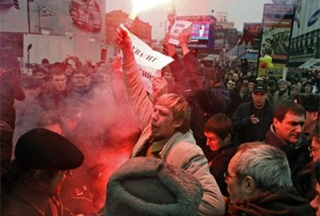
Russian police arrest anti-Putin demonstrators
presstv.ir
Sat, 20 Mar 2010
Police in
Moscow have dispersed a group of demonstrators, as thousands participated in a nationwide rally against the United Russia government and the Kremlin’s economic policies.
Around 50 rallies were staged across the country on Saturday called by a coalition of opposition groups that declared a national « Day of Anger. »
The demonstrators are decrying the downward spiral in living standards under Prime Minister Vladimir Putin since the economic crisis, as well as rising unemployment and transport taxes.
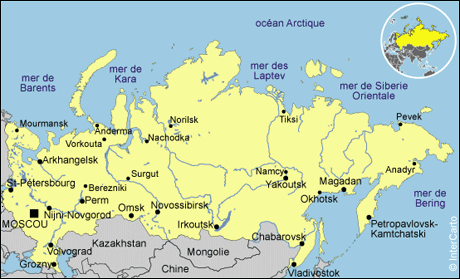
In the eastern port city of Vladivostok, at least 1,500 people took to the streets to express their anger over the country’s economic situation, while another 1,000 in Saint Petersburg chanted slogans demanding Putin’s resignation.
The country is facing its worst economic slump in a decade and the Kremlin critics are blaming the prime minister for not taking steps in the direction of ending the crisis.
The public’s discontent was reflected in last week’s local elections. Putin’s United Russia party won the poll but support had visibly weakened since the financial downturn.
‘Day of Wrath’ brings Russians on to the streets against Vladimir Putin
The observer
Sunday 21 March 2010
Nationwide protests sparked by falling living standards and demanding the prime minister’s resignation have taken Kremlin by surprise
Thousands of people across Russia took to the streets yesterday demanding the resignation of Vladimir Putin, in the largest show of discontent since he came to power more than a decade ago.
Opposition movements called the nationwide « Day of Wrath » to express growing discontent at falling living standards following years of oil-fuelled growth. The protests followed weeks of sustained demonstrations across Russia that have riled a leadership that does not forgive displays of unrest.
Cries of « Freedom » and « Putin resign » filled the main square in Kaliningrad, where up to 5,000 people gathered in pouring rain. The Baltic territory, which is nestled between Poland and Lithuania and separated from the Russian mainland, has been the site of some of the largest protests to date.
« We want the government to start treating us like people, not like slaves, » said Kirill, a 22-year-old student. Protesters called for free elections and complained about widespread corruption, high unemployment and rising prices.
Russia’s first major anti-Putin demonstration was held in Kaliningrad on 30 January, drawing 12,000 people and shocking local leaders and the Kremlin. « It really surprised us, » said Konstantin Polyakov, deputy head of the regional parliament, or Duma, and member of the ruling United Russia party. « We didn’t think so many people would turn out, to be honest. » The Kremlin was obviously shaken, dispatching a high-level delegation to the Baltic exclave and firing its Kaliningrad adviser, Oleg Matveichev.
Saturday’s protest had been banned, and opposition leaders withdrew calls for an organised demonstration, fearing violence. Yet several thousand showed up anyway, organising through the internet and word of mouth.
« The general public in the regions is beginning to recognise that it is Putin who is actually to blame for various troubles they have – increased cost of living, communal tariffs, taxes and no growth in real wages, » said Vladimir Milov, a co-leader of Solidarity, an umbrella opposition movement.
Regional and local elections held on 14 March appear to support that theory. United Russia, the party created with the sole purpose of supporting Putin’s rule – he is currently prime minister – garnered unprecedentedly low results, losing its majority in four of eight regions and giving up the mayorship of Irkutsk, Siberia’s largest city, to a Communist candidate who took 62% of the vote.
In Kaliningrad, protesters wore badges criticising United Russia and held aloft mandarins, the fruit that has come to symbolise the region’s unpopular governor, Georgy Boos, a Muscovite appointed by Putin.
Few, even those in opposition, believe the Putin government will fall. « It will take time, » Milov said. « But just two years ago it would have been impossible to imagine mass demonstrations making political demands like the resignation of Putin’s government. »
A poll this month by Russia’s Public Opinion Foundation found that 29% of Russians were ready to take part in protests, up from 21% in February.
More than 1,000 people turned out on Saturday in the port of Vladivostok, where discontent has steadily grown since the government imposed a tax on imported cars. About 500 people rallied in Irkutsk and St Petersburg. Riot police broke up an unsanctioned rally in Moscow violently and arrested 50 activists. Authorities also shut down a website set up for the « Day of Wrath », http://www.20marta.ru, and in the northern city of Arkhangelsk an opposition leader was arrested and charged with theft.
In Kaliningrad, on the border with the European Union and far from the seat of power, the police presence was minimal, although agents in plain clothes roamed through the crowd.
« Our population is different from Russia, » said Polyakov, sitting in his office adorned with photos of Putin and President Dmitry Medvedev, in what is, technically, Russia. « Our people, especially the youth, travel more to Europe than to Russia. There’s no reason to go there. »
In an implicit criticism of Moscow politics, he added: « We’re more European – more relaxed, less eastern. And we’re more democratic. » Despite the protesters’ rhetoric, Polyakov argued that Putin’s popularity in the region remains high. His wife, Lyudmila, was born here and visits regularly.
But local authorities, acting in concert with Moscow, reacted with unusual harshness to Kaliningrad’s wave of protests. They banned a rally in the city centre, saying protesters could gather in a stadium on the outskirts instead.
In an ironic twist, the government has been forced to give in to opponents of liberal market reforms. Following the Kaliningrad protest, it has promised to slow the post-Soviet desubsidisation of utilities like heat and water. That will only widen a budget deficit expected to exceed 6% of GDP this year.
« The leadership is scared, » said Solomon Ginzburg, an independent deputy in the regional Duma. « I have been saying the Kaliningrad region is an indicator – in nine months, it will be all over Russia. »
Huge anti-government protests in Russia
March 21, 2010
Thousands of Russians voice their discontent with local and national government in the face of economic problems. Police in Moscow haul away demonstrators.
Reporting from Moscow
Thousands of demonstrators took to the streets across Russia on Saturday demanding the resignation of local and national leaders, including Prime Minister Vladimir Putin, over lingering economic woes.
A coalition of opposition groups, hoping to channel rising anxiety over unemployment and financial policy into anti-government activism, had called for nationwide protests under the slogan « Day of Wrath. »
In Moscow, Mayor Yuri Luzhkov’s government had banned the demonstration, and rows of riot police lined the perimeter of a bustling square in the city’s historic heart to prevent protesters from gathering.
Police pounced as demonstrators slipped from the crowds of bystanders to unfurl banners, light flares or erupt into slogans such as « Down with Putin. » Grabbing at limbs and clothes, they seized the demonstrators and dragged them, kicking and hollering, into waiting paddy wagons.
« Shame! Shame! » yelled the crowd as the police shoved the protesters into the vans. « Fascists! »
The opposition had applied for a permit but shrugged off the city’s denial. Because the Russian Constitution guarantees the right to assembly, they argued, they had no real obligation to ask the city’s permission.
« The Luzhkov government should resign, the Putin government should resign, » opposition leader Sergei Udaltsov told reporters. « We’ll hold our gathering here no matter what. »
A few minutes later, Udaltsov was shoved into a police vehicle.
There is little question that discontent is rising in Russia, pushed by lingering economic troubles. In a recent poll, the Public Opinion Foundation found that nearly a third of Russians said they were ready to protest against the government. They named their greatest sources of anger as financial problems, increases in prices, unemployment and poor performance by government housing and utilities services.
But Saturday’s demonstrations seemed to highlight the disarray of the opposition and its multitude of ideas and causes; complaints about local government and the federal government mingled.
Here in the capital, a 74-year-old retiree named Pelageya Matveyeva wandered amid the crowd.
« We are sick and tired of this kind of life, » she said. « Everybody’s complaining about the government because there is so much unemployment. In Soviet times, we didn’t have unemployment. We had our two hands, and we could work anywhere. »
« For three pennies! » snapped a passing woman who swept along in a fur hat.
Matveyeva frowned.
A man with dark hair leaned out the door of the police wagon to shout down to the gathered crowd. « I came here, and I wanted to fulfill my civic duty! » he yelled. « And they told me. . . . » Somebody yanked him back into the shadows of the wagon and slammed the door shut.



 anthropologie du présent