
Emeute à Kampala après l’incendie de tombes royales – mars 2010
[Youtube=http://www.youtube.com/watch?v=9K1LeIHz6Ig]
[Youtube=http://www.youtube.com/watch?v=51dtWqKWN-E]
3 dead in Uganda riots after tombs set alight
AP
17 03 2010
KAMPALA, Uganda — Ugandan security forces fatally shot three people in the capital Wednesday during clashes with rioters angry after the tombs of five traditional kings were destroyed overnight by fire, a tribal government official said.
Lubega Segona, minister of information for the Buganda kingdom, said three people were killed and several wounded by members of the presidential guard. He said the guards shot at angry members of the traditional kingdom who had tried to stop Ugandan President Yoweri Museveni from visiting the tombs.
« Those killed were among a crowd which was stopping the guards to enter where the tombs are located, » Segona said. « The guards responded by opening fire and killing three people and injuring several. »
Police Inspector General Kale Kaihura condemned the shootings and said police would investigate.
« I have instructed the criminal investigation department director to investigate all those who shot at people, » he said. « All those involved will be arrested and punished. »
In 1993, Museveni restored Uganda’s traditional kingdoms, which his predecessor had banned in 1967. But Museveni has been adamant that kings restrict themselves to cultural duties and keep out of politics.
Buganda’s leader, King Ronald Muwenda Mutebi II, declared five days of mourning after the building housing the kings’ tombs was destroyed by fire early Tuesday.
Museveni told the crowd that the government will help pay for the tombs’ reconstruction. Earlier Wednesday, angry protesters attacked policemen, firefighters and soldiers who attempted to approach the tombs.
One rioter said he suspected the government set fire to the tombs, a charge that a police spokeswoman denied.
« We know that the relationship between the central government and Buganda kingdom is not good, » said George Senvuma said, who is a member of the kingdom. « There is a possibility that government operatives set fire on the tombs. »
Police spokeswoman Judith Nanbakooba said hundreds of policemen were sent to the scene but could not approach the tombs for fear of being attacked.
« Those people do not want to see anyone in police or army uniform, » she said. « They have been beating up policemen and army men sent to keep law and order since last night. They even stopped firefighters from reaching the burning tombs. Only policemen in plainclothes can access the place. »
In September, riots broke out in Kampala when security agents clashed with Buganda members, leaving more than 20 protesters dead. The government had prevented a representative of the Buganda king from traveling to a region near the capital on « security grounds. » Many saw it as an insult to the king.
Deaths in riot after Uganda fire
aljazeera.net
Thursday, March 18, 2010
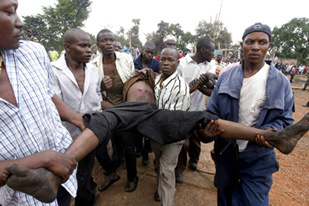
Three people have been killed during clashes between Ugandan security forces and rioters after a fire gutted the site of five royal tombs outside the capital, Kampala.
The country’s presidential guard opened fire at members of the Baganda ethnic group on Wednesday, after rioters tried to stop Yoweri Museveni, the Ugandan president, from visiting the destroyed tombs, officials said.
« Those killed were among a crowd, which was stopping the guards to enter where the tombs are located, » Lubega Segona, the minister of information for the Buganda kingdom, was quoted as saying by the Associated Press news agency.
« The guards responded by opening fire and killing three people and injuring several, » he said.
Kale Kaihura, the police inspector-general, condemned the shootings and said officials would investigate the incident.
« I have instructed the criminal investigation department director to investigate all those who shot at people, » he said.
« All those involved will be arrested and punished. »
Arson suspected
Security forces had earlier used tear gas to disperse members of the Baganda ethnic group angry at the destruction of the tombs of the country’s largest historic kingdom.
Malcolm Webb, a Kampala-based journalist, told Al Jazeera that the burial site of the traditional kings represented 200 years of the group’s cultural heritage.
He said members of the group suspect the fire was caused by arsonists.
Buganda is one of Uganda’s four historic kingdoms and the Baganda are the biggest ethnic group in the country.
The burial site of Kasubi, designated as a world heritage site by Unesco, the UN cultural agency, is an important tourist site housing the burial grounds of four former kings of Buganda. The last king was buried there in 1971.
Baganda have previously complained that the government has tried to expropriate the kingdom’s land and have been involved in disputes over the influence of Buganda’s traditional leaders.
A spokesman for the Buganda kingdom on Wednesday described the fire as « an attack on Buganda », whose people are concentrated in the south of Uganda and Kampala.
« This fire is very strange given what we [the Baganda] have been going through, » Peter Mayiga said without giving further details.
‘Firefighters obstructed’
Kale Kaihura, the chief of the Uganda police, refused to confirm reports that the blaze was started deliberately and said his officers were still investigating the cause of the fire.
He said however that firefighters had been prevented from reaching the site in time to put out the blaze before it gutted the burial site late on Tuesday.
« When the fire broke out, police were called in and got there in time but the fire brigade was obstructed by a hostile crowd, three trucks were damaged and a fireman injured, » Kaihura told the AFP news agency.
Wednesday’s violence triggered fears of renewed tension between the government and ethnic Baganda, who accuse the government of undermining their kingdom.
Last September, riots in Kampala left at least 17 people dead after the government prevented Ronald Muwenda Mutebi, the current Buganda king, from visiting a district near the capital.
The government said the district had its own traditional ruler and it did not owe allegiance to the king.
The king holds a largely ceremonial position in Uganda, but wields considerable influence among his people.
Monarchies were restored in Uganda in 1993 after they were banned in the 1960s, but they are not allowed to participate in elective politics by campaigning or fielding candidates.
Deux morts dans les heurts liés à l’incendie d’un mausolée
Lcitf1.fr
17 03 2010
Deux personnes ont été tuées par balles mercredi lors d’une manifestation visant à empêcher le président ougandais Yoweri Museveni d’accéder au site d’un mausolée de souverains traditionnels détruit par un incendie mardi soir, a-t-on appris de source militaire.
Ouganda: crainte de violences après l’incendie du mausolée des Kabakas
AFP
17 mars 2010
KAMPALA — Un mystérieux incendie a ravagé mardi soir près de Kampala le mausolée révéré des Kabakas, puissants souverains traditionnels du sud de l’Ouganda, suscitant des manifestations de colère dans la capitale, où la police et l’armée se sont massivement déployées.
« Réduit en cendres », constatait mercredi matin le quotidien New Vision, sous une photo de l’une des huttes traditionnelles en flammes sur le site de Kasubi, dans les environs immédiats de Kampala.
Inscrit depuis 2001 au patrimoine mondial de l’Unesco, ce site d’une trentaine d’hectares, avec en son centre une vaste colline, abrite les tombes des Kabakas (rois) du Buganda. Il s’agit du premier des royaumes coutumiers du pays sur une riche région bordant le lac Victoria dont l’Ouganda contemporain tire son nom.
Très influents économiquement et politiquement, les Bagandas, une des principales tribus ougandaises, sont viscéralement attachés à leur royauté, et vénèrent aujourd’hui Ronald Muwenda Mutebi II, symboliquement rétabli dans ses droits en 1993 par le président Yoweri Museveni, au pouvoir depuis 1986.
Le mausolée de Kasubi, où le Kabaka et son entourage tiennent régulièrement des cérémonies religieuses, joue un rôle majeur dans la culture des Bagandas.
Il est un témoignage rare de la culture de ces puissants royaumes pré-coloniaux des Grands lacs d’Afrique centrale, dont certains –comme le Buganda– remonteraient jusqu’au XIIIème siècle et se targuent d’avoir résisté à l’envahisseur britannique.
L’ancien palais des Kabakas avait été construit à Kasubi en 1882. Quatre tombes royales, dont celles de Mutesa I (1835-1884) et Basamula Mwanga II (1867-1903), y sont aménagées sous des bâtiments de bois, de chaume et de roseaux. L’endroit est également devenu un site touristique réputé.
Les dommages exacts de l’incendie, notamment sur les quatre tombes, restent à établir avec précision.
« Les secours ont été empêchés d’arriver sur place par une foule hostile », selon le chef de la police, l’Inspecteur général Kayihura, qui a fait état de « trois camions détruits et de pompiers blessés ».
« Des policiers sur place ont dû tirer en l’air pour se dégager mais personne n’a été blessé », a-t-il encore affirmé.
Dès la nouvelle connue, des jeunes Bagandas ont tenté de se rassembler dans plusieurs quartiers de Kampala pour exprimer leur indignation.
En septembre 2009, des émeutes dans la capitale de ces partisans du Kabaka, sévèrement réprimées par la police et l’armée, avaient fait une quinzaine de morts.
De nombreux Bagandas s’estiment marginalisés par le président Museveni, sans doute candidat à sa propre succession en 2011.
Pour prévenir toute nouvelle violence, les forces de l’ordre se sont déployées en masse dans la ville mercredi matin, a constaté un correspondant de l’AFP.
Appuyés par des unités motorisées, policiers et militaires lourdement armés patrouillaient à pied en plusieurs endroits stratégiques de la capitale, où ils sont venus renforcer les unités anti-émeutes déjà déployées dans la nuit. L’activité était cependant à peu près normale en matinée dans le centre-ville, mais réduite et plus tendue dans des quartiers populaires.
La police, « avec le soutien de l’armée, a intensifié ses efforts pour assurer la sécurité de tous alors que les enquêtes sur l’incendie se poursuivent », a expliqué l’Inspecteur général Kayihura, qui a déclaré ignorer l’origine du sinistre.
Un porte-parole du Kabaka, Peter Mayiga, a décrit l’incendie comme « une attaque contre le Buganda », sans cependant nommer de coupable.
Accident ou acte délibéré, cet incendie contribuera à tendre la situation politique en Ouganda à l’approche de l’élection présidentielle.
Riots after fire guts Uganda tombs
aljazeera.net
Wednesday, March 17, 2010
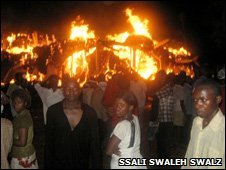
Ugandan soldiers and police have clashed with rioters in the capital after fire gutted the site of the burial grounds of the former kings of the country’s largest historic kingdom.
Security forces used tear gas on Wednesday to disperse members of the Baganda ethnic group angry at the destruction of the tombs at Kasubi on the outskirts of Kampala.
« Last night the tombs of their kings – 200 years basically of their cultural heritage – was burnt to the ground, » Malcolm Webb, a Kampala-based journalist, told Al Jazeera.
« They suspect it was arson, » he said.
« I’ve seen four people who were injured – some of them may be dead. But the crowd has been largely chased away.
« A lot of them were marched out of the tombs compound with their hands up and sent down the road, chased off with tear gas. »
‘Attack on Buganda‘
Buganda is one of Uganda’s four historic kingdoms and the Baganda are the most populous ethnic grouping in the country.
Kasubi, designated as a world heritage site by Unesco, the UN cultural agency, is an important tourist site housing the burial grounds of four former kings of Buganda. The last king was buried there in 1971.
Baganda have previously complained that the government has tried to expropriate the kingdom’s land and have been involved in disputes over the influence of Buganda’s traditional leaders.
A spokesman for the Buganda kingdom on Wednesday described the fire as « an attack on Buganda », whose people are concentrated in the south of Uganda and Kampala.
« This fire is very strange given what we [the Baganda] have been going through, » Peter Mayiga said without giving further details.
There was no immediate confirmation that the blaze was started deliberately and Kale Kayihura, the chief of the Uganda police, said his officers were still investigating the cause of the fire.
He also said that firefighters had been prevented from reaching the site in time to put out the blaze before it gutted the burial site late on Tuesday.
« When the fire broke out, police were called in and got there in time but the fire brigade was obstructed by a hostile crowd, three trucks were damaged and a fireman injured, » Kayihura told the AFP news agency.
« Faced with this hostility and in an effort to stop the fire from destroying the tombs, the officer fired some shots in the air to disperse the crowd but no one was hurt, » he said.
Considerable influence
The violence triggered fears of renewed tension between the government and ethnic Baganda, who accuse the government of undermining their kingdom.
Last September, riots in Kampala left at least 17 people dead after the government prevented Ronald Muwenda Mutebi, the current Buganda king, from visiting a district near the capital.
The government said the district had its own traditional ruler and it did not owe allegiance to the king.
The king holds a largely ceremonial position in Uganda, but wields considerable influence among his people.
Monarchies were restored in Uganda in 1993 after they were banned in the 1960s, but they are not allowed to participate in elective politics by campaigning or fielding candidates.
The kingdom’s radio station – the Central Broadcasting Service (CBS) – remains banned after it was taken off air in the aftermath of the riots, its staff accused of inciting violence.
Informations
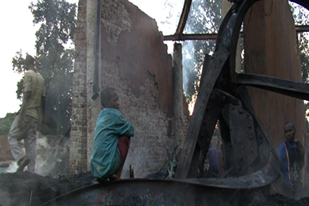
Kasubi Tombs in Kampala, Uganda, are the burial grounds for four previous Kabakas (Kings of Buganda Kingdom), and a UNESCO World Heritage Site.
The royal enclosure at Kasubi hill was first built in 1881. Also known as the Ssekabaka’s Tombs, these are the royal tombs where four previous Kabakas are buried. The tombs, revered by the Baganda people, are held in straw thatched buildings and are a major tourist attraction.[1] The Kasubi Tombs remain an important spiritual and political site for the Baganda people. The tombs were declared a UNESCO World Heritage Site in 2001.





 anthropologie du présent