
Emeutes en Cisjordanie – 15 mars 2010

Cisjordanie: 10 Palestiniens blessés par l’armée israélienne
AFP
15 mars 2010
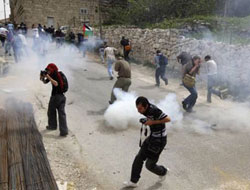
RAMALLAH (Cisjordanie) – Dix étudiants palestiniens ont été blessés lundi en Cisjordanie, dont deux par balles réelles, lors d’affrontements avec des soldats israéliens près du point de contrôle d’Atara, proche de Bir Zeit, a-t-on appris de source médicale palestinienne.
« Nous avons accueilli six blessés, dont deux atteints par balles réelles, l’un à l’estomac et l’autre au cou », a déclaré à l’AFP Mohammed Ida, directeur central des hôpitaux de Ramallah, ville proche de Bir Zeit, où les blessés ont été emmenés.
Il a précisé que quatre étudiants ont été blessés par des balles en caoutchouc, et quatre autres ont été soignés sur place après avoir été légèrement blessés lors des affrontements.
Une source des services de sécurité palestiniens avait auparavant fait état de trois étudiants blessés par des tirs à balles réelles, dont une femme, et de quatre autres touchés par des balles en caoutchouc.
L’armée israélienne a pour sa part indiqué que quatre Palestiniens avaient été blessés, mais elle n’a pas confirmé des tirs à balle réelle.
Selon une porte-parole, un soldat israélien a été légèrement blessé par des jets de pierres de Palestiniens.
Elle a ajouté que 70 Palestiniens avaient jeté des pierres contre des soldats qui ont riposté à l’aide des « moyens de dispersion anti-émeute ».
Les étudiants, venus par dizaines de l’université de Bir Zeit voisine, manifestaient pour « la défense de Jérusalem-est », le secteur à majorité arabe annexé par Israël en 1967, agité par des tensions politico-religieuses entre Israéliens et Palestiniens depuis plusieurs jours.
La tension est montée d’un cran à Jérusalem-Est notamment en raison de l’inaugration officielle, lundi en fin d’après-midi, de la synagogue de la Hourva, dans le quartier juif de la Vieille ville de Jérusalem, perçue comme une provocation par les Palestiniens.
Cette inauguration survient dans un contexte déjà tendu, avec le feu vert la semaine dernière du ministère israélien de l’Intérieur à la construction de 1.600 logements dans la partie orientale de Jérusalem, dont l’annexion par Israël n’est pas reconnue par la communauté internationale.
Cisjordanie: 7 Palestiniens blessés
Lefigaro.fr
15/03/2010
Sept étudiants palestiniens ont été blessés aujourd’hui en Cisjordanie occupée lors d’affrontements avec des soldats israéliens près du point de contrôle d’Atara, proche de Bir Zeit.
L’hôpital de Ramallah, proche de l’université de Bir Zeit, a confirmé avoir accueilli sept blessés, dont certains atteints par balles réelles, sans plus de précision.
Selon une source au sein des services de sécurité palestiniens, trois étudiants, dont une femme, ont été blessés par des tirs à balle réelle, et quatre par des balles en caoutchouc tirées par des soldats israéliens.
L’armée israélienne a pour sa part indiqué que quatre Palestiniens avaient été blessés, mais n’a pas confirmé des tirs à balle réelle. Selon une porte-parole, un soldat israélien a été légèrement blessé par des jets de pierres par des Palestiniens.
Heurts entre Palestiniens et Tsahal
lejdd.fr
15/03/2010
Au moins sept Palestiniens ont été blessés ainsi qu’un soldat israélien lundi lors de heurts à Atara, au nord de Ramallah, ont rapporté des sources médicales. Les Palestiniens protestaient contre les nouvelles constructions dans une colonie juive de Jérusalem et la réouverture d’une synagogue dans le quartier juif de la vieille ville. Les dizaines de manifestants ont jeté des pierres sur les soldats, qui ont répondu avec « des moyens de dispersion des émeutes ». Deux manifestants auraient été blessés par des tirs de balles réelles, selon des sources médicales, mais un porte-parole de l’armée dément cette information. Invoquant des raisons de sécurité, Israël a interdit jusqu’à mardi l’accès de Jérusalem aux Palestiniens non résidents de la ville. L’ancien Premier ministre palestinien Ahmed Koreh, a estimé que les mesures d’Israël pour renforcer la « judaïsation » de Jérusalem conduisait tout droit à une troisième intifada.
Israel wounds Palestinians, bans activists over « shame wall »
worldbulletin.net
Monday, 15 March 2010
Israel declared two Palestinian villages « closed military zones » in an attempt to ban foreign activists.
Israel army on Monday declared two Palestinian villages « closed military zones » in an attempt to halt foreign activists who join weekly protests against « shame wall » in the occupied West Bank.
The two villages lost farmland to the separation wall and have become international symbols of the fight against the wall condemned internationally.
International Criminal Court in the Hague ruled on 9 July 2004 that Israel’s separation wall should be demolished in a decision that were all agreed by the judges by a margin of 14-1.
« Dozens of masked soldiers raided the West Bank villages of Bil’in and Ni’ilin Monday morning to post decrees designating the village’s lands closed military zones on Fridays from 8.00 a.m. and 8.00 p.m for a period of six months », residents said.
Israel may use this decree as an excuse for arrests or deportations of foreign and local rights activists.
« Illegitimate »
The verdict, requested by the UN’s general assembly says « Israel’s wall is illegal, it must be removed and adequate compensation paid, » Israel has ignored this and pressed on with its construction.
The wall leaves some 80 percent of Jewish settlements on the Israeli side, leading the court to conclude that the route of the wall threatened to create « de facto annexation », with the wall itself described as severely impeding « the exercise by the Palestinian people of its right to self-determination ».
« People have the natural right to demonstrate. This decision will not prevent people from going into their lands, » Nilin Mayor Ayman Nafie told Reuters.
« Protesters do not see this decree as legitimate, but it could be a sign of heightened pressure on the popular resistance than we’ve seen so far, » Jonathan Pollak, an Israeli who coordinates anti-barrier protests, told Reuters.
Palestinian news agency quoted Lawyer Gaby Lasky, who represents residents of the villages as saying, that « this is yet another illegal measure taken by the Army, which makes ill use of its authority in order to suppress dissent and infringe on the already volatile freedom of speech in the Territories. Closed military zone orders are not meant to deal with demonstrations, which are clearly in the civic rather than the military realm. »
Palestinians refer to the barrier as the « apartheid wall » and view it as nothing more than a land grab by Israel to help support and expand settlements in the West Bank.
« Live rounds »
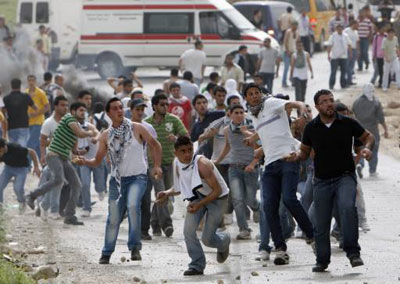
Israeli troops wounded 10 Palestinians on Monday as they opened fired on dozens of students at a West Bank checkpoint, Palestinian medics and witnesses said.
Witnesses and medics said the soldiers had fired live rounds at the demonstrators but the Israeli military denied this.
The Palestinians had marched to the checkpoint from the nearby Birzeit University. Dozens of them hurled rocks at the soldiers.
The medical sources said two of the men were hit by bullets at Atara checkpoint, north of Ramallah.
Israel has banned Palestinians from crossing into the city from the West Bank until Tuesday.
An Israeli military spokeswoman said one soldier was lightly wounded. She declined to say whether live rounds were used against Palestinians. Israeli troops sometimes fire live rounds to disperse demonstrations in the West Bank while mostly using means like tear gas, stun grenades and rubber bullets.
« Aqsa call »
Meanwhile, tensions remain high as Israeli officials plan to rededicate a synagogue 330 meters from the Al-Aqsa Mosque compound in the Old City. The decision to rededicate the building on Monday was condemned as an act of aggression by Palestinian religious officials.
Palestinian leaders in the city mobilized residents to gather at the Al-Aqsa Mosque.
Israel has deployed heavily policemen in Jerusalem’s Old City during the reopening of a 17th century synagogue near the Al-Aqsa Mosque compound.
Palestinian national and Islamic groups in Jerusalem released a statement calling on Jerusalemites and Palestinian citizens of Israel to go to the Al-Aqsa Mosque. Observers expect a growing crowd to remain in the mosque overnight on Monday and likely Tuesday.
Bil’in, Na’alin declared closed military areas each Friday for months
haaretz.com
15 mars 2010
The Israel Defense Forces yesterday designated Bil’in and Na’alin as closed military areas every Friday until mid-August, in a bid to halt the weekly demonstrations against the separation fence in those West Bank villages.
On Sunday night dozens of troops, some wearing masks, entered the villages and plastered storefronts and home windows with notices announcing the closure order signed by the GOC Central Command, Maj. Gen. Avi Mizrahi.
The order officially runs from February 18 to August 17. The 12-hour closure will apply to the area stretching from the separation fence to the edge of the villages’ built-up areas.
Weekly demonstrations against the fence have been held in Bil’in for the past five years. Over the last three years the villages of Na’alin and Al-Ma’sara have also become weekly protest spots, attracting not only Palestinians but activists from Israel and abroad. Similar rallies were held in Jayyous, Budrus, Beit Liqya and Bidu. In all, 23 Palestinians – including 12 minors – have been killed at five rallying sites by IDF fire directed at protesters. Six were killed in Bidu and five in Bil’in. Dozens of protesters have been injured by IDF fire, including rubber-coated bullets and direct hits from stun grenades and tear gas. Two weeks ago, a boy from the Ramallah-area of village Nabi Saleh was seriously hurt by a rubber-coated bullet as protesters rallied against settlers’ seizure of village lands on which a spring is situated. Palestinian Prime Minister Salam Fayyad and Fatah leaders like Jibril Rajoub and Nabil Sha’ath have supported the fight against the wall and taken part in several rallies. The IDF Spokesman told Haaretz, « Every week violent, illegal disturbances occur in Na’alin and Bil’in, during which security forces are hurt and serious damage is caused to the security fence and public property. In an effort to prevent the arrival of individuals inciting violent unrest in the area, GOC Central Command Maj. Gen. Avi Mizrahi signed an order three weeks ago designating the area between the security fence and the villages Na’alin and Bil’in as closed military zones. » The order, it said, « applies to Israeli citizens, foreigners and Palestinians who are not residents of the villages on Fridays between 8 A.M. and 8 P.M., and will remain in force for six months. Note that the order does not apply to village residents, who will be allowed free movement. » The order states that individuals will be allowed entry if they have been « given authorization … to enter and remain in the closed military area » by GOC Central Command or the Binyamin Brigade commander or his representative. It remains unclear whether issuing the permits will require bureaucratic action similar to that undertaken by the Civil Administration in granting access to individuals owning land on the western side of the separation fence. Village residents said that in the past, their own entry to areas designated as closed military zones was routinely denied. Last year the IDF and Shin Bet security service made a number of night incursions into Na’alin and Bil’in to carry out mass arrests. Minors and mentally ill people were detained first, and in Shin Bet and police interrogations produced lists of people who had supposedly participated in illegal activity such as stone-throwing and « incitement. »
Israel closes villages of Bilin and Nilin to protests
news.bbc.co.uk
Monday, 15 March 2010
The Israeli Defence Force has barred Israelis and foreigners from two West Bank villages, the scene of protests against Israel’s « separation wall ».
Soldiers have posted flyers declaring areas around the villages of Bilin and Nilin are « closed military zones ».
The restriction applies to the areas every Friday, the day that protests are held, for the next six months.
Activists have been protesting against the barrier for five years in what they say are mostly peaceful demonstrations.
But the Israeli Defence Force says it considers the riots to be « violent and illegal ».
‘Inciters’
Around 100 members of the security forces have been injured policing the demonstrations, a spokesman said.
« Every week violent, illegal riots take place in the area of Nilin and Bilin, during the course of which members of the security forces are wounded and heavy damage is caused to the security fence and to public property, » a statement from the IDF said.
« In an effort to prevent the inciters of these riots from reaching the area in which the riots take place, three weeks ago, OC Central Command signed an order designating the area between the fence and the villages of Nilin and Bilin as a closed military zone. »
The statement said residents of the villages were exempt from the order.
Protests at the « separation barrier », a fence between Palestinian land and Israeli settlements, had attracted young Israelis and peace activists from around the world.
Some demonstrations had also been attended by stone-throwing Palestinian youths.
Israeli security services have fired tear gas, stun grenades, rubber bullets and on occasion live rounds at protesters.
There have been two fatalities among protesters and an American peace activist remains in a coma after being hit by a rubber bullet.





 anthropologie du présent