
Emeutes à Jérusalem – 16 mars 2010

>> cisjordanie 15 mars <<
‘Day of Rage’ riots rocks e. J’lem
jpost.com
By ABE SELIG
17/03/2010
Police officer shot, 14 others hurt, 100 Palestinians wounded, 60 arrested.
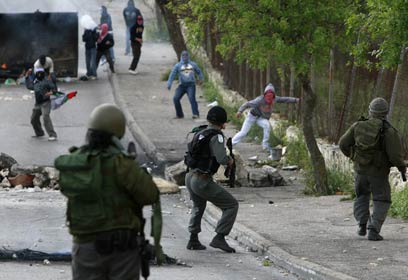
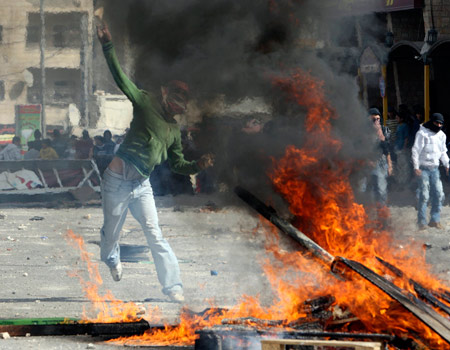
In what they called “a Day of Rage,” Palestinians rioted across east Jerusalem on Tuesday, throwing rocks, setting tires and garbage bins ablaze and even using live fire against police forces deployed by the thousands in the capital.
The violence spread from one neighborhood to another. In one incident, youths hoisted a Palestinian flag and shouted, “We shall die and Palestine shall live!”
A police officer was shot and lightly wounded in the east Jerusalem neighborhood of Ras el-Amud on Tuesday evening, after the widespread rioting saw more than a dozen security forces wounded and upward of 60 arrests.
The policeman, a member of the elite Yasam unit, sustained a gunshot wound to the hand and was evacuated to the capital’s Hadassah-University Hospital, Mount Scopus. Security forces were searching for the assailant.
The rioting erupted in the Muslim quarter of the Old City, along with the east Jerusalem neighborhoods of Wadi Joz, Ras el-Amud, Isawiya, the Shuafat refugee camp and Jebl Mukaber, among other locations.
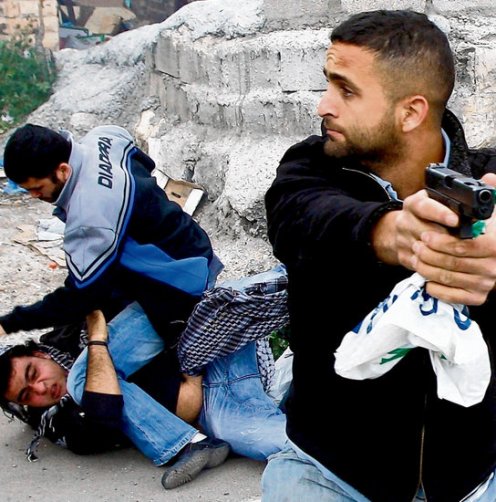
“They are donkeys and dwarfs!” a woman screamed as riot police and plainclothes security men hauled away a handcuffed, hooded youth.
Throughout the day, more than 60 rioters were arrested for throwing rocks, among other violations, and 15 policemen were wounded. Four of those officers were evacuated for medical treatment, while the rest were treated at the scene.
According to Palestinian reports, more than 100 people sustained injuries during the unrest. Palestinian medics said 10 people were seriously wounded, five from rubber bullets.
Order was restored to the capital for a brief interlude in the afternoon, with the exception of the Shuafat refugee camp, where sporadic clashes were still being reported.
In addition, a Jewish activist who attempted to enter the Temple Mount through the Mughrabi Gate was arrested after he attacked policemen barring his way.
At one point, police used stun grenades to disperse dozens of Arabs who were blocking the Majlis Gate, one of the Old City entrances to the Temple Mount.
The protesters, some of them chanting “Allah hu akbar,” were pushed back into the nearby Via Dolorosa.
In Wadi Joz, mobs of rioters clashed with mounted police, who rode past smoking trash bins that had been set alight in the neighborhood during the melee.
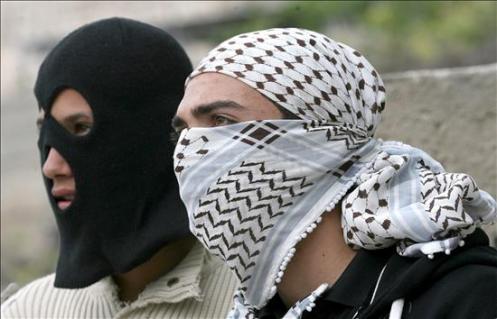
In Ras el-Amud, dozens of Palestinian youths, their faces shrouded in scarves and keffiyehs, repeatedly clashed with security forces throughout the day. The boom of stun grenades could be heard echoing through the neighborhood’s alleyways, even from inside the Old City, which is located across the Kidron Valley from the neighborhood.
Rioting also erupted in Isawiya, in northeast Jerusalem, where dozens of Palestinians hurled rocks and burned tires as they clashed with border patrolmen.
In Jebl Mukaber, in the capital’s southeast, dozens of youths approached a police force that had been deployed nearby and began hurling rocks in their direction. The rock-throwers were soon dispersed by police, and five of them were arrested.
Palestinian merchants in east Jerusalem shuttered their stores in solidarity with the protests, and Palestinian schools in the city were closed.
Speaking to reporters after completing a tour of the Western Wall Plaza and the recently rededicated Hurva Synagogue on Tuesday afternoon, Israel Police Insp.-Gen. David Cohen said he wasn’t concerned that the unrest would turn into a “third intifada.” He added, however, that the reinforced police presence in the capital would remain through Sunday.
Cohen also blamed the recent violence on the Palestinian leadership, which the inspector-general said was inciting the public.
Earlier Tuesday, two buses carrying Israeli Arabs to Jerusalem from the North were turned back by police, who suspected that the passengers were heeding calls from Palestinian clerics and officials to join the unrest in the capital. One passenger was arrested after he attacked a policeman who boarded the bus.
Additionally, dozens of buses carrying hundreds of Israeli Beduin from the Negev will make their way to Jerusalem every day this week, to protest what they say are Israeli threats against the Aksa Mosque on the Temple Mount.
The protests, organized largely by the Islamic Movement in Israel, will include busloads of protesters from the Galilee as well.
Jews “have no right to the Temple Mount,” Rahat Mayor Faiz Abu Sehaba, whose Negev city of some 45,000 inhabitants is the country’s largest Beduin community, told The Jerusalem Post on Monday, citing Jewish teachings that forbid Jews from going onto the Temple Mount before the arrival of the messiah.
Abu Sehaba, a member of the Islamic Movement’s southern branch – considered to be “more moderate” than its northern counterpart – said that while buses leave Rahat for the Aksa compound every day, this week far more would make the journey, in an effort to bring the masses to protest what they perceive as threats to the foundation of the mosque from Israeli archaeological digs nearby.
“We feel that there is a threat to the foundations of the Aksa Mosque. It would threaten the peace of the entire Middle East if, God forbid, something were to happen to the building,” Abu Sehaba said.
“We don’t want this; we want peace, not a new war in the Middle East,” he insisted, adding, “Religious Jews know about the ban on going to the Temple Mount.”
He blamed “settlers and right-wing Jews” for heading to the site for the sake of “provocation and politics.”
Riots in Jerusalem on Hamas ‘day of rage’
Irishtimes.com
Wednesday, March 17, 2010
MARK WEISS in Jerusalem
HUNDREDS OF Palestinians clashed with Israeli police in east Jerusalem yesterday as US envoy George Mitchell put off a trip to the region, leaving the future of Israeli-Palestinian peace talks in doubt.
Throughout the day, gangs of Palestinian youths hurled rocks at Israeli police who were out in force in the Arab neighbourhoods in response to a “day of rage” declared by the Islamic Hamas.
Police turned back a number of buses carrying Israeli-Arab Muslims to Jerusalem to join the protests.
Some 90 protesters and 15 policemen were injured as the security forces used rubber bullets, tear gas and stun grenades to disperse the crowds.
More than 30 Palestinians were arrested in the most widespread disturbances in the capital in recent years. Despite the riots, Jerusalem’s police chief David Cohen stressed that the unrest did not herald the start of a new popular uprising.
Violent clashes also occurred at a number of locations in the West Bank. In Hamas-ruled Gaza, thousands took to the streets in solidarity rallies.
Hamas, supported by radical Islamic groups within Israel, planned the day of rage in protest at this week’s dedication of a restored ancient synagogue in the Jewish quarter of Jerusalem’s old city, claiming the move was part of a plot to destroy the Al-Aqsa mosque on the nearby Temple Mount.
Behind the rise in tension lies Israel’s decision last week to permit the construction of another 1,600 homes for religious Jews in the east Jerusalem neighbourhood of Ramat Shlomo.
The controversial decision not only sparked Palestinian anger but triggered what Israel’s ambassador to Washington described as the worst crisis in Israeli-US relations in 35 years.
What particularly angered the Americans was that the Israeli announcement not only coincided with the visit by vice-president Joe Biden, but came only days after Washington announced a breakthrough in the Middle East peace process, securing the agreement of the sides to begin indirect talks after a 15-month hiatus.
US secretary of state Hillary Clinton set three conditions for prime minister Binyamin Netanyahu to get the peace process back on track: cancel the new building plans for Jerusalem; make gestures to the Palestinians, and commit to discussing the substantive core issues when the peace talks get under way.
Yesterday, after Mr Netanyahu defiantly declared that the building in Jerusalem would go ahead, US envoy George Mitchell cancelled his planned trip to the region. The talks are now on hold.
If the Israeli decision to press ahead with building beyond the 1967 Green line took the Americans by surprise, the harsh American response left Israeli leaders shell-shocked.
Ill-timed Israeli decisions on settlement expansion are hardly something new. They have occurred with alarming regularity just before, during or just after previous visits by senior US officials. What is new this time is the administration’s refusal to accept Israel’s apology and turn a blind eye.
All Israeli governments place great importance on maintaining friendly ties with Washington, often described as Israel’s only true ally in the world. Today the relationship for Israel is more important than ever. Mr Netanyahu is aware of the necessity of moving in tandem with Washington to try to prevent Iran obtaining a nuclear bomb.
On the other hand, he was elected on a mandate of maintaining a “united Jerusalem” as Israel’s “eternal indivisible capital”. Any concessions on Jerusalem could leave his largely right-wing, religious coalition in tatters.
The coming days will tell whether a formula can be found where the Netanyahu government can continue building in disputed areas of Jerusalem without damaging its all-important strategic partnership with America.
‘Day of rage’: Riots in Jerusalem
Ynet reporters
03.16.10
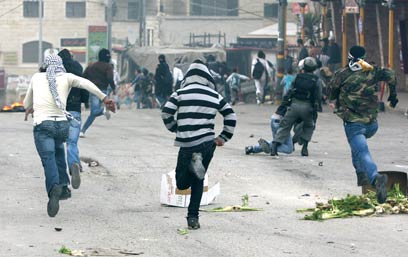
Masked rioters torch tires, stone Border Guard officers in Shuafat, Isawiya neighborhoods; Three police, 11 rioters lightly wounded. Police set up roadblock on Route 6, inspect all buses traveling to capital; Arab bus from western Galilee turned back
The day dubbed « the day of rage » by Hamas and extremist Islamic groups opened with riots – both in the holy city and on the way to it. Hundreds of Arabs burned tires and hurled stones at Border Guard officers at several locations throughout the city Tuesday morning. At least three officers and 11 rioters were lightly injured, and eight were detained. Meanwhile, in the North, a bus full of Muslim passengers on their way to al-Aqsa Mosque was stopped and turned back. Police said the bus was inspected following tip-offs of possible plans to riot in Jerusalem.
Arab MKs and members of the Higher Arab Monitoring Committee also arrived at the al-Aqsa Mosque Tuesday morning. « The Netanyahu government is dangerous and irresponsible, and is leading the region to a third intifada, » said MK Talab El-Sana (United Arab List – Ta’al).MK Ahmad Tibi told Ynet he was inside the mosque: « There is a renewed occupation of east Jerusalem and the al-Aqsa Mosque, gunshots can be heard in every direction. »
Dozens of masked rioters hurled stones at Border Guard officers near the Shuafat refugee camp in Jerusalem, and set fire to tires. The force dispersed the rioters using stun grenades. Two policemen were lightly injured and seven Palestinians were arrested.
In another incident, at the northern entrance to the Isawiya neighborhood in Jerusalem, masked protesters also burned tires and hurled stones at Border Guard officers. The rioters were calmed and dispersed by the village’s elders. Security forces also dispersed masked rioters hurling stones near the Temple Mount’s Majlis Gate.
In Abu Dis, some 50 Palestinians hurled stones at security forces. Police and Border Guard officers responded with teargas and stun grenades. One of the rioters was detained and taken in for questioning. Riots were also noted at the Qalandiya checkpoint.
Meanwhile, dozens of Palestinian youths threw stones in Maale Mota Gur in the Old City and near the wholesale market. Similar riots ensued in Wadi Joz and Silwan. In total, thousands of police officer were deployed throughout the city.
Buses to capital inspected
Meanwhile, at the Achihod junction in the western Galilee, police stopped a bus containing Arab Muslims who were making their way from Majdal Krum in the north, to Jerusalem. The Bus driver was forced to turn back. During an inspection of the bus, a 38-year-old passenger allegedly assaulted a Traffic Police officer and was detained.
Heavy traffic jams were felt on Highway 6 due to a police checkpoint set up to inspect buses traveling to al-Aqsa. Balad Chairman MK Jamal Zahalka, who was also on his way to Jerusalem in his private vehicle, told Ynet, « I suggest they stop with these checkpoints, which only create provocations. »
Police said that since Tuesday was considered a very sensitive day, and in light of information obtained on possible riots in Jerusalem by civilians arriving in buses, every bus on its way to the capital will be inspected. Police added that the decision was backed and approved by the attorney general.
Sources from the Islamic Movement’s northern branch said police stopped two buses. The movement’s spokesman, Attorney Zahi Nujeidat, told Ynet, « Those who are preventing worshippers from traveling to al-Aqsa are the ones who are fermenting the situation. It is natural that a Muslim would visit and pray at the al-Aqsa Mosque. Those that are preventing us from getting there will ultimately carry the blame for any possible scenario. »
On Monday, during the inauguration of the Hurva Synagogue in the Old City, more than 3,000 police and border guards gathered in the Temple Mount area. The event passed in tense calm.
Jérusalem: heurts entre des centaines de Palestiniens et la police
AFP
16 03 2010
JERUSALEM — Des affrontements ont éclaté mardi entre des centaines de jeunes Palestiniens et les forces de l’ordre israéliennes dans plusieurs quartiers de Jérusalem-est, selon des témoins.
Dans le camp de réfugiés de Choufat, les manifestants ont caillassé les policiers et gardes-frontières israéliens qui ont riposté en tirant des grenades assourdissantes et des balles en caoutchouc.
Aucun blessé n’a été rapporté dans l’immédiat.
Au moins un Palestinien a été interpellé par les forces de l’ordre qui ont rétabli le calme après avoir pénétré dans le camp, selon un photographe de l’AFP.
Des heurts se poursuivaient en début de matinée à Issawiyeh, un quartier à majorité palestinienne de Jérusalem-est, où la police et les gardes-frontières ont tiré en l’air pour disperser les manifestants.
Des affrontements ont également lieu dans le quartier de Wadi Joz, dans le secteur oriental de Jérusalem à majorité arabe annexé en 1967.
La police israélienne a été déployée en masse pour faire face à tout débordement à Jérusalem-est, où les tensions politico-religieuses sont vives depuis des semaines.
Le mouvement islamiste palestinien Hamas a appelé à « une journée de la colère » mardi pour dénoncer l’inauguration lundi de la synagogue historique de la Hourva, reconstruite dans le quartier juif de la Vieille ville de Jérusalem.
Affrontements entre Palestiniens et police israélienne à Jérusalem-Est
ASSOCIATED PRESS
16 03 2010
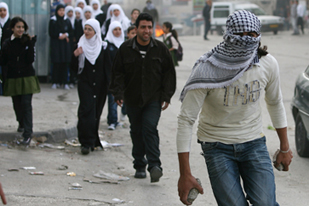
JERUSALEM — Des Palestiniens masqués ont lancé des pierres contre la police israélienne et brûlé des pneus mardi à Jérusalem-Est alors que les tensions sont vives entre Israël et la communauté internationale au sujet de la colonisation.
Le porte-parole de la police de Jérusalem Shmuel Ben-Ruby a précisé que ses hommes ont lancé des grenades assourdissantes pour disperser les assaillants à un endroit. Des anciens les ont aidés à mettre un terme à la manifestation sur un autre site. Personne n’aurait été blessé.
L’atmosphère est très tendue à Jérusalem-Est, où l’Etat hébreu veut construire 1.600 nouveaux logements destinés à des familles juives dans la partie arabe de la ville annexée par Israël.
Des militants du Hamas ont appelé à une « journée de colère ».
Le ministre israélien des Affaires étrangères Avigdor Lieberman a estimé mardi sur Radio Israël qu’il n’était pas « raisonnable » que la communauté internationale attend d’Israël le gel de la construction à Jérusalem-Est.
Dans un discours prononcé lundi, le Premier ministre israélien Benyamin Nétanyahou n’a laissé entrevoir aucune intention d’annuler le nouveau projet immobilier, ni même de ralentir les constructions de logements juifs à Jérusalem-Est.
Le chef du gouvernement a rappelé qu’Israël construisait depuis plus de 40 ans dans cette partie de la ville – que les Palestiniens revendiquent comme capitale de leur futur Etat. « La construction de ces quartiers juifs n’a lésé en aucune façon les Arabes de Jérusalem-Est et ne s’est pas faite à leurs dépens », a déclaré Benyamin Nétanyahou.
Des affrontements entre Palestiniens et force de l’ordre israéliennes
20minutes.fr
16.03.10
ISRAEL – L’inauguration lundi de la synagogue historique de la Hourva a suscité la colère des Palestiniens…
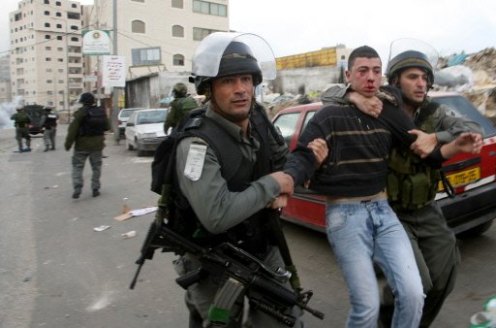
Des affrontements ont éclaté mardi entre des centaines de jeunes Palestiniens et les forces de l’ordre israéliennes dans plusieurs quartiers de Jérusalem-est, selon des témoins.
La police israélienne, qui craignait des manifestations violentes palestiniennes, était déployée en force mardi à Jérusalem-est pour faire face à tout débordement, a indiqué un porte-parole.
Au moins une interpellation
Dans le camp de réfugiés de Choufat, les manifestants ont caillassé les policiers et gardes-frontières israéliens qui ont riposté en tirant des grenades assourdissantes et des balles en caoutchouc.
Aucun blessé n’a été rapporté dans l’immédiat. Au moins un Palestinien a été interpellé par les forces de l’ordre qui ont rétabli le calme après avoir pénétré dans le camp, selon un photographe de l’AFP.
«Une journée de la colère»
Le mouvement islamiste palestinien Hamas, au pouvoir à Gaza, a appelé à «une journée de la colère» mardi pour dénoncer l’inauguration lundi de la synagogue historique de la Hourva, reconstruite dans le quartier juif de la Vieille ville de Jérusalem.
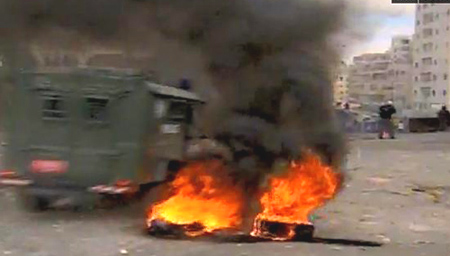
A Issawiyeh et Wadi Joz, des quartiers arabes du secteur oriental de Jérusalem conquis et annexé par Israël en 1967, des jeunes Palestiniens masqués jetaient des pierres contre les forces de sécurité et incendiaient des pneus, selon des photographes de l’AFP. Avant l’aube, un garde-frontières israélien a été légèrement blessé par un jet de pierres dans la Vieille ville de Jérusalem et deux cocktail molotov ont été lancés par des inconnus dans le quartier arabe de Silwan à Jérusalem-est, a précisé la police.
L’accès de l’esplanade des Mosquées de Jérusalem interdit
La police a aussi de nouveau interdit l’accès de l’esplanade des Mosquées de Jérusalem, troisième lieu saint de l’islam, aux fidèles musulmans âgés de moins de 50 ans, ainsi qu’à tous les visiteurs non musulmans. Dans un contexte de tensions politico-religieuses, des centaines de personnes ont participé à l’inauguration de la synagogue historique de la Hourva. Cette cérémonie a été vue par les Palestiniens comme une nouvelle provocation israélienne.
Ces dernières semaines, de violents heurts avaient opposé des Palestiniens aux policiers israéliens à Jérusalem, faisant des dizaines de blessés.



 anthropologie du présent