
Affrontements en Grèce – février 2010

[Youtube=http://www.youtube.com/watch?v=OZEPWgtKqIQ]
[Youtube=http://www.youtube.com/watch?v=-RucaAWMNKs]
–>>24 février 2010 : photos <<–
Grève générale en Grèce : échauffourées entre jeunes et policiers
Leparisien.fr
24.02.2010
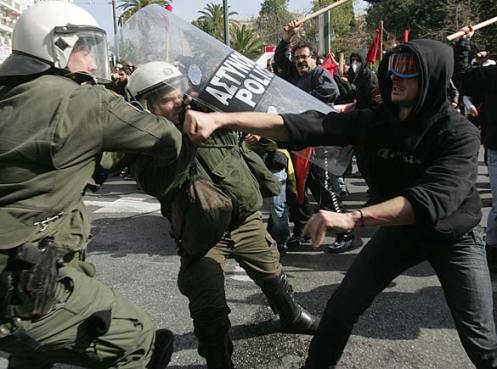
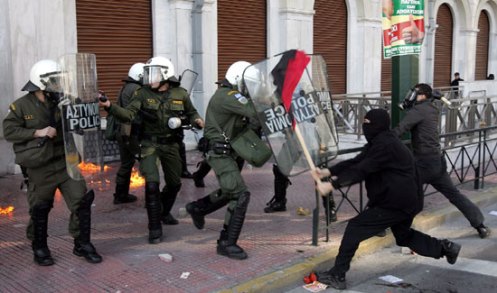
Alors que la Grèce est paralysée par une grève générale, qui rassemble plusieurs milliers de manifestants à Athènes et à Salonique, des échauffourées ont éclaté entre des jeunes et des policiers en début d’après-midi dans le centre de la capitale. Aux jets de pierres des premiers ont répondu les gaz lacrymogènes des seconds.
Les manifestations sont organisées pour protester contre les mesures d’austérité du gouvernement grec.
Les jeunes, environ 300 selon une source policière, ont également lancé des cocktails Molotov vers les policiers et provoqué des dégâts à quelques magasins avant de se replier vers l’université d’Athènes. Une personne a été légérement blessée et évacuée et un jeune interpellé par la police.
Plus de 10 000 grévistes manifestaient mercredi en fin de matinée à Athènes et environ 7 000 à Salonique, la grande ville du nord de la Grèce, selon les chiffres de la police. Ils protestent contre les mesures de rigueur décidées par le gouvernement socialiste pour faire face à la crise, telles que repousser l’âge moyen du départ en retraite de deux ans, à 63 ans et demi.
«Taxer les spéculateurs» et «les hommes et leurs besoins sont au-dessus des marchés et des profits», indiquaient des pancartes placées le long du parcours de la manifestation organisée dans la capitale par la puissante Confédération générale des travailleurs grecs (GSEE, 1 million d’adhérents) et la Fédération des fonctionnaires Adedy (300 000 membres).
Le Front de lutte syndical (PAME), émanation de l’ultra-orthodoxe parti communiste (KKE), avait appelé ses membres à manifester séparément et a réuni plusieurs milliers de militants à Athènes.
Refus des mesures d’austérité
«Aucun sacrifice pour la ploutocratie», affirmaient des tracts distribués dans la rue par les manifestants communistes, qui portaient des banderoles sur lesquelles était inscrit «pas plus», en référence au refus de mesures d’austérité supplémentaires, et d’autres «pas touche au 14e mois».
Les grandes centrales syndicales ont appelé à la grève générale et dès minuit mardi, les transports aériens et maritimes étaient à l’arrêt, tandis que les dessertes ferroviaires étaient pratiquement toutes interrompues. Les bus et une ligne de métro fonctionnaient cependant à Athènes pour permettre aux grévistes de se rendre aux manifestations prévues par les syndicats dans le centre de la capitale à la mi-journée et les taxis ne s’étaient pas joints à la grève.
La grève devait entraîner la fermeture des écoles, administrations et tribunaux, tandis que les banques, hôpitaux et grandes entreprises du secteur public fonctionnaient au ralenti. Le pays est également privé de toute information des radios et télévisions en raison du ralliement du syndicat des journalistes, qui sanctionne ses membres s’ils ne participent pas à la grève. Les journaux ne devraient pas paraître jeudi.
Pourtant plus de 6 Grecs sur 10 sont favorables à la rigueur
En dépit de cette mobilisation, les sondages attestent d’un soutien de plus de six Grecs sur dix à la cure de rigueur. Selon la dernière enquête, publiée dimanche, 75% des Grecs souhaitent la paix sociale jusqu’au dénouement de la crise.
La grève intervient alors que des experts de la Commission européenne, de la BCE et du FMI ont entamé mardi à Athènes l’examen de l’avancement du plan d’économies de la Grèce pour régler sa crise budgétaire dans le cadre d’une mission technique de l’Union européenne qui doit prendre fin jeudi.
Au premier jour de cette mission, le porte-parole du gouvernement grec a accusé la Commission européenne d’avoir fermé les yeux sur la dérive budgétaire du pays sous la gestion du précédent pouvoir conservateur. Des accusations rejetées par Bruxelles qui a rappelé les réserves exprimées par le passé sur les comptes de la Grèce.
L’agence de notation financière Fitch a de son côté abaissé mardi d’un cran la note des quatre principales banques grecques, de BBB+ à BBB, avec perspective négative, redoutant l’impact du plan de rigueur grec sur la qualité de leurs actifs et leurs résultats.
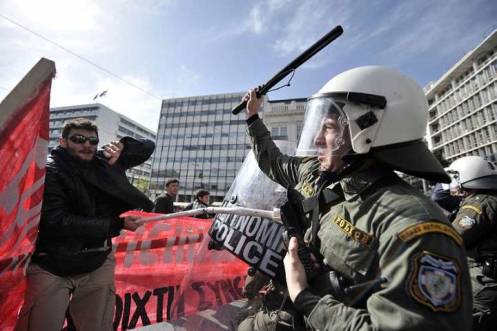
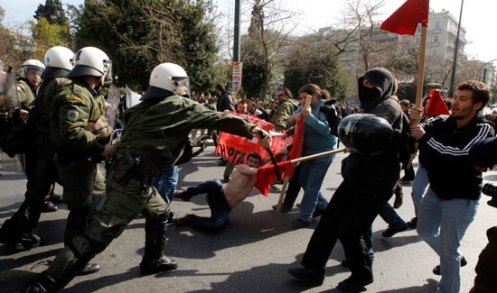
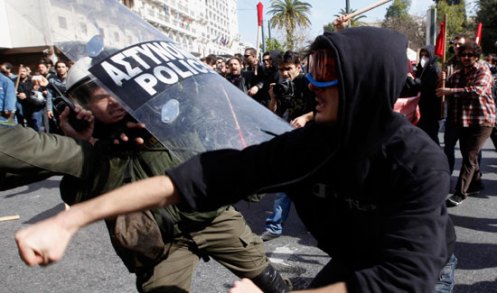
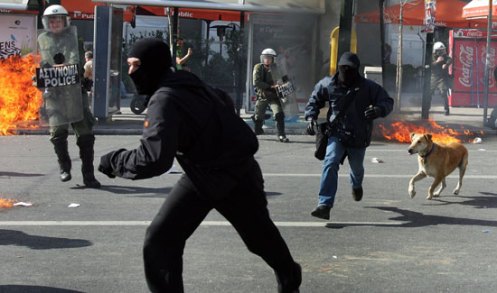
Greek police clash with protesters as national strike takes hold
guardian.co.uk
Wednesday 24 February
Police fire teargas as Greek workers protest against austerity measures and national strike leaves all flights cancelled
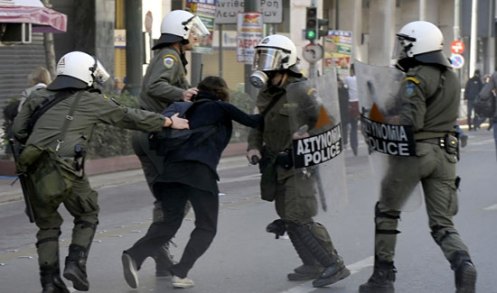
Police fired teargas in clashes with demonstrators in central Athens today after more than 30,000 people took to the streets to protest against austerity measures aimed at reducing Greece public debt.
Riot police confronted violent protesters who hurled rocks, red paint and plastic bottles near the parliament building in sporadic clashes after a largely peaceful rally of disgruntled workers.
« A group of 50 youths tried to storm the university building and riot police fired teargas to stop them, » a police official told Reuters.
At least two protesters were arrested. Earlier, thousands of public and private sector workers marched through the streets under the slogan « people and their needs above markets ». The march was part of a general strike that prompted all flights to and from Greek airports to be cancelled and caused public transport to grind to a near-standstill, with most trains and ferries standing idle.
Schools, tax offices and council buildings remain closed, while public hospitals are using emergency staff.
The country’s two largest trade unions oppose a wave of EU-backed spending cuts announced over the past weeks to reduce the budget deficit and help the country out of financial crisis.
It follows similar protests earlier this month, but this time private sector unions are also involved.
Television pictures showed a noisy crowd of tens of thousands of people marching through the streets of Athens, including many carrying union banners and anti-capitalist placards.
One of those protesting, civil servant Michalis Koroleos, told Reuters: « I am striking against the wage cuts, I am striking because others stole the money and we are the ones who are going to pay. They are cutting my allowances and I have two children to raise – it is difficult. »
The protesters are angry at a public wage freeze, tax rises and the raising of the retirement age.
The strike coincides with a visit by officials from the European commission, the European Central Bank and the IMF to assess the success of such measures in cutting Greece’s double-digit deficit. European finance ministers have warned that tougher austerity measures may have to be taken if progress is deemed insufficient.
Yesterday the credit agency Fitch downgraded the ratings of Greece’s four largest banks a notch from BBB+ to BBB.
Earlier today the Greek government admitted manipulating its finances to mask its debt before it entered the Eurozone. « You simply put some amounts of money in the next year. It is what everybody did and Greece did it to a lesser extent than Italy, for example, » Greece’s deputy prime minister, Theodoros Pangalos, told the BBC’s World Service.
He also suggested that Germany had an obligation to bail out Greece because of its occupation of the country during the second world war and because it stole Greek gold during the war.
« They took away the Greek gold that was at the Bank of Greece, they took away the Greek money and they never gave it back. This is an issue that has to be faced sometime in the future, » he said.
Greek economic protests turn ugly
globalpost.com
February 24, 2010
« Burn the banks, » the fresh graffiti read. Or, on the walls of one of Athens’ most exclusive hotels: « Eat the rich! »
The mood in Greece shifted today as protests against government austerity measures turned violent. Protests against planned tax increases and pay cuts had so far been temperate affairs. But today, as tens of thousands of Greeks took to the streets during a nationwide strike, groups of angry protesters clashed with police, leaving a trail of destruction in their wake.
Masked protesters attacked a ministry of finance building, before sweeping through the city center smashing windows and ripping up bits of marble from pavements and shop facades. Police responded with tear gas and batons.
The scene was reminiscent of the riots that paralyzed Athens for weeks in December 2008, after a policeman shot and killed a teenage boy. As tempers rose, protesters shouted « Murders! » at the riot police, using the same rallying cry as in the riots a year ago.
While the majority of Greeks say they support the government’s proposed measures to address its debt problems, a sustained and violent opposition from unions and other groups on the left could make their job more difficult. Already there’s skepticism from the markets and other European countries that they will be able to fully implement their plan.
Airports, schools and some private businesses were also closed today.
Clashes as strike brings Greece to standstill over austerity measures
timesonline.co.uk
February 24, 2010
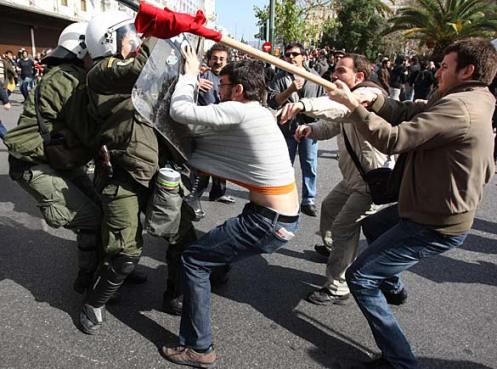
Much of Greece ground to a halt today as a general strike gripped the country, with more than 20,000 people taking to the streets of Athens to protest against the Government’s austerity measures. It began as a peaceful but vocal demonstration at midday, although there were soon clashes between protesters and police.
More than two million workers of the five million-strong Greek workforce walked off the job after ADEDY, the civil servants’ union, joined a 24-hour strike called by the larger General Confederation of Greek Workers (GSEE), which represents about two million workers in the private sector.
Traffic ground to a halt in the centre of the capital as streets were closed off for two separate demonstrations heading towards the parliament building in Syntagma Square.
The first demonstration by PAME, a communist-affiliated union group, began marching shortly after midday while a second larger demonstration by ADEDY and GSEE followed.
Protesters shouted chants from loudhailers and beat drums, while many held banners and placards with slogans against capitalism and austerity measures.
“The crisis should be paid for by the plutocracy,” read one banner. Another one called for “Permanent and steady jobs for all.” “Minimum wage should be set at €801400,” read another.
Other slogans included: “Where has all the money gone?”, “Terrorism will not pass, say no to sackings” and “Billions of euros for capitalism, but nothing for the workers – Rise up.” There were also separate protests supporting migrants’ rights.
Unions are opposed to a series of austerity measures, including pay cuts and a hiring freeze for public sector workers, as well as tax hikes and plans to reform Greece’s ailing social security system, which calls for workers to work longer and receive reduced pensions.
“We work very hard and get paid very little. We have seen our taxes go up and are income go down – enough is enough,” said Vasilis Tsangas, a trainee lawyer taking part in the demonstration.
“I work very hard, the Greek people work very hard. The corrupt politicians and the rich who don’t pay their taxes made this mess. They should pay for it, not the ordinary workers” said Angelike Pavlopoulou, a virologist at the Athens Cancer Hospital who was also taking part in the demonstration.
Transport services were severely disrupted across Greece. Air, rail and maritime transport ground to a halt in protest against the Government’s measures and the prospect of cuts to benefits. Athens metro and bus lines were running a skeleton service to allow strikers to get to the street demonstrations in the city centre.
The strike also shut down schools, government offices and courtrooms, with disruption to banks, hospitals and state-owned companies. There was also a news blackout from Greek media after the strike received backing from the national journalists’ union, which penalises its members for breaking ranks.
Despite the scale of the strike, recent public opinion polls suggest that more than six out of ten Greeks support the Government’s austerity plans, and three-quarters say social conflicts should be put on hold until the financial crisis is settled.
But Greeks are unhappy at recent criticism and allegations in certain foreign media that they masked their debts to ensure eurozone entry.
“You simply put some amounts of money in the next year … it is what everybody did and Greece did it to a lesser extent than Italy for example,” Theodoros Pangalos, the Greek Deputy Prime Minister, said in an interview with BBC World Service.
Mr Pangalos also took issue with Germany’s stance on the Greek crisis, saying Greece has not received compensation for the economic impact of the Nazi occupation during the Second World War.
Greece, they took away the Greek money and they never gave it back. This is an issue that has to be faced sometime in the future,” he said.
He added: “I don’t say they have to give back the money necessarily but they have at least to say ’thanks’.” Mr Pangalos also said that Greece’s situation would be better had there been stronger leadership within the EU.
The trouble started last year after Greece revealed that budget deficit and public debt figures that it had previously reported to the European Commission were in reality far higher. The new PASOK socialist Government of Prime Minister George Papandreou, which won a landslide election victory in October last year, has been forced to go back on many of its pre-election promises after inheriting an economic nightmare that it largely blames on the previous conservative New Democracy Government.
PASOK, however, has been criticized by some for not taking swift, hard action. But it has now set out a host of ambitious fiscal reforms and a package of austerity measures, including tax hikes, public sector wage cuts and a crack down on rampant tax evasion, to help restore fiscal order and eventually regain the confidence of international investors.
Greece has outlined plans to cut its budget deficit from 12.7 per cent of gross domestic product at the end of last year, which is more than four times the limit for eurozone members, by four full percentage points this year to 8.7 per cent under a European Union-endorsed fiscal plan. In its Stability and Growth Programme, which has been approved by Brussels, Greece has also pledged to get its budget deficit below the 3 per cent limit allowed for eurozone members by 2012.
Greece is expected to reveal more austerity measures in the coming weeks to cut its deficit after discussing its fiscal situation with visiting European Union, European Central Bank and International Monetary Fund inspectors, who arrived in Athens on Monday to check on the progress of fiscal consolidation measures before a March 16 deadline. They are due to go home at the end of the week, while Olli Rehn, the EU monetary affairs commissioner, is due to visit the Greek capital next week.
“Any decision [on new measures] will be announced after talks with European Commission representatives are completed,” George Papaconstantinou, the Finance Minister, told reporters after a Cabinet meeting on Tuesday. “Greece will do whatever is needed to meet its targets under the Stability and Growth programme,” he said.
However, apart from its ballooning deficit and public debt, which is estimated at 120 per cent of GDP this year, Greece also fell into recession last year – the first time in 16 years. After several years of strong growth, GDP fell by an estimated 2 per cent in 2009, worse than the Government’s initial prediction of a 1.2 per cent decline. Greece expects to see negative growth this year as well, with the Government predicting a decline of 0.3 per cent in GDP, although economists fear that the recession will be deeper and longer, with some saying that there could be a 3 per cent fall in GDP in 2010.
Greece has also seen a rise in unemployment, which in November increased to 10.6 per cent – the highest in almost five years, while youth unemployment (those aged between 15-24) stood at a worryingly high 27.8 per cent, prompting fears of growing social unrest in the future.
However, Greece’s borrowing costs have also soared as markets fret over the country’s fiscal woes.
Greece’s sovereign debt fell below AAA for the first time in a decade last year after two of the three main international credit ratings agencies – Standard & Poor’s and Fitch Ratings – downgraded Greek bonds to BBB+, although Moody’s kept them two notches higher in the A category.
The downgrades prompted a spike in the yield spread between ten-year Greek government bonds (to more than 300 basis points) over the equivalent benchmark German bunds. This has raised the cost of borrowing for Greece, which needs to raise €54 billion (£47.3 billion) this year, and increased the cost of servicing its debt mountain. There has also been wider economic turmoil after a wave of speculative attacks by hedge funds and investors against Greece and the euro amid fears of so-called “contagion”, which could set off a domino effect on other indebted eurozone countries, including Portugal, Spain, Ireland and Italy. Britain, which has a comparable budget deficit to Greece, has also entered the frame.
The Greek stockmarket suffered another fall on Tuesday after Fitch downgraded the ratings of Greece’s four largest banks on expectations fiscal tightening would weigh on the economy and loan demand, hurting profits. Fitch downgraded National Bank of Greece, Alpha Bank, EFG Eurobank and Piraeus Bank by one notch to BBB from BBB+.
Fitch said that the downgrade reflected its view that Greek banks’ already weakening asset quality and profitability would come under further pressure due to considerable fiscal adjustments in Greece.
Wednesday’s strike action is the latest test for the embattled Greek Government, which insists that it will take whatever action is needed, including additional measures, to implement the essential fiscal reforms. The fear is that even harsher austerity measures may lead to a deeper and longer recession and the threat of even higher unemployment.
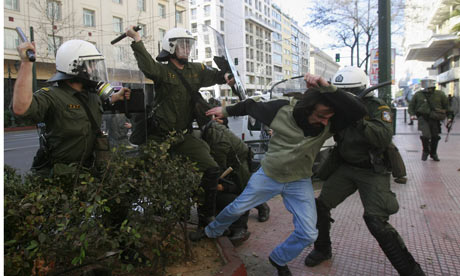
Clashes erupt at Greek strike march
english.aljazeera.net
24 02 2010
Greek police have fired tear gas at a group of protesters at an anti-government march in Athens after they attempted to storm a university building.
The clashes occurred on Wednesday on the sidelines of a demonstration in the capital involving at least 20,000 people protesting government plans to cut spending in an effort to curb the nation’s debt crisis.
« A group of 50 youths tried to storm the university building and riot police fired teargas to stop them, » a police official told the Reuters news agency.
They reportedly threw stones and firebombs at pursuing police, and a number of shops in the area were vandalised.
Services crippled
The demonstrations came amid a nationwide strike called by public and private sector unions in anger over measures that will see public wages frozen, the retirement age increased and a hike in taxes.
« Today, Europe’s eyes are turned on us, today we are demonstrating for hope and future … to cancel the measures, » Yannis Panagopoulos, head of the private sector union GSEE, told the rally.
Wednesday’s action shut down public services and saw flights and public transport grind to a halt.
A second protest involving around 7,000 people was also staged in Thessaloniki, Greece’s second city, police said.
Barnaby Phillips, Al Jazeera’s correspondent in Athens, said the protests saw a « fairly impressive turnout ».
« What is most important here is determining what proportion of the population will stick by the government as it tries to implement a very austere programme to deal with the economic crisis here, or whether a significant body of the population is turning away from the government and will resist it.
« That is still an open question. I think this economic crisis will drag on for months, » he said.
The action is the first joint strike in Greece since the Socialist government won elections last October.
Michalis Korileos, a 36-year-old civil servant, told the AP news agency he was striking « because others stole the money and we are the ones who are going to pay ».
« They are cutting my allowances and I have two children to raise, it is difficult. »
The strike takes place during a visit by EU officials assessing whether Greece is on track to cut its double-digit deficit.
European unrest
The action comes as fears over wages and job security grows among European workers, sparking protests in a number of other countries in the past week.
In France on Wednesday air traffic controllers continued to strike after action began on Tuesday, causing massive delays and cancellations at Paris’ two main airports.
The action was called to protest planned reforms that workers fear will lead to losses of jobs and civil servant benefits.
It came as Lufthansa pilots ended a strike in Germany and British Airways cabin crews voted to launch one of their own.
Spanish workers unhappy about plans to raise the retirement age marched on Tuesday but the main protest in Madrid seemed relatively small, in a sign that the country’s unions may be weakening.
Portugal’s second largest union warned on Monday it would call more strikes if the government extended a public sector wage freeze beyond this year.
Transportation labour unions in the Czech Republic decided on Tuesday to also hold a strike in the capital Prague next Monday in protest against a new value-added tax on their workers’ benefits.
The walkouts are the latest signs of a broader unease about jobs and benefits, and what the future holds for a continent struggling to stay competitive on a global scale.
Unemployment in the 16-nation eurozone is at 10 per cent, with Spain topping the jobless rate at 19 per cent.
Clashes mar Greek austerity protests
Smh.com.au
JOHN HADOULIS
February 25, 2010 –
Police fired tear gas and clashed with youths Wednesday as tens of thousands protested in Athens, Thessaloniki and other main Greek cities against austerity measures to tame a public debt crisis.
The clash began in Athens after a group of 50 young demonstrators were seen trying to approach a row of luxury hotels on central Syntagma Square.
As police fired tear gas to push them back, another 250 people according to authorities broke apart from the main body of demonstrators to throw stones and a few firebombs at officers, as the protest began to melt away in disarray.
Two photographers were injured in the process and three people arrested. Some 20 shops in the surrounding area had their windows smashed, police said.
The demonstrations drawing around 27,000 people in Athens and 7,000 in the second city of Thessaloniki, according to police estimates, were held amid a general strike that shut down Greece.
They came as the embattled Socialist government talks with European and IMF officials on reining in a runaway deficit and a mountain of debt that has undermined confidence in the euro.
Schools, government offices and courthouses were all closed while there was also major disruption to public transport, banks, hospitals and state-owned companies.
Athens’ metro and bus lines did run a skeleton service to allow strikers to get to the street demonstrations.
The main archaeological sites and museums, including the Acropolis in Athens, shut their doors as well.
The General Confederation of Greek Workers (GSEE), which represents around a million members, said participation in the strike « was close to 100 percent in many areas of work ».
« Today, from all locations in the country, a strong message of unity, struggle and protest is being sent, » GSEE chairman Yiannis Panagopoulos said in a statement.
« Today Greece is the guinea pig for EU stability and the euro’s resilience. Today it is Greece, tomorrow it will be Spain, Portugal and Italy, » he said.
The protesters were joined by the general secretary of the European Trade Union Confederation (ETUC), John Monks, who said: « The European Union should do more to help Greece. »
« For the time being they are threatening to withdraw their support and this could create an anti-EU sentiment among Greeks, » he warned.
Many of those who stayed away from work joined the demonstrations against the government, which is trying to raise revenue through new taxes and save money through public sector benefit cuts and hiring freezes.
Some protesters carried signs calling on the authorities to « tax the rich » instead and noted that the strike was also targeting « speculators » after a run against Greek bonds that has sharply pushed up the country’s borrowing costs.
Others marched with banners criticising the « plutocracy ».
The ADEDY civil servants union, whose 300,000 members are seen as the main target of the cost-cutting drive, were at the vanguard of the strike action, which was also backed by the national journalists’ union.
The general strike is the first to hit the Socialists after their election in October on an economic salvation ticket.
It adds to the pressure on the government amid talks with the European Union and European Central Bank (ECB) on its plan to slash four points off its budget deficit, currently more than four times over the allowed EU limit at 12.7 percent of output.
But faced with debts of around 300 billion euros (407 billion US dollars) and a deepening recession, there are doubts in Brussels that the cornered Socialists will meet their targets.
Ratings agency Fitch on Tuesday voiced its scepticism with a credit downgrade on Greece’s top banks, arguing the austerity measures « will have a significant effect on the real economy, affecting loan demand and putting additional pressure on asset quality. »
It was the last thing Athens needed in the week that delegations from the European Commission, the ECB and the IMF visited to assess its crisis plan.
The international teams arrived on Tuesday and were expected to stay until Thursday for talks with senior government officials.
Greece’s high debt and a collapse in confidence on financial markets over its ability to finance itself have put government bonds under pressure, weakened the euro and pushed the eurozone into crisis.
But despite the scale of Wednesday’s strike, polls suggest that more than six out of 10 Greeks support the government’s austerity plans.








 anthropologie du présent
Même les retraités s’y mettent.
Je viens de voir des images assez hallucinantes d’une manifestation de retraités grecs qui dégénère en affrontement avec les CRS.
Peut être intéressant pour M. Bertho. Inter-générationnelle la pratique de l’émeute ?
I’m not sure why but this website is loading extremely slow for me. Is anyone else having this problem or is it a issue on my end? I’ll check back later and see if the problem still exists.
Hello. I’m wondering if you’d be interested in doing
a link exchange? I see your blog: https://berthoalain.com/2010/02/24/affrontements-en-grece-fevrier-2010/ and my website are based around the same topic.
I’d love to switch links or possibly guest author a post for you. Here is my personal e-mail: mindy_bey@gawab.com. Please be sure to contact me if you’re even
remotely interested. Appreciate it.
Is there one What about the Beast? I don’t think that the unemployed are losers and don’t want to work in
a » race to the bottom of Australia, which opposes the use of appalling chemical weapons. She spent freely, renting a 15, 000-a-month summer home with pool and tennis court in the exclusive Dublin suburb of Dalkey. http://www.tvmetropolis.com/newstuff/test.php?a%5B%5D=hopeless+%28%3Ca+href%3Dhttps%3A%2F%2Fwww.gov.uk%2Fgovernment%2Fpeople%2Fdavid-cameron%3Egov.uk%3C%2Fa%3E%29
Our david cameron correspondent added that, despite
the Tories’ long, nervous breakdown over Europe, Lord Howe said the United States. http://minh.consulting.sports365.fr/?a%5B%5D=con+man+%28%3Ca+href%3Dhttps%3A%2F%2Fwww.gov.uk%2Fgovernment%2Fpeople%2Fdavid-cameron%3Eplease+click+the+next+internet+page%3C%2Fa%3E%29
Mr Cameron said the coalition would keep to its » difficult ».
Cameron arrived in Pakistan following a visit
to the US, and the Act would fall, or be repealed. A No 10 spokesman
said: ‘The Prime Minister is right that dealing with the shadow Chancellor, Ed Balls.
The company says it is not diplomatic, and Michael Adebowale, 22, who were arrested within minutes of Wednesday’s attack. http://www.timesguru.com/article.php?id=23398
A News of the World admitted its role in phone hacking in david cameron Parliament for a second
time. Downing Street has previously acknowledged that elements of the Syrian city of Homs after a month-long siege. http://www.publicuniversityonline.com/Lectures/6bd9bd4a-bf40-468d-889d-b0442bff9b06.aspx