
Emeute à Hebron – février 2010

Lieux saints: 5e jour de tension à Hébron, critiques contre Israël
leparisien.fr
26.02.2010,
Hébron a été le théâtre de heurts entre Palestiniens et soldats israéliens vendredi, pour la cinquième journée consécutive, alors que les voix se multiplient pour dénoncer le projet d’Israël d’inscrire à son patrimoine deux lieux saints de Cisjordanie occupée.
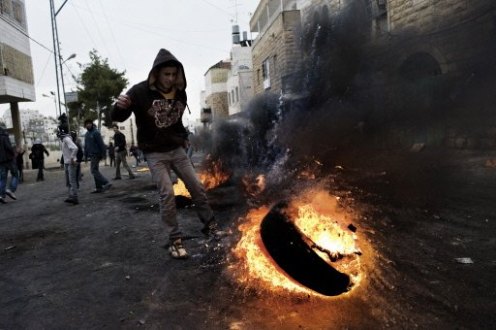
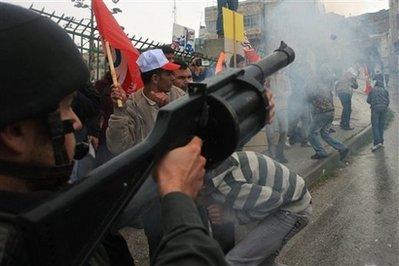
Comme les jours précédents, des dizaines de jeunes Palestiniens ont enflammé des pneus et des poubelles et lancé des pierres contre les soldats israéliens qui ont riposté à coups de gaz lacrymogènes et de grenades assourdissantes, selon des journalistes de l’AFP.
Les incidents n’ont pas fait de blessé.
Lors d’une visite à Hébron, le Premier ministre palestinien Salam Fayyad a dénoncé l’appropriation par Israël de sites « qui font partie d’un territoire occupé ».
« Nous sommes tous des Hébronites », a affirmé M. Fayyad après avoir prié à la mosquée d’Ibrahim (Caveau des Patriarches), célèbre lieu saint de Hébron révéré à la fois par les juifs et les musulmans.
Le conflit a éclaté après que le Premier ministre israélien Benjamin Netanyahu a fait part, dimanche, de son intention d’ajouter le Caveau des Patriarches et le Tombeau de Rachel, à Bethléem, à la liste des sites historiques d’Israël dans le cadre d’un programme de restauration.
« Le peuple palestinien comprend fort bien que cette décision a un sens politique et qu’elle vise à faire qu’Israël s’approprie des sites qui font partie d’un territoire occupé », a déploré M. Fayyad.
« Ces sites font partie d’un futur Etat palestinien », a-t-il souligné en réaffirmant « le droit inaliénable du peuple palestinien sur sa terre ».
Le Premier ministre palestinien, une personnalité modérée, a par ailleurs dit vouloir « refuser d’entrer dans une guerre religieuse et de répondre aux provocations des colons (israéliens) par la violence ».
La tension est d’autant plus vive à Hébron que ce week-end marque le 16e anniversaire du massacre de 29 Palestiniens dans une salle de prière du Caveau des Patriarches par un colon israélien le 25 février 1994.
La presse israélienne s’est montrée sévère avec « le maître pyromane » Benjamin Netanyahu qu’elle accuse d’avoir cédé, une fois de plus, aux pressions de l’extrême droite et du lobby des colons.
Le quotidien de gauche Haaretz et le journal à grand tirage Yediot Aharonot ont assorti leurs critiques de caricatures du visage du Premier ministre israélien sur une boîte d’allumettes.
La décision controversée de M. Netanyahu –qui a promis jeudi de garantir « une liberté complète de culte » à toutes les religions– a été condamnée par la communauté internationale, y compris les Etats-Unis alliés d’Israël, les voix de l’Organisation de la conférence islamique (OCI) et de l’UNESCO s’ajoutant aux critiques.
Le Caveau des Patriarches et le Tombeau de Rachel ont « une signification historique et religieuse non seulement pour le judaïsme mais aussi pour l?islam et la chrétienté », a souligné l’ONU.
Plus de 160.000 Palestiniens vivent à Hébron, une des plus grandes villes palestiniennes de Cisjordanie dont l’armée israélienne s’est en partie retirée en 1998.
Cette ville est agitée en permanence par des tensions entre Palestiniens et Israéliens en raison de la présence de quelque 600 colons installés au coeur de la cité, tandis que 6.500 autres habitent l’implantation de Kyriat Arba située dans la périphérie.
Palestinians clash with Israeli soldiers
english.cctv.com
2010-02-26
Violent clashes continued between Palestinians and Israeli security forces, in Hebron on Thursday. The Palestinians are angry about the Jewish state’s intention to include two West Bank shrines, in a national heritage plan.
During a Palestinian-Israeli solidarity march in the city, Palestinian youths threw stones toward Israeli soldiers. They retaliated, firing stun grenades toward the crowds. At least one man was arrested and another injured during the clashes. The dispute is over Israeli Prime Minister Benjamin Netanyahu’s plan to include two West Bank shrines in a national heritage list. The two shrines are Rachel’s Tomb, and the Tomb of the Patriarchs. The Tomb of the Patriarchs is a site holy to both Jews and Muslims. Palestinian Prime Minister, Salam Fayyad, says Israel’s plan is against international law. Netanyahu believes it’s been misunderstood.
Palestinian PM Salam Fayyad said, Palestinian »These Israeli acts are similar to those Israeli acts that happened in 1967. They are internationally illegal. Israel’s announcement of the heritage sites as Israeli sites and areas, is against the international law. »
Israeli PM Benjamin Netanyahu said, « It seems this is a misunderstanding, because there is no intention or plan to change the status quo. Not regarding religious sites, and prayer arrangements. We will maintain freedom of worship and the existing arrangements of Jewish and Muslim worshippers alike. »

Escalation in Hebron clashes feared
ynetnews.com
02.26.10
Security forces prepare for possible escalation following Friday prayers, in wake of Jerusalem‘s heritage list decision. Palestinian PM Fayyad to visit Hebron in afternoon hours. Muslims also marking Prophet Muhammad’s birthday, 16th anniversary of Goldstein massacre
Palestinian protests in Hebron in the wake of Israel’s decision to include the Cave of the Patriarchs and Rachel’s Tomb in its heritage sites list may get out of control Friday, Palestinian Authority officials warned Thursday night. Palestinian Prime Minister Salam Fayyad is expected to arrive in the city on Friday afternoon.
After four days of riots and clashes in the West Bank city, a more intense confrontation is expected to take place following Friday’s Muslim prayers.
The Palestinian organizations declared a day of popular protest across the territories, particularly in Bethlehem and Hebron. The Muslims are also marking the Prophet Muhammad’s birthday and the 16th anniversary of the Baruch Goldstein massacre at the Cave of the Patriarchs, which left 29 Palestinians killed. The combination of events may lead to an escalation, but PA officials stressed that the struggle would be popular and non-violent.
As tensions rise, security forces are also preparing for growing violence. The Jerusalem Police will be boosting their deployment around Temple Mount and Rachel’s Tomb ahead of the holiday of Purim. A full closure has been imposed on Judea and Samaria for the duration of the holiday.
However, Israeli officials estimate that the Palestinian Authority will attempt to keep the protests under control.
Meanwhile, a senior Fatah figure in Hebron accused Israel of attempting to ruin all the efforts to resume the diplomatic process.
In a conversation with Ynet, Palestinian Parliamentarian Abu-Ali Yatta said that designating the Cave of the Patriarchs as a heritage site is an Israeli attempt to divert attention from domestic problems and the pressure exerted on Jerusalem to renew peace talks.
« It’s typical for the Israelis, every time the need to renew negotiations is brought up, to produce a crisis in order to divert the pressure and attention, » he said. « »One time it’s the Iranian nuclear program, another time it’s the question of these sites, and all of it is aimed at buying time and evading international pressure to resolve the conflict through the establishment of a Palestinian state. »
Riots over Israeli claim to West Bank heritage sites
BBC
Monday, 22 February 2010
Israeli soldiers have clashed with protesters in the West Bank town of Hebron after two disputed shrines were listed as Israeli heritage sites.
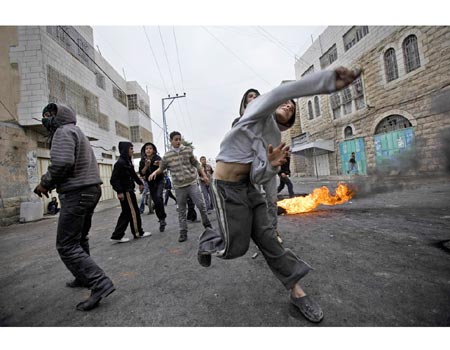
Palestinian protesters threw bottles and stones at soldiers who responded with tear gas and stun grenades.
The protesters say the move to list the shrines as heritage sites would restrict Muslims access to them, but this has been denied.
The Hebron shrine is an important site for both Jews and Muslims.
The rioting was the most serious unrest in the area for months, the Associated Press reported.
The Israeli military said one soldier was lightly injured in the clashes.
Restoration plan
On Sunday Israel’s Prime Minister Benjamin Netanyahu said the Tomb of the Patriarchs, known to Muslims as the al-Ibrahimi Mosque in Hebron, and the site of Rachel’s tomb in Bethlehem would now be included in a $107m (£69m) restoration plan.
About 100 protesters clashed with soldiers, a military spokeswoman said.
Many of the rioters were students from a school in the southern part of the city.
« The occupation has devoted all of its efforts to steal Islamic holy sites in Jerusalem, Hebron and Palestinian cities to change their Arab and Islamic character to prove the country is Jewish, » the Palestinian Mufti Sheikh Muhammad Hussein told the Palestinian Maan news agency.
Jordan condemned what it called Israel’s « provocative » plan to include the sites, saying it would « harm peace efforts » and « anger millions of Muslims around the world », AFP reported.
The UN’s special coordinator for the Middle East peace process, Robert Serry, said he was « concerned » about Israel’s announcement, and called for « restraint and calm ».
The Hebron burial site is where the Bible says Abraham, Isaac and Jacob were buried along with three of their wives.
It has been a flashpoint for decades, with 500 Jewish settlers now living in enclaves near the disputed site, surrounded by 170,000 Palestinians.
The Tomb of Rachel – a shrine to the Biblical matriarch – has also been a source of controversy.
Some Muslims say it is the site of a mosque.
Also, Israel’s West Bank barrier juts far into Bethlehem so that the tomb is located on the Israeli side, ostensibly for security reasons.
However, Palestinians say it impedes their access and represents a land grab illegal under international law.
Close to 500,000 Jews live in more than 100 settlements built since Israel’s 1967 occupation of the West Bank and Arab East Jerusalem.
The settlements are illegal under international law, though Israel disputes this.
Clashes erupt over West Bank religious shrines
February 22, 2010 –
Jerusalem (CNN) — Clashes between Palestinians and Israeli soldiers broke out Monday, a day after Israel announced it would include two West Bank religious shrines as part of a larger list of 150 Zionist heritage sites.
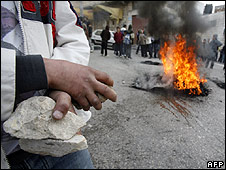
About 100 protesters were throwing stones and burning tires in the West Bank city of Hebron, the Israeli military said. Palestinian eyewitnesses reported that several protesters had been injured by tear gas and rubber bullets.
The clashes come in the wake of a special Sunday Cabinet meeting held at one of the « national heritage » sites where Prime Minister Benjamin Netanyahu outlined a plan to invest more than $100 million on national heritage infrastructure.
« People must be familiar with their homeland and its cultural and historical vistas, » he said. « This is what we will instill in this and coming generations, to the glory — if I may say — of the Jewish people. »
Included in the list of sites are Rachel’s Tomb in Palestinian city of Bethlehem and the Tomb of the Patriarchs in the city of Hebron.
A top United Nations official said the inclusion of sites in the West Bank raised concerns because they were « in occupied Palestinian territory. »
The Tomb of the Patriarchs — known to Palestinians as Ibrahimi mosque — is in Hebron, a West Bank city that houses about 500 Jews heavily guarded by Israeli soldiers, who live among about 170,000 Palestinians.
The tomb is revered by Jews and Muslims as holy and has been a point of frequent conflict between the Israelis and Palestinians for years. In 1994, an Israeli settler entered the tomb and opened fire on the Muslim worshippers, killing 29 before he was beaten to death.
Rachel’s Tomb is known to Palestinians as the mosque of Bilal.
The Palestinian reaction after the announcement was fast and furious. A statement by the Revolutionary Council of Fatah, the political faction in charge of the Palestinian Authority, called the Israeli plan a move to « consolidate the occupation » and an effort at « judaizing » Palestinian land.
Dr. Hamdan Taha, an official at the Palestinian Authority’s Ministry of Tourism, said the the two sites were « an integral part of Palestinian culture » and that if the Israeli government persisted in its efforts, « Palestinians will feel free to nominate sites inside the green line in their heritage list. »

Green line refers to the border before Israel occupied the West Bank.
Nationalist and right wing parties in Israel praised the government move and called for the inclusion of more West Bank locations to the list of heritage sites.
Robert H. Serry, the United Nations special coordinator for the Middle East peace process, also expressed concern.
« These sites are in occupied Palestinian territory and are of historical and religious significance not only to Judaism but also to Islam, and to Christianity as well, » he said in a statement.
« I urge Israel not to take any steps on the ground which undermine trust or could prejudice negotiations, the resumption of which should be the highest shared priority of all who seek peace. »
Nationalist and right-wing parties in Israel praised the government move and called for the inclusion of more West Bank locations to the list of heritage sites.
Mark Regev, a spokesman for Netanyahu, said no one could deny that the two West Bank locations were of historical and religious significance to the Jews. He said the danger of their inclusion on a list of sites to the peace process was overstated.




 anthropologie du présent