
Affrontements meurtriers à Rangamati au Bangladesh – février 2010

Curfew off at Kh’chhari
bdnews24.com
Fri, Feb 26th, 2010
Khagrachhari, Feb 26 (bdnews24.com) — After three consecutive days, curfew was withdrawn at Khagrachhari district town on Friday evening.
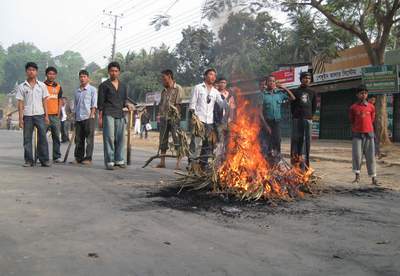
The curfew and a daytime section 144, preventing people from gathering at one place in large numbers, had been in force for the last three days due to widespread violence in the hill district.
The deputy commissioner, Mohammad Abdullah, told bdnews24.com that the section 144 would still be in force.
The police have arrested four prominent politicians of the main parties including those from the ruling Awami League, opposition BNP and its main ally the fundamentalist Jamaat-e-Islami.
The arrested are, local Jamaat chief Maybubul Haque Selim, former municipal chairman and former president of district BNP, Md Abul Kashem, district AL leader Md Islamuddin and PBCP organising secretary Md Anwar Hossain.
Khagrachhari’s acting police superintendent Md Amir Zafar confirmed bdnews24.com of their detention at about 10.00pm
Bangladesh imposes curfew after riots
hindustantimes.com
Dhaka, February 25, 2010
Authorities in Bangladesh imposed a fresh night-time curfew in its south-eastern Khagrachhari hill district following riots between rival ethnic groups, officials said.
« Night-time curfew between 2200 hours (2130 IST) Wednesday and 0700 hours (0630 IST) Thursday will remain in force, » chief administrator of the district Mohammad Abdullah, told DPA.
Troops had remained deployed to prevent any trouble, he added.
Soldiers and police earlier launched a crackdown in the Khagrachhari hill district following riots between ethnic minority people and Bengali settlers.
They arrested 55 people allegedly involved in Tuesday’s violence, which left at least 15 people injured and several homes torched, additional police chief of the district Amir Jafar said.
« The drive against the criminals is underway, and the ban on all sorts of gatherings remains in force, » he said.
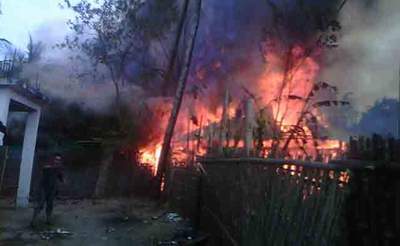
A total of 94 families were affected by Tuesday’s arson attacks, officials said. Ninety-two homes were completely burnt down while two others were vandalised.
The victims were being forced to sleep in the open and had no food, Chaithoai Marma, a tribesman, said.
The streets were mostly deserted and businesses were shut, said one resident from the district centre, some 275 km south-east of Dhaka.
Khagrachhari is one of the three districts in Chittagong Hill Tracts, home to at least 12 ethnic minority groups. Long-standing animosity exists between indigenous communities and Bengali settlers in the area.
The region was battered by insurgency for over two decades until a peace deal was signed between the government and the Parbatya Chattagram Jana Sanghati Samiti, a political party of the indigenous people, in late 1997.
State Minister for Home Affairs Shamsul Haq Tuku has toured the area and promised relief assistance to the victims, most of whom were said to be from ethnic minorities.
Ethnic violence continues in Bangladesh’s Chittagong Hill tracts
timesofindia.indiatimes.com
Feb 25, 2010
DHAKA: Curfew was reimposed as ethnic violence in Khagrachhari resumed late on Wednesday night after a day long calm. It’s now been six days since the clashes began between Muslim settlers and the Buddhist tribals in Chittagong Hill Tracts (CHT).
Seven houses in Golabari, the tribal neighbourhood and five houses of Bengali-speaking settlers in Mollah Para and Ganj Para were set on fire on Wednesday night.
« The flames were licking the night sky while electricity supply in the town was cut off. Screams, yells, wailings, and sirens of rushing fire trucks were filling the air amid a curfew that went into effect at 10 p.m., scheduled to be lifted at 7 a.m. on Wednesday, » The Daily Star said.
The six-day violence has claimed three lives and injured 70 while more than 500 houses were set on fire, over 400 of which belonged to tribals. The violence made 3,000 tribals and 500 Bengali settlers homeless, the newspaper said.
Journalists visiting the affected areas were pursued on motorcycles by settlers who sought to intimidate them and block their routes, the newspaper said.
State Minister for Home Shamsul Hoque Tuku who visited Khagrachhari and Rangamati Wednesday, alleged that the opposition Bangladesh Nationalist Party and the Jamaat-e- Islami Bangladesh « are hatching conspiracies to create unrest in the country ».
Despite orders banning any demonstration, Parbatya Bengali Chhatra Parishad, a student organisation of Bengali settlers, announced a daylong transport strike in all three hill districts on Thursday.
All through Wednesday, security forces comprising the army, Rapid Action Battalion (RAB), Bangladesh Rifles (BDR), and police patrolled the streets of Khagrachhari town.
The law enforcers arrested 70 people, including 42 tribals. However, the drives ended up flaring the ethnic tension as many indigenous people complained that many of those who were arrested were innocent.
Located in southeastern Bangladesh bordering Myanmar, CHT, home to Buddhist tribals, has witnessed ethnic violence. Bengali-speaking Muslims were settled in the area to keep the militancy-affected area under control.
Prime Minister Sheikh Hasina reached an accord with the tribals in 1997, but most of the provisions remain to be implemented.
Curfew off at Kh’chhari
bdnews24.com
Fri, Feb 26th, 2010
Khagrachhari, Feb 26 (bdnews24.com) — After three consecutive days, curfew was withdrawn at Khagrachhari district town on Friday evening.
The curfew and a daytime section 144, preventing people from gathering at one place in large numbers, had been in force for the last three days due to widespread violence in the hill district.
The deputy commissioner, Mohammad Abdullah, told bdnews24.com that the section 144 would still be in force.
The police have arrested four prominent politicians of the main parties including those from the ruling Awami League, opposition BNP and its main ally the fundamentalist Jamaat-e-Islami.
The arrested are, local Jamaat chief Maybubul Haque Selim, former municipal chairman and former president of district BNP, Md Abul Kashem, district AL leader Md Islamuddin and PBCP organising secretary Md Anwar Hossain.
Khagrachhari’s acting police superintendent Md Amir Zafar confirmed bdnews24.com of their detention at about 10.00pm
Bangladesh imposes curfew after riots
hindustantimes.com
Dhaka, February 25, 2010
Authorities in Bangladesh imposed a fresh night-time curfew in its south-eastern Khagrachhari hill district following riots between rival ethnic groups, officials said.
« Night-time curfew between 2200 hours (2130 IST) Wednesday and 0700 hours (0630 IST) Thursday will remain in force, » chief administrator of the district Mohammad Abdullah, told DPA.
Troops had remained deployed to prevent any trouble, he added.
Soldiers and police earlier launched a crackdown in the Khagrachhari hill district following riots between ethnic minority people and Bengali settlers.
They arrested 55 people allegedly involved in Tuesday’s violence, which left at least 15 people injured and several homes torched, additional police chief of the district Amir Jafar said.
« The drive against the criminals is underway, and the ban on all sorts of gatherings remains in force, » he said.
A total of 94 families were affected by Tuesday’s arson attacks, officials said. Ninety-two homes were completely burnt down while two others were vandalised.
The victims were being forced to sleep in the open and had no food, Chaithoai Marma, a tribesman, said.
The streets were mostly deserted and businesses were shut, said one resident from the district centre, some 275 km south-east of Dhaka.
Khagrachhari is one of the three districts in Chittagong Hill Tracts, home to at least 12 ethnic minority groups. Long-standing animosity exists between indigenous communities and Bengali settlers in the area.
The region was battered by insurgency for over two decades until a peace deal was signed between the government and the Parbatya Chattagram Jana Sanghati Samiti, a political party of the indigenous people, in late 1997.
State Minister for Home Affairs Shamsul Haq Tuku has toured the area and promised relief assistance to the victims, most of whom were said to be from ethnic minorities.
Ethnic violence continues in Bangladesh’s Chittagong Hill tracts
timesofindia.indiatimes.com
Feb 25, 2010
DHAKA: Curfew was reimposed as ethnic violence in Khagrachhari resumed late on Wednesday night after a day long calm. It’s now been six days since the clashes began between Muslim settlers and the Buddhist tribals in Chittagong Hill Tracts (CHT).
Seven houses in Golabari, the tribal neighbourhood and five houses of Bengali-speaking settlers in Mollah Para and Ganj Para were set on fire on Wednesday night.
« The flames were licking the night sky while electricity supply in the town was cut off. Screams, yells, wailings, and sirens of rushing fire trucks were filling the air amid a curfew that went into effect at 10 p.m., scheduled to be lifted at 7 a.m. on Wednesday, » The Daily Star said.
The six-day violence has claimed three lives and injured 70 while more than 500 houses were set on fire, over 400 of which belonged to tribals. The violence made 3,000 tribals and 500 Bengali settlers homeless, the newspaper said.
Journalists visiting the affected areas were pursued on motorcycles by settlers who sought to intimidate them and block their routes, the newspaper said.
State Minister for Home Shamsul Hoque Tuku who visited Khagrachhari and Rangamati Wednesday, alleged that the opposition Bangladesh Nationalist Party and the Jamaat-e- Islami Bangladesh « are hatching conspiracies to create unrest in the country ».
Despite orders banning any demonstration, Parbatya Bengali Chhatra Parishad, a student organisation of Bengali settlers, announced a daylong transport strike in all three hill districts on Thursday.
All through Wednesday, security forces comprising the army, Rapid Action Battalion (RAB), Bangladesh Rifles (BDR), and police patrolled the streets of Khagrachhari town.
The law enforcers arrested 70 people, including 42 tribals. However, the drives ended up flaring the ethnic tension as many indigenous people complained that many of those who were arrested were innocent.
Located in southeastern Bangladesh bordering Myanmar, CHT, home to Buddhist tribals, has witnessed ethnic violence. Bengali-speaking Muslims were settled in the area to keep the militancy-affected area under control.
Prime Minister Sheikh Hasina reached an accord with the tribals in 1997, but most of the provisions remain to be implemented.

Troops sent to quell unrest in Bangladesh town
Associated Press
2010-02-23
Bangladeshi troops were called in Tuesday to stop ethnic clashes between Bangalee settlers and an indigenous tribe in a southeastern hill town that left nearly a dozen people injured.
Troops and extra police were patrolling the streets of Khagrachhari and all public gathering were banned after several homes were set ablaze by the opposing groups, who are involved in a decades-old land dispute, said Ashraf Ahmed, a police official.
Tribal activists from the United People’s Democratic Front blocked roads and waterways in the area to protest the deaths of two tribal people they say were killed last week by security officials during clashes with the settlers, local police Chief Amir Zafar said.
The government has said it will investigate the deaths as well as a series of arsons that the tribal people blame on the settlers.
Ahmed said no arrests were made in Khagrachhari on Tuesday and the situation there had calmed.
Ethnic tension in the region 110 miles (176 kilometers) southeast of the capital, Dhaka, is not new. Authorities resettled landless Bangalees into the area in the 1980s in a bid to end a tribal insurgency that had troubled the region for nearly two decades.
Tribal groups say many of their people have lost their land because of the settlement and faced brutal repression during years of military operations meant to quell the insurgency. The insurgents signed a peace treaty with the government in 1997, but the tensions have remained.
Tribals killed, temple burnt down by Bangladesh forces
Merinews.com
Sun, Feb 21, 2010
The poverty stricken South Asian country has witnessed the killing of six tribal people in Chittagong Hill Tracts and also the burning down of a Buddhist temple in the locality.
BANGLADESH IS in news but once again for the wrong reasons. The poverty stricken South Asian country has witnessed the killing of six tribal people in Chittagong Hill Tracts during the third week of February. Authentic sources confirmed that the Bangladesh armed forces had also burnt down a Buddhist temple in the locality.
“At least three tribals including Lakkhi Bijoy Chakma and Litan Chakma were shot dead on February 20, and dozens were injured in the firing by the Bangladesh Army while one Buddhist monk, Purnabash Bhikkhu, has been missing after the Buddhist temple was burnt down. Four tribal villages namely Gangaram Doar, Retkaba, Purba Para and Guchachagram, under Sajek Sub-Division of the Chittagong Hill Tracts of Bangladesh, were burnt into ashes,” informed a credible New Delhi based rights body.
Asian Centre for Human Rights, in an official statement also added that the armed force personnel also involved in burning down few shops in Ladumani bazaar and an UNDP sponsored village centre with one Buddhist temple and one church in the night of February 19 last.
Speaking to this writer from New Delhi, the ACHR director Suhas Chakma, informed that his centre had already ‘sought the intervention of the UN High Commissioner for Human Rights, Ms Navi Pillay with the government of Bangladesh for initiating appropriate actions against the culprits’.
“Bangladesh Army and illegal plain settlers had arrived in the locality during the night of February 19, and went about burning the tribal villages and also indiscriminate killing of indigenous Jumma people there,” quoting reliable sources, Chakma asserted.
He also added that the Bangladesh Army continued the destructive activities in the tribal villages till the evening of February 20.
Since the beginning of January this year, illegal plain settlers with the support of Bangladesh army personnel posted at Baghaihat zone under Rangamati district resumed expansion of their illegal settlement into the villages of the Chakma people. A number of houses have already been erected by the illegal plain settlers by forcibly occupying Jumma villagers’ lands.
The Jumma villagers under the banner of Sajek Bhumi Rakkha Committee (Sajek Land Rights Protection Committee) submitted a memorandum to the Baghaichhari Upazila Nirbahi Officer on January 10, 2010 with an ultimatum of January 16 to return them their lands. As the deadline expired without any fruitful result, Jumma villagers started their agitation and started to boycott Baghaihat market from January 18, 2010.
The Bangladesh Army personnel have reportedly erected barricades and have further been preventing the public leaders, civil officials and the journalists from visiting the affected areas.
“This particular attack on the indigenous Jumma peoples shows that the government of Bangladesh has failed to change its policy of indiscriminate killings of indigenous Jumma people in order to occupy their lands and implant more illegal plain settlers instead of implementing the Chittagong Hill Tracts Accord of 1997,” Chakma concluded.

Bangladesh tribals clash with settlers;100 hurt
reuters
Sun Feb 21, 2010 1:31pm IST
DHAKA (Reuters) – Authorities in Bangladesh deployed the army to the southeastern hill region after more than 100 people were injured in clashes between tribals and Bengali settlers, police and local media said on Sunday,
At least two people were killed in the clashes that raged
throughout Saturday in the Rangamati Hill District, about 350 km (220 miles) from the capital Dhaka, the worst violence in the area in years.
Thousands of landless Bengalis, mostly victims of river erosion, were settled in the Chittagong Hill Tract region under a government plan in the 1980s to ease population pressure in the plains and also to defuse a tribal insurgency.
Relations between the settlers and the tribal groups have been tense over ownership of lands, often leading to violence.
« Army troops have been deployed and the situation is under control but very tense, » a local reporter said on Sunday by telephone. « Assembly of more than five people has been prohibited. »
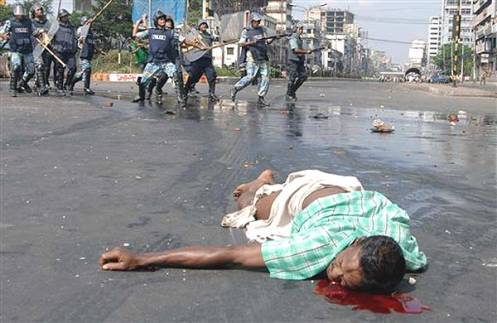
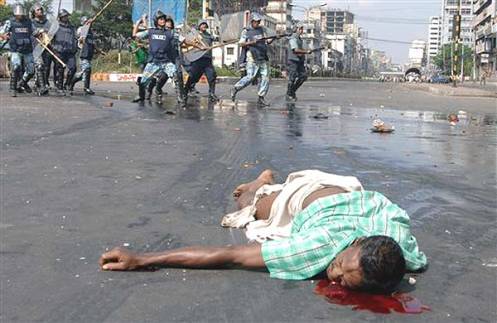
Police said they found bullet-riddled bodies of a man and a woman in the Rangamati district where the clashes erupted. More than 100 homes were set on fire.
In 1997 the Bangladesh government signed a peace deal with tribal Shanti Bahini guerrillas who waged a 25-year insurgency over demand for political autonomy in the 5,500 sq miles (14,200 sq km) Chittagong Hill Tracts, bordering India and Myanmar.
Police said a tribal group opposed to the peace accord attacked a settlers village, sparking the latest violence.

Action against culprits in 7 days, minister says in Rangamati
thedailystar.net
Sunday, February 21, 2010
State Minister for Chittagong Hill Tracts Affairs Dipankar Talukder on Sunday assured the indigenous people that action would be taken against those responsible for Saturday’s Rangamati incident within the next seven days.
The minister made the assurance while visiting Gangaram Mukh village in Baghaichhari upazila of Rangamati where two indigenous people were killed in army firing on Saturday, report our Khagrachhari and Rangamati correspondents.
Meanwhile, the outraged villagers vandalised the car of Baghaichhari upazila nirbahi officer AHM Humayun Kabir in Ansar Camp area. However, the UNO was not inside the vehicle.
Protesting imposition of the section 144 in the area, they damaged the car, the indigenous people said.
While visiting, the minister said, « there is no word like ‘indigenous and Bangalee’. We all are citizens of the same country. »
There are some criminals in both the indigenous and Bangalee people, who practice ill politics involving people from the groups, he said adding that the criminals benefit from the practice but the general people suffer.
He condemned the incident and assured of proper investigation and exemplary punishment to the culprits.
« I am here to listen you. You will get your lands and houses back, » he said.
The government has taken measures to distribute enough relief materials among the victims, the minister said.
A list of victims will be made very soon to compensate them, he added.
The minister also distributed cloths and dry foods among the victims.
Earlier in the morning, the CHT affairs minister along with CHT Refugee Affairs Taskforce Chairman Jyotirindra Lal Tripura, Police Super Masud-ul-Hassan and security forces tried to enter the area but the ethnic villagers resisted them at Bangaltali, 15km off the spot for 30 minutes, putting barricade on the road around 10:00am.
In Bangaltali, locals brought one of the two bodies of indigenous people, who were killed in army firing on Saturday, before the minister and placed their demands, including withdrawal of section 144 from the area.
Earlier, they recovered the bullet-hit bodies of Budhaboti Chakma, 32, and Laxmi Bijoy Chakma, 35, from the village in the morning.
The body of Budhaboti Chakma was sent to Khagrachhari Adhunik Sadar Hospital morgue for autopsy.
Sumita Chakma, daughter of slain Budhaboti Chakma, claimed that her mother was killed in army firing.
Earlier Sunday night, police confirmed the deaths of the two indigenous people.
Seven people, including an army person, were also injured in the incident, which followed an attack on Friday night allegedly by a group of Bangalee settlers on the indigenous people over land disputes.
The settlers had allegedly set fire to 40 houses of indigenous families on Friday night. They burnt 160 more houses in 11 villages Sunday morning in the presence of the army. They also burnt down a church and a Buddhist temple, alleged members of the indigenous community.
The army arrived at the place Sunday morning and charged truncheons to bring the situation under control.
However, the situation got worse when an indigenous man attacked and injured an army sergeant, Rezaul, with a sharp weapon, prompting the army to open fire.
Informations
Rangamati (bengalî : রাঙ্গামাটি, Rāṅgāmāṭi) est la capitale du Kapas Mahal ou Jumland, 75 000 habitants, en 1991. Cette ville, située sur les rives du fleuve Borgang, est fondée par le roi Chakma, Harish Chandra Rai en 1874, en quittant un des anciens palais d’hiver, Raja Nogor (Raja Nagar) à Rangunia. De nos jours, l’ancien Rangamati et le palais royal sont sous les eaux du lac artificiel de Kaptaï. Et la nouvelle Rangamati est désormais au « sommet des montagnes », au milieu de paysage tropical et luxuriant. Elle abrite un des centres bouddhistes les plus importants de l’Asie : Raj Bono Vihar.






 anthropologie du présent
Ils ont intéret à donner la Terre perdu à leur propriétaire Chakma autochtone et Jumma. (dire c’est bien il faut assumer). Les dégats il faut qu’il soit rembourser et réparer jusqu’au tous le monde. Payeront à vie ce qui ont fait les dégats donnera exemple aux autres de ne pas faire. Les locataire Settlers payeront leurs dette de loyer avant de repartire. Le Monde vie avec la justice. Les dégats moin grave possible.