
Emeute à Dresde – février 2010
German Neo-Nazi Rally Faces Human Chain by Dresden Citizens
Businessweek.com
February 13, 2010
By Patrick Donahue and Karin Matussek
Feb. 13 (Bloomberg) — Some 5,000 members of neo-Nazi and skinhead groups marched in the eastern German city of Dresden, countered by a human chain around the city center of 10,000 counterdemonstrators.
The human chain was organized by the city government as part of the 65th anniversary of the 1945 firebombing of Dresden, according to a statement on the city’s Web site. The neo-Nazis, linked to anti-immigrant groups and the National Democratic Party, assembled for a “mourning march” through the city, the capital of the state of Saxony.
“When we take each other by the hands now, we put a strong protective chain around our city,” Mayor Helma Orosz said in the statement. “We confront old and new Nazis, who try to misuse our day of mourning.”
For more than a decade, anti-immigrant and skinhead groups have exploited the anniversary of the Allied bombing of Dresden, which took place for three days from Feb. 13, 1945, near the end of World War II. Since the NPD entered the Saxony state assembly in 2004, the groups’ aims have been bolstered.
The neo-Nazi turnout, which police spokesman Thomas Geithner estimated at 5,000, compared with last year’s record of 6,000. The groups didn’t encounter each other, as they demonstrated in different parts of the city.
The event was organized by the NPD-supported Junge Landsmannschaft Ostdeutschland. The NPD successfully retained its presence in the Saxon state assembly after it won more than 5 percent of the vote in state elections last August.
The commemoration of the Dresden bombing has become a centerpiece for neo-Nazis as extremist groups try to appropriate the event to portray Germany as a wartime victim. While such groups have claimed that hundreds of thousands died in the 1945 firebombing, a group of historians commissioned by the city two years ago concluded that as many as 25,000 were killed.

Violence At Neo-Nazi Protest In Germany
Sky News Online
Saturday February 13, 2010
Scuffles have broken out between neo-Nazis and their opponents during rival protests marking the 65th anniversary of the Dresden bombing in Germany.
There was a heavy police presence to try to keep the two groups apart – as around 5,000 neo-Nazis gathered to take part in a march to commemorate those killed in the Allied attack on the city.
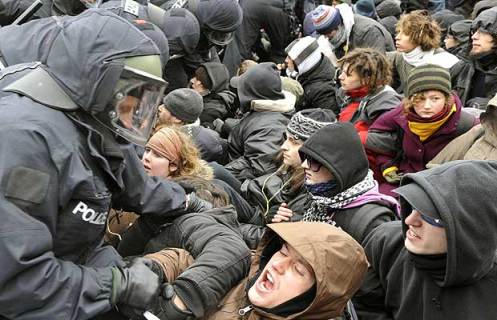
Across the Elbe River, some 10,000 people took part in a rival demonstration.
They joined hands to create a human chain symbolically protecting the restored city centre from the far-right supporters.
In the end, police did not allow the neo-Nazi march to go ahead for security reasons and the demonstration was limited to a rally.
About 5,000 police officers had been brought in from across the country to help stop trouble.
And five police helicopters flew overhead to monitor the crowds
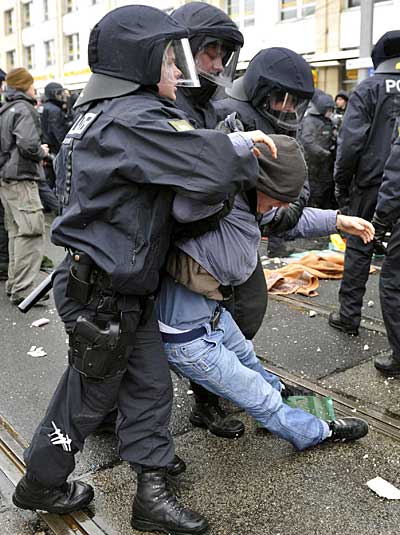
But there were some skirmishes and officers said several people were injured, including some who were hit by rocks.
A number of barricades were also set on fire – but they were quickly put out.
At Dresden’s Neustadt station, where trains packed with Jews departed for the Auschwitz concentration camp, several hundred neo-Nazis, clad all in black, gathered.
Some held pre-war German flags and a voice shouting « Strength and Honour » blasted out of loudspeakers.
The protests were remembering German victims of the Allied air raid that flattened the city in 1945 towards the end of World War Two.
The attacks, by British and US bombers, used incendiary bombs which created an inferno that ripped through streets, and burned people and buildings.
Neo-Nazis have caused outrage by comparing the 1945 bombing of the city to the Holocaust.
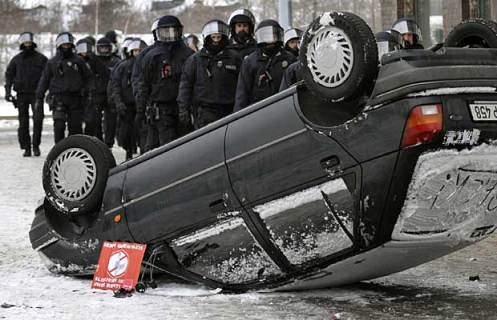
German riots on 65th anniversary of Dresden bombing
BBC
Saturday, 13 February 2010
More than 1000 neo-Nazis were confronted by around 10,000 of their left-wing opponents as they protested in Dresden on the 65th anniversary of the Allied bombing at the end of World War II.
More than 5,000 police were dispatched to try to prevent the groups from clashing but there have been scuffles on the streets and damage to property.
Tristana Moore has been tracking the day’s events from the German capital Berlin.
Eine Menschenkette gegen Neonazis
abendblatt.de
Von Volker ter Haseborg
13. Februar 2010
Hamburg. Die Nacht, als Dresden brannte und bis zu 25 000 Menschen starben, wird Werner Hanitzsch nie vergessen. Er war dabei, als britische und US-amerikanische Bomber die Stadt zerstörten. Und gerade deshalb macht es den heute 81-Jährigen so wütend, dass Neonazis den 65. Gedenktag der Bombennacht an diesem Sonnabend für ihre Propagandazwecke missbrauchen wollen. « Sie nutzen das Schicksal Tausender Opfer schamlos aus. Ich finde das abscheulich », sagt Hanitzsch dem Abendblatt.
Hamburger Abendblatt
Seit Jahren schon ruft die rechte Szene zu « Trauermärschen ». Für diesen Sonnabend haben sich bis zu 8000 Rechtsextreme aus ganz Europa angesagt. Die Polizei rechnet mit mehreren Tausend linksextremen Gegendemonstranten. Bis zu 8000 Polizisten sollen dafür sorgen, dass es nicht zu Krawallen kommt.
Dresdens Bürgermeisterin Helma Orosz (CDU) hat mit Kirchen, Gewerkschaften und anderen Verbänden zu einer Menschenkette aufgerufen. Die 1,5 Kilometer lange Kette soll die Altstadt « wie ein symbolischer Wall umschließen und damit vor dem Eindringen Rechtsextremer schützen ». Die Bürgermeisterin hofft auf 10 000 Teilnehmer. Für die schwarz-gelbe sächsische Regierung ist der Neonazi-Aufmarsch eine Niederlage: War doch das Versammlungsgesetz insofern verschärft worden, dass Demonstrationen am Jahrestag der Bombardierungen verboten werden können. Das verstieß gegen die Versammlungsfreiheit. Das Oberverwaltungsgericht Bautzen genehmigte die von der « Jungen Landsmannschaft Ostdeutschland » geplante Demonstration am vergangenen Donnerstag endgültig.
« Ich kann nicht begreifen, warum das Gericht die Demonstration genehmigt », sagt Zeitzeuge Werner Hanitzsch. In der Bombennacht war er Helfer des Roten Kreuzes, kümmerte sich um die Flüchtlinge aus dem Osten, die in der Stadt waren. Nach der ersten Angriffswelle trug er mit anderen noch die Leichen zusammen. « Die aufgerissenen Bäuche, die abgetrennten Gliedmaßen werde ich nie vergessen », sagt er. Als die zweite Angriffswelle über Dresden hereinbrach, flüchtete Hanitzsch in einen Luftschutzkeller, die Bomben rissen die Stahltür wie ein Stück Blech aus der Verankerung. « Die Tür flog auf und riss allen Menschen, die im Weg saßen, den Kopf ab. » Er selbst blieb unversehrt.
« Normalerweise würde ich an diesem Wochenende zur Gedenkveranstaltung gehen », sagt er. « Aber ich habe Angst vor Krawallen. Die Toten hätten ein stilles Gedenken verdient. »








 anthropologie du présent