
Face aux émeutes, la Chine va changer sa législation sur les expulsions – janvier 2010

China outlines plans to outlaw forced evictions
news.bbc.co.uk
Friday, 29 January 2010
The Chinese government has outlined major changes to the way in which land can be seized for redevelopment.
Under the draft proposals, using violence and coercion to make people move would be banned and owners would be able to appeal against evictions.
Anyone losing land or property would have to be given at least its market value in compensation.
Forced evictions are a key social concern in China and have frequently lead to rioting.
The country has been plagued by the perception that local authorities acquiesce in, and sometimes actively aid, summary land grabs.
China’s cabinet said all strong-arm tactics used to force people to leave their properties – including violence and cutting off water or power – would be banned, the Xinhua news agency reported.
Local governments would have to ensure public opinion was heard before going ahead with development.
In homes deemed to be old or dangerous – a reason often given for demolition – 90% of homeowners would have to give approval before they could be taken down.
The new proposals are open for public comment until mid-February.
Violence
All land in China is effectively controlled by the state and current laws allow local governments to claim land and confiscate homes for urban development projects.
But critics say the system is open to abuse and that evictees often receive a fraction of the value of their home in compensation.
Such cases have led to several violent clashes between residents and police or private security guards.
Several people have also set themselves on fire to protest against their home being seized.
Hundreds of thousands of people in China have been moved in recent years to make way for major projects including the Three Gorges Dam and the redevelopment of the capital for the 2008 Olympics.
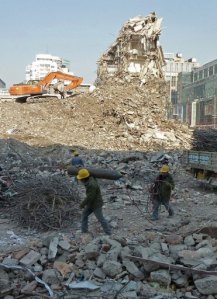
China moves to stop developers forcing people from homes with violence
guardian.co.uk
Friday 29 January 2010
Rules to set compensation and curb abuses of demolition crews aimed at calming unrest
Chinese authorities hope to calm anger at forced demolitions of homes with rules designed to curb abuses by developers and demolition crews that have led to poverty, unrest and even deaths.
The country’s full-tilt urban development has led to the relocation of millions of people. But complaints of inadequate compensation ‑ or none ‑ are common.
A spate of high-profile cases has increased anger at the system. A Chengdu woman died after she set fire to herself last November as an eviction crew hired by local officials beat her family. Local media reported today that a 68-year-old man in Jiangsu, eastern China, set fire to himself after police questioned him about his son’s protest against relocation.
The draft rules, issued today by the state council ‑ China’s cabinet ‑ would ban developers and demolition crews from forcing people out through violence or by shutting off water and electricity. They would also demand that compensation be set at market price and that where homes are judged « old and dangerous », 90% of residents would have to agree to projects. Demolitions would be halted if occupants brought lawsuits. At present, they can go ahead even when challenged.
But there are potential loopholes in the rules and enforcement will be at least as important as the changes on paper, experts warn.
The move comes after officials met law professors from Peking University, who had warned that regulations breached the constitution, encouraged developers to adopt abusive tactics and were leading to social unrest.
One of the professors, Shen Kui, said: « I’m basically satisfied; this is progress and there are some big changes. » He said he believed the rules, still in draft form, would take effect within months.
« I believe the regulations will decrease the new cases where you get violence, but of course it also depends on a change in attitude from local governments … Courts [also] need to be more independent when dealing with these cases. »
He warned that some problems remained. The regulations applied only to cities, not the countryside, and related rules allowed for land to be seized in some circumstances even if the public interest justification did not apply.
Although people can own homes in China, the government still controls the land. Local authorities are keen to promote development to bring jobs, economic growth and tax revenues. Relocated residents often complain that those spurs for new construction are compounded by corruption, with officials accepting bribes from developers to approve schemes.

China moves to calm unrest over property seizures
www.telegraph.co.uk
The Chinese government has moved to calm huge public anger over the widespread seizure of property, an issue that has driven three people to set themselves on fire in as many months.
29 Jan 2010
A large proportion of China’s estimated 100,000 or so public protests each year are driven by rage over compulsory evictions. Over the past decade, hundreds of thousands of Chinese have been forcibly evicted from their homes to make way for one of the greatest property booms of all time.
Rapacious developers, often in cahoots with government officials, rarely pay enough compensation for the property they seize, and instead have been known to employ gangs of thugs to chase out stubborn homeowners. Property development is one of China’s most lucrative industries, with house prices rising 68 per cent in Shanghai last year.
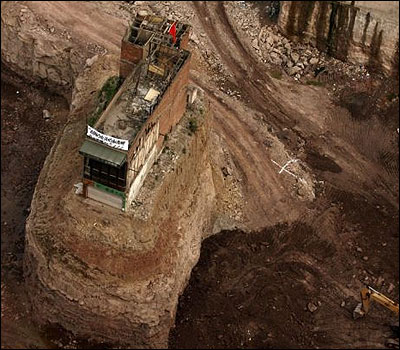
Other tactics include shutting off water and electricity to blocks of homes or beginning construction around houses that are still standing, creating « nail houses », which stand precariously in the middle of excavated building sites.
Yesterday the State Council, China’s equivalent of a cabinet of ministers, said developers and their demolition companies would be banned from using violence and from shutting off electricity and gas to homes. Under new draft proposals, buildings will not be allowed to be demolished unless 90 per cent of the tenants had signed.
This week, a 68-year-old man named Zeng Huan doused himself in petrol and set himself alight in a street in Yangcheng city. Mr Zeng’s three-storey house was scheduled for demolition in October and no compensation deal has yet been agreed. In November, Tang Fuzhen, a 47-year-old businesswoman in Chengdu, stood on the roof of her home and set herself ablaze.
The government’s move came in the wake of a rare protest by five of China’s most senior professors, at Beijing University, who said that abusive tactics had contributed to « mass incidents » and « extreme events ». Shen Kui, one of the academics, said: « The interests of the companies and people are sharply contradictory. So increasingly, more demolition cases end in a horrible way. »
China issues proposals to ease land seizure disputes
AFP
30 01 2010
BEIJING — China moved Friday to quell possible unrest by proposing new rules on seizing land for development — including getting permission from the vast majority of residents before mass evictions.
Land seizures for new buildings — sometimes involving corrupt officials eyeing real estate profits — have been a problem for years in China and have given rise to violent and deadly protests.
The proposals, published on China’s State Council website, suggest a raft of changes to the regime, including insisting that 90 percent of residents in old or damaged housing agree to move before their property is taken.
In another proposal, those forced to move would be given the right to return, in a new building. Currently, many residents are relocated miles from where they lived.
Those responsible for relocating people would be banned from cutting water, heating, gas or electricity to force them out, as is sometimes the case now.
The problem of land seizures has stirred an uproar recently as economic stimulus measures and an urban development push have fuelled a property boom and resulting rash of mass evictions in the rush to cash in.
In a case that shocked the nation, Tang Fuzhen, 47, set herself on fire in November in Sichuan province over the planned demolition of her husband’s garment-processing business. She died 16 days later.
Violent resistance has been reported in numerous other cases as ordinary people take matters into their own hands.
In December, five prominent Peking University law scholars called for the abolition of a statute that allows local officials to seize land if a different use for it is deemed in the public interest.
The proposals published Friday are open for review by the public and a final text will be decided based on overall reaction to the suggestions.
China shakes up rules on land seizures
www.ft.com
By Geoff Dyer in Beijing
January 29 2010
China on Friday unveiled a shake-up of the way that land is seized for redevelopment after a public outcry over violence used by some developers and a rare public campaign by leading academics.
The State Council, China’s cabinet, published the proposed regulations, which should increase compensation for relocation, make it easier for residents of houses marked for redevelopment to take legal action and limit conflicts during demolitions.
Land seizures have been central to the rapid modernisation of hundreds of Chinese cities over the past decade, which in turn has been one of the main drivers of economic growth. However, they have also been the source of often violent conflicts, especially in the past year when huge volumes of stimulus funds have gone into building projects.
Under the proposed guidelines, residents would receive market value if their property were redeveloped. Relocation teams would be barred from cutting off water and power to residents who were resisting eviction. The rules also say houses cannot be demolished if residents have a pending lawsuit challenging an eviction.
Analysts welcomed the regulations but said rigorous implementation would be crucial.
A Chinese academic who specialises in land issues but asked not to be named said: “The new rules say that violence cannot be used to force people to relocate but it is already against the law to use violence and that has not stopped people before.” Tang Fuzhen, a woman in the south-western city of Chengdu, took her life in November by setting herself on fire while a gang of men were trying to evict her family.
The incident was filmed and became a national scandal. Similar incidents have occurred elsewhere. The public outcry prompted five leading legal scholars to publish an open letter in December which said that land seizure regulations were in breach of the constitution and a landmark property law passed in 2007.
They said it was too easy for local governments to decide urban land could be seized for redevelopment. And while it is the government’s responsibility to take care of demolition and negotiate compensation with residents, they said that in reality this was often done by developers and demolition companies.
In recent years developers have been accused of hiring thugs to bully reluctant residents out of their homes.
Startled by self-immolations and protests, China suggests major changes for land seizures
Canadianpress
By Cara Anna (CP) – 29 01 2010
BEIJING — China’s Cabinet suggested major changes Friday to the way land is seized for redevelopment in an attempt to calm a passionate issue that has sparked growing violence and even prompted some protesters to set themselves on fire.
Developers and demolition companies would be banned from using violence or shutting off water and electricity to force residents from their homes, according to changes proposed by the State Council, or Cabinet, and posted on its Web site.
All are common tactics in China, where hundreds of thousands of people have been uprooted for booming urban redevelopment, fueled by government lending and often with the approval of local officials.
The draft proposal also calls for compensation for seized property to be above its market price, an effort to calm protests over little or no payment. More than 90 per cent of residents in places marked as old or dangerous would have to agree to demolition first – even for projects judged to be in the public interest.
China Central Television led its midday news broadcast with the proposals.
« Definitely these would have helped us, » said Zhang Weimin, who camped out in his unlit, unheated Beijing restaurant for weeks, resisting threats from what he and other holdouts suspected were hired thugs before their strip of businesses was torn down this month. « What happened to us would have been a violation. »
Property seizures have caused widespread protests. Late last year, a video and photos of a woman standing on a roof and setting herself on fire in protest in the southwestern city of Chengdu spread across state-run media. Shortly after that, a man protesting another demolition set himself ablaze in Beijing. Unlike the woman, he survived.
Five law professors from China’s top Peking University then took a rare public stand, asking the National People’s Congress Standing Committee to change a regulation they said encouraged abusive tactics by developers and led to « mass incidents » and « extreme events. » Meetings with legislative officials from the State Council followed.
Property seizures are supposed to be limited to projects in the public interest, and seizing land and negotiating with residents for compensation is the government’s job under China’s property law.
But a regulation issued in 2001 allows developers to step in and handle those negotiations, the professors argued. Developers are sometimes accused of using hired thugs to threaten residents, sometimes with violence.
« The interests of the companies and people are sharply contradictory. So increasingly, more demolition cases end in a horrible way, » Shen Kui, the professor who organized the request to the National People’s Congress, told The Associated Press last year.
Shen praised the government’s speed in dealing with the issue Friday, but said it can still forcibly demolish a property if it thinks its decision is fair and people have been compensated.
Friday’s proposals are open for public comment until Feb. 12, a statement on the State Council’s site said. The National People’s Congress has already authorized the State Council to enact regulations on the issue after the comment period is over.
In another self-immolation, a man in the southeastern province of Jiangsu set himself on fire Tuesday to protest a demolition, the People’s Daily newspaper reported on its Web site Thursday.
Associated Press researcher Zhao Liang contributed to this report.








 anthropologie du présent