
Emeutes à Nagaa Hamadi en Egypte – janvier 2010
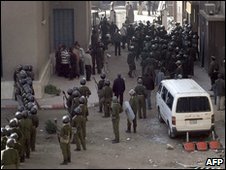
Clashes in Egyptian town after Coptic killings
news.bbc.co.uk
Thursday, 7 January 2010
Clashes have broken out in the southern Egyptian town where seven people died in a drive-by shooting outside a church after a Coptic Christmas Eve Mass.
A BBC correspondent in Cairo said protesters clashed with police at the hospital in the town of Naga Hamady.
The shooting happened as churchgoers left midnight Mass to welcome in the Coptic Christmas on 7 January.
The attack is thought to be in revenge for the alleged rape of a 12-year-old Muslim girl by a Christian man.
Following the reported rape in November there were five days of riots in the town, with Christian properties set on fire and damaged.
The BBC’s Yolande Knell, in Cairo, said more than 1,000 Christians had gathered at the hospital to collect the bodies of six of the victims.
Stones were thrown at security forces and ambulances were smashed as they vented their anger, she added.
Three people are reported to have pulled up outside the church in Naga Hamady on Wednesday evening, killing at least six Coptic Christians and a security official and injuring 10 others, including two Muslim passers-by.
Police say the chief attacker in Wednesday’s shooting has been identified but no arrests have yet been made.
The church’s Bishop Kirollos said there had been threats in the days leading up to the Christmas Eve service – a reason he decided to end his Mass an hour earlier than normal.
« For days, I had expected something to happen on Christmas Eve, » he told the Associated Press.
He said he left the church minutes before the attack.
« A driving car swerved near me, so I took the back door, » he said. « By the time I shook hands with someone at the gate, I heard the mayhem, lots of machine-gun shots. »
Witness Youssef Sidhom told the BBC that the attack shocked everyone, including police guarding the church.
Harassment claims
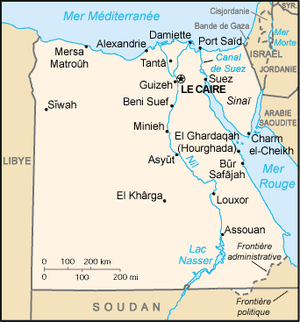
Naga Hamady is 40 miles (64km) from Luxor, southern Egypt’s biggest city.
Coptic Christians – who make up 10% of Egypt’s 80 million population – have complained of harassment and discrimination.
Some Copts argue that previous attacks on them have gone unpunished or have resulted in light sentences.
Most Christians in Egypt are Copts – Christians descended from the ancient Egyptians.
Their church split from the Eastern Orthodox and Roman Catholic Churches in AD451 because of a theological dispute over the nature of Christ, but is now, on most issues, doctrinally similar to the Eastern Orthodox Church.
Egypt church attack sparks riots
www.arabnews.com
Friday 8 January 2010
CAIRO/JEDDAH: Thousands clashed with police during a funeral procession Thursday for six of seven people killed in an attack on churchgoers leaving a midnight mass for Coptic Christians, security officials said.
Two Copts injured in the shooting died Thursday night. Their deaths brought the number of Copts killed in the attack to eight, most of them teenagers. A Muslim policeman guarding the church was also killed in the attack.
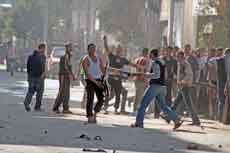
Throughout the day, protesters in the southern town of Nag Hammadi pelted police with rocks and damaged cars and stores.
Early in the day, they smashed ambulances outside a hospital in frustration over delays in turning over the bodies for burial. A security official said police fired tear gas to disperse the crowd.
The riots resumed after the burial services, with angry Copts smashing shop windows, chasing Muslims off the streets and bringing down street light poles. The riots continued into the late afternoon.
The riots followed an attack the previous night, in which three gunmen in a car sprayed automatic gunfire into a crowd leaving a church in Nag Hammadi, about 40 miles north of the ancient ruins of Luxor.
The lead attacker was identified by authorities as a known criminal.
Christians, mostly Copts, account for about 10 percent of Egypt’s population of some 80 million people. They generally live in peace with Muslims although clashes and tensions occasionally occur in southern Egypt, mostly over land or church construction disputes.
Wednesday’s attack happened on Coptic Christmas Eve. Copts celebrate Christmas on Jan. 7 along with many other Orthodox communities around the world.
Egypt’s Interior Ministry said it suspected that Wednesday’s attack was in retaliation for the alleged November rape of a Muslim girl by a Christian man in the same town. The man is in custody awaiting trial.
Security was tight in the town Thursday as police searched for suspects. The release of bodies was delayed because of fear the funerals would turn into a flash point for more violence.
The funeral procession took place later and was attended by local officials. Security officials said some 5,000 protesters stoned police cars and scuffled with security forces. Shops were forced to shut their doors in the town to avoid the violence.
The head of provincial security, Mahmoud Gohar, said security was beefed up in the town and neighboring villages, and checkpoints were set up in the area as tensions ran high among the town’s Christian population.
Gohar said an angry crowd from a nearby church smashed two police cars shortly after the attack.
The attack, he said, happened in the town’s main street about 200 meters from the church.
Bishop Kirollos of the Nag Hammadi Diocese told The Associated Press he was concerned about violence on the eve of the Coptic Christmas because of previous threats following the alleged rape of the 12-year-old Muslim girl.
He recently received a message on his mobile phone that said: “It is your turn.” He told AFP that he saw gunmen spraying worshippers with automatic gunfire outside the archbishopric after the mass ended the previous night.
“We concluded the mass at 11:00 p.m. (2100 GMT) and I was heading to the bishopric when I saw one of the men, in a car, open fire with an automatic rifle at Copts who were walking past the building,” Kirilos said in a phone interview. The bishop said the “author of this crime has a police record and should have been arrested” for past crimes, but is under the protection of prominent figures.
Egyptian expatriate workers in the Kingdom told Arab News that the tribal issue could snowball into a bigger conflict.
“This is what is happening in Nag Hammadi,” said Mamdouh Al-Hawari, who hails from Farshout, a place close to the flash point. Al-Hawari, who works as a journalist in Jeddah, said when a Muslim girl from the Hawara tribe was raped by a Copt youth, the tribe wanted to take revenge. The clashes are in retaliation for the rape incident. “It’s wrong to call it a communal riot,” he said.
Syed Abdul Hakeem, a marketing executive from Nag Hammadi, said the fighting took place because of tension between Muslims and Christians in the area. He described the area as a stronghold of Christians. He said there were heated verbal exchanges between leaders of the two religious groups before Thursday’s clashes.
Abdul Hakeem urged Egyptian authorities to find the root causes for tension between the two communities in the area in order to solve them. “Muslims and Christians have been living peacefully in Egypt since the dawn of Islam,” he pointed out.
Abdul Raheem Al-Shaqifi said Nag Hammadi and Farshout had never witnessed any communal conflict in the past.
Amgad Shehata Boutros, attending the funeral of the Copts on Thursday, told Al Jazeera: “The incident is an attempt to create sectarian tension in Nag Hammadi?”
Egyptians riot after 7 killed in church attack
Associated Press
By SARAH EL DEEB ,
01.07.10,Early in the day, they smashed ambulances outside a hospital in frustration over delays in turning over the bodies for burial. A security official said police fired tear gas to disperse the crowd.
The riots resumed after the burial services, with angry Copts smashing shop windows, chasing Muslims off the streets and bringing down street light poles. The riots continued into the late afternoon.
The official and witnesses spoke on condition of anonymity because of the sensitivity of the issue.
The riots followed an attack the previous night, in which three gunmen in a car sprayed automatic gunfire into a crowd leaving a church in Nag Hamadi, about 40 miles north of the ancient ruins of Luxor.
The lead attacker was identified by authorities as a known criminal.
Christians, mostly Copts, account for about 10 percent of Egypt’s predominantly Muslim population of some 80 million people. They generally live in peace with Muslims although clashes and tensions occasionally occur in southern Egypt, mostly over land or church construction disputes.
In recent years, the clashes have spread to the capital.
Wednesday’s attack, which happened on the holiest day in the Coptic calendar, was the worst known incident of sectarian violence in a decade.
In 2000, the deadliest Christian-Muslim clashes in years left 23 people dead. All but two of the 23 were Copts. The clashes were touched off by an argument between a Coptic merchant and a Muslim shopper in the southern village of el-Kusheh.
The latest attack, however, was unusual because it appeared to have been planned, rather than the customary spontaneous violence that arises from misunderstandings or disputes between Muslims and Copts.
Egypt’s Interior Ministry said it suspected that Wednesday’s attack was in retaliation for the alleged November rape of a Muslim girl by a Christian man in the same town. The man is in custody awaiting trial.
Security was tight in the town Thursday as police searched for suspects. The release of bodies may have been delayed because of fear the funerals would turn into a flashpoint for more violence.
The funeral procession took place later and was attended by local officials. The security officials said some 5,000 protesters shouted: « Long live the Cross, » and « No to persecution. » The protesters also stoned police cars, and scuffled with security. Shops shut their doors in the town to avoid the violence.
The Bishop of the Nag Hamadi Diocese said the dead were mostly young males in their teens.
As Islamic conservatism gains ground, Egypt’s Christians have increasingly complained about discrimination by the Muslim majority.
Coptic Christians are limited in where they can build churches and must obtain government approval before expanding existing facilities. The government insists Christians enjoy the same rights as Muslims.
The head of provincial security, Mahmoud Gohar, said security was beefed up in the town and neighboring villages, and checkpoints were set up in the area as tensions ran high among the town’s Christian population. Gohar said an angry crowd from a nearby church smashed two police cars shortly after the attack.
The attack, he said, happened in the town’s main street about 200 meters (yards) from the church. He said nine people were injured in the attack, including three who were in critical condition.
Bishop Kirollos of the Nag Hamadi Diocese told The Associated Press six male churchgoers and one security guard were killed. He said he left St. John’s church for his nearby home just minutes before the attack. He said he saw five bodies lying on the ground.
« I heard the mayhem, lots of machine gun shots, » he said in a telephone interview.
The bishop said he was concerned about violence on the eve of the Coptic Christmas, which falls Thursday, because of previous threats following the alleged rape of the 12-year-old Muslim girl in November.
He recently received a message on his mobile phone that said: « It is your turn, » he said.
« My faithful were also receiving threats in the streets, some shouting at them: ‘We will not let you have festivities,' » he said.
Because of the threats, he said he ended his Christmas Mass one hour early.
He said Muslim residents of Nag Hamadi and neighboring villages rioted for five days in November and torched and damaged Christian properties in the area after the rape.
« For days, I had expected something to happen on Christmas Day, » he said. The bishop said police have asked him to stay at home for fear of further violence.
Qena, in which Nag Hamadi is located, is one of Egypt’s poorest and most conservative areas.
A recent Amnesty International report said attacks on the Coptic Christian community, comprising between 6 million and 8 million people in Egypt, increased in the year 2008, leaving eight people dead.
The bishop said the attack could have been motivated by revenge and blamed it on « Muslim radicals. »
« Suppose it is vengeance, where was the security? » he asked.
« We are facing a religious war and lax security. »
Copyright 2009 Associated Press. All rights reserved. This material may not be published broadcast, rewritten, or redistributed
Egypte: sept morts dont six coptes dans des tirs lors du Noël copte
AFP
De Mona SALEM 7 01 2010
LE CAIRE — Une fusillade visant la communauté copte a fait sept morts, six coptes et un policier, mercredi soir à Nagaa Hamadi, en Haute-Egypte, aggravant l’inquiétude de cette minorité chrétienne dans un pays majoritairement musulman.
Neuf autres coptes ont été blessés lors de cette fusillade visant des personnes qui sortaient de la messe ou faisaient des achats à l’occasion du Noël copte, célébré le 7 janvier.
Des heurts ont eu lieu jeudi dans la journée entre forces de l’ordre et des manifestants alors que se déroulaient les funérailles des victimes.
Selon les premiers éléments de l’enquête judiciaire, trois hommes qui circulaient mercredi soir en voiture ont ouvert le feu dans une rue sur une distance de 400 mètres, aux abords de deux églises et d’un centre commercial.
Ils ont aussi tiré dans une rue adjacente sur un couvent et les bâtiments de l’évêché de cette localité située dans le gouvernorat de Qena, à quelque 700 km au sud du Caire.
L’évêque copte de la ville Anba Kirolos a raconté à l’AFP: « nous avons terminé la messe à 23H00 (21H00 GMT) et je me suis dirigé vers l’évêché. J’ai vu un homme à bord d’une voiture en train de tirer à l’arme automatique contre tous les coptes qui passaient devant le bâtiment de l’évêché ».
L’homme « a ensuite continué à tirer dans les rues de la ville sur les coptes », a poursuivi Mgr Kirolos, en faisant état de cinq blessés graves.
« Les gens sont en colère et très inquiets », a-t-il ajouté.
Des heurts entre la police et plus de 2.000 manifestants coptes regroupés près de l’hôpital où avaient été transférés les corps ont eu lieu en matinée, selon des sources policières et des témoins.
Les manifestants ont lancé des slogans comme « non à l’oppression » ou « ô croix, nous te défendrons par notre âme et notre sang ». Ils ont lancé des pierres sur la police qui a répondu avec des gaz lacrymogènes et des lances à incendie.
Des incidents sporadiques ont encore eu lieu après les funérailles, célébrées dans l’après-midi, selon des sources de sécurité.
La minorité copte représente environ 8% des 80 millions d’Egyptiens. Les coptes se plaignent depuis plus de vingt ans de discriminations et de harcèlement systématique.
Ils protestent également contre leur mise à l’écart de certains postes-clés au sein de l’armée, de la police, de la justice ou des universités.
Mgr Kirolos a d’ailleurs déploré que la police n’ait pas agi préventivement pour neutraliser le principal meurtrier, dont il a assuré qu’il était déjà « fiché » mais bénéficiait de protections politiques.
Les services de sécurité ont reconnu que cet homme, un musulman du nom de Mohamed Ahmed Hussein, était « connu des services de police ».
Mgr Kirolos a également assuré que depuis une semaine, des chrétiens de la ville recevaient des menaces sur leurs téléphones portables affirmant que les musulmans allaient, à l’occasion de la fête de Noël, « venger le viol » d’une fillette musulmane par un jeune copte.
Cette agression, qui avait eu lieu en novembre à Farchout, près de Nagaa Hamadi, avait à l’époque provoqué la colère des musulmans qui avaient incendié des maisons et des pharmacies appartenant à des coptes dans la localité.
Plusieurs heurts ont eu lieu au cours des dernières années entre musulmans et coptes dans différentes régions d’Egypte, le plus souvent en raison du refus des musulmans de voir les coptes construire de nouvelles églises ou agrandir celles existantes.
Les tensions surgissent fréquemment également en raison de liaisons amoureuses entre coptes et musulmans.
Les coptes ont été aussi l’une des cibles privilégiées de la vague de violences islamistes que l’Egypte a connue tout au long des années 1990.
Morti e feriti in scontri religiosi
http://www.tgcom.mediaset.it
7 01 2010
Egitto, musulmani contro cristiani
Due persone sono morte ed altre otto sono rimaste ferite in scontri tra cristiani e musulmani avvenuti in un villaggio dell’Alto Egitto. Secondo le prime informazioni, gli scontri sono nati dopo che si era diffusa la voce che alcuni cristiani avevano abusato sessualmente di una giovane musulmana. L’episodio è avvenuto proprio durante la notte del Natale copto.
Seven Killed in Egyptian Shooting
http://www.cfra.com
Josh Pringle
Thursday, January 7, 2010
At least seven people have been killed in a drive-by shooting at a church in southern Egypt.
The church bishop and security officials say three men in a car sprayed automatic gunfire into a crowd of churchgoers as they left a midnight Mass for Coptic Christmas.
The attack took place in a town about 40 miles from the famous ancient ruins of Luxor.
Egypt’s Interior Ministry said the attack was suspected retaliation for the November rape of a Muslim girl by a Christian man in the same town.
Coptic girls being abducted
http://www.washingtontimes.com
Thursday, January 7, 2010
Ten years ago, I was in Egypt interviewing Coptic Christians who described how persecution by Muslims had become a way of life for them. The situation is worse now because of increased abductions of Coptic girls, who are forced into a sham marriage with a Muslim, raped, forced to convert to Islam and separated for good from their families.
These are girls as young as 12 who are being grabbed off Egyptian streets. Photos are taken while the girl is being raped to blackmail her into converting, says Mary Abdelmassih, a Coptic activist.
« She’s told the pictures will go to her family, » she told me. « They’d rather die than have that happen. »
Today (Jan. 7) being the Coptic Christmas, this as good a time as any to describe how these kidnappings are at epidemic levels in Egypt and how the plight of these poor women has become Christian sex slavery.
Because local police are more often than not in collusion with the kidnappers, the families have to come up with enormous sums to get their daughters back. If the family is poor, their daughter is gone forever. The Assyrian National News Agency says very few of the girls who have been kidnapped since the 1970s ever get returned to their families and none of the kidnappers have been brought to justice.
For instance, after Myrna Gamal Hanna, a 20-year-old Christian woman, called her family Sept. 30 to ask them to rescue her from a forced marriage to a Muslim, her father and five other men showed up at her Alexandria apartment and rescued her. Instead of punishing the husband, police tortured Myrna’s family until they revealed where they had hidden the daughter. Then the family had to cough up several thousand dollars for those who had kidnapped the girl.
And last October, Samria Markos, a single mother living in Alexandria, said her 17-year-old daughter, Amira, disappeared while on her way to work at a plastics factory. She got a call from « Sheikh Mohammed » who told her Amira was converting to Islam. When she showed up at a local mosque to look for her daughter, she was told to keep silent or her 9-year-old son would be killed. The woman and her son fled the area. Amira has not been heard from since.
Many groups have criticized Egypt for this. On Nov. 10, Christian Solidarity International sent an open letter to President Obama reminding him of his human rights speech in Cairo last June and pointing out the Egyptian government’s tacit approval of this scandal.
And late last month, the Pew Forum specifically mentioned the kidnappings and pinpointed Egypt as one of the world’s most religiously repressive countries.
I called the Egyptian Embassy Tuesday for a response but got none. Judging from past responses, the government will say these girls ran away with Muslim men then claimed they were kidnapped to escape the ire of their families.
But Al Ahram, an Egyptian weekly, said in September that relations between Christians and Muslims in Egypt are at a « boiling point » over this. The latest trend, Ms. Abdelmassih says, is that women are being mined for organs, as happened to an American University student who was kidnapped two years ago.
« The kidnappers said to get back his daughter, he had to pay 600,000 Egyptian pounds, » she said. « When he protested, he was told both of her kidneys are worth more than that. »
Egyptian law forbids the conversion of minors to another religion but that doesn’t seem to apply to these hapless Coptic girls. Ms. Abdelmassih said the abductions are part of a campaign to Islamicize Egypt’s Christian community.
« It’s a business, » she said. « For each Christian girl who gets ‘converted,’ there are Islamic charities that give out money to the husband and the dealers who obtained her. »
• Contact Julia Duin at jduin@washingtontimes.com.
Attack at a Church in Egypt Kills 7
http://www.nytimes.com
By THE ASSOCIATED PRESS
Published: January 6, 2010
CAIRO (AP) — Three men in a car sprayed automatic gunfire into a crowd of churchgoers on Wednesday in the southern Egyptian town of Nag Hammadi, killing at least seven people as they left a midnight Mass for Coptic Christmas, security officials and the church bishop said.
The Interior Ministry said three people were seriously wounded in the attack, at St. John’s Church, which was suspected to be retaliation for the rape in November of a 12-year-old Muslim girl by a Christian man. A statement said witnesses had identified the lead attacker.
Bishop Kirollos said six male churchgoers and one security guard were killed. He said he had left the church, about 40 miles from the ancient ruins of Luxor, minutes before the attack.
“A driving car swerved near me, so I took the back door,” the bishop said. “By the time I shook hands with someone at the gate, I heard the mayhem, lots of machine gun shots.”





 anthropologie du présent