
Chine : mouvements sociaux en augmentation en 2009
Academy of Social Sciences: increase of mass revolts and crime in China
http://www.asianews.it
12/22/2009
The « mass incidents » are caused by the growing difference between rich and poor, and abuse of power by government representatives. In the first 10 months of 2009 criminal cases increased by 15% compared to last year. The social concerns are a risk to the survival of the Communist Party
Beijing (AsiaNews / Agencies) – Social unrest and crime are increasing in the country. The source of these allegations is not any non-governmental organization attentive to human rights, but the Chinese Academy of Social Sciences.
The annual report entitled « Society of China: Analysis and Forecasting 2010 », presented yesterday, says that riots and other disturbances are increasing, they are caused by long-standing deep-rooted problems and involve people from all walks of life.
The authors state that in recent decades, the resentment of the population has increased because of growing differences between rich and poor, and for abuses of power by the representatives of government. Li Pielin, director of the Institute of Sociology, who presented the report states that « during the economic boom in China, many problems remained unsolved such as laws on relocation [and dispossessions – ed], the reforms and the use of industrial land. This has deepened the discontent of the population ».
The report cites six examples of popular revolts, from the taxi strike in Chongqing and elsewhere, to those in central China, due to the suspicious deaths, presented by the police as a suicide (see the 22/06/2009 » Clashes between police and people who can’t take it any more become daily occurrence).
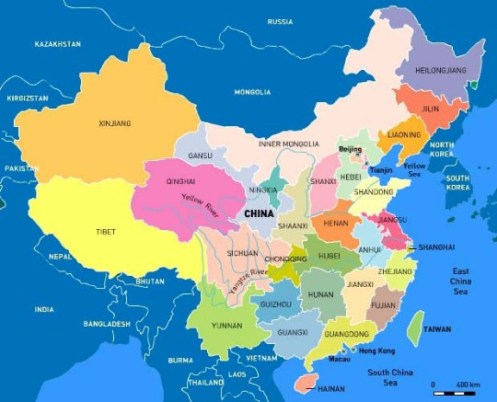
The report does not include the revolts of Uyghurs in Xinjiang, in July last year, with 200 deaths and thousands of arrests.
The report also acknowledges that the political and economic policies of the country leave many people without the benefits derived from economic development and points out the growing gap in living standards between urban and rural residents, an unbridled industrial development that has occurred at the expense of the rural population and pollution of the environment.
According to official figures there is also an increase in crime: from January to October this year there were over 4 million cases, an increase of 15% over last year.
The report also has positive news, such as predictions that the end of 2010 GDP per capita will increase by up to 4 U.S. dollars, and that unemployment (official statistics) will remain steady at 4%.
But the gulf between rich and poor will increase: the income of urban residents will increase by 10%, those of the poor rural people only 6%.
According to the ministry for security in the country there are tens of thousands of cases of social unrest each year. These revolts, often sedated with arrests and armed intervention of the police, are – according to the leaders of the party a « threat to the survival of the Chinese Communist Party. »
Social unrest ‘on the rise’ in China

Monday, 21 December 2009
By Shirong Chen
The authors believe deep resentment has been accumulating over the past few decades against unfairness and power abuses by government officials at various levels.
They quote six large-scale popular protests – from taxi strikes to unrest in central China in June – involving tens of thousands of people.
This does not include the rioting in the north-western region of Xinjiang, where nearly 200 people were killed in early July.
Urban-rural gap
There has been more crime too – official figures for January to October 2009 show more than four million recorded criminal cases, an increase of about 15% above last year.
The report admits some of China’s policies have prevented more people from sharing the benefits of the economic development.
The urban-rural income gap, for example, has become even bigger and the country’s phenomenal GDP growth has been achieved at the expense of the rural population, the environment and overall social cohesion.
The report is a damning indictment on the authorities’ slogan of building a harmonious society.
But there is one ray of hope in the report – while the Chinese authorities are taking tighter control over the media, people are turning more and more to the internet to expose official failings and abuses.
In the past 12 months, nearly a third of the top stories originated from the internet, pushing the boundaries of press freedom.
Mass protests on the rise in 2009: blue book

December 22, 2009
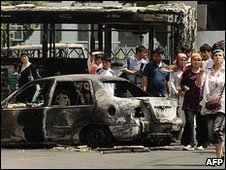
Sit-ins, roadblocks and other forms of mass protest have been more frequent this year due to « people’s discontent in the way government policy is implemented, » said the 2010 blue book released Monday by the Chinese Academy of Social Sciences (CASS).
« During China’s economic boom, many problems involving relocation law, industrial reform and land-use still remain unresolved. It has deepened people’s discontent, » Li Peilin, director of the Sociology Institute of CASS, said at Monday’s press conference for the release of the government blue book report, Society of China: Analysis and Forecast 2010.
Although the annual report does not reveal how many mass incidents were reported this year, the number rose from over 10,000 in 1994 to 74,000 in 2004, according to a report by the Outlook Weekly in March of last year.
Li also says such incidents can be classified into two types; « non-direct interest, » meaning most participants have no connection with each other nor the organizer and « direct interest, » indicating all involved are assembling for a common cause and have vested interest in the outcome.
A recent example of « non-direct interest » assembly is an incident involving thousands who assembled in protest over the mysterious death of a man in a Hubei Province hotel in June. Tu Yuangao, 24, was found dead at the gate of the hotel on June 17.
Although local police announced it a suicide, the family remained unconvinced and displayed Tu’s body among a crowd at the hotel gate in protest.
The second type of incident is « direct interest » such as the incident surrounding the manager of Tonghua Iron & Steel in Jilin Province, who was beaten to death by a mob of angry workers reportedly dissatisfied with the restructuring of the company in July.
The workers were facing wage cuts and layoffs as a result of the company’s looming makeover stemming from a merger in which Beijing-based Jianlong Heavy Machinery Group would buy a majority stake in Tonghua.
General manager Chen Guojun, installed by Jianlong according to the merger plan, was beaten to death during a 1,000 strong workers’ protest on July 24.
However, Yu Jianrong, director of the Institute of Rural Development at CASS who studies trends in social unrest, told the Global Times Monday that it is the conflicts of interest that cause the rise in mass incidents.
« Up to 80-90 percent of these incidents were caused by conflicts of interest between parties involved rather than discontentment with policy administration, » Yu explains. « And people are learning to use the power of masses to protect their rights. »
According to Yu’s research issued in 2007, over 36 percent of mass incidents were initiated by workers attempting to ensure their rights, followed by those initiated by farmers at 35 percent.
« If the government merely solves these mass incidents by simply defining them as ‘disturbances of public order,’ then this skin-deep harmony is likely to trigger bitter conflict, » he said. « Mass incidents should be solved through law. »
Source: Global Times
Social security tops labor disputes

By Wang Zhuoqiong (China Daily)
2009-12-22
Labor disputes are on the up, especially between migrant workers and their employers, with conflicts pertaining to social welfare measures such as pensions topping the list of grievances, a survey released yesterday has revealed.
Jobs lost due to last year’s financial crisis, when companies across China responded by drastic cost cuts, was another trigger for patchy relations between employers and the employed, the Blue Book of China’s Society survey brought out by the Social Sciences Academic Press has shown.
Yet, unlike earlier rows that focused on wage hikes, the disputes this time relate more to bettering social security cover.
And, topping that list is the issue of pensions to the country’s earliest batch of migrant workers, the survey showed.
« The first generation of migrant workers who entered the labor market in the 1980s is facing retirement, » Li Peilin, director of the Institute of Sociology at the Chinese Academy of Social Sciences, said during the release of the survey. « The phenomena (disputes) will become more acute in the days to come. »
The nation’s courts dealt with nearly 170,000 labor disputes in the first half of the year, an increase of 30 percent over the same period last year, the survey revealed, without specifying how many of these disputes related to migrant workers and their employers.
Courts in the coastal provinces in southeast China heard more such cases, with the number increasing by as much as 150 percent there, Li said during the conference in Beijing.
« Labor disputes are the ones that have seen the highest increase among all civil legal cases (in the country), » said Li.
There is, however, some good news on the jobs front, the survey pointed out. The labor market, especially for migrant workers, is showing signs of recovery as the global financial crisis wanes, it said.
Migrant workers – most of whom were employed in export-oriented units – were the first group to be hit by job losses when the financial crisis hit last year.
In fact, during the Spring Festival this year, around 12 million migrant workers, or about 8.5 percent of the total number of such workers, were estimated to have lost their jobs and returned home.
The survey, however, revealed that since August this year, employers in traditional manufacturing bases such as Dongguan and Shenzhen had started recruiting people.
The up-tick has come as a big surprise, and trumped earlier forecasts that jobless migrant workers were returning in large numbers to their respective villages, Li said.
In fact, the number of migrant workers who returned to work in cities by October this year touched 97 percent of the number seen before the financial crisis rocked the world in August last year, the Ministry of Human Resources and Social Securities said.
« The impact of the financial crisis, however, continues to be felt even now, » Li said. « We are expecting that our economy and job market will take a long time to recover fully. »








 anthropologie du présent