
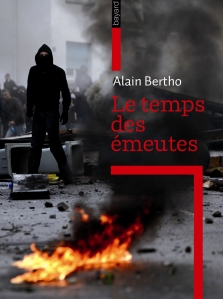
Affrontements à Katmandou au Népal – décembre 2009
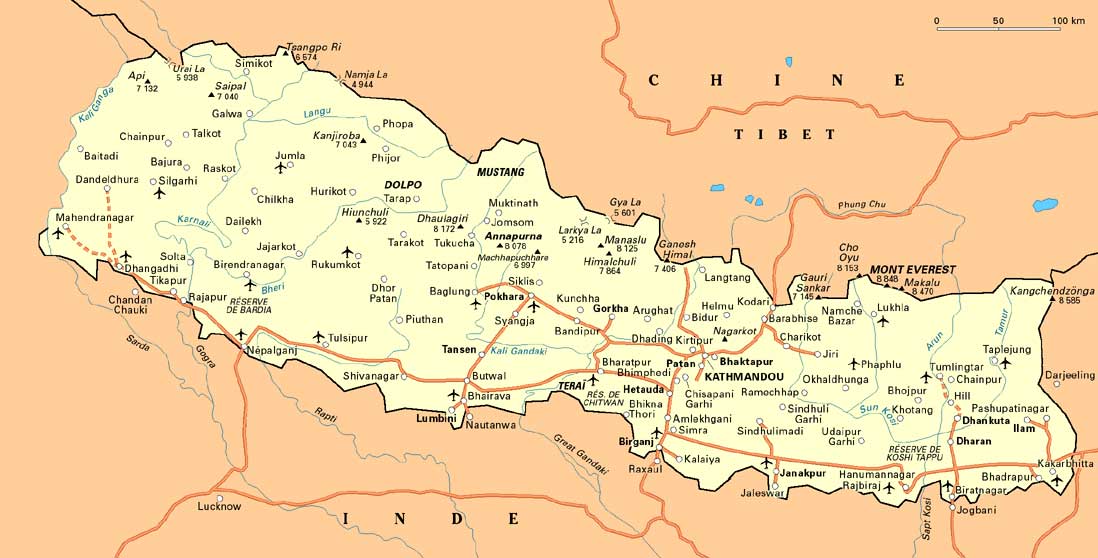
Maoist Activists Clash With Police as Strike Cripples Nepal

By Ed Johnson
Dec. 21 (Bloomberg) — Maoist activists in Nepal clashed with riot police leaving dozens of people injured as a national strike forced shops to close and disrupted transport in the Himalayan country.
Protesters burned tires, vandalized passing cars and threw stones at officers, who used water cannons and tear gas to break up demonstrations in the capital, Kathmandu, yesterday, Nepalnews.com reported. More demonstrations are scheduled for today and tomorrow.
The Unified Communist Party of Nepal (Maoist) called the three-day strike to demonstrate against President Ram Baran Yadav, whom they accuse of acting unconstitutionally by overturning the previous government’s decision to fire the army chief. Strikes are choking the $9 billion economy and political unrest is delaying the writing of a new constitution for the nation that is trying to rebuild after a decade of civil war.
Shopping malls in Kathmandu were closed yesterday and schools, colleges and most government and private offices were shut, Nepalnews.com reported.
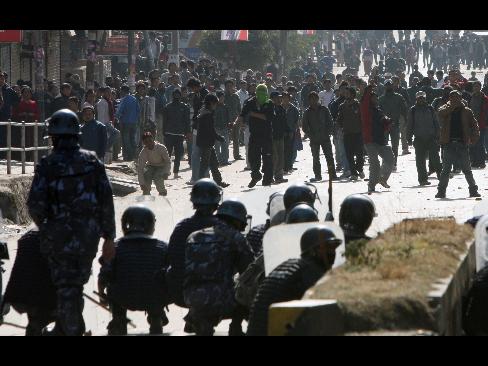
Activists threw stones at a vehicle carrying a state minister on his way to the airport to welcome Prime Minister Madhav Kumar Nepal, who was returning to the country after attending the climate change summit in Copenhagen, according to the report. More than 60 people were arrested, Nepalnews.com said.
The Maoists fought a 10-year insurgency to overthrow the monarchy in the landlocked nation between India and China before disarming under a United Nations-backed peace accord in 2006.
Politically Indoctrinated
Maoist leader Puspa Kamal Dahal became prime minister in August 2008 after his party won the most seats in parliamentary elections. He resigned in May after the president overturned his decision to dismiss Army Chief of Staff Rookmand Katawal. The army has resisted integrating former rebels, a condition of the peace accord, saying they’ve been politically indoctrinated.
The Maoists are demanding the president, who oversees the military, accepts the dismissal of the army chief, who has since retired, the Associated Press reported last month. They want the present government to be disbanded, followed by the formation of a new coalition government led by them, AP said.
Growth in Nepal may slow to 3.8 percent this year from 5.3 percent in 2008, according to the Asian Development Bank.
To contact the reporter on this story: Ed Johnson in Sydney at ejohnson28@bloomberg.net
Nepal: violenti scontri tra maoisti e polizia, 70 arresti e 100 feriti

21 12 2009
Domenica a Katmandu i manifestanti hanno lanciato pietre contro la polizia anti-sommossa e gli ufficiali hanno risposto con i gas lacrimogeni
Agenti di polizia nepalese in tenuta antisommossa e armati di manganelli e lacrimogeni domenica scorsa si sono scontrati con i simpatizzanti maoisti a Kathmandu, che hanno messo in scena la protesta più grande dall’abbandono del governo sette mesi fa.
La violenza è un nuovo segno che il processo di pace si è ormai arenato. Tutto è iniziato con i maoisti che hanno bloccato le strade a Katmandu, la capitale del Nepal, bloccata anche dai tre giorni di sciopero generale indetto per protestare contro il presidente Ram Baran Yadav e la domanda di un ripristino del suo potere politico.
Le agenzie di stampa riportate dal New York Times hanno riferito che la polizia ha arrestato almeno 70 persone con l’accusa di atti di vandalismo, mentre i maoisti hanno sentenziato le dure cariche delle forze dell’ordine che avrebbero causato il ferimento di almeno 100 dimostranti. Gli scontri di questi giorni rappresentano il culmine di un’escalation di tensioni in Nepal, originatesi dopo che i maoisti hanno lasciato il governo nel maggio scorso in seguito a una controversia con il presidente sulle forze armate nepalesi.
Nei mesi seguenti, i maoisti hanno inscenato manifestazioni, sequestrato terreni e dichiarato che alcune aree, come Katmandu, erano zone autonome al di fuori della competenza del governo.
Nel mese di aprile 2008, i maoisti hanno vinto il maggior numero di seggi in un corpo speciale legislativo eletto al progetto con il progetto di riformare la Costituzione. Quattro mesi più tardi, il leader dei maoisti, Pushpa Kamal Dahal, anche conosciuto come Prachanda, è diventato primo ministro in un governo di coalizione.
Ma i maoisti sono rimasti decisamente delusi dal confinamento di più di 19.000 dei loro ex combattenti. Sequestrati in caserma, monitorati dalle Nazioni Unite, i combattenti dovevano essere miscelati a poco a poco nelle forze di sicurezza del Nepal, secondo l’accordo di pace. I maoisti hanno quindi lasciato il governo in segno di protesta.
Domenica a Katmandu i manifestanti hanno lanciato pietre contro la polizia anti-sommossa e gli ufficiali hanno risposto con i gas lacrimogeni. Un portavoce della polizia a Katmandu, ha detto alla Reuters che gli agenti hanno caricato i manifestanti con i manganelli, dopo che 17 poliziotti sono rimasti feriti dai sassi lanciati.
Una dichiarazione rilasciata dall’ufficio regionale delle Nazioni Unite per i diritti umani ha criticato gli ufficiali di polizia per l’utilizzo di una «forza eccessiva».
Une grève et des affrontements paralysent le Népal

Agence France-Presse Katmandou 20 décembre 2009
Des centaines de policiers ont chargé à la matraque et fait usage de gaz lacrymogènes contre des centaines de manifestants maoïstes à Katmandou, au premier jour d’une grève générale prévue pour trois jours, selon la police et des témoins.
Au moins 15 protestataires ont été blessés lors de la manifestation qui est la plus importante depuis que les maoïstes ont quitté le pouvoir en mai, selon un reporter de l’AFP. Cinq policiers ont également été blessés, a précisé un porte-parole de la police, Bigyan Raj Sharma.
Les affrontements ont commencé quand les manifestants ont jeté des briques et des pierres sur les policiers qui tentaient de dégager une rue bloquée de la capitale du Népal.
«Nous avons eu recours à la force quand les protestataires sont devenus violents et ont commencé à attaquer la police avec des pierres», a déclaré le porte-parole.
La grève a paralysé le pays dimanche. 62 maoïstes ont été arrêtés dans tout le pays pour avoir endommagé 20 bus, camions et voitures, selon le porte-parole.
Les maoïstes ont déclenché une serie de manifestations, empêchant notamment le Parlement de sièger et paralysant la capitale depuis que leur gouvernement est tombé en mai après huit mois au pouvoir.
Les maoïstes ont remporté les élections au Népal en avril 2008, abolissant du même coup la monarchie, mais le gouvernement est tombé huit mois plus tard après la démission fracassante du Premier ministre. Ce dernier a invoqué la décision du chef de l’Etat de maintenir dans ses fonctions le chef de l’armée, pourtant limogé par le gouvernement pour insubordination.
Les anciens guérilleros d’extrême gauche voulaient se débarrasser du général Katawal, un sympathisant royaliste, en raison de son refus d’intégrer à l’armée les 19 000 ex-combattants maoïstes cantonnés dans des camps supervisés par l’ONU.
Les maoïstes, qui se sont engagés dans une sanglante guerre civile contre l’Etat pendant dix ans au prix de 13 000 morts, exigent que le chef de l’Etat présente des excuses après sa décision qu’ils jugent inconstitutionnelle.
Grève générale au Népal

(CP) 20 décembre 2009
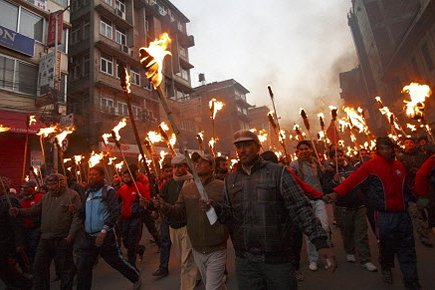
KATMANDOU — Des affrontements ont opposé dimanche la police anti-émeutes népalaise et des sympathisants de l’ancienne guérilla maoïste, qui ont également attaqué des véhicules, contraint des magasins à fermer et bloqué des routes dimanche au Népal, paralysé dimanche par une grève générale.
Les affrontements ont eu lieu dans deux endroits de Katmandou la capitale, les manifestants lançant des pierres sur la police, qui a riposté à coups de grenades lacrymogènes et à coups de bâton, a annoncé le porte-parole de la police.
Six policiers ont été blessés, dont un grièvement, ainsi qu’une vingtaine de manifestants. Au moins 67 personnes été interpellées dans tout le pays, selon cette même source.

Les maoïstes, qui ont lancé un mot d’ordre de grève de trois jours, protestent contre la décision du président, Ram Baran Yadav, de revenir sur le limogeage du chef des armées, prise par le gouvernement.
Le Népal est en proie à une crise politique depuis la démission, en mai, du gouvernement, opposé au président Yadav au sujet du refus par le chef des armées d’incorporer les ex-combattants maoïstes.
Les anciens guérilleros, qui ont renoncé à la lutte armée en 2006 et sont désormais majoritaires au parlement, organisent depuis des manifestations contre le président.






 anthropologie du présent