
Emeute de l’eau à Mumbai en Inde – décembre 2009
[Youtube=http://www.youtube.com/watch?v=ie4X7YwrS44]
1 killed as cops beat up water rally in Mumbai

4 Dec 2009,
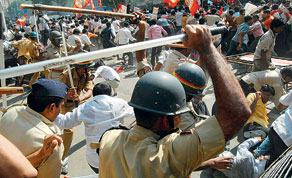
MUMBAI: A game of one-upmanship in Mumbai politics took away a life on Thursday after the police resorted to lathi charge to disperse demonstrators, led by Narayan Rane’s son Nitesh Rane, in front of the BMC headquarters. Planned in the wake of Mr Rane’s candidate’s humiliating defeat in Mumbai mayoral elections two days ago, the agitation took a violent turn forcing police to use force.
Vishal Dholakia, 43, reportedly died of head injuries he sustained in the lathi charge. The police authorities, however, attributed his death to heart attack.
The agitation was apparently a desperate exercise by Mr Rane to settle score with the ruling Shiv Sena-BJP after the defeat of Congress candidate in the mayoral poll earlier this week. The Congress nominee was a Rane protege.
Mr Nitesh Rane, who is eyeing a political debut following the footsteps of his elder brother Nilesh, a Congress MP from Ratnagiri-Sindhudurg , was clearly out to exploit politically the 15% water cut announced by the BMC to make up for the scarcity. Waving red flags and shouting slogans against the BMC, agitators, under the banner of Mr Rane’s NGO “Swabhiman” , tried to storm the civic headquarters.
Additional commissioner of police R K Padmanabhan said the crowd turned unruly, forcing the police to use minimal force. “They engaged in vandalism outside BMC office and could have gone out of control if allowed inside,” Mr Padmanabhan said. Some of the agitators were trying to force open gates at the BMC building.
The deceased Dholakia apparently had some medical condition and died of heart attack, the police said. Superintendent of G T Hospital, where Dholakia was admitted, A V Kulkarni, said the deceased did not have any injury marks on his body. Asked what could possibly be the reason behind Dholakia’s death, he said it would be clear only after a postmortem examination . He said nine of the wounded demonstrators were undergoing treatment at the hospital but refused to comment on their condition.
Mr Nitesh Rane, meanwhile, was arrested, police said. He was later released on bail by a local court. Earlier Rane Jr had threatened municipal authorities saying ‘Swabhiman’ would not allow the mayor, BMC commissioner and corporators to move around if the water cut was not rescinded.
Water protester dies during lathi charge
timesofindia.indiatimes.com
SUKHADA TATKE, TNN 4 December 2009,
MUMBAI: In an unprecedented incident, a 30-year-old man, who was part of a 1,000-strong group protesting against the stringent water cut outside
the BMC headquarters on Thursday, died of apparent cardiac failure during a police lathicharge. Viral Dholakia, who died before he could be taken to GT Hospital a few metres away, was a founder member of Swabhimaan, an NGO set up by Narayan Rane’s son, Nitesh, who was also leading the protest. Uncannily, it was Dholakia’s birthday on the day he died.
While 18 others were injured in the lathi charge, Dholakia did not have any external injury on his body, according to the police as well as GT and Bombay Hospital doctors. The doctors, however, refused to specify the cause of his death without seeing the post-mortem report.
Police officials claimed that their personnel had been “provoked’’ by the protesters; state home minister R R Patil too defended the police action. “The protesters stalled traffic for one hour, and the police had information that they were planning to enter the BMC headquarters. Had they done that, they would have caused mayhem. The police was forced to lathi-charge,’’ he said. As for Dholakia, Patil said his “deepest sympathies’’ were with the dead man’s family, but the fact was that he was not beaten by the police. “There is not a single injury on his body. His death and the police lathi charge cannot be correlated physically,’’ Patil said.
The explanation, however, did not cut much ice with the protesters, who demanded an inquiry into the circumstances of Dholakia’s death and the “unnecessarily harsh’’ police action. The controversy also has the potential to blow up into an issue between government partners Congress and NCP; Patil is from the NCP and Rane is from the Congress.
Many of the 18 others suffered multiple injuries, including injuries to the head, although the version of the GT and Bombay Hospital (where Dholakia was later taken) doctors seemed to corroborate Patil’s statement; there was no external injury on him and there no blood clot either, doctors said. “He may have died of suffocation or heart failure,’’ a police officer said.
Whatever be the reason for Dholakia’s death, his family is shattered. “When he left to protest, we didn’t know he wouldn’t come back. If only we had known, we wouldn’t have let him go,’’ said an uncle. Dholakia lived with his wife, a one-year-old child, a brother and sister-in-law.
But the brains behind Thursday’s protest have sensed that they could be on to an emotive political issue, and have vowed to take forward their protests. “We are protesting against the water cut and we will continue till the city gets water round the clock,’’ Nitesh Rane said. “The BMC has to ensure that Mumbaikars get 24 hours’ water supply. Why is it that only malls get water and not the common citizen?’’
Stating that there was “continuous water at Matoshree’’ (Bal Thackeray’s residence), Rane said that water was also lost in theft and leakages, for which civic employees were responsible. “If the cut is not reduced, we will not allow the mayor, corporators and the municipal commissioner to move around,’’ he threatened. Shiv Sena leaders, on their part, claimed that the protest was Narayan Rane’s “last-ditch attempt to prove his worth to the Congress’’.
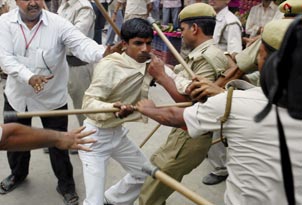
Around 1.30 pm, Nitesh Rane—accompanied by four others—went up to the third floor to meet additional municipal commissioner Ashish Kumar Singh. Angry agitators outside pulled down barricades put up by the police and tried to barge into the BMC building. This prompted the police to swing into action. DCP (Zone I) Vishwas Nangre-Patil went up and requested Rane to calm down the mob, but by then blood had already been spilled on the streets as policemen beat up protesters, including women and senior citizens.
The drama ended an hour later with the Azad Maidan police arresting 13 people, including Rane. “We produced them in court and they were later released on bail. They were booked for damaging public property, forcible entry, obstructing public servants from doing their duty, burning effigies and blocking the road,’’ Nangre-Patil said.
Acting municipal commissioner R A Rajeev said that it was not at all possible to reduce the water cut. “We have to go with the cut now so that there are no problems in April and May next year,’’ he said.
Mumbai battles and bleeds for water

Building boom sucks a priceMumbai, Dec. 3: India’s commercial capital is bracing for severe water shortage and sporadic water wars.
The city’s 18 million have been restive since July, when the water reservoirs began getting depleted because of a sub-normal monsoon.
“The Brihanmumbai Municipal Corporation (BMC) had proposed a 30 per cent cut on July 7 but later, because of public protests, we brought it down to 15 per cent,” said BMC spokesperson Saudagar Jadhav.
“The decision overtaxed the lakes. Now the situation is such that if we do not continue to ration water, the lakes will dry out before the next monsoon.”
The civic body had announced on October 28 that it would retain the 15 per cent water cut for residential consumers and 30 per cent cut for businesses till July 15 next year.
“The crisis is expected to continue till next year’s monsoon. If the monsoon is good, things may improve; if not, the future is dark,” said additional municipal commissioner Ashish Kumar Singh.
He conceded that the scarcity could not be blamed on the monsoon alone.
“The monsoon certainly played a part. But over the years, the spurt in real estate construction in this city has put an immense load on water supply,” he added.
“Many builders eschew a commercial connection to avoid higher charges. Water theft is rampant and an old pipe system, much of it built in the British era, is giving way. The loss through leaks is massive.” (See chart)
The worst hit are the suburban and slum areas, which receive less water than the posh south Mumbai colonies where the rich and influential live.
“The water problem is acute — nowadays water comes for only two hours. We queue for hours and store as much as we can,” said Shamim Sayed, a resident of Bandra East, home to Shiv Sena supremo Bal Thackeray.
The Thackeray residence has 24-hour water supply, though. That is a sore point with many protesters, helping rival political parties turn the crisis into a political slugfest.
In the upscale lanes of Pali Hill, the wealthy are buying water from tankers while squabbling about the steep prices.
“A tanker costs Rs 2,500 for approximately 800 litres of water. That is not enough for an eight-floor apartment block with 16 families. So, we sometimes need two tankers,” said Usha Madhok, Pali Hill resident and actor Dev Anand’s sister.
“Then, some people use up more water than others; so, many do not want to contribute equal amounts to buy water. Things are getting very bad.”
In the nearby fishing village of Danda, residents make do with four buckets of water for a family of five every day.
“It’s a shame. Mumbai gets so much rainfall and still there is no water in the city,” complained Kandivili resident Anuradha Dutta, who left Calcutta to live in Mumbai in July.
In October 2002, the BMC had made it mandatory for all buildings with a plot area of 1,000 square metres or more to practise rainwater harvesting. In 2007, it was made compulsory for buildings with plot areas of 300 square metres.
But thanks to the lack of a monitoring mechanism, only 900 buildings had actually implemented the plan till June 2009.
The sales of loft tanks for household use have gone up in the city. Girish Malviya, chief executive officer of Sharp Water Tanks, said there was a 20 per cent increase in sales compared with the figures six months ago.
“Many Mumbaikars are enquiring about water tanks. We expect that the sales of these tanks in Mumbai will go up by 50 per cent to 70 per cent,” he said.
Last month, the BMC had announced a plan to set up a toll-free helpline through which citizens could inform the corporation about water theft and pipeline leak. It remains another number on the list of hundreds of similar helplines that have been announced, forgotten and abandoned.
Water protest claims a life

Friday , Dec 04, 2009
BMC: Demonstrator dies after lathicharge; cops claim heart attack
A protester against water cuts died and 25 others were injured after the police lathicharged a mob outside the Brihanmumbai Municipal Corporation (BMC) headquarters on Thursday. The police said he had no injuries and died of a heart attack.
Led by Congress leader Narayan Rane’s son Nitesh and his Swabhiman Sanghatna, 1,000 protesters had assembled outside, demanding a reduction in the 15 per cent water cut.
After the lathicharge, Viral Dholakhia, 30, of Kandivili, was taken to GT Hospital, where he died. The body was shifted to Bombay Hospital, where sources said Dholakia had died of heart failure and had no external injuries or blood clots. He is survived by his parents, wife and a two-year-old son.
“He was brought with chest pain and breathlessness. He died in half an hour. His family wanted a second opinion and took him to Bombay Hospital,” said Dr A V Kulkarni, medical superintendent of GT. The police claimed Dholakia had complained of chest pain and had walked to GT himself.

Man Dies, a Dozen Injured During Mumbai Water Shortage Protest

by Jaymi Heimbuch, San Francisco, Californiaon 12. 3.09
Mumbai has had serious difficulties regarding water supplies this year, going from drought, to a deluge during monsoon season, and now back to water shortages. In order to deal with the shortages – which are expected to worsen until the next rainy season – officials have made water cuts that sparked a violent protest during which one man died and dozens of others were injured, adding to India’s growing record of violence over water and showing the beginning of what will likely be more social unrest over water supplies.
Reuters reports that Mumbai is facing an estimated water shortfall of about 400 million litres of the 4,300 million litres needed daily to sustain the city’s approximately 14 million residents. Mumbai is the world’s second largest city, yet most of the residents only get water for a few hours during the day. This leaves them to have to buy water at drastically inflated rates from touts. So, it is no wonder that the additional 15% cuts in supplies sparked a protest that turned violent.
As residents protested outside the corporation building, they went up against riot police and it turned ugly. The man who died during the protest reportedly died of a heart attack, while about a dozen other residents suffered injuries because of the clash.
This is a news story we’re bound to hear more and more often. Already we’ve seen violence in India over a lack of water , and according to a recent study, by 2050, per capita water availability in India is expected to drop by about 44% due to growing populations and higher demand, as well as higher pollution levels.
After experiencing an unusually intense monsoon earlier this year, climate change seems to be factoring in on top of a lack of sustianable water practices and infrastructure. By 2025, India, China and select countries in Europe and Africa will face water scarcity if adequate and sustainable water management initiatives are not implemented, and an estimated 3 Billion people will be living below the water stress threshold.
And with a scarcity of a resource we can only live for a few days without, water wars are a near certainty.
More on the Water Crisis
Water Crisis coverage on TreeHugger
Water Shortages Rising Across the Globe, But Especially India
What the Water Crisis Really Means for You and the Planet
Clean Tech Forum 2009: Experts Discuss the Impending Water Crisis (Video)








 anthropologie du présent
Super site. Je le note tout de suite à mon technorati.