
Révolte d’une prison aux Maldives – octobre 2009
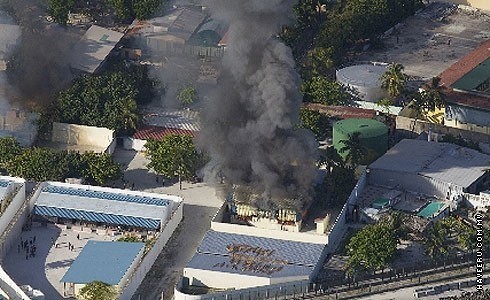
Inmates set fire to Maafushi Jail

2009-10-13
Inmates at Maafushi Jail set fire to some of the cells and caused severe damage to Jail property on Monday.
An officer of the Emergency Support Group (ESG) said that after the incidents of the previous day, all the inmates been kept locked in their cells when they had started breaking out of their cells around 2:30pm on Monday. The inmates had proceeded to set fire to their cells, break everything and ‘create havoc in the jail’, the officer said.
By 4:00pm the inmates had set fire to the high security ward of the prison, Block U2, Unit 4 and 6, and the so-called ‘pentagon’, and continued destroy all accessible areas of the cells. Two staff members of the jail were also seriously injured when inmates beat them up. Some of the inmates were also injured; one suffering a broken arm while another had broken his leg.
The ESG officer said that no one was able to get near the area and that if anyone other than an inmate tried to enter the area the prisoners would attack them with makeshift weapons.
“They were saying that they would destroy Maafushi Prison so that no one could ever be kept prisoner in there,” the officer said.
Another officer said that when the inmates had started setting fire to the cells, all the officers had gathered near the main gate. He said that although the inmates had tried to escape out of the prison and into the island, they had not been able to do so.
“They tried to break out twice,” the officer said. “But they weren’t successful.”
On Sunday, the inmates in the Unit Two (U2) block of Maafushi Jail brought down the walls separating the sections, converting the entire block into one big cell. The U2 block is the high-security wing of the jail where the most dangerous prisoners are kept.
An officer from the jail’s ESG Group said on Sunday that inmates of the U2 block, housing around 70 prisoners, had destroyed the walls separating the three sections of the cells and taken control of the block. He said that the incident had occurred in the morning when some of the U2 inmates were taken outside to the yard.
“Every day some of the inmates would be given access to the yard for around two hours,” the officer said on Sunday. “When they were released to the yard today, then climbed on top of the U2 block.”
He said that the inmates had then broken the locks on the other cells and released the prisoners there. After breaking the locks the inmates had proceeded to break down the walls.


Inmates set Maafushi jail on fire

12 October 2009
Maryam Omidi
Inmates at Maafushi Jail have set fire to units three, four and six following a clash with the Emergency Support Group (ESG) and riot police yesterday.
Speaking to Minivan News today, one prisoner said the jail was “under inmates’ control” after ESG and riot police had been forced outside.
“Yesterday, the SOD (riot police) beat us and took everything, even our toothbrushes and put ten of us to a cell in unit two,” he alleged.
Mattreses in unit two have been set alight, he said.
He further alleged two inmates sustained serious injuries to their heads while a third had his hand broken. He added police “beat” prisoners with batons even after the situation was brought under control.
The inmate said that after the clash, prisoners were stripped of all their belongings except their clothes and packed into cells of ten as the locks and bars of most cells were broken.
Both police and the DPRS have denied the allegations. Rasheed told Minivan News today that inmates had a tendency to “cook up stories”.
He said five prisoners and five prison officers all sustained minor injuries and were currently receiving medical assistance in the jail.
Police Sergeant Ahmed Shiyam said five police officers also received minor injuries.
Rasheed said inmates would now have some of their privileges, such as conjugal visits, suspended. He added the jail required more staff and funding to tighten up security in order to be able to control inmates.
“It takes not even five minutes to damage and destruct but to repair, we need time and money,” he said.
Riot police were deployed to Maafushi Jail yesterday to provide support to the ESG after inmates in unit two demolished walls and destroyed cells using metal bars.
Rasheed said the police have been asked to stay at the jail for several days.
Earlier this year, inmates smashed up several wings in the jail before setting them alight. The health centre and industrial workshop were completely destroyed while a desalination plant and classrooms were thoroughly damaged.
The riots followed a report from the Human Rights Commission Maldives (HRCM) which recommended immediate action to stop drug use and abuse in the prison, the removal of all communication devices, categorisation of prisoners and an overhaul of prison regulations.
Ahmed Irfan from Maldivian Detainee Network (MDN) said the NGO was “extremely concerned” about the frequency and severity of incidents at Maafushi Jail.
“These incidents are a threat to the safety and security of both prison officials and inmates,” he said.
Irfan further pointed to recent reports from both the MDN and the Human Rights Commission Maldives, which underscored structural problems such as overcrowding, a lack of resources for prison officials and a lack of a rehabilitative mechanism.
“We call upon the relevant authorities to address these issues as a matter of the greatest urgency,” he said.
Police suspect political parties behind jail riots

13 October 2009
Maryam Omidi
Defence Minister Ameen Faisal said yesterday that he had reason to believe certain political parties had orchestrated the recent unrest at Maafushi Jail.
In an interview with Television Maldives (TVM), Faisal said police had received information about the complicity of political parties and had initiated an investigation into the matter.
Speaking to Minivan News today, Faisal said his statement was an appeal to political parties to refrain from using the jail to achieve political ends.
“We urge all parties not to carry out such acts that harm our society,” he said to TVM.
Ibrahim Mavota Shareef, spokesperson for the main opposition Dhivehi Rayyithunge Party (DRP), said today his party condemned the riots at the jail. “We never support such action by anyone,” he said.
He added many inmates believed they had been unfairly imprisoned by the former government and the DRP’s relationship with prisoners was “negligible”.
Mavota said the riots were because of inmates’ frustrations and unfulfilled expectations.
“What happened was when MDP [Maldivian Democratic Party] campaigned for the presidential election, they gave a lot of hope to them, saying they might be released but they didn’t realise it would take so long because of the due process of the law,” he said.
He said many inmates and their families had voted for President Mohamed Nasheed in the presidential election last year as well as members of his party in the May parliamentary election.
A statement from police issued yesterday confirmed that an investigation into reports about the involvement of political parties was underway.
“We take this opportunity to make it known that action will be taken against people involved in these activities to any extent as the unrest at Maafushi Jail has caused large financial loss to the state,” the communique reads.
It adds that the riots at the jail had now been brought under police control.
Inmates at Maafushi Jail set fire to three units yesterday following a clash with the Emergency Support Group (ESG) and riot police the day before.
A total of 15 inmates, prison officers and police officers were injured.
The riots were the second to take place this year as inmates smashed up and set fire to sections of the jail in March.
In a press release issued today, the Human Rights Commission Maldives (HRCM) expressed serious concern over the unrest at the jail.
“Since Maafushi is an inhabited island, the commission empathises with the psychological damage being done to the islanders and is very concerned about this,” the statement said.
The HRCM further noted the absence of an effective mechanism to control and manage the jail resulted in such incidents.
“This is an issue that the commission has repeatedly noted, discussed with the relevant authorities, expressed concern about and made recommendations,” the HRCM added. “We regret that the recommendations have not been implemented.”
The riots in March followed a comprehensive report on the jail by the HRCM which recommended immediate action against drug use in the prison, categorisation of prisoners and an overhaul of prison regulations.
In today’s statement, the commission said that inaction against those responsible for setting parts of the jail alight in March had emboldened inmates.
The commission called on the government to establish a mechanism to prevent further riots and advised legal action against inmates involved in the unrest.
In its statement, the HRCM said stabilising the jail was in the public interest and more prison officers were necessary to oversee the institution.
“The unrest at Maafushi Jail was an atrocity that violated the human rights of many people,” the statement concluded. “The commission urges the government to take necessary measures as soon as possible.”








 anthropologie du présent