
Emeute à Kuala Lumpur août 2009

Malaysian street protest turns ugly

AFP, KUALA LUMPUR
Sunday, Aug 02, 2009
Malaysian police fired tear gas and water cannons, and arrested dozens of demonstrators yesterday in an attempt to disperse a mass street protest against Draconian internal security laws.
Thousands of police backed by riot squad officers and helicopters cracked down at three rallying points in Kuala Lumpur — two major mosques and a popular shopping district.
Web news portal Malaysiakini said some 200 people had been arrested as police tried to disperse crowds at the rallying points and scupper their plans to march to the royal palace or the city’s Independence Square.
At least 50 rounds of tear gas were fired and water cannons were directed at a crowd of around 10,000 people who gathered at the Sogo shopping complex in downtown Kuala Lumpur.
An AFP reporter saw at least 25 people arrested, before the huge group began marching down a main thoroughfare toward the royal palace, triggering the police offensive.
Organizers said they intended to present a 10-point memo to the king, including demands for the abolition of the Internal Security Act, which allows for detention without trial.
They were also calling for the closure of a camp in northern Perak State where detainees are held and an inquiry into all deaths in custody and allegations of police abuse of power.
At the national mosque, where an AFP reporter saw at least 50 detained, opposition Islamic PAS Legislator Siti Mariah Mahmud criticized the arrests.
“This is not reasonable. It’s prayer time and this action is a breach of our religious freedom and duty,” she said.
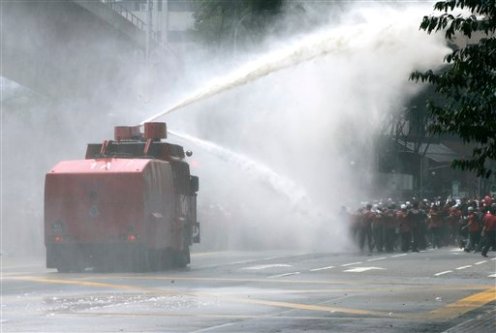
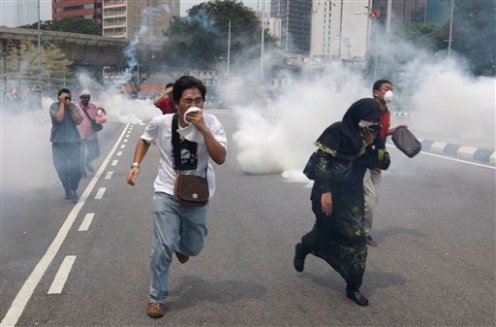

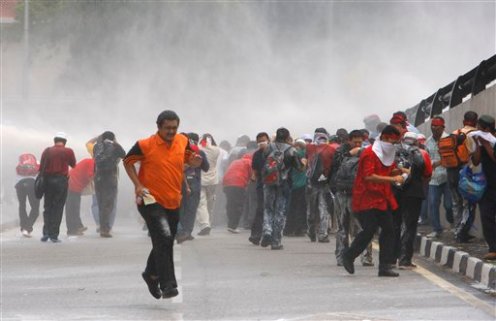
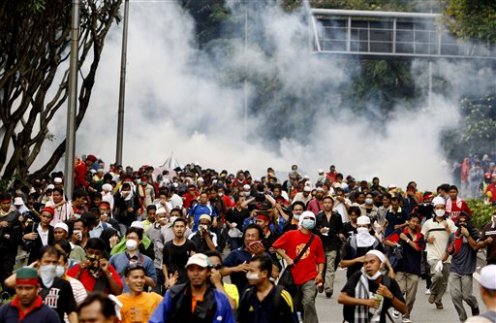
Malaysian police tear gas, scuffle with protesters

KUALA LUMPUR, Malaysia — Riot police charged demonstrators with batons and fired tear gas Saturday to disperse thousands of people marching in Malaysia’s largest city to protest a law that allows indefinite detention without trial.
People began massing at Kuala Lumpur’s main mosque, a shopping mall and a train station Saturday morning in defiance of government warnings that police would crack down on demonstrators, who are pushing leaders to scrap the Internal Security Act, which allows the imprisonment of people regarded as security threats. Police said many thousands had taken to the streets, with some news Web sites putting the count as high as 20,000.
Police fired tear gas and chemical-laced water to disperse the crowds shortly after they began marching toward the national palace. The protesters — who chanted « Reformasi, » the opposition’s slogan for political change — had planned to submit a petition to the country’s king, the constitutional monarch, to denounce the security act.
Witnesses said police wielding batons charged the protesters and scuffled with them. Many people ran into alleys and shops nearby to avoid being arrested.
« The police are really brutal, » opposition leader Anwar Ibrahim told reporters at the protest. « This clearly shows (the government’s) intolerance to any dissent. … We gather here today to fight a cruel law. »
Before the march started, Kuala Lumpur Police Chief Muhammad Sabtu Osman said 150 people — identified as protesters because they were wearing opposition T-shirts and headbands — had been detained to prevent them from taking part. Opposition activists estimated at least 200 people were detained by the time the protest ended.
Government authorities had warned they would not allow the protest, saying it could undermine public peace.
Authorities set up roadblocks across Kuala Lumpur to deter the demonstrators from trying to reach the city center, sparking massive traffic crawls. Hundreds of riot police backed by trucks mounted with water cannons stood outside train station and shopping mall where the demonstrators had arranged to gather.
Restaurants and stores were shuttered on several streets ahead of the rally — the biggest street protest in Kuala Lumpur since a November 2007 when tens of thousands of minority ethnic Indians demanded racial equality.
A police official at the scene, who spoke on condition of anonymity because he was not authorized to make public statements, said authorities could only estimate that there were « many thousands of protesters. »
The Star newspaper and Malaysiakini news Web site reported a total of 20,000 protesters in three different areas.
Prime Minister Najib Razak has promised to consider amending the security act, though government officials have repeatedly said it is necessary to safeguard national security, and on Friday he urged people not to join the protest.
Nazri Aziz, the Cabinet minister in charge of legal affairs, said Saturday that as long as the National Front ruling coalition « is leading the government, the ISA will not be abolished, » The Star reported on its Web site.
Human rights groups estimate at least 17 people are being held under the act, mainly for alleged links to militants and document forgery.
Activists have long decried the decades-old act, instituted during the British colonial era, saying it is sometimes used to jail government critics and dampen dissent.
Human rights activists have held numerous smaller rallies over the years to protest the security act, but Saturday’s protest received a boost after opposition parties urged their supporters to come out in force.
Associated Press writer Sean Yoong contributed to this report.
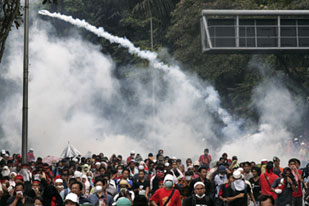
La police anti-émeutes charge les manifestants en Malaisie

AP | 01.08.2009
La police malaisienne a tiré des gaz lacrymogènes et chargé la foule à coups de bâtons et de camions à eau, cherchant à disperser quelque 10.000 partisans de l’opposition qui manifestaient samedi à Kuala Lumpur contre une loi autorisant la détention sans jugement pour une période indéfinie.
L’édition en ligne du journal « The Star » et le site d’informations Malaysiakini avançaient le chiffre de 20.000 manifestants, marchant sur le palais royal aux cris de « reformasi », le slogan pour le changement de l’opposition. Les manifestants envisageaient de remettre une pétition au roi.
Pendant la manifestation, Anwar Ibrahim, chef de l’opposition, a dénoncé la « brutalité de la police », alors que nombre de manifestants couraient, se cachant dans les ruelles pour éviter d’être attrappés et frappés par la police.
Avant même le début de la manifestation, au moins 150 personnes ont été arrêtées, a annoncé la police. L’opposition faisait pour sa part état d’environ 200 interpellations pendant la manifestation, qui avait été interdite par les autorités.
Les forces de l’ordre avaient dressé des barrages pour empêcher l’accès au centre ville, et des centaines de policiers anti-émeutes étaient déployés, ainsi que des camions équipés de canons à eau.
Les restaurants et magasins avaient baissé leurs rideaux, par crainte de débordements et de violences.
L’opposition cherche à pousser le gouvernement à suspendre cette Loi sur la Sécurité intérieure, qui permet de garder indéfiniment sous les verrous et sans jugement les personnes considérées comme des menaces pour la sécurité. Selon les militants des droits de l’homme, au moins 17 personnes sont détenues en vertu de ce texte, instauré sous la colonisation britannique. Ils considèrent qu’il permet d’emprisonner ceux qui critiquent le gouvernement et d’étouffer ainsi toute dissidence. Le gouvernement de son côté affirme que c’est un instrument nécessaire à la protection de la sécurité nationale.
Il s’agissait de la plus importante manifestation à Kuala Lumpur depuis novembre 2007: des dizaines de milliers de membres de la minorité d’origine indienne avaient manifesté contre la discrimination ethnique et pour réclamer l’égalité de traitement.




 anthropologie du présent