Emeute à Shishou 石首 juin 2009
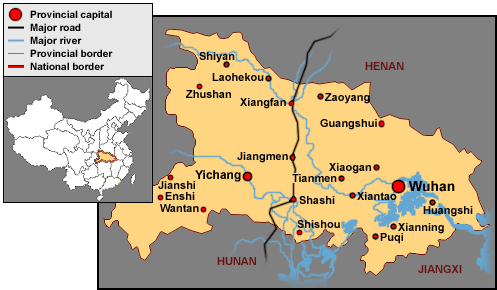
La mort d’un cuisinier provoque des émeutes dans le Hubei

22.06.2009
Un hôtel a été incendié, des voitures de police renversées et des officiers criblés avec des pierres lors des protestations de plusieurs milliers de personnes le week-end dernier à la suite de la mort mystérieuse d’un cuisinier dans la province du Hubei, ont déclaré les habitants locaux.
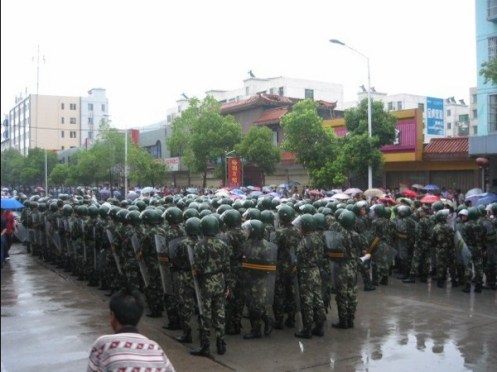
Près de 10 000 policiers du régiment anti-émeute ont utilisé des boucliers de protection, soutenus par des véhicules blindés, tentant de mettre fin à trois jours de violences à Shishou à l’aube le 21 juin, raconte une habitante de la ville qui s’appelle Cheng.
Selon les affirmations de Cheng, près de 10 000 personnes ont participé à l’émeute, mais certains médias ont parlé des chiffres beaucoup plus élevés.
Selon Xinhua ce chiffre était près de 1 000 personnes et l’agence chinoise d’information a déclaré qu’il n’y a pas eu de rapports officiels concernant les blessés.
La situation était tendue hier soir lorsque la police tentait de maintenir l’ordre sur les artères dans les environs de l’hôtel Yonglong noirci par l’incendie en tentant de disperser la foule.
Les violences ont été provoquées par la mort de Tu Yuangao, âgé de 24 ans qui était cuisinier à l’hôtel Yonglong. Son cadavre a été retrouvé à l’extérieur du portail de l’hôtel mercredi soir.
Selon la police, la lettre de suicide laissée par le jeune homme témoignait de son « pessimisme et de son mal de vivre ».
Le corps de Tu a été transporté à la morgue hier matin après l’acceptation par sa famille de faire son autopsie, proposée par la police.

Tens of thousands of Chinese fight the police in Shishou

Jun 22, 2009
Tens of thousands of rioters torched a hotel and overturned police cars, after the authorities allegedly tried to cover up the murder of a 24-year-old man as a suicide.
The deceased, Tu Yuangao, was the chef of the Yong Long hotel. According to the cops, he committed suicide by jumping off the roof of the building and left a note.
Witnesses said there was no blood on the scene and Tu’s body was already cold just after it hit the ground. His parents were surprised at the suicide note, since he was allegedly illiterate.
There are plenty of rumours flying around – that two other employees at the hotel had died in the same way, that the boss of the hotel is related to the mayor of Shishou, that the hotel was a centre for the local drug business and Yu was killed for threatening to expose what was going on. There’s also a rumour that three further bodies have been found at the hotel.
There are more details and photos here (EastWestNorthSouth).
It’s a strange story, and it gets stranger. A huge mob, of anywhere between a few thousand to 70,000 people, depending on which report you read, quickly gathered outside the building. Tu’s parents refused to let his body be taken away, and instead placed it inside the hotel on ice.
The crowd defended the body against waves of policemen. However, on Saturday, a fire was lit inside the hotel, but the corpse was saved. Tu’s cousin apparently armed himself with two barrels of gasoline and threatened to blow himself up if the body was taken.
The police restored order yesterday, imposed a curfew and took the body to a funeral parlour. Today, the website of the local government has been defaced by hackers.
What’s extraordinary is the speed in which the riot blew up, and the venom directed against the local authorities. Whatever was behind Tu’s death, there’s clearly something rotten in Shishou.
But after months of calm, there have been a spate of reported riots recently. Is this because media restrictions have been lifted, allowing news of riots to spread, or has there been a genuine increase in social tension in the countryside?
It is impossible to tell. China no longer publishes the figures for how many riots take place each year, but most people put the figure at around 80,000 and the vast majority go totally unnoticed.
The fact that there have been a dozen riots reported in the last couple of months may not demonstrate anything out of the ordinary. There is no theme that connects the recent protests – some are about property, some have been triggered by work disputes, some are because of corruption.
But then again, a huge number of migrant workers are still out of work because their factories have not recovered from the economic crisis, the harvest is finished and people’s savings may be running low. Perhaps the tinderbox is drier than usual.
Cook’s death sparks protests in Hubei

By Xie Chuanjiao (China Daily)
2009-06-22
A hotel was torched, police cars overturned and officers pelted with rocks as thousands of people rioted over the weekend following the mysterious death of a cook in Hubei province, residents said.
Many police officers marching in formation used shields for protection and were backed by armored vehicles as they put an end to three days of violence in Shishou by dawn yesterday, a local woman surnamed Cheng said.
Cheng estimated that up to 10,000 people were involved in the riot but some media organizations said the figure was much higher.
Xinhua put the number at around 1,000 and said that there were no official reports of injuries.
Security was tight last night as police guarded roads surrounding the blackened Yonglong hotel after dispersing the crowd.
The violence followed the death of 24-year-old Tu Yuangao, a cook at Yonglong Hotel, who was found dead outside the hotel’s gate on Wednesday evening.
Police said a suicide note left by the chef showed he was « pessimistic and hated the world ».
A resident surnamed Chen told AP that protesters started gathering outside the hotel Friday and by late Saturday had clashed five or six times with police, smashing six police vans and fire trucks.
Chen said thousands of armed police forces with shields and batons were deployed in the area, AP reported.
Amateur video, which could not be independently verified, showed protesters pelting rocks and projectiles at riot police. Using a megaphone, police told protesters to drop their weapons and said that the demonstration was illegal and ordered the crowd to disperse.
Cheng told China Daily that local officials were involved with the hotel, which she said was « engaged in drug dealing ».
Tu found out the truth and decided to resign, Cheng said.
 |
She said he asked for his salary but was refused, and alleged that Tu was later beaten to death by hotel staff or gangsters.
Xinhua reported that some local people believe that gangsters killed Tu, and others blame the hotel boss, believed to be the mayor’s brother.
A man surnamed Zhang in his 50s said « Yonglong hotel is a den for drug-addicts » and showed Xinhua reporters used syringes in the rubbish at the back of the hotel.
A man who answered the phone at the Shishou government office refused to comment on the allegations, saying that the cause of death was being investigated.
Tu’s body was taken to the morgue yesterday morning after his family agreed to conduct a police-proposed autopsy.
Xinhua contributed to the story

City in central China rocked by violent riots: residents

21 juin 2009
BEIJING (AFP) — Police were struggling to restore order Saturday in a central China city hit by riots following a man’s death in a government-linked hotel, local residents and a human rights group said.
The unrest in the city of Shishou in Hubei province saw violent clashes between police and thousands of residents amid suspicions over the cause of the man’s death Wednesday, a resident said.
« There were at least 10,000 people gathered near the hotel yesterday (Friday). Police were being chased away by residents, who were hitting the police, » a woman employee at a nearby hotel told AFP by phone.
The woman, who would not give her name, said she also saw police vehicles that were damaged or overturned.
She added that large crowds were still present on Saturday near the Yonglong hotel where the man was a chef.
The official Xinhua news agency reported that more than one thousand people crowded outside the hotel at 5pm (0900 GMT) Saturday, with hotel walls « blackened by fire, » it said.
The clashes occurred after the man’s parents raised suspicions about the nature of his death, the Hong Kong-based Information Centre for Human Rights and Democracy said in a statement.
The report, which quoted local sources, also said the owner of the hotel where the man died was known to be a relative of the city’s mayor.
The centre quoted sources saying at least 200 people were injured in the clashes and that police reinforcements were arriving.
The female hotel employee said a person had fallen to their death years earlier from the same hotel, adding to the suspicions of local residents.
A person who answered the phone at the city government headquarters on Saturday dismissed the reports.
« There are a lot of rumours floating around, » said the man, who declined to give his name.
Staff at the local police headquarters declined comment to AFP.
However, a report by the official China News Service said the city government had sent out a notice on Friday acknowledging there was an « abnormal » death.
It identified the man as 24-year-old hotel chef Tu Yuangao.
It quoted the notice as saying local authorities concluded Tu had killed himself and that a suicide note had been found, but that Tu’s parents had rejected that conclusion.
China sees tens of thousands of large-scale riots each year, often sparked by allegations of government corruption and other official abuses.
Residents protest over chef’s death in central China city

2009-06-20
WUHAN, June 20 (Xinhua) — Many local residents gathered in front of a hotel in Shishou city of central China’s Hubei province, protesting over death of a chef from the hotel on Saturday.
At about 5 p.m., more than one thousand people still crowded at the six-storey Yonglong hotel, where the ulterior walls were blackened after a fire. Windows at the first floor facing the street were smashed and the street was blocked.
A fire engine and two police vehicles were battered by protestors, witnesses said.
According to the city government of Shishou, police received a phone call at 8:36 p.m. Wednesday. A man’s body was found at the gate of the Yonglong hotel at Dongyueshan road.
Initial investigation showed that the dead was 24-year-old Tu Yuangao, a chef of the hotel.
Police didn’t find life-threatening injuries in the surface of the body. A note left by the chef showed that he was pessimistic and hates the world. Thus the death was believed then as suicide.
Police suggested to have autopsy of the body so as to make out cause of the death, but the request was rejected by Tu’s relatives, who were not convinced by the allegation of suicide.
Local residents blocked the Dongyueshan road and the Oriental avenue on Friday, alleging foul play.
According to the local authorities, someone set fire to the hotel at 0:30 a.m. Saturday, which was put out at 3 a.m.
The body was in the first floor and some residents guarded the gate, saying that police tried to take the body.
Some local people believed that the chef was killed by gangsters.
« The Yonglong hotel is a den for the drug-addicts, » said a man surnamed Zhang in his 50s. He showed Xinhua reporters the used injectors in the garbage at the back of the hotel.
A 16-year-old girl died in the hotel a few years ago. The death was later recognized by police as suicide, local people said
Residents in central China protest over death

Sat Jun 20, 2009
BEIJING, June 20 (Reuters) – Police in central China’s Hubei province have been called in to quash protests over the mysterious death of a man in a government-owned hotel, eyewitnesses told Reuters on Saturday.
« There are still a lot of armed police around, » a local resident surnamed Chen told Reuters. « But they haven’t convinced (the protestors) to go home yet. »
On June 17, Xu Yuangao, a 24-year-old chef, was found dead at the Yonglong Hotel in the city of Shishou, and while the police say they found a suicide note, Xu’s family continue to allege foul play.
Another resident said that local people were suspicious because of another incident that took place at the hotel several years ago.
« Yonglong Hotel doesn’t have a good reputation because of its connections with the government and the death of a girl there a few years ago, » she said.
She added that « around 10,000 people » have taken part in the protests, most of them local farmers angered by the way the case has been handled.
According to a short statement posted on the website of the Shishou city government, the police have kept in touch with Xu’s family to arrange an autopsy and confirm the cause of death, but the family refused.
« A large number of uninformed people set up a roadblock at East Yueshan Road and Oriental Avenue in Shishou, disrupting traffic and creating a disturbance, » the statement said.
Chinese sociologists have described the spate of riots and protests in the country’s deprived hinterlands as « anger-venting social incidents » brought about by years of hardship and inequality.
Last year, the death of a 16-year-old girl in southwest China’s Guizhou province led to riots involving 30,000 local residents, fired up by rumours that the girl had been raped and murdered. (Reporting by Beijing newsroom; Editing by Alex Richardson)






 anthropologie du présent