
Emeute à Jaigaon জয়গাঁও en Inde mai 2009
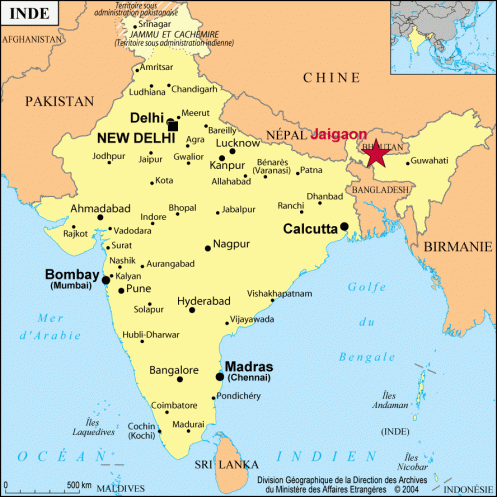
Jaigaon riot, short but savage

Bhutanese, living across the border in Jaigaon town, got the fright of their lives yesterday, when a riot broke out between the Nepalese and Muslim communities and rioters prevented Bhutanese from coming out from their house.
The riot, which started at around 9:00 am, was set off after a Muslim boy, who was kidnapped by a group of Nepalese boys on Saturday, was found dead yesterday morning, according to Jaigaon police.
Local Indian media, who came to cover the elections, said that a Nepalese auto-rickshaw man was also killed and his rickshaw burnt. Bhutanese, who chose to reside in Jaigaon because of cheaper house rents, said that they were targeted not because they were Bhutanese, but since they looked like Nepalese living in Jaigaon. “We were asked to stay inside or risk our lives,” said a resident.
“A group of Bengali youth went on a beating rampage. Anybody thought to be a Nepali or looking like one was beaten up,” said Sonam, a Jaigaon resident. His friend, who lives in Jaigaon’s Chinese Line, said that his citizenship identity card saved him from a group, who nearly attacked him.
“I ran towards the Bhutan gate holding my ID card,” he said, looking relieved.
Pema, another resident of that quarter, said that a group stormed the line with bottles and sticks and smashed roofs and windows as they left.
“Early in the morning, my wife called me in panic. When I got up, I saw a group of Bengali boys shouting and smashing houses,” said another. “We were locked inside for six hours.”
The Phuentsholing police and the SSB personnel quickly escorted Bhutanese vehicles approaching Phuentsholing from Jaigaon to Bhutan.M
By 4:00 pm, the violence has subsided and Jaigaon police had arrested about 10 people. They said the situation was under control. Jaigaon police said that the Phuentsholing gate could be open to traffic today itself.
By Samten Yeshi in Phuentsholing

Clash bares ethnic fault lines
5 May 2009
JAIGAON (Jalpaiguri): Sunday’s sectarian violence in Jalpaiguri’s Jaigaon, bordering Bhutan, has sent tremors through the Dooars, exposing ethnic fault lines in towns like Hamilton, Kalchini and Samsing that have strong pockets of non-Nepali population.
Though strong police and paramilitary presence in Jaigaon prevented a repeat of Sunday’s rioting and arson on Monday, there are fears that a fresh round of violence can ignite the powder keg on which the deeply polarised communities in the region are sitting.
On Monday, the situation in Jaigaon was nearly normal in the morning, but flared up around 3 pm when rumours spread that Nepalis from Dalsingbagan were marching towards Muslim settlements in Jaigaon. Armed to the hilt with rods, swords and soda bottles, Muslims from Trivenitol, Mollahpara and Daragaon defied Section 144 and took to the streets. A Nepali woman passing through the area was targeted, but she somehow managed to take refuge in another Nepali person’s house.
Once the word of the attack reached Nepali localities like Dalsingbagan and Ramgaon, enraged Nepalis emerged to confront the mob with khukris and soda bottles.
Heavy deployment of Sashastra Seema Bal as well as police, however, ensured that the two mobs were kept at least half a kilometre apart. The police lathicharged several times to push the mobs into alleys. By late evening, the situation was under control but extremely tense.
Jaigaon business chamber secretary Ram Shankar Gupta said shops of Bihari, Marwari and other communities had also been attacked on Sunday. « We opened shops on Monday, but downed shutters when the situation deteriorated, » he added.
Jalpaiguri SP Anand Kumar acknowledged the undercurrents of volatility. « We are deploying more forces and trying to mediate talks between the communities, » he said. In addition to one company of SSB that was deployed on Sunday, five platoons of state armed police, one platoon of Indian Reserve Battalion and two platoons of Rapid Action Force were deployed on Monday.
Another officer said Sunday’s riots were not spontaneous. « The nature of attack was plotted and counter-attack expected. Interrogation of the 22 arrested revealed the complicity of both sides, » he said.
Though it was the brutal murder of two youths one Nepali and the other Muslim that sparked Sunday’s rioting, it was merely a catalyst that set fire to an outburst waiting to happen. For over two decades, Bengali Muslims in Jaigaon and elsewhere, along with Bengali Hindus, Biharis, UPites and other regional communities settled in pockets across Dooars have had an uneasy relationship with Nepalis. While the insecurity on the part of Nepalis the earlier settlers stems from the growing dominance of outsiders’ in business and growth in population, the others are piqued with Nepalis’ refusal to accept them despite some settlements dating back 40-50 years.
In Jaigaon, for instance, six Muslim families first migrated from Cooch Behar 40 years ago and settled in shanties next to a spring in the Nepali-dominated town. Today, the population has grown to 20,000 with some setting up auto workshops and furniture stores and others still earning their daily wage doing odd jobs.
Abu Kasem Sarkar, a local leader from the community, said Nepalis’ refusal to accept Muslims and others ensured that the divide was never bridged. The Gorkhaland movement and GJM’s decision to back BJP candidate Jaswant Singh in the elections has further widened the gulf.
« How can Muslims vote for BJP that is so brazenly anti-Muslim? The demand for a Gorkha state is a direct threat to non-Nepalis. The violence is aimed at evicting the non-Nepalis, » Sarkar said.
The simmering tension had just about managed to refrain from exploding in 2006 when three Muslim boys from Jharnabasti in Jaigaon Rafiqul, Ikram Miyan and Kuddus were abducted. Their bodies were found in the Torsa river near Ramgaon, close to where Ahidul Mian’s body was found on Sunday.
« Back then, the Nepali community showed restraint. But this time, the situation was more volatile as Nepalis have joined forces under a common platform. While GJM’s insistence that everyone vote for BJP has created pressure on other communities, it is maximum on Muslims because Nepalis know that they will not vote for the party, » Sarkar added.
GJM central committee member Bishnu Lama, who hails from Jaigaon, dismissed the allegation. « We have only made an appeal to the people. The high 90% turnout is in response to the call, » he said.
Former Congress leader Kamal Pakhrin, who now has GJM leanings, said Nepalis were insecure, having lost business and land to migrants. GJM spokesperson Benoy Tamang, who visited Jaigaon on Monday, expressed fears of escalation in the violence, especially after election results are declared.
Two persons killed in group clash at Jaigaon

3 mai 2009
Siliguri (WB) (PTI): At least two persons have been killed in a group clash at Jaigaon town near the Indo-Bhutan border in Jalpaiguri district even as agitators torched vehicles in the area early on Sunday, police said.
The trouble began on Saturday night in the town, 200 km from here, when there was an altercation between two persons which soon took a larger shape with other people joining the two sides, they said.
While one person died during the clash on Saturday, another body was found at Jaigaon Chowpatty area on Sunday morning, the police said.
Inspector General of Police (North Bengal) K L Tamta also confirmed the two deaths.
Trouble spread this morning with three shops set on fire and about seven two and three-wheelers set ablaze, the police said.
Police and para-military forces arrived at the spot and brought the situation under control.






 anthropologie du présent