
Emeute à l’Université de Kent avril 2009
Anatomy of a riot

05/03/2009
It was early Sunday morning, April 26, by the time several dozen riot police — and several hundred raucous partygoers — found their way off Dinkytown streets.
Glass shards from broken bottles and dented cars lined the 1300 block of Seventh Street Southeast, the remnants of an hours-long riot that marred a celebration that began the day before as a high-spirited block party.
But things got out of control.
Alcohol fueled tempers and a street fire, and both ultimately exploded into high-stakes chaos that would risk the future of a decades-long tradition at the University of Minnesota.
The Spring Jam Riot put Spring Jam itself on the table.
Students face possible sanctions, in court and at school. University leaders fear a reputation tarnished beyond repair. Scrutinized police say they did everything they could to diffuse the mayhem.
Still, questions linger and administrators aren’t sure if the annual end-of-the-school-year celebration should continue.
“This incident, I don’t think, represents the kind of conduct, behavior and sense of responsibility that I’ve come to appreciate from the University of Minnesota student body,” University President Bob Bruininks said . “I think this was a breakdown that we should try to learn from.”
Elements of a riot
The first-ever recorded riot on a U.S. college campus occurred at Harvard University in 1766.
Later deemed the “Great Butter Rebellion,” the uprising followed the suspension of Asa Dunbar — the grandfather of author Henry David Thoreau — for protesting rancid butter in the school’s cafeteria.
Riots have since carved a place in college culture around the country.
In the aftermath of a 2002 riot at Ohio State University, the school created a task force to prevent celebratory riots. The task force found 20 riots had occurred on U.S. college campuses between 1997 and 2002 — one of which was at the University of Minnesota — and drafted the following definition for a celebratory riot:
-Frequently occurring in relation to a sporting event.
-Generally involving the participant consumption of alcohol.
-Fire setting as common practice.
-A majority of white males as active participants.
-The eventual police intervention met with resistance and disrespect.
In his report, “An Analysis of Issues Related to Celebratory Riots at Higher Education Institutions,” Jeffery M. Van Slyke cites 10 common denominators generally found in college riots, including an “attitude of entitlement” among participants, a high-population neighborhood with “little sense of community” and a “mob mentality” that “sweeps up many who had no intention of becoming involved.”
Van Slyke’s report also suggests there are several psychological theories that could explain the “mob mentality” behind these riots.
Joshua Page , University sociology professor, said it’s common in mob situations for participants to act as a whole. When acting in a group, Page said, participants often experience feelings of invulnerability and lack of accountability.
“There’s something really enervating, if not enjoyable, about really moving as one with a group,” he said. “If you do illicit things within a group, there is the sense that you’re not accountable and you’re not going to get caught or hurt.”
In incidents when groups are acting violently, like the Dinkytown riot, Page said it’s common for participants to greet police with aggression. Page said people who do not have much experience with police are often more likely to lash out against them.
A tarnished reputation
On April 13, 2003, hundreds contributed to the destruction of on- and near-campus property , with damage totaling more than $150,000.
The incident began as a celebration of the University’s Division I NCAA Men’s Hockey Championship , but quickly escalated to aggressive behavior that included tipping cars, setting fires and the destruction and looting of local businesses.
In addition to mass property destruction, administrators feared the University’s reputation had suffered irreparable damage, and clung to save the nearly severed ties between the college and surrounding communities.
Jerry Rinehart , who transitioned from assistant dean of the Carlson School of Management to vice provost for student affairs during the disciplinary process in 2003, said community members closely monitored the University’s handling of students involved in the riot.
“There was just a great deal of outrage in the community about student behavior and a real demand for justice for those students,” Rinehart said.
In the end, the University took disciplinary action against 11 students for violations of the school’s conduct code during the riot, according to University records. Two students were expelled.
City action against the students ranged from minor consumption tickets to felony second-degree arson charges, according to University records .
“It took a while to get all that straightened out because there were court cases pending,” Rinehart said. “We also had some difficulty because the conduct code wasn’t formally extended off campus.
“It really brought to our attention the need to be able to address some of the serious behaviors that students might engage in, that because of the definition of our conduct code, we couldn’t do anything about.”
The Riot Act
In 2006, three years after the Hockey Riot, the University amended its code of conduct to extend disciplinary reach off campus.
Among these provisions is a subdivision titled, plainly, “Rioting.”
“Rioting means engaging in, or inciting others to engage in, harmful or destructive behavior in the context of an assembly of persons disturbing the peace on campus, in areas proximate to campuses, or in any location when the riot occurs in connection with, or in response to, a University-sponsored event,” the code states.
In contrast to the 2003 incident, the amended code will allow the University more disciplinary power over students involved in the Spring Jam Riot. The code carries penalties ranging from warnings to expulsion to degree revocation, based on the nature of offenses.
The code of conduct
New information about individual conduct could come from a University-sponsored website that displays images from the riot.
School administrators are calling on students for help identifying people shown in the video as participating in the riot.
So far, Rinehart said, there have been a couple of identifications made by visitors to the site.
Still, he’s not expecting widespread feedback from students.
“I don’t think it’s going to be real effective,” he said. “But it’s an effort, and if we can even just get a few more people” it’ll be successful.
Each of the arrested students will meet with University officials to discuss their actions and potential violations of the Student Conduct Code.
Now, the conduct code office is waiting for police reports that it expects to receive soon to review the arrestees’ alleged conduct.
From there, the students will meet with conduct code coordinators to discuss the circumstances and possible resolutions. The coordinator will offer each student a sanction that they can agree to immediately.
Otherwise, the student can request a hearing, which Rinehart said can prolong the disciplinary process.
He estimated that, if each student accepted the suggested sanction, the process could be finished within two weeks of the initial meeting in the conduct code office.
But the hearing process could stretch through the summer, he said.
Bruininks said it’s too early to say how administrators will apply the conduct code in this case, the first notable broad application of the off-campus amendment since its approval.
“I think it’s very important to be fair to our students, but at the same time expect them to be accountable for their behavior,” he said. “In the deliberations, I’m sure we’ll come out with fair and just outcomes.”
Fostering accountability is important, Rinehart said.
“I’m less worried about the sanctions in some cases than having a conversation about whether some students understand the implications of their behavior,” he said.
The court of law
The night of the most recent riot, Minneapolis police at the scene arrested and later filed misdemeanor charges against eight people, including five enrolled University students.
Police leveled six unlawful assembly charges, three for obstructing the legal process and two for disorderly conduct among the arrestees. Most of them face only an unlawful assembly charge, but some doubled up.
Officers have jurisdiction to file misdemeanor charges. The City Attorney’s Office then reviews the cases independently to determine whether there’s enough evidence to prosecute.
A number of the cases are already scheduled for arraignment, some as soon as May 8.
Many of the cases are still under review, Assistant City Attorney Tim Richards said. In some instances, the office is still awaiting information.
Richards wouldn’t comment on the nature of that information.
Met with resistance, police strike back
Peter Robbins is among the students facing penalties in a court of law and at the University.
Cited with unlawful assembly, the computer science junior said he headed to the riot about the time police got there because he wanted to document it.
About a half-minute after he arrived, Robbins said he was standing still and focusing his camera when an officer in riot gear shot him in the groin with a marking round. Police arrested Robbins shortly thereafter.
Robbins, who noted in an interview the day after his arrest that he was “not intoxicated at all” at the time, maintains he told an officer that he was simply there taking pictures.
“I was assaulted, in my opinion, without any cause,” he said, adding that he plans to fight the charge.
Robbins said he hasn’t heard from the University about discussing his conduct, but his arraignment is scheduled for May 8.
Sgt. Jesse Garcia, spokesman for Minneapolis police , the agency that responded to the riot, said the marking rounds are “mainly used to pick out instigators and agitators.”
Police arrived at the scene en masse and clad in riot gear shortly before 11 p.m., hours into the block party that had, by that time, turned into a large street fire surrounded by a largely alcohol-fueled crowd of several hundred.
Some of the most raucous partygoers threw glass bottles at police, who lined up several dozen strong and advanced on the crowd.
At times during the police response, they seemed to fire projectiles arbitrarily, including down alleyways. Police also used concussion grenades and chemical irritants, such as pepper spray and tear gas, to disperse the rowdy crowd.
University Police Chief Greg Hestness said his department spent $2,099 in overtime pay to staff enough officers to handle the unruly pack of people.
Despite criticism, Garcia said last week that preliminary information indicates police tactics were “necessary and appropriate.”
“The focus should be on these kids getting out of hand,” he said. “The focus is not the police. The focus is these kids and the damage.”
Bridging the divide
Jim Forrey , a recent University graduate, said he believes police overstepped their bounds.
Last week, the activist spoke at an on-campus event and spent time canvassing the 1300 block of Seventh Street Southeast — the heart of Dinkytown, where the riot took place.
Forrey went door to door on the block in an effort to link anti-police brutality activism with “the average college student” who he said doesn’t typically face intense police action like that during the riot.
The idea was to approach residents and gather their stories, to understand what happened and facilitate discussion.
“I’m not trying to promote any kind of ideology,” he said. “I just want to talk to people that were directly faced with this kind of force by the police and open up a discussion for it.”
Forrey, who lives in the Como neighborhood, hurried to the scene when he heard the situation in Dinkytown was escalating.
After he got there, he was helping a man who had been pepper sprayed by police, and an officer shot three marking rounds that struck Forrey’s buttocks.
On Thursday night when he went canvassing, five days after he was initially wounded, Forrey’s bluish-purple, yellow-flecked abrasion still ran across the right side of his buttocks.
Police spokesman Garcia said the marking rounds aren’t designed to hurt and won’t cause long-term damage.
“If you’re a weasel, they might be painful,” he said. “If you’re a piddly little guy, you’re going to feel it.”
Forrey stands 5 feet 10 inches tall and weighs 150 pounds.
“I’m not the biggest guy in the world,” he said. “But it hit me in the fleshiest part of my body and it hurt real f—ing bad.”
Based on his experience, Forrey said he knows there are other people caught in the melee who unjustly received the same kind of treatment.
Armed with fliers featuring his contact information, a clipboard with blank pages ready to be filled with people’s stories and a friend who believes in the cause, Forrey went knocking.
Most houses on the block had lights on. Some residents didn’t answer. Some tenants shooed Forrey and his partner away. Others said they were uncomfortable talking to Forrey because they feared University and police punishment.
But some talked — and more still took the flyers. Forrey is hopeful that some of them will contact him with more stories, allowing him to open a dialogue about what could happen next.
“I’m here as a resource, not to tell them what to think,” he said. “I don’t have to tell them what to think. They saw what I saw.”
Who’s to blame?
In the sobering week that followed the Spring Jam Riot, administrators, students and community members all demanded the answer to a single question: Who’s to blame?
Among the contributing factors that surfaced included a Minnesota Daily headline, the last-minute cancellation of a student-sanctioned performer, the unexpected nice weather and a slow police response. Others thought those involved shouldered all of the responsibility.
“I don’t know,” Bruininks said when asked if this or future incidents could be prevented. “I think that’s a great, great question that we should ask ourselves, and we should not be afraid to pursue the answers.”
The Minnesota Daily
Two days before the Spring Jam Riot, The Minnesota Daily’s most prominent headline read, “No party patrol for Spring Jam.”
Rinehart said many students clipped the headline out of the newspaper to hang it up in their dorms, celebrating the perceived lack of authority for the upcoming weekend.
“Many, many people think that headline played a major role,” Rinehart said. “I think the headline was a real mistake.”
Hestness echoed the sentiment, calling it “very poor judgment” on part of the Daily.
Rinehart added that he doesn’t blame the headline, “because it shouldn’t be the presence or absence of law enforcement that determines how people behave.”
Talib Kweli cancels
Hip-hop artist Talib Kweli was scheduled to headline the Spring Jam concert that Saturday, but flight delays in Chicago kept him from performing on campus.
Would-be concert-goers filed back into Dinkytown when word of the cancellation spread, many stopping on the block that would later play host to the riot.
Police mishandle the situation
Psychology senior Ashley Schultz lives on the block, but was at a concert most of the evening of the riot.
Around 5 p.m., before she went out, Schultz noticed the party on her block was escalating.
“The cops probably should’ve done something at that point to disperse people,” she said.
She returned home to find a fire blazing in the street and riot police lined up in front of her house. Later, partygoers she didn’t know crammed into Schultz’s entryway, seeking refuge from police action outside.
Faulting young people who wanted to have a good time is misplacing the blame, Schultz said.
“I was drinking,” she said. “But there’s no way I would ever say it was a good idea to throw a bottle.”
Young people get out of hand
Police and University administrators have each addressed the riot as a case of young people behaving badly.
“What concerns me most is that there’s some students who think this was totally OK, that it was just a party,” Rinehart said.
Both Bruininks and Rinehart expressed relief that no one was seriously injured in the melee, but said students need to mull over their role in what happened.
“Perhaps students reflecting on this, if they can get around blaming the police, can get around being angry at the president for being angry, and recognize, ‘Is this how your mom and dad raised you?’” Rinehart said. “That’s the kind of maturity that takes some time to develop and sometimes a major bad event like this can have some growth potential for students.”
Dinkytown Rentals originally planned to take both units of a duplex on the 1300 block of Seventh Street Southeast to housing court — an effort to evict the tenants who, during the course of the party-turned-riot, allegedly violated terms of their lease, including serving alcohol to minors and receiving several noise complaints.
The two sides ultimately negotiated a settlement out of court that allows the tenants to stay in the properties.
“It just was a bad situation and I think it’s good to get it settled, » landlord Tim Harmsen said. « Some sort of court case wasn’t really going to be in anyone’s interest or really prove anything.”
A long way to go
Just more than a week after the riot, administrators struggle with the difficult decision of whether or not to continue Spring Jam, a tradition that began in the 1940 s.
Bruininks said he hopes to find a way to keep Spring Jam from being discontinued.
“I’m only speaking for myself, but I believe it would be a shame to cancel Spring Jam,” Bruninks said. “I think the students, faculty and staff who live through Minnesota winters have every right and reason to want to celebrate the onset of spring. So I think Spring Jam is a good idea.”
However, he and Rinehart agree there is a lot of work to do.
“We have to set conditions in which people are inclined to make better decisions about their behavior and recognize their impact. We clearly have a long way to go on that,” Rinehart said. “We must find a way to do that. There’s not a silver bullet here, but it’s going to take real cooperation.”
Police fire baton rounds at Kent State rioters

26 avril 2009
KENT, Ohio (AP) — Police fired baton rounds and used pepper spray to break up hundreds of rioting college students who sparked a string of street fires at Kent State University.
Video shows students hurling furniture and street signs into the flames on Saturday night as a SWAT team in riot gear converges on the crowd. Kent police say the riot began when partying students ignored orders to disperse and pelted police officers with bottles and rocks.
Police dispatcher Rosemarie Mosher (MOH’-sher) says 64 students were arrested, and several officers suffered minor injuries. Mosher says the riot occurred on an off-campus street where many students live.
Kent State spokesman Tom Neumann (NEW’-man) says the students’ behavior is inexcusable and the university is awaiting more information from police.
Questions burn after riots. 4 fires, 53 arrests trigger big batch of court visits
media.www.kentnewsnet.com
Kristine Gill
4/27/09
More than 50 students have arraignments set for Wednesday and Thursday after this weekend’s College Fest riots. But it still remains unclear what sparked the riots.
Only minor injuries to officers were reported by the Kent City Police and Fire departments, and there were no reports of major injuries to partygoers.
In a news release issued around 3 a.m. yesterday, Kent Police reported that about 53 people were arrested after multiple warnings for charges, including failure to disperse, a fourth-degree misdemeanor. Dispatchers said that number is climbing.
« We got arrested for failure to disperse, but we didn’t hear the order. We were inside, and we went out on the porch to grab some things and they arrested us, » senior psychology major Joey Smith said. « …They dragged me down the street without shoes on, with all the glass and the fire. They didn’t even tell me what I was being arrested for. »
What students saw
According to the press release from police, the riot started « when partying students and others began pelting police officers with bottles and rocks at the scene of an arrest. »
Students corroborated that story yesterday.
« There were four or five cops, and they started arresting people on the sidewalk for open container. This girl’s friend got arrested and she went up to see why, then she got pushed down, » said Kirk Price, junior justice studies major. « People started throwing bottles after that, and the cops fired those rubber bullets right after. »
Students said partygoers responded by starting a fire in the middle of East College Avenue.
« The fires didn’t start first. I was running from the cops’ shots before any fires started, » said Lauren McCumber, junior integrated language arts major.
Max Nixon, junior airport management major, began taking video between 7 and 7:30 p.m., after what people are calling « the push, » when he said an officer shoved a girl onto the pavement while she was apparently inquiring about the arrest of a friend. Nixon captured video as the girl, who was pushed, went back to talk to officers again. His video is posted on YouTube.
« The officer kind of rushes over to the female and arrests her (in the video). He pushes her around and swings her around, » Nixon said. « In my opinion it was excessive force. »
Nixon said beer bottle throwing that followed this scene was in direct response to « the push. » He said officers retreated to the dead end of East College Avenue, where they regrouped and later advanced down the street to disperse students using paintball guns and tear gas.
« I was told they just blindly fired rubber bullets into the crowd to disperse the crowd, » Nixon said.
Flames and smoke licked tree branches hanging over the street where students had climbed for a better view. John Tosko, Kent City Fire Department captain, said firefighters received a call at 8:19 p.m. and arrived at the scene shortly after. They had to wait for police to clear the streets before trucks could get to the fire.
« (The fire) didn’t look like it was going to spread anywhere, » Tosko said. « We were worried about the electrical wires, so we called the power company. »
Tosko said firefighters met with police to form a game plan to safely extinguish the flames.
« Police had to get enough officers together to form a large enough group to safely go down and clear the street of partiers, » he said. « It took a little while to get everybody together. Once we did, we were able to get down the street to put the fire out between 9 and 9:30 p.m.
« Police kind of put people toward campus. They were lighting other fires as they were retreating, » he said. « It was a pretty good fire. We were putting the main one out; then from the other end, three other fires started. We got those out, too. »
Tosko said firefighters were hit by glass bottles, but no one was seriously injured. Extra ambulances were called to the scene in case of injuries as a precautionary measure. Tosko said the fire department was well prepared and able to call in extra manpower from local stations.
The police department’s press release makes no mention of the methods police used to disperse the crowds, and dispatchers said a new press release will be available today. Officers at the scene late Saturday night weren’t in yesterday to comment about the events.
Students said they were hit by rubber bullets and paintballs filled with mace.
Cleaning up and moving forward
The Health Department issued about 10 citations to East College Avenue residents whose lawns had not been cleaned by 10:30 a.m. yesterday when commissioner John Ferlito went door to door.
« I told them they had to clean up their front yards, and I asked them to clean the street, » Ferlito said, adding that students were asked to clean their yards by 5 p.m.
« This doesn’t give us a good image. It makes it sound like college kids are always partying when most of the students aren’t that way, » he said. « I have nothing against partying if you do it responsibly. »
Ward 5 City Council member Heidi Shaffer, whose jurisdiction includes East College Avenue, said she was disappointed by the events.
« I think this is going to set us back. It’s difficult for residents who see this kind of behavior to have a good impression (of students), » Shaffer said, adding that she plans to look into reports that police used unnecessary force on partygoers.
Shaffer said some students she talked to said they expected the city to clean up the streets and repair the damages.
« We can’t afford, as a city, to go in and replace all (the street signs) without someone taking responsibility for it, » Shaffer said.
Shaffer plans to meet with Greg Jarvie, associate vice president and dean of students, this week to address upcoming parties this semester.
« I think we are going to be talking about this for a while, » Shaffer said.
Saturday’s events come eight years after 40 people were arrested for flipping cars and setting dumpsters on fire at University Townhomes. Tosko said there was more damage in 2001 but that this event was similar.
« This is probably the worst since then, » he said.
Ferlito agreed that the scene in 2001 was worse.
« Students were setting cars on fire, » he said.
The university responds
University officials issued a statement at 12:23 a.m. yesterday after things calmed down, saying they were disappointed in the events that occurred and found the behavior inexcusable.
President Lester Lefton would not comment on the incident and said it was inappropriate for a reporter to call him at his home late on a Saturday night.
Jarvie would not comment because he said it was family time.
Pete Goldsmith, vice president for enrollment management and student affairs, did comment.
« My current belief is that there was too much alcohol in too long a period, » Goldsmith said, adding alcohol was a fuel and students used poor judgment and didn’t respond when police intervened.
« I think the issue is that it really isn’t appropriate to throw bottles or rocks at police or anyone else or set fires in the middle of the street, » Goldsmith said.


Bonfire at Kent State College Fest prompts police to break up crowd with tear gas, rubber bullets

Sunday, April 26, 2009
Mark Naymik and Amanda Garrett
Plain Dealer Reporters
Kent — Police using tear gas and rubber bullets on Saturday night broke up a crowd of at least 400 college students who used couches to build a towering fire on a city street just off the Kent State University campus.
Some were arrested. It’s unclear whether anyone was injured. By 10 p.m., the fire was out and most of the students who didn’t live on the street had moved onto porches and into yards.
Police had anticipated problems. The student newspaper said police beefed up patrols Saturday because it was the fifth annual College Fest, a block party held on College Avenue to celebrate the near-end of the school year.
Kent city officials and police did not immediately provide information Saturday evening, but witnesses described what happened this way:
Students, many drunk, began gathering about 8:30 p.m. around a fire on East College Avenue, a short residential street just west of campus.
Some who lived in nearby houses fed the flames by throwing things out of windows onto the fire. Eventually, groups of students began carrying old couches to the street and stoking the fire with the furniture. Police didn’t immediately intervene.
The students, for the most part, were not angry or violent. Many had spent the warm spring day drinking and having fun.
But after 9 p.m., some of the flames shot 25 feet in the air, as high as the power lines. Some of the students were challenging officers, ripping down stop signs.
An auxiliary campus police officer, who would not provide her name, said she was told to lock campus buildings because police didn’t know what would happen once they broke up the crowd.
About 9:30 p.m., police in riot gear moved in. Throngs of students ran from the tear gas toward nearby Franklin Hall, which had been locked.
People who had gathered earlier for a party in Franklin Hall said they heard the sound of running feet heading in their direction, followed by the popping noises of guns firing rubber bullets.
At 10 p.m., more than two dozen police and fire vehicles surrounded the area. They came from as far away as Cuyahoga Falls in Summit County.
Witnesses said police, who were standing nearby, let the fire burn for about 20 minutes. But when they acted, they acted quickly.
Some students said they thought police overreacted.
« I expected the cops to be walking around making sure no one got hurt, » said Ross Eisenberg, a freshman majoring in marketing. « I never thought they’d be shooting tear gas. »
Some students described the scene as « chaos. »

Kent‘s College Fest turns rowdy

Apr 25, 2009
By Paula Schleis
Beacon Journal staff writer
College Fest, an annual Kent State University spring rite marked by drinking and general hanging out on College Avenue, ended in several furniture-fed street fires and police in full riot gear Saturday night.
The Kent Police Department would not make a statement Saturday evening, but student journalists at the Daily Kent Stater and KentNewsNet.com were out in full force, covering events on their Web site and updating the community regularly on Twitter (http://www.twitter.com/kent360.).
Kristine Gill, editor of KentNewsNet.Com, said she and others went to investigate after seeing flames from their office at Franklin Hall.
»The flames were filling the street, like 15 feet high, and kids were throwing furniture on it and hanging from trees and screaming ‘KSU’ over and over again, » she said.
She said students told her the fire was started because police were harassing students on their front lawns and firing rubber bullets. Gill said some students showed her welts.
Police assembled into a »skirmish line, » she said, dressed in riot gear, with night sticks and »rubber bullet guns. »
»A fireman said they were going to just get the students out of the way marching down the street so they could reach the fire and put it out, » Gill said.
But after that fire was put out, three more fires were started, and she witnessed people pulling down street signs and stop signs. Many people ran from the police, Gill said, but others appeared to be getting arrested.
Jonas Fortune, a KSU student and Akron Beacon Journal sports correspondent, said he was in the neighborhood watching the NFL Draft when he heard about the fire.
When he got to College Avenue, he saw people feeding a fire with two-by-fours, mattresses, »even doors they were carrying from houses. »
He watched police arrive in riot gear, and Fortune said two of his photojournalism friends told him they were hit with rubber bullets.
»I heard some shooting, » Fortune said. »I’m not sure if it was tear gas or pepper gas or something like that. »
Fortune said a crowd »stampeded » past him to get away from police, and he watched several people stop at the intersection of College Avenue and South Willow Street to light another fire. He also saw people throwing glass bottles at police and ripping down street signs.
After rioters were pushed off Willow, Fortune said, the crowd moved toward Lincoln Hall, on North Willow Street, where people tried to start more fires.
KentNewsNet.com reported seeing emergency vehicles from Suffield Township, Munroe Falls, Tallmadge, Ravenna, Cuyahoga Falls, Streetsboro, Brady Lake, Kent, Kent State, Brimfield, the Portage County sheriff, Aurora and the State Highway Patrol.

Kent firefighters douse flames at the first of several fires in the middle of East College Avenue on Saturday, April 25, 2009, in Kent, Ohio. Police units from numerous area agencies gathered to disperse hundreds of people who had gathered for a block party. (Daniel R. Doherty | Daily Kent Stater)
College Fest, an annual Kent State University spring rite marked by drinking and general hanging out on College Avenue, ended in several furniture-fed street fires and police in full riot gear Saturday night.
The Kent Police Department would not make a statement Saturday evening, but student journalists at the Daily Kent Stater and KentNewsNet.com were out in full force, covering events on their Web site and updating the community regularly on Twitter (http://www.twitter.com/kent360.).
Kristine Gill, editor of KentNewsNet.Com, said she and others went to investigate after seeing flames from their office at Franklin Hall.
»The flames were filling the street, like 15 feet high, and kids were throwing furniture on it and hanging from trees and screaming ‘KSU’ over and over again, » she said.
She said students told her the fire was started because police were harassing students on their front lawns and firing rubber bullets. Gill said some students showed her welts.
Police assembled into a »skirmish line, » she said, dressed in riot gear, with night sticks and »rubber bullet guns. »
»A fireman said they were going to just get the students out of the way marching down the street so they could reach the fire and put it out, » Gill said.
But after that fire was put out, three more fires were started, and she witnessed people pulling down street signs and stop signs. Many people ran from the police, Gill said, but others appeared to be getting arrested.
Jonas Fortune, a KSU student and Akron Beacon Journal sports correspondent, said he was in the neighborhood watching the NFL Draft when he heard about the fire.
When he got to College Avenue, he saw people feeding a fire with two-by-fours, mattresses, »even doors they were carrying from houses. »
He watched police arrive in riot gear, and Fortune said two of his photojournalism friends told him they were hit with rubber bullets.
»I heard some shooting, » Fortune said. »I’m not sure if it was tear gas or pepper gas or something like that. »
Fortune said a crowd »stampeded » past him to get away from police, and he watched several people stop at the intersection of College Avenue and South Willow Street to light another fire. He also saw people throwing glass bottles at police and ripping down street signs.
After rioters were pushed off Willow, Fortune said, the crowd moved toward Lincoln Hall, on North Willow Street, where people tried to start more fires.
KentNewsNet.com reported seeing emergency vehicles from Suffield Township, Munroe Falls, Tallmadge, Ravenna, Cuyahoga Falls, Streetsboro, Brady Lake, Kent, Kent State, Brimfield, the Portage County sheriff, Aurora and the State Highway Patrol.

Bonfire at Kent State College Fest prompts police to break up crowd with tear gas, rubber bullets
Sunday, April 26, 2009
Mark Naymik and Amanda Garrett
Plain Dealer Reporters
Kent- Police used tear gas and rubber bullets on Saturday night to break up a crowd of at least 400 college students who built a towering fire with couches on a city street just off the Kent State University campus.
Some were arrested. It’s unclear whether anyone was injured. By 10 p.m., the fire was out and most of the students who didn’t live on the street had moved onto porches and into yards.
Police had anticipated problems Saturday and beefed up patrols for the school’s fifth annual College Fest, a street party on College Avenue to celebrate the near-end of the school year.
Kent city officials and police did not immediately provide information about what unfolded, but witnesses described the chaos this way:
Students, many drunk, began gathering about 8:30 p.m. at the block party on a short residential street just west of campus.
Some started a fire in the street and people who lived in nearby houses fed the flames, throwing things out of windows. As the fire grew, so did the crowd.
Eventually, groups of students carried couches onto the street and stoked the blaze with the furniture. Police didn’t immediately intervene.
The students, for the most part, were not angry or violent. Many had spent the warm spring day drinking and having fun.
By 9 p.m., however, the mood had changed. Police announced they would arrest anyone who did not clear the area, the student newspaper reported. Some flames shot as high as the power lines and a few students challenged police, ripping down stop signs. Others said some party-goers threw rocks and bottles.
An auxiliary campus police officer, who would not provide her name, said she was told to lock campus buildings because police didn’t know what would happen once they broke up the crowd. About 9:30 p.m., police in riot gear quickly moved in. Throngs of students ran from the tear gas toward nearby Franklin Hall, which had been locked.
People who had gathered earlier for a private party in Franklin Hall said they heard the sound of thumping feet heading in their direction, followed by the popping noises of guns firing rubber bullets.
Some students who ran tried to start a fire a couple of blocks away, but it was quickly doused.
At 10 p.m., more than two dozen police and fire vehicles surrounded the area. They came from as far away as Cuyahoga Falls in Summit County.
All fires were out, but the smell of smoke lingered.
Nationally, Kent State is probably best known for the May 4, 1970, anti-war rally that turned deadly when Ohio National Guardsmen opened fire on a crowd of students, killing four and injuring nine others.
Crosby, Stills, Nash and Young memorialized the confrontation in the song « Ohio. »
In recent years, police and college students and both Kent State and the University of Akron have had run-ins over springtime parties.
Some Kent State students said Saturday night that they believed police overreacted.
« I expected the cops to be walking around making sure no one got hurt, » said Ross Eisenberg, a freshman majoring in marketing. « I never thought they’d be shooting tear gas. »
Block party becomes Kent riot: 40 arrests and climbing as police break up mob

April 26, 2009
By Kasha Legeza-Burton
Record-Courier staff writer
A day of partying by college-aged residents of East College Avenue in Kent ended with Metro SWAT officers breaking up a crowd of hundreds of rioters, allowing firefighters to douse the couch-fueled bonfires burning in the street.
At least 40 people were arrested after Kent police called in assistance from Metro SWAT and numerous other area police and rescue squads. Kent’s Prisoner Transport van and other vehicles made repeated trips from College Avenue to the emergency services staging area between Water, Day and DePeyster streets.
Police radio traffic began heating up around 8 p.m., with reports of officers calling for pepper guns and a dispatcher stating that “college students are throwing beer bottles and stuff at the officers and their cars.”
By 8:30 p.m., a small group of officers stationed in the middle of College Avenue were dodging beer bottles and other debris being thrown at them by the throng, gathered on porches and in yards, with the greatest numbers filling the yards at 308 to 300 E. College Ave.
The officers retreated toward the street’s dead end at Haymaker-Parkway, causing the crowd to surge into the street, screaming and breaking glass. Newcomers continued arriving, toting cases of beer and cameras.
Numerous students reported that the street partying — which many termed “College Fest” — began as early as 7 a.m. in some yards. Spirited outdoor games of beer pong drew crowds by 10 a.m., they said.
Several partyers said they believe problems escalated when Kent’s “paddy wagon,” followed by two to three police cars, cruised slowly down the street around 8 p.m.
One longtime Kent resident said a female sitting on a porch at 308 E. College was hit in the back by a pepper ball, causing her to fall off the porch. He believed that action set students off.
Daniel Stone, a KSU junior, said he was in the yard at 308 E. College with his dog on a leash. “They started pepper balling me and I got down and covered my dog to protect her and they kept shooting pepper balls at me,” Stone said.
At 8:45 p.m., with police withdrawn, competing music blared from several houses, audible above the boisterous crowd. The smell of beer permeated the air up and down the street of primarily student rentals.
While waiting to see what officers would do next, students began bringing furniture — mainly couches — out of their homes to create a bonfire in the middle of the street.
Their success was cheered by the crowd, prompting more people to toss in such items as tables, doors, house steps and bottles of alcohol. Flames reached as high as 25 feet in the air, and acrid smoke filled the neighborhood. The crowd was festive, with people climbing trees to cheer the fire.
Students stationed farther away from the bonfire could be heard muttering, “This is ridiculous” and “Where are the cops?”
Joel Black, a KSU senior, had spent the evening at the American Cancer Society’s Relay For Life on campus. He returned home to his Alpha Epsilon Pi fraternity house at 323 E. College to see the bonfire and hundreds of partyers in the street.
“This is nuts. I’ve never seen it this bad before,” said the conflict management major. “We (the fraternity) don’t participate in College Fest.”
In fact, most of his fellow fraternity brothers also were at Relay, but they left the event in order to protect their fraternity house. One starting sending text messages to fellow brothers, telling them to stay away. “This type of stuff screws organizations like ours, and we don’t even participate,” he said.
By nearly 9:15 p.m., the crowd began scattering, running into houses and toward Lincoln as more than two dozen Metro SWAT officers in full riot gear began marching in formation down the street. Minutes later, those who did not disperse began a chant of “What the f***.”
Numerous arrests could be seen taking place up and down the street, with officers quickly parading the arrestees toward the Haymaker-Parkway area.
Once officers had cleared the street, firefighters appeared with hoses to begin putting down the bonfire. Their efforts were greeted by “boos” from the crowd. Beer bottles continued flying, and pepper balls could be heard hitting houses.
Seeing those flames doused prompted other students farther down toward Lincoln to start another, smaller fire in the street. The brothers of Alpha Epsilon Pi hurried to bring their burnable porch and lawn furniture inside.
Their home had become a refuge, with girlfriends hiding inside, crying because they were afraid — all watching from windows as the SWAT formation passed by.
Police could be heard yelling through bullhorns, “Clear the front porch or you will be arrested” and “Stay inside.” A firefighter walking by said to a straggler, “Get in the house or we’re going to pepper spray you.”
One of the girls hiding in the fraternity house said to her friends, “They (police) are warning them fair and square. They have to do this.”
The second, smaller street fire was extinguished by 9:30 p.m., but it was seen still smoldering a half hour later. By then, the street was mainly cleared.
At one point, Kent State University sent a text message on its emergency notification system. “Police are dispersing people on College Avenue as two fires broke out amidst parties tonight. Authorities are asking everyone to stay away from the area,” it read.
Emergency reponse vehicles parked near the Kent police and fire stations hailed from Rootstown, Ravenna City and Township, Aurora, Mantua, Brimfield, Streetsboro, Franklin Township, Macedonia, Cuyahoga Falls and Munroe Falls. Troopers from the Ohio Highway Patrol and Portage County Sheriff’s Office also were working the scene.
Party aftermath in Kent: More than 50 arrested after parties rage out of control
26 avril 2009
By Matt Fredmonsky
Record-Courier staff writer
The action on East College Street in Kent Sunday was as far from the riotous events of Saturday’s couch burning and bottle-throwing as possible.
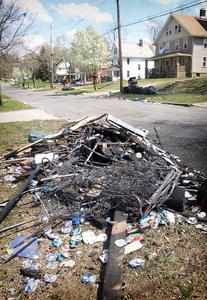
The only things that remained on the empty street to tell the story were the charred remains of furniture, empty cups and shattered glass strewn about in yards.
City and Kent State University officials said little Sunday about the hundreds of people who gathered for the “College Fest” block party, which erupted into a fiery scene. The Kent Police Department is planning a news conference for 10 a.m. today at the police station.
In a press release, Kent police reported Sunday “approximately 53 people were arrested” Saturday night after “‘College Fest’ turned into a riot when partying students and others began pelting police officers with bottles and rocks at the scene of an arrest. The responding officers called in to assist were also pelted with bottles, rocks and other debris.”
Several officers received minor injuries, according to the press release.
Unconfirmed reports allege an officer attempting to arrest a woman shoved her to the ground, and the rough arrest led to the violent retaliation against police.
Kent State University issued a brief statement Sunday evening.
“We’re disappointed in the events that occurred, and at this time we are still gathering information to get an accurate picture of the weekend,” said Kent State University spokesman Scott Rainone.
Fliers posted around Kent earlier in the week advertised “College Fest” as a near-end of the school year party on the dead-end street. There are at least 19 licensed rooming houses on East College Avenue, according to the Kent health department’s list of 2008 licensed boarding houses.
Kent Health Commissioner John Ferlito said he cited 10 houses on the street, just west of the KSU campus, for violating the city’s litter ordinance Sunday.
“Some houses weren’t a problem,” Ferlito said. “They were cleaning up when I got there.”
Ferlito said he did not believe a permit had been obtained to close the street and hold the block-party type event.
“It was just a thing that got into the (Daily) Kent Stater that they were having a party down on College Street called ‘College Fest’,” Ferlito said. “When it hit the Kent Stater everyone knew about it. It wasn’t an official party that the street was closed off.”
Kent Safety Director William Lillich said he was out of town Saturday night and declined to comment on the events when reached Sunday.
Kent police requested mutual aid from area police departments in order to restore order to East College Street after students began throwing objects, according to the police department press release.
“Officers moved down the street announcing a dispersal order and arrested a number of people who failed to leave after multiple warnings,” the release stated. “The crowd continued to throw objects at officers and began building several fires in the middle of the street.”
Firefighters who responded to extinguish the blazes also were struck with debris.
Most of the people who were arrested Saturday and early Sunday morning were charged with failure to disperse, which is a fourth-degree misdemeanor. Arraignment dates for those arrested have been set for Wednesday and Thursday at 8:15 a.m. in the Kent branch of Portage County Municipal Court.
Kent Fire Capt. John Tosko said the fire department did not transport anyone to area hospitals as a result of the events, but the department extinguished at least three fires in the street, including one with flames that reached 30 feet or more into the air.
One EMS report was written up for a minor injury Saturday. Tosko said he was surprised there were no serious injuries.






 anthropologie du présent