
Emeute au Balouchistan बलूचिस्तान avril 2009

बलूचिस्तान में दंगों
–>Vidéo<–
Des habitants non originaires du Baloutchistan fuient la province

QUETTA, 14 avril 2009 (IRIN) – Les violences généralisées qui continuent de sévir dans la province du Baloutchistan, dans le sud-ouest du Pakistan, perturbent gravement la vie quotidienne des populations et un grand nombre d’habitants non-originaires de la province, craignant pour leur vie, se trouvent contraints de fuir, selon les habitants.
Ansar Pervaiz, 50 ans, qui vit depuis 20 ans à Quetta, le chef-lieu de la province, a expliqué qu’il quitterait la région pour au moins 15 jours.
« C’est risqué, ici, en ce moment, pour ceux qui ne sont pas baloutchis. Je suis du Punjab [une province pakistanaise voisine] et je vais y retourner avec ma femme et mes trois filles. Je travaille comme dessinateur industriel et c’est dangereux d’être sur les sites de construction. Nous verrons plus tard ce qui se passera », a-t-il déclaré à IRIN.
Trois jours de violence et d’émeutes, qui ont fait au moins 11 morts et de nombreux blessés au Baloutchistan, ont été déclenchés par la découverte, le 9 avril, des cadavres mutilés de trois éminents leaders nationalistes baloutchis dans la ville de Turbat, à environ 1 000 kilomètres au sud de Quetta.
Les banques, les bureaux de poste, les bureaux des autorités publiques, ainsi que des dizaines de véhicules ont été incendiés dans les villes et les bourgades de la province. Les établissements d’enseignement ont été fermés et la vie des habitants est gravement perturbée.
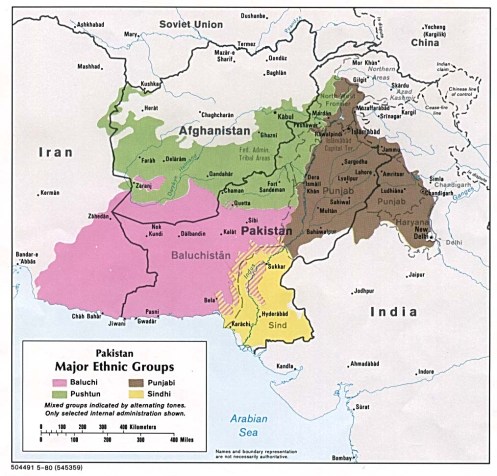
Le Baloutchistan, qui s’étend sur 347 190 kilomètres carrés – une superficie quasi équivalente à celle de l’Allemagne – et compte 10 millions d’habitants, est la plus grande des quatre provinces du Pakistan, mais aussi la moins développée. La région a un passé marqué de longue date par les conflits entre les mouvements nationalistes, défenseurs autoproclamés des droits du peuple baloutche, et les forces de l’Etat.
Le gouvernement pakistanais a condamné ces meurtres et appelé à l’ouverture d’une enquête exhaustive.
Selon les Services de relations publiques de l’armée pakistanaise (ISPR), organisme porte-parole des forces militaires, ces meurtres sont le fait « d’éléments hostiles à l’Etat », désignés sans plus de précision, qui cherchent à saboter les efforts de réconciliation déployés par le gouvernement au Baloutchistan. Mais d’autres en sont moins sûrs.
« Tout porte à croire que des membres des forces de sécurité publique ont arrêté les trois victimes, les ont torturées et tuées avant de se débarrasser de leurs cadavres, qui ont été retrouvés mutilés et décomposés », a déclaré Asma Jahangir, présidente de la Commission pakistanaise de défense des droits humains, un organisme indépendant.
Pris au piège et terrifiés
Dans la ville de Khuzdar, à quelque 300 kilomètres au sud-est de Quetta, où un officier de police a été abattu par des émeutiers le 9 avril, Rasheeda Bibi, 35 ans, a déclaré à IRIN par téléphone : « Je suis dans notre maison, avec mes beaux-parents âgés et mes trois jeunes enfants. Mon mari est parti travailler à Quetta et il est coincé là-bas parce que les transports sont perturbés. Nous avons peur de sortir, ne serait-ce que pour aller faire les courses, parce que les manifestants sèment le chaos partout ».
Si ces flambées de violence sont en partie ciblées contre les institutions et les infrastructures publiques, certaines ont pour cible les habitants non-originaires du Baloutchistan. Le 12 avril, les corps de six mineurs de charbon, tous abattus d’une balle dans la tête, ont été découverts dans un village situé à une cinquantaine de kilomètres à l’est de Quetta. Abdul Malik, un responsable des forces de police, a déclaré aux médias que ces mineurs venaient tous d’autres provinces, et que quatre d’entre eux auraient été originaires du Cachemire pakistanais.
Le Baloutchistan compte un nombre important d’habitants originaires de la province de la Frontière du nord-ouest (PFNO) et d’autres régions.
« Nous venons ici juste pour gagner notre vie. Je travaille dans un magasin, ici, à Quetta. Nous n’avons aucun lien avec la politique, mais cela fait peur, quand de telles violences éclatent et que les Baloutchis accusent les non-Baloutchis », a déclaré Junaid Khan, qui vient de Peshawar, chef-lieu de la PFNO.
Quatre officiers de police ont également été abattus le 12 avril, à Jaffarabad, une ville de l’est du Baloutchistan.
Face à ces événements, la communauté internationale a promptement réagi. « C’est l’incapacité persistante du gouvernement pakistanais à traiter la question des disparitions forcées au Baloutchistan qui a abouti aux événements tragiques de jeudi [9 avril] », a estimé Sam Zarifi, directeur de la branche Asie Pacifique d’Amnesty International.
L’ambassade américaine d’Islamabad a appelé à enquêter et déclaré que l’un des leaders assassinés avait contribué à obtenir la libération de John Solecki, un représentant des Nations Unies enlevé il y a plusieurs semaines à Quetta. John Solecki, ressortissant américain, libéré il y a quelques jours, a pu retourner chez lui.
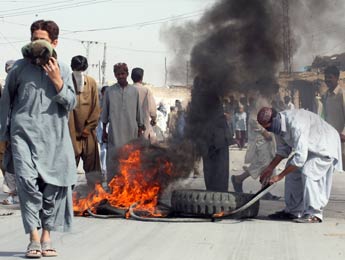
Le sud-ouest du pays secoué par de violentes émeutes
http://www.france24.com
Mardi 14 avril 2009
L’assassinat de trois leaders politiques au Balouchistan, un province du sud du Pakistan, a suscité colère et indignation au sein de la population. Depuis le 9 avril, une grève générale, qui tourne à l’émeute, paralyse la région.
Quetta n’est plus qu’une ville morte : les routes sont désertes, les tribunaux sont en grève, les écoles et les universités sont fermées, les transports publics ne fonctionnent plus.
Depuis la mi-avril, la capitale du Balouchistan, une province du sud du Pakistan, est paralysée par une grève générale lancée à l’appel des partis nationalistes baloutches. A l’origine de la crise : l’assassinat de trois politiciens locaux dont les corps mutilés ont été retrouvés, le 9 avril, à Turba, une ville située au sud-ouest de la province.
Les forces de sécurité prises pour cible
Les victimes auraient été d’abord détenues par les forces de sécurité pakistanaises, ce que dément le gouvernement.
Le Premier ministre, Yousouf Reza Gilani, a d’ailleurs condamné ces meurtres. Cela n’a pas suffi à empêcher de violentes émeutes qui ont fait une vingtaine de morts. Les manifestants s’en sont pris aux commissariats de police et aux forces de l’ordre mais aussi à des voitures de l’ONU, à des agences bancaires et à des bâtiments gouvernementaux. Les autoroutes menant à Quetta sont bloquées.
Pour l’heure, le gouvernement n’a pas fait grand chose pour calmer la situation puisqu’il s’est contenté de faire appel à la police anti-émeute.
Une province très pauvre
Les partis nationalistes baloutches réclament, depuis des décennies, plus d’autonomie, voire l’indépendance de la région. La Constitution pakistanaise de 1973 prévoyait l’autonomie du Baloutchistan, mais elle n’a jamais été appliquée.
Les enlèvements, les meurtres de leaders nationalistes et la répression gouvernementale se sont poursuivis les années suivantes et, depuis 2002, les installations gazières sont régulièrement attaquées par des insurgés qui accusent Islamabad de « coloniser » la province.
De fait, la population reproche au gouvernement fédéral de ne pas réinvestir les profits réalisés grâce à l’exploitation du gaz, du pétrole et du charbon et qui bénéficient surtout au Penjab, la région la plus riche du Pakistan dont la plupart des leaders politiques et militaires pakistanais sont originaires. Les exploitations minières sont d’ailleurs toujours des cibles : samedi, l’armée de libération du Baloutchistan a revendiqué l’assassinat de six ouvriers qui travaillaient dans une mine de charbon. Aujourd’hui, le Baloutchistan est une des provinces les plus pauvres du pays alors que c’est la plus riche en ressources naturelles.
Mais c’est aussi une plaque tournante pour les Taliban afghans qui y font transiter du pavot et des armes.
Eight killed in Pakistan‘s Baluchistan province

QUETTA, Pakistan (AFP) — Gunmen shot dead eight people in separate incidents in Pakistan’s southwestern province of Baluchistan Saturday, amid protests over the killing of three local leaders this week, police said.
Gunmen riding on a motorbike shot dead a police official in Quetta, the capital of gas-rich province, senior police officer Rana Khalid told AFP.
In another drive-by shooting gunmen killed one person and wounded another, he said.
« Both incidents could be linked to a three-day strike being observed in the province » since the bodies of three separatist politicians were found on Thursday, he said.
Police also found bodies of six employees at a coalmine in Margat, a town on the outskirts of Quetta.
« The victims who were abducted on Friday, were killed before dawn on Saturday, » local police officer Jaffar Hussain said.
« They were shot dead, » he said, adding that all had bullet wounds to the head.
Meerak Baloch, spokesman for a shadowy group called the Baluch Liberation Army, telephoned AFP to claim responsibility for the Margat killings, saying that those targeted were people from Punjab and North West Frontier Province.
« We wanted to give a message to the ethnic Pushtuns from NWFP also because soldiers in the paramilitary Frontier Corps used batons against our women protesters in Quetta, » he said.
Baluchistan, which borders Iran and Afghanistan, is rife with militant and sectarian violence.
Riots broke out Thursday after the bodies of three dissident Baluch politicians were dumped on the outskirts of the southwestern town of Turbat, near the Iranian border.
During a strike in Turbat angry mobs Saturday torched three banks and two government buildings, including the mayor’s office, said police officer Ayaz Baloch.
The three slain politicians were identified as the head of the Baluchistan National Party (BNP), Ghulam Mohammad Baloch, his deputy Lala Munir Baloch, and Sher Mohammad, deputy secretary general of the Baluchistan Republican Party (BRP).
The United Nations in a statement Friday expressed « serious concern » over the killings.
The late BNP chief played an important role in securing the release of American UN official John Solecki last Saturday, two months after Solecki was abducted in Quetta, the party official said.
Hundreds of people have died in insurgent violence in Baluchistan since 2004, when nationalist tribes rose up demanding political autonomy and a greater share of revenue from the region’s natural resources.
6 found dead as riots continue in Pakistan

QUETTA, Pakistan (AP) — The bodies of six slain coal miners were found in southwestern Pakistan on Saturday and a policeman and a civilian were shot dead, police said, as rioting over the slaying of three regional leaders continued for a third day.
Rising tension in Baluchistan, a vast province bordering Afghanistan and Iran, presents another risk to the stability of Pakistan as it faces rising Islamist militancy and serious economic problems.
The dead miners were discovered in a village about 30 miles (50 kilometers) east of Quetta, the provincial capital. All six men had been shot in the head, police official Abdul Malik said.
It was unclear when they were killed or who was responsible, but Malik said they had all come from other provinces of Pakistan and that the area was a stronghold of ethnic Baluch militants.
Baluch groups fighting for more autonomy for the region are regularly blamed for attacks on outsiders as well as on security forces.
Also Saturday, unidentified gunmen killed a police officer and a civilian in two separate incidents in Quetta, police official Khalid Masood said.
Protesters also torched a string of government buildings and a bank in other towns in the region, police said.
Unrest has wracked the impoverished but resource-rich province since Thursday, when the mutilated bodies of three Baluch nationalist politicians were found.
The U.S. Embassy condemned the deaths of the politicians and said one had helped secure the recent release of an American U.N. worker held for two months by a purported nationalist group.
Baluch activists have accused Pakistan‘s shadowy intelligence agencies of killing the trio and dismissed the provincial government’s pledge to investigate as meaningless.
Policeman killed in Pakistan riots

QUETTA, Pakistan (AFP) — Riots in southwest Pakistan left one policeman dead and three injured Thursday, as public anger boiled over following the murder of three nationalist politicians, officials said.
The mutilated bodies of the dissident Baluchs, who supporters said were picked up by intelligence agents in Turbat on April 2, were found dumped in a remote location on the outskirts of the southwest town, a party official said.
The victims were identified as the head of the Baluchistan National Party (BNP), Ghulam Mohammad Baloch, his deputy Lala Munir Baloch and Sher Mohammad of the Baluchistan Republican Party, according to the official.
« Security agencies picked them up on April 2 and they had been missing since then, » BNP spokesman Asif Baluch told reporters.
The late BNP chief played an important role in helping to secure the release of kidnapped American UN official John Solecki two months after he was snatched in the Baluchistan capital Quetta, he said.
Solecki was released Saturday and was purported to have been held by the little-known Baluchistan Liberation United Front.
News of the killings sparked protests and violent riots in several cities across restive southwest Baluchistan province, which borders Iran and Afghanistan, and is rife with militant and sectarian violence.
The riots left a policeman dead in the town of Khuzdar.
« A policeman was shot dead by a mob who were damaging government buildings, » senior police official Ghulam Ali Lashari told AFP.
« Now the situation is under control after paramilitary forces were called in to help police restore law and order, » Lashari said.
Around 12 people were detained for disturbing the peace, he added.
A spokesman for the rebel Baluch Liberation Army (BLA), Meerak Baluch, later claimed responsibility for the policeman’s death.
« We killed the policeman because security forces have again started targeting our unarmed people, » he told AFP by telephone.
In Quetta, protesters torched government vehicles and a UN car while up to 20 people were arrested in connection with rioting, police said.
« At least five government vehicles and a UN vehicle were set on fire by the rioters, » senior police official Rasool Bakhsh Rind told AFP.
« Three policemen were injured when unknown people threw a hand grenade at them, » Rind said.
Police fired tear gas to disperse the crowds as protesters blocked roads, including the main artery linking Quetta to the southern port city of Karachi, an AFP reporter said.
Two nationalist parties in Baluchistan issued a call for a general strike on Friday and Saturday to protest the killings of the politicians, party officials said.
Hundreds of people have died in insurgent violence in Baluchistan since 2004, when rebels separate from mainstream Baluch politicians rose up demanding political autonomy and a greater share of profits from the region’s abundant natural resources.
Elsewhere in the province, a hand grenade attack in the southwestern town of Hub wounded at least 10 people on Thursday.
« Unidentified men hurled a hand grenade on a minibus, which was heading to Karachi, in Hub town, wounding 10 people, » local police official Mohammad Amin Lasi told AFP.
Nobody has claimed responsibility for the attack.

Two killed in protests in Pakistan’s Baluchistan

Thu Apr 9, 2009
QUETTA, Pakistan, April 9 (Reuters) – Two people were killed when violent protests erupted in the Pakistani province of Baluchistan on Thursday after three Baluch nationalist leaders were found shot dead, police said.
Baluch nationalists have for decades campaigned for greater autonomy and control of the province’s gas resources. Baluch militants have also waged a low-level insurgency. Protesters set ablaze a bank and torched vehicles in the provincial capital, Quetta, soon after news emerged that the three mid-level leaders of Baluch political groups had been found dead near the border with Iran.
Protesters said the three had been picked up by the security forces about a week ago. The provincial government said the killings were an act of terrorism and ordered an inquiry.
Violence also erupted in other parts of Baluchistan, including the port town of Gwadar, and a policeman and a doctor were killed in the disturbances, police said.
Police used teargas in some areas to disperse protesters. There were no reports of disruptions at gas fields.
Baluchistan is Pakistan‘s biggest province in terms of area but its population is the smallest and poorest.

Several Injured During Pakistan Riots in Baluchistan
bloomberg.com
By Farhan Sharif
April 9 (Bloomberg) — Several people, including three police officers, were injured during riots in Pakistan’s southwestern province of Baluchistan, triggered by the discovery of the bodies of three missing political dissidents.
Protesters set fire to several cars, including a United Nations vehicle, Mohammed Mahboob, a spokesman for Edhi Foundation, the biggest ambulance service, said by telephone from the provincial capital of Quetta today. “The fighting is intense.”
The clashes are the worst the province has seen since Nawab Akbar Bugti, a tribal chief, was killed on Aug. 26, 2006. Supporters of Bugti, who led demands for a share of Baluchistan’s gas and mineral wealth, accused the army of deliberately killing him in his mountain hideout. The army said he died when the cave he was sheltering in collapsed after an explosion.
Security officials were shown on GEO television exchanging gunfire with protesters today while buses were in flames. Shops and offices remained closed in several cities across the province, as rioters set fire to a bank, a post office and the building of a charitable organization, GEO TV reported.
The mutilated bodies of three ethnic Baluch nationalists were found before dawn in another part of the province, the Associated Press reported. Several groups are demanding more autonomy from the central government.
At least 10 people were killed in riots across the province in 2006 as protesters torched government buildings and set off explosions after Bugti’s death.
Reaction Riots
“Today’s riots are in reaction to yesterday’s killings,” Munir Husain Mirani, a police inspector said by telephone from Quetta. Rioters attacked police with hand grenades, in which the officers were injured. One police officer was shot dead during the riots, AP reported.
“The intelligence agencies have decided that the only way to deal with Baluchis is with the gun,” Senator Hasil Bizenjo, a leader of the Baluch National Party, told reporters in a televised news conference. “We warn them that the reaction will be severe.”
This is a “provincial matter and we have nothing to do with it,” Athar Abbas, the army spokesman, said by telephone from Rawalpindi. “We will look into it if there is such an allegation. For now, we don’t have any comment.”
Protesters also demonstrated against the killings and exchanged gunfire with the police in parts of Karachi where Baluchis have settled, GEO television reported.
To contact the reporter on this story: Farhan Sharif in Karachi, Pakistan fsharif2@bloomberg.net.
Last Updated: April 9, 2009 05:27 EDT





 anthropologie du présent