
Emeutes aux Iles Salomon avril 2006

Pas de complot derrière les émeutes de 2006 à Honiara

6 April 2009
Tout le monde attendait le rapport de la Commission d’enquête sur ces émeutes qui ont en partie détruit Honiara, la capitale des îles Salomon.
Le rapport rejette la thèse de la conspiration et analyse que l’incompétence des forces de sécurité qui n’ont pas su contenir la foule est à l’origine de l’ampleur des émeutes qui ont réduit en cendres le quartier chinois.
Ces émeutes ont éclaté en avril 2006 après l’élection, par les députés de l’Assemblée nationale, de Snyder Rini au poste de Premier ministre. Peu de temps après, des dizaines de commerces chinois ont été mis à sac et incendiés.
Ce quartier chinois est parti en flammes à la suite d’allégations affirmant que des hommes d’affaires chinois ont tenté d’acheter les voix de certains députés pour asseoir M. Rini au poste de Premier ministre.
Qui fait quoi ? Le rapport d’enquête conclu aussi qu’une certaine confusion entre la police des Salomon et les policiers de la Mission d’assistance régionale aux îles Salomon (RAMSI), sous commandement australien, a en partie permis aux manifestations de dégénérer en émeutes

Îles Salomon : conflit dans un paradis terrestre

7 octobre 2006
Joanie Thibault Couture
Université de Sherbrooke
Les différents conflits qui font rage dans le monde ne jouissent pas d’une attention similaire de la part des médias. Par exemple, la crise aux îles Salomon, qui s’est déroulée de 1998 à 2003, n’a pas fait couler beaucoup d’encre. Par contre, au mois d’avril 2006, le pays est revenu discrètement dans l’actualité internationale.
Cette région du monde est plutôt méconnue de la majorité de la population. Ces îles du Pacifique, situées au nord-est de l’Australie, n’abritent que 500 000 habitants (1). Cette ancienne colonie britannique, composée d’une majorité de Mélanésiens et d’une minorité d’immigrants (2), est constituée de plusieurs îles, dont la principale, Guadalcanal, où se situe la capitale, Honiara.
Origines de la violence
C’est sur un fond de tensions ethniques que l’escalade de la violence est apparue dans ce lieu paradisiaque. Depuis l’indépendance du pays en 1978, le fort sentiment d’appartenance de la population à leur île d’origine a amené l’accroissement des différences sociales et légales entre les individus (3). De plus, l’immigration de la population de l’île de Malaita vers celle de Guadalcanal depuis la fin de la Deuxième Guerre mondiale, en vue d’obtenir de meilleures opportunités économiques, a alimenté l’animosité entre Mélanésiens et Malaitans.
À la fin des années 90, un groupe militant mélanésien a vu le jour; l’Isatabu Freedom Movement (IFM). Ce groupe avait pour but de mener une campagne de terreur et d’intimidation contre la population malaitane de l’île de Guadalcanal, en réponse à l’immigration de cette dernière. Plus de 20 000 personnes ont été forcées de quitter l’île ou de se réfugier à Honiara (4). Suite à ces agressions et au contrôle des zones rurales entourant la capitale par l’IFM, un groupe malaitan, la Malaitan Eagle Force (MEF), a été créé en 1999.
Les affrontements entre les deux groupes rivaux ont entraîné une escalade de la violence. Les actes d’agression se sont alors succédés, comme la prise d’otage du Premier ministre Bart Ulufa’alu, perpétrée par le MEF, le 5 juin 2000 (5). Plusieurs tentatives de paix ont par la suite été tentées, sans obtenir de résultats satisfaisants jusqu’au dénouement officiel du conflit en 2003.
La consolidation de la paix
Malgré quelques accords de paix, la situation à l’interne restait très fragile au début des années 2000. C’est pourquoi, le 24 juillet 2003, la Mission régionale d’assistance aux îles Salomon (RAMSI), chapeautée par l’Australie, a été déployée (6). Cette mission avait pour principal objectif d’arrêter les chefs des groupes militants et d’assister les populations déplacées par les affrontements. Plusieurs autres pays de la région du Pacifique ont participé à la mission. À la suite de cette intervention, la situation s’est beaucoup améliorée. En 2004, la quasi-totalité des effectifs de la RAMSI ont été retirés.
La mission est encore présente aux îles Salomon en 2006. Ses activités sont maintenant consacrées à la relance économique et à la restauration des institutions gouvernementales.
Bref retour dans l’actualité
Malgré une certaine stabilité des îles depuis quelques années, la situation s’est envenimée de nouveau en avril 2006. Le 5 avril 2006, les premières élections législatives depuis l’arrivée de la RAMSI ont eu lieu. Par la suite, M. Snyder Rini a été élu à la tête du gouvernement par le Parlement, le 18 avril 2006 (7). Or, ce dernier a été accusé d’avoir versé des pots-de-vin à certains députés avec l’aide de Taïwan et d’hommes d’affaires chinois (8). Sa démission a été demandée par des manifestants.
Des émeutes ont alors éclaté dans la capitale. Les émeutiers ont saccagé 90% du quartier chinois d’Honiara (9). Les dommages furent évalués à des millions de dollars. À Guadalcanal, la minorité chinoise, constituée d’environ 2 000 personnes, contrôle la majeure partie du commerce, ce qui alimente l’antipathie des Mélanésiens à leur égard (10).
Cette recrudescence de la violence a duré seulement deux jours grâce à une intervention rapide, notamment de l’Australie et de la Nouvelle-Zélande. Le Premier ministre Rini a donné sa démission pour laisser sa place à Manasseh Sogavare (11).
Enfin, la fragile stabilité des îles Salomon peut être ébranlée de nouveau, comme l’ont démontré les événements du mois d’avril 2006. Malgré le déploiement de la RAMSI, les rivalités tribales aiguës sont encore présentes au sein de la société salomonaise.
Violences aux Îles Salomon
http://www.operationspaix.net
avril 2006
La RAMSI remise en cause par des émeutes dans la capitale
Des violentes manifestations ont plongé l’archipel des îles Salomon dans une crise politique aiguë. Suite à l’élection d’un nouveau premier ministre par le parlement, mardi le 18 avril, des centaines de partisans du leader de l’opposition ont provoqué des émeutes et se sont livrés au pillage à Honiara, capitale de ce pays du Pacifique. Les émeutiers ont particulièrement visé les intérêts chinois. Faisant face à une motion de défiance, le nouveau Premier ministre, Snyder Rini, démissionne le 26 avril. La rue triomphe finalement le 4 mai avec l’élection par le Parlement de Manasseh Sogavare, leader de l’opposition, comme nouveau Premier ministre. Cette situation relance le débat sur la pertinence de la Mission régionale d’assistance aux Îles Salomon (RAMSI) déployée en 2003 et soutenue par l’Australie et plusieurs pays du Pacifique.
L’Australie et la Nouvelle-Zélande ont dépêché d’urgence des renforts de troupes et de policiers afin de reprendre le contrôle de la situation après deux jours de violences. Au moins 19 des leurs ont été blessés en tentant sans succès de contenir les débordements. Les secteurs chinois de Honiara sont en majeure partie détruits et on craint le pire pour l’économie du pays déjà chancelante. La prise du pouvoir houleuse de Manasseh Sogavare relance les luttes politiques à l’origine des violences.
Les émeutes éclatent le 18 avril 2006 lorsque qu’une foule rassemblée devant le Parlement apprend la nomination de Snyder Rini au poste de Premier ministre. L’élection du Premier ministre aux îles Salomon est la prérogative des parlementaires au nombre de 50. Lors d’un premier tour de scrutin, Job Tausinga obtient 22 votes, Snyder Rini, dauphin du Premier ministre sortant, 17 et Manasseh Sogavare 11. Causant la surprise, Rini emporte ensuite le deuxième tour avec 27 votes contre 23 pour Tausinga. Les supporters de l’opposition dans la foule ont aussitôt attribué ce revirement à la distribution de pots-de-vin à certains parlementaires par des hommes d’affaire d’origine chinoise. Ils ont d’abord pris en otage les membres de la législature et ensuite redirigé leur colère vers les commerces de la capitale associés aux intérêts chinois.
Les îles Salomon peinent encore à se remettre des séquelles qu’ont eu la crise financière asiatique de 1997. Entre 1998 et 2002, l’activité économique a été réduite du quart alors que le pays compte une démographie galopante. Cette détérioration s’est accompagnée d’une montée des tensions interethniques. Les migrations des habitants de l’île de Malaita vers l’île de Guadalcanal, sur fond de crise, ont été mal reçues. Des milices à caractère ethnique se sont organisées et ont fait vaciller le pouvoir en 2000.
La situation ne s’est véritablement stabilisée qu’à partir du déploiement de la RAMSI en juillet 2003 sous la direction de substantiels contingents australien et néo-zélandais. La Mission Régionale d’Assistance aux Îles Salomon a rempli son mandat en arrêtant les principaux chefs activistes, notamment un ancien ministre des affaires étrangères, en démobilisant les agents de police spéciaux et les anciens rebelles, ainsi qu’en favorisant le retour de milliers de personnes déplacées. Au mois d’août 2004, jugeant la situation suffisamment stable, le gouvernement australien a annoncé le retrait de la quasi-totalité de ses soldats, ce qui réduit les effectifs militaires à une centaine de Papous, de Fidjiens et de Tongiens.
Cette embellie sur le plan politique n’a cependant pas eu les retombées économiques espérées. Le chômage persistant et les perspectives d’avenir bloquées ont sans aucun doute tenu un rôle dans les récentes émeutes. La prospère communauté chinoise, particulièrement ciblée, s’est constituée une influence politique significative aux Îles Salomon. Associée aux problèmes de corruption endémique affectant les autorités locales, cette communauté symbolise l’influence souterraine des intérêts étrangers exercée sur le pays. Il n’en demeure pas moins que les entreprises attaquées sont un véritable moteur pour l’économie des Îles Salomon et qu’un exode en masse de la communauté chinoise aurait des conséquences désastreuses.
Les violences perpétrées remettent en cause le bilan de l’action de la RAMSI depuis 2003. Selon The Australian, journal australien qui suit la situation de prêt, l’opération n’a pas rempli trois objectifs clés. Elle n’a pas réussi à endiguer la corruption qui mine le pays depuis son indépendance en 1978. Elle n’a pas convaincu les habitants du bien fondé des processus démocratiques pour faire valoir leurs griefs ou leurs projets. Finalement, elle n’a pas dissuadé de larges pans de la population d’avoir recours à la violence pour arriver à leurs fins. Le Premier ministre australien John Howard a réitéré suite à la crise l’engagement durable de son pays pour assurer la stabilisation et la reconstruction des Îles Salomon. Les émeutes rappellent toute la difficulté de la tâche.
Marc André Boivin
Réseau francophone de recherche sur les opérations de paix

Rioting in Honiara, April 2006

15/11/2007
Military and police response to riots in Honiara, following 2006 national elections
Introduction
Following national elections in early 2006, former Deputy Prime Minister Snyder Rini won the position of Prime Minister as leader of a coalition of parties. The announcement of his victory was met with widespread anger from the crowd gathered to hear the results of the leadership decision, sparking protests which spread to rioting and arson in the capital Honiara.
There was extensive damage to businesses owned by key politicians, and also to many Chinese trade stores and businesses, prompting debate as to whether the rioting was spontaneous.
The Participating Police Force (PPF) and Australian forces were criticised after the riots, for their failure to predict and prevent the looting and arson, and for the tactics of riot police, though many officers were injured while protecting key buildings or people affected by the rioting. This led to the establishment of a Commission of Inquiry.
Following the riot, extra police and military forces were deployed from Australia, New Zealand and Fiji.
Government sources
Giving help to Honiara, LT Simone Heyer, Air Force News, Volume 48, No. 7, 4 May 2006
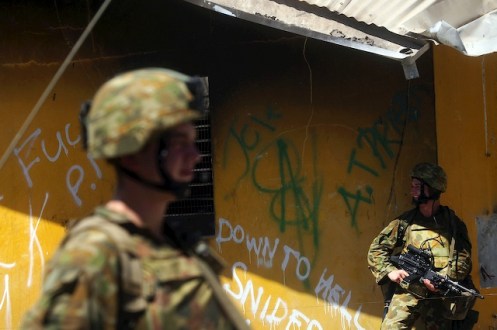
“For now there is calm in the Solomon Islands after approximately 500 Australian and New Zealand soldiers deployed there following riots in the country’s capital, Honiara. For the third time this year, Air Force provided emergency support, this time to the Solomon Islands. 1 Air Terminal Squadron Detachment Townsville stepped up to the enormous task of moving hundreds of soldiers and their equipment to Henderson Airfield, just outside Honiara.
“Within hours of the riots, soldiers from 1RAR’s Ready Company Group were preparing to leave Australia to bolster the RAMSI forces. Over the next 36 hours, the Government announced A Coy 3RAR would also deploy, along with aviation assets, a flight of Airfield Defence Guards, logistic support elements and two patrol boats. The Commander of Combined Task Force (CTF) 635, LTCOL Andrew Gallaway, said the task force was spread out throughout the main Guadalcanal Island, with ADGs from 4 Rifle Flight providing tarmac security at Henderson Airfield.”
An extraordinary day at the office, AFP News, Issue 128, June 2006
« As interest in the announcement of the new Prime Minister intensified, the advisors kept an eye on the crowd gathering at Parliament House from the vantage point of their second- storey office. The working day took a dramatic turn – from being a normal day at the office, to becoming the target of large rocks thrown by a mob. This was not the kind of treatment these officers were expecting from Solomon Islanders when they deployed as part of RAMSI.
« As the crowd built, observations were relayed through to Honiara Radio Communications (HRC). The advisors who had been monitoring the situation since about 2pm, watched as the behaviour of the crowd escalated over the course of several hours into a full blown riot. Around 300 people had congregated around Parliament House for the announcement of the results of the Prime Ministerial election. From their vantage point, the PSII members saw a PPF vehicle being pushed over the embankment at Parliament House and Solomon Islanders charging at the other PPF cars. A car was rolled side-over-side down the embankment and smoke billowed into the air. From their office, the PSII members observed the crowd dispersing from Parliament House with more than one thousand people converging on the shops at Point Cruz. (The PSII office is located on the second floor of a building – above shops.) Observations of the melee that followed were relayed to HRC – advising of the rioting and destruction that was occurring.
Protests over Parliamentary elections and NZ Drawdown, NZDF website
« Due to the unrest that occurred after the April 2006 elections New Zealand increased its presence in the Solomon Islands to assist the government and participating police forces to maintain security. Much of Chinatown was destroyed in the riots with the loss of 1,600 jobs and the destruction of such places as the Casino Hotel and Fortunes Restaurant.
« New Zealand Defence Force sent a Infantry Company increasing troop numbers from 46 to 125. Defence personnel are located in Honiara (RAMSI Headquarters and Rove Prison). Since then the situation has improved and New Zealand has reduced troop numbers. Eighty-one defence personnel returned home on 15 June on a RNZAF C130 and a RNZAF Boeing 757. The remaining troops assist RAMSI police in downtown Honiara, carry out patrols, and help with external security at Rove Prison.
RAMSI Police Did Not Break Rules in April Riots: McDermott, RAMSI media release, 29 July 2007
« RAMSI Participating Police Force Commander, Denis McDermott has strongly refuted allegations that the PPF broke the rules of engagement in their response to the April riots last year. Claims that PPF officers were instructed to shoot people in the neck with rounds of ‘beanbags’ are simply untrue, Mr McDermott said in a statement released today.
“ ‘The PPF did not have such equipment in the Solomon Islands at the time and no one has ever encouraged our officers to shoot people in the neck or back.’
« He said the Australian Federal Police’s Professional Standards Unit had also investigated the allegations and found that there was no substance to the allegations. »
Commentary and analysis
Second Interim Report, Commission of Inquiry into the April 2006 Civil Unrest in Honiara, Government of Solomon Islands, 7 September 2007
“There is evidence that the 18 April 2006 civil unrest in Honiara was not spontaneous as is originally claimed but rather the event has the hall mark of having been orchestrated and planned….There is now some evidence connecting the identity of a number of leading politicians, political groups and organisations who had in one way or another contributed to the execution of the planning for a regime change, should the previous government or elements of it return to power.”
Riots shake island capital, The Age, 20 April 2006
The troops’ commander, Brigadier Mick Slater, said his men were well trained to deal with civil unrest. « They’re exceptionally tough, they’re highly skilled, they are the best at doing this sort of work in the country. »
But the Australian-led forces also faced accusations of inflaming a peaceful protest when they fired tear gas on demonstrators blocking a driveway at the Parliament building on Tuesday night. The Speaker of the Parliament, Sir Peter Kenilorea, criticised handling of the unrest by the Regional Assistance Mission to Solomon Islands (RAMSI), saying police should have allowed negotiations to continue between demonstrators, MPs and police.
Luke Johnston, an Australian aid worker who was filming outside the Parliament compound for a documentary on the elections, backed Sir Peter’s view. Mr Johnston, speaking to The Age by phone from his home in Honiara, said the crowd had been protesting peacefully until RAMSI officers tried to physically break the blockade.
« It appears that that’s when things got out of hand, when there were some more aggressive approaches to the crowd while they were still negotiating through their own local representatives, » Mr Johnston said. « When they brought a riot squad in and a lot of riot gear there was a noticeable change in tone. My own view of what happened is that there was a lack of preparation. »
Transnational Police Building: critical lessons from Timor- Leste and Solomon Islands, Andrew Goldsmith and Sinclair Dinnen, Third World Quarterly, Vol. 28, No.6, 2007, pp 1092, 1101
“RAMSI’s early success earned high praise and it was commended as a model for future deployments. However, these assessments proved premature after serious disturbances in Honiara in April 2006 and a subsequent deterioration in relations between Australia and Solomon Islands following a change of government. The announcement of Snyder Rini as prime minister-elect on 18 April 2006 angered many Solomon Islanders anticipating a clean break from the corrupt and dysfunctional politics of recent years. Two days of rioting and opportunistic looting injured around 50 police and caused extensive damage to Chinatown, Honiara‘s commercial centre.
“Local and RAMSI police were caught off guard and overseas reinforcements were required. Former senior officers disputed claims by the Australian Commissioner of the RSIP that there had been no prior intelligence indicating potential trouble. The Speaker of Parliament accused Australian police of over-reacting by using tear gas. Others viewed the severity of the disturbances and lack of police preparedness as evidence of more fundamental short- comings in the regional mission.”
Honiara erupts as PM quits
smh.com.au
April 26, 2006 – 5:05PM
Scenes of jubilation followed the resignation today of Solomon Islands prime minister Snyder Rini, whose election last week sparked rioting and looting in the Pacific nation’s capital.
Rini resigned in parliament in Honiara this morning after just eight days as prime minister and as MPs were due to vote on a motion of no-confidence against him.
He quit after five members of his governing coalition crossed the floor, ready to vote him out of office.
« I have no alternative but to tender my resignation as prime minister of the Solomon Islands, » Rini told parliament.
Rini was then rushed out of parliament, guarded by heavily armed Australian police, who pushed him into a vehicle and drove him away.
One of defectors, former prime minister Manasseh Sogavare, later emerged as a favourite to take over as the nation’s leader when MPs vote early next week.
Rini will remain caretaker prime minister until then.
Australian Foreign Minister Alexander Downer said he hoped MPs would be able to vote for a new leader « unencumbered and without inappropriate incentives, if you know what I mean ».
News of Rini’s resignation sparked hours of celebration in Honiara, with opposition supporters cheering, singing and dancing as they rode through the streets of the capital.
Shouting « victory’s on our side » and waving palm fronds, they crammed onto the backs of trucks and headed for Honiara‘s Ironbottom Sound Hotel to celebrate with opposition leaders.
The scenes were in stark contrast to those which greeted Rini’s election as prime minister last week, when two days of riots and looting left most of Honiara‘s Chinatown district burnt down.
Several Australian Federal Police (AFP) officers were hurt in the rioting.
Hundreds of extra Australian and New Zealand troops and Australian police were sent in to quell the strife, later charging two opposition MPs with riot-related offences.
Protesters and opposition MPs had accused Rini of corrupt links to prominent local business leaders and of accepting cash from Taiwan, and claimed the election was rigged.
Rini was also associated with the old guard of politics in the Solomon Islands and with the failed governments of the past, which led to the Australian-led armed intervention in 2003 to end five years of civil strife.
Rini’s resignation came after Sogavare crossed the floor with four members of his Social Credit Party, leaving the prime minister with only 20 MPs, to the opposition’s 28.
Missing today were the two opposition MPs charged over last week’s riots, who remain in custody.
One of the MPs to change sides, Peter Shanel, said the parliament had to listen to the people.
« We can’t govern in fear, we needed a new leadership, » Shanel said.
Sogavare was later chosen as the opposition nominee for the prime ministership, although he conceded the situation was fluid.
« Anything could happen, the lobby is still on, we’re back to square one, the house is fluid and anything could happen, » Sogavare said.
Sogavare said perceptions he was anti-Australian were untrue and if he led the next government it would establish a good working relationship with the Australian-led Regional Assistance Mission to Solomon Islands (RAMSI).
He said he was confident the troubles of the past week were over.
Today, armed Australian soldiers covered the approach road to parliament, while Australian Federal Police officers were stationed on the building’s roofs and a helicopter patrolled overhead.
Rini was rushed into parliament under Australian police escort.
Inside, Opposition MP Patteson Oti, who had given notice of a motion of no-confidence in the prime minister, called on Rini to do the honourable thing and resign.
After a 15-minute suspension requested by Rini, he returned to announce his resignation, which was greeted with applause.
Rini told MPs he was quitting « so all MPs can come together so this country can go forward ».
AAP







 anthropologie du présent