
Emeute à Riga janvier 2009


Latvia‘s president blasts politicians after riot

RIGA, Latvia (AP) — Latvia‘s president lashed out at lawmakers and threatened to dissolve Parliament after more than 40 people were injured in the worst rioting since the Baltic country split from the Soviet Union in 1991.
President Valdis Zatlers said Wednesday he would disband the legislature by March 31 unless lawmakers agree to a series of reforms to help restore political and economic order in the crisis-hit nation.
Latvia‘s economy was once the fastest-growing in the European Union, but it has undergone a dramatic reversal and is expected to contract 5 percent this year. The Central Bank burned through about one-third of its reserves to defend the currency, the lat, and unemployment rocketed from 6 percent to 7 percent in December.
International lenders including the EU, the International Monetary Fund and Nordic countries have pledged $10.5 billion in financial assistance to help the nation of 2.3 million recover.
Zatlers’ ultimatum came a day after an anti-government demonstration that included an estimated 10,000 participants turned violent when scores of angry protesters tried to storm Parliament and clashed with police.
More than 40 people were injured, mostly protesters but also six police officers and eight military police, Interior Ministry spokeswoman Sigita Pildava said. Police detained 106 people.
The rampage echoes similar clashes in Greece and Bulgaria, where protesters vented their anger at deteriorating economic conditions and widespread corruption.
In Latvia, government and opposition leaders blamed each other for the violence, but Zatlers said politicians must address « the catastrophic collapse of trust in authorities and state officials » that was expressed at the demonstration.
His ultimatum surprised many in the Baltic state considering the current coalition placed him in the president’s chair. In Latvia, the president is elected by Parliament.
Latvians are irate about the country’s deepening recession, and many blame Prime Minister Ivars Godmanis’ center-right government for the economic woes.
Zatlers demanded lawmakers amend the constitution to give voters the right to dissolve the legislature between elections, and called for the creation of a council to oversee Latvia‘s economic recovery program.
He also told Godmanis that his Cabinet had to restructure the way the government works, including minimizing the number of ministerial posts.
« Both Parliament and the government have lost touch with voters, » Zatlers told reporters.
The violence started as a peaceful anti-government demonstration ended in Riga‘s historic Old Town. Most of the demonstrators left the area but about 100 of them turned violent and tried to storm the Parliament building. Riot police kept them away, using tear gas and truncheons.
The rioters pelted officers with cobblestones and chunks of ice and vandalized three police vehicles. They smashed windows of boutiques, the Finance Ministry and a bank, and looted a liquor store.
Godmanis told the LNT TV station Wednesday that protest organizers bear responsibility for the violence, citing their decision to hold the rally despite tensions over the deepening economic crisis.
Opposition lawmaker Aigars Stokenbergs, one of the rally’s main organizers, called the government incompetent for not providing sufficient security at the protest.
« What happened at Parliament was because of a lack of competence on the part of the Interior Ministry, » Stokenbergs told The Associated Press. He called on Interior Minister Mareks Seglins to step down.
Emeutes en Lettonie : le rêve de l’argent facile

15/01/09
Traduction : Julie Stroz
Pendant la période du miracle économique letton, de nombreuses personnes ont vécu au-dessus de leurs moyens. Aujourd’hui tout s’écroule et les Lettons endettés jusqu’au cou sont dans la rue.
La situation déjà tendue en Lettonie s’est aggravée dans la nuit de mardi à mercredi. Après les protestations massives contre le gouvernement de centre droit, le pays vit de violentes émeutes. Le ministre des finances, Atis Slakteris va bel et bien devenir le ministre le plus connu de l’histoire de la Lettonie. Lorsqu’ à l’automne, la Lettonie était au bord de la faillite nationale, il a déclaré dans une interview en affichant une certaine confiance en lui : « Tout va bien ». Depuis, cette fameuse phrase s’est propagée comme une traînée de poudre sur la Toile et se heurte à une incompréhension massive.Zane Licite, membre du service relations presse du président, réagit avec calme à la question quand on lui demande si « tout va bien ». Avec gravité, elle explique que tant qu’il y a assez d’argent, tout va bien. Mais pour combien de temps y aura-t-il encore assez d’argent ? On peut difficilement l’évaluer. Zane est une des plus jeunes victimes de la vague de réformes engagées par l’Etat. Comme presque un fonctionnaire sur dix, elle a été licenciée sans préavis. Pour réduire encore plus les charges salariales de l’Etat, le gouvernement a diminué de 15 % le salaire des fonctionnaires qui gagnaient plus de 480 euros brut et annulé les primes. La situation sur le marché du travail devient d’heure en heure plus précaire. Et la peur augmente de voir l’Etat bientôt incapable de pourvoir aux allocations chômage.
La Lettonie : tigre balte ou chaton apeuré ?
Les partis et les associations invitent donc les gens à manifester massivement. L’atmosphère au sein de la population est la pire que la Lettonie ait connu depuis l’indépendance. C’est ce que ressent aussi la patronne du café « Kapucino-Bar », au début du vieux centre de Riga. Elle vient de mettre en ligne une annonce d’emploi. Au bout d’une demi-heure et d’un nombre incalculable d’appels, elle retire l’annonce, épuisée. Elle n’a pas pu répondre à toutes les personnes intéressées. Elle n’avait pas imaginé cela. Il n’y a pas si longtemps, beaucoup de sociétés lettones menaçaient de mettre la clé sous la porte parce qu’elles n’arrivaient pas à trouver de personnel qualifié.
« La Lettonie ne se trouve pas uniquement au cœur d’une crise économique et financière, mais aussi au cœur d’une crise de gouvernance », explique Artis Pabriks, ancien ministre des affaires étrangères letton et membre de l’opposition. Il ne veut pas entendre parler de langue de bois à la sauce « tout va bien ». En faveur d’une politique populiste, le gouvernement a ignoré les multiples avertissements de la communauté internationale concernant les conséquences d’une économie en surchauffe, ajoute Pabrik en guise de reproche.
Atis Slakteris, le ministre des finances, explique les problèmes de son pays à la lumière de la situation bancale du marché mondial et place le fondement des problèmes de la Lettonie dans la crise financière mondiale. Mais l’opposition, les intellectuels et les associations imaginent des causes extérieures. Ils reprochent au gouvernement son ignorance des problèmes réels du pays.
Une des causes les plus importantes réside dans l’inflation. Elle a pris des proportions énormes durant les années du miracle économique, et surtout avant 2001. Et l’entrée de la Lettonie dans l’UE a apporté un élan puissant. A cela s’est ajouté le comportement de la population qui s’est mise à consommer massivement à crédit. L’explosion des prix et des salaires qui s’en est suivie a détruit l’équilibre entre performance et productivité. Les secteurs de la finance et de l’immobilier se sont effondrés. Peu de temps après, le pays est tombé dans une profonde récession économique.
Devoirs internationaux
Le fonds monétaire international (FMI), les représentants de l’Union Européenne et des pays scandinaves ont travaillé à l’automne à un plan commun pour sauver la Lettonie de banqueroute. Avec 7,5 milliards d’euros d’aide, les liquidités de l’Etat et du secteur de la finance devraient être sauvées. Avec ce plan, le monde a accompli son devoir envers la Lettonie. Mais celle-ci n’a pas employée l’aide comme les donneurs s’y attendaient. C’est ce que souligne Helena Demakova, ministre des affaires culturelles, peu après l’annonce que neuf millions d’euros, prélevés sur l’aide d’urgence, allaient être alloués à un bureau d’architectes pour la réalisation d’une salle de concert.
La population lettonne se dirige vers des temps difficiles. Pour Signe K., la situation est frustrante. Depuis des mois, elle cherche un emploi sur Internet et est désespérée. A 25 ans, elle a arrêté ses études il y a quelques années pour fonder sa propre entreprise. A cette époque, l’économie lettone se développait à vive allure. Comme beaucoup de jeunes de son âge, elle rêvait d’argent facile. Et tous les moyens étaient bons. Mais un jour, la police est venue, elle a fouillé les bureaux et a emporté des dossiers. Des criminels avaient utilisé son entreprise pour blanchir de l’argent. Signe K. avait certes senti que quelque chose n’allait pas, mais l’abondance d’argent était plus intéressant pour elle. Aujourd’hui, cette jeune mère vit avec sa fille de un an dans un centre d’aide d’urgence pour jeunes femmes dans la banlieue de Riga, à Agenskalns. Elles ont environ 50 euros d’aide sociale par mois pour vivre. Le même problème menace toute une génération de jeunes familles qui ont accumulé les crédits durant les années d’argent facile.
L’appartenance de la Lettonie à l’UE, la convergence des marchés financiers baltes et scandinaves et l’aide rapide du FMI ont maintenu la Lettonie à l’abri d’une terrible catastrophe. Le pack d’aides donne au gouvernement un champ d’action mais ce n’est nullement une réponse à l’état d’urgence du pays ; et certainement pas non plus à la crise politique.

The riots in Riga are over

13 janvier 209
Marge Tubalkain-Trell
The riots in Riga old town on January 13 in which 28 people, including three policemen were taken to hospital, are over.
The other two wounded policemen refused to stay at the hospital.
By the morning the crowd pacified and there have not been any other clashes with policemen.
According to the medic from Riga ambulance people have mainly head and limb harms, also eye traumas caused by chemicals and hits. Allegedly there is no people heavily wounded, but there are new reports about harmed people, Mixnews.lv and other internet publications reported.
The riots began after a protest on Riga’s Dome Square, where thousands of people demanded Saeima to resign. People broke the windows of Saeima building and other houses, robbed the store Latvijas Balsams and did other material damage.
The police detained 128 people.
The PM Ivars Godmanis does not exclude the mass riot was planned. He said in his interview to Latvian television that he needs information about the organisers before he can estimate the situation, but thought that part of people prepared for the people and part of the people joined them later. Godmanis said the calls were put up to the internet and people had used foreign servers.
A short video clip is available here
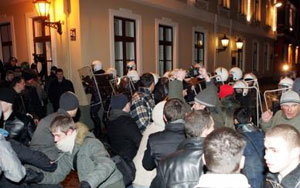
Mass riots follow protest- Emergency declared
baltictimes.com
What was planned to be a peaceful protest soon turned into a mass mob. Photo: Toms Baugis
RIGA-What began as a calm 10,000 strong protest in Dome Square has turned into a riot. Following the peaceful demonstration, thousands of demonstrators mobbed the parliament building and have destroyed several police cars.
Protestors have also broken into a Balzams liquor store and are currently looting the general vicinity around the parliament.
Medics report that eight people have been injured so far, as rioting continues into the night.
A state of emergency has been declared by police as they report that drunk youths are still vandalizing the Old Town of Riga.
Early in the evening, a mob tried to break into the Parliament building by breaking windows and were held back with police tear gas.
With shouts of “Dissolve the Saeima” the protestors attempted to storm into the parliament building.
The rally earlier had been held to protest the Saeima and to demand the dissolution of its current members.

Protest in Riga on January 13

Nina Kolyako, BC, Riga, 14.01.2009.
An estimated 10,000 people have jammed into Riga‘s Dome Square yesterday evening, and cheered loudly when Society for Different Politics Saeima deputy Artis Pabriks called on President Zatlers to dissolve Saeima.
Periodically, the crowd chants: « Dissolve Saeima! »
Despite some side streets were totally jammed, people were still streaming into Old Town, reports LETA.
Police were out in great numbers as well, and ambulances were also at the scene just in case. Security forces in military uniform were guarding the Saeima building nearby.
Several thousand unruly mass rally protesters tried to storm the Saeima building in Old Town Riga after the mass rally on Dome Square, clashing with police officers.
The police, using tear gas, had forced the mob to move away from the building in the direction of Valdemara Street; several people were laying on the ground and were arrested.
Chanting « Dissolve Saeima! », the mob tried to storm Saeima’s entrance from Dome Square. They were met by the Military Police.
A police squad car was set on fire, but the blaze was promptly put out. Windows in the vicinity of Saeima have been smashed, and the cobblestone broken. Most windows at Saeima on the Jekaba Street side have been broken.
Police in Riga had declared an emergency situation in all of Riga yesterday evening, and were on high alert as drunk and aggressive youths were roaming the streets of Old Town.
Among other things, vandals have looted a Rigas balzams liquor store on Smilsu Street, not far from Saeima.
Eight people have been injured in violence, medics report.
106 hooligans were arrested during yesterday’s riots in Riga Old Town, the State Police Riga Region Headquarters Chief Andris Dzenis said in an interview to Latvian State Radio this morning.
The persons have been detained for committing criminal offences and administrative breaches. Police were working all night long to establish the guilt of all the persons arrested last night.
Hooligans caused serious damage to four State Police cars, four Military Police and six Riga Municipal Police vehicles. As Dzenis comments, the material losses are very impressive.
Strong material damage has been caused also to several buildings in Riga Old Town. The estimate of the total losses will be calculated and the hooligans, who caused them, will have to pay.
Four persons were arrested at the Latvijas balzams liquor store for looting.
As reported, a peaceful protest was held in the Dome Square in Riga, where protesters were demanding dissolution of the parliament.
After the protest, several hundred people tried to storm the Saeima building but were dispersed by the police, and many of them went on to smash windows and loot a Latvijas Balzams liquor store near the scene.
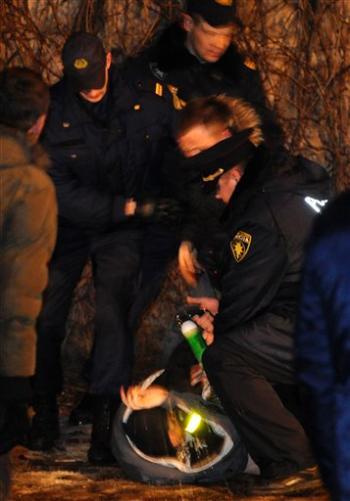
Une manifestation dégénère près du Parlement de Lettonie

14 janvier 2009
Une manifestation contre la politique économique du gouvernement letton a tourné à l’émeute mardi à Riga. Elle a dégénéré lorsque des centaines de jeunes gens ont tenté de pénétrer dans l’enceinte du Parlement.
Les jeunes se sont alors dirigés au centre-ville où ils ont détruit des véhicules de police, brisé des vitrines et pillé des magasins lorsque la police antiémeute a chargé à l’aide de matraques et de grenades lacrymogènes. Le calme est revenu à l’issue de trois heures environ.
Selon un porte-parole de la police, 126 personnes ont été interpelées et on a dénombré huit blessés – cinq manifestants et trois policiers.
Environ 10 000 personnes, selon la police, s’étaient rassemblées à proximité du parlement pour réclamer la démission du gouvernement et des élections anticipées dans ce pays confronté à une crise économique qui va s’aggravant. Il s’agissait d’une des plus importantes manifestations de rue depuis que la Lettonie a retrouvé son indépendance de l’Union soviétique en 1991.
Membre de l’Union européenne (UE) depuis 2004, la Lettonie, pays balte de 2,3 millions d’habitants, s’était vu attribuer peu après le surnom de « tigre » à cause de son boom économique qui s’est poursuivi jusqu’en 2007. Mais après plusieurs années de prospérité, le pays a sombré dans la récession.
Latvia Shaken by Riots Over Economy

14 janvier 2009
Violent protests over political grievances and mounting economic woes shook the Latvian capital, Riga, late Tuesday, leaving around 25 people injured and leading to 106 arrests by the police.
In the wake of the demonstrations, President Valdis Zatlers threatened on Wednesday to call for a referendum which would allow voters to dissolve Parliament, saying trust in the government, including in its ability to deal with growing economic problems, had “collapsed catastrophically.”
Latvia has for years boasted of double-digit economic growth rates. But it has been shaken by the global economic downturn. Its central bank has spent a fifth of its reserves to guard against a steep devaluation in the lat, and experts expect a 5 percent contraction of the country’s gross domestic product in 2009. Salaries are expected to fall substantially, and unemployment to rise.
Mr. Zatlers has long been aligned with the ruling coalition, so his threat to dissolve Parliament came as a surprise — and was testament to nervousness about how economic troubles in the region could intersect with simmering political grievances.
The rioting broke out on Tuesday when around 10,000 people gathered in Dome Square for a protest that focused on the economic troubles and grievances over corruption and competence of the government.
Most demonstrators dispersed, but several hundred protesters remained behind and started throwing snowballs and cobblestones at government buildings.
The violence follows days of clashes in Greece last month, over a number of issues including economic stagnation and rising poverty as well as widespread corruption and a troubled education system. In Bulgaria on Wednesday, separate riots broke out in the capital, Sofia, after more than 2,000 people — including students, farmers and green activists — demonstrated in front of Parliament over economic conditions, Reuters reported.
In the rioting in Latvia, several demonstrators threw gasoline-filled bottles, known as Molotov cocktails, according to Mareks Mattisons, a spokesman for Latvia’s Interior Ministry. In a public statement on Wednesday, Mr. Zatlers, the president, denounced the violence, but said it was more important to ask “why people gathered in Dome Square.”
“We must not face further confrontation, we must do the things that are demanded by the public,” he said. “I refer to constitutional amendments, a plan to stimulate the economy, and reform of the national system of governance.”
Krisjanis Karins, a member of Parliament and former leader of the opposition New Era party, said the violence showed that financial woes have injected a new vehemence into old political complaints.
Protests in Latvia, he said, tended to follow a pattern of “standing, singing and just going home,” but the young protesters who showed up on Tuesday evening “seem to think the Greek or French way of expressing anger is better,” he said.
“In our neck of the woods, this just doesn’t happen,” he said. “But it did this time. Everyone is trying to figure out how much of this was provoked. Who are these people? Where did they come from?”
Whatever the answer, he said, Tuesday’s protests seem likely to force political change.
“In six months, we’re going to look back and yesterday will be a watershed,” he said. “I would be deeply surprised if it were not.”
In his comments on Wednesday, Mr. Zatlers, made a series of strict demands of the Parliament, including a Constitutional amendment that would allow voters to dismiss Parliament, and a new supervisory council to oversee economic development and the state’s use of loans.
He called for “new faces in the government,” chosen for competence rather than “their influence in the relevant party.” He said the changes must be made by March 31, or else he would propose a referendum that could dissolve the Parliament.
“Only with such specific work can we calm the public down and offer at least a bit of hope that the process in this country will develop in a favorable direction,” he said.



 anthropologie du présent