
Emeute à Notting Hill août 2008
[Dailymotion id=k5hcZku0dlKcEjKc0x&related=1]

Notting Hill Carnival crackdown targets young black men

26 août 2008
by Yuri Prasad, Simon Assaf and Simon Basketter
London‘s Notting Hill Carnival is rightly hailed as a celebration of multi-ethnic Britain.
But it turned into a nightmare for hundreds of young black men as heavily armed police swooped on buses carrying them to the street party.
In a pre-planned operation, police boarded buses in the Oval area of south London to take off those who fitted their profile.
The first of dozens of partygoers were corralled into a side street next to the famous cricket ground from around 2pm onwards.
Hundreds of police, some carrying machine guns, sealed off the surrounding area and fingerprinted and searched the mainly teenagers inside the cordon.
Over the course of the afternoon the police raided bus after bus. By 7pm around 200 men, overwhelmingly black and some appearing to be as young as 13, were being held.
Teenagers walking on nearby streets weren’t safe either. One young man, who had been with a group of friends returning from a birthday party, told Socialist Worker that police had put him and his friends into the cordon.
He explained how they had been on the way to the park to play football when a police van screeched to a halt and officers piled out.
Outside the cordon Socialist Worker spoke to many people who had just been released and were now waiting, hoping their friends would emerge soon.
Handcuffed
While some were resigned, saying that this kind of policing had become the norm, others were incensed. « This is some Rodney King shit going on here, » said one, referring to the beating of a black man by police that led to the Los Angeles riot in 1992.
« The Feds [the police] had us up against the wall and some of us on the floor being handcuffed until they searched us. Then they just let us go because they know we hadn’t done anything wrong. »
By early evening parents were joining the crowds outside the cordon, arguing with police about why their children were being held, and angry that a trip to carnival should be the pretext for such a clampdown.
The police commandeered buses to take more than 100 young people to police stations – though only seven were charged with any offence.
For some who made it to carnival, things were only a little better. Outside Notting Hill tube station, among the diverse mix of tens of thousands of revellers, gangs of police swooped almost exclusively on young black males.
It was the first of many hurdles that they would face. In the 200 metres between the station and the road where carnival floats were parading there were five separate police lines.
Socialist Worker stood behind one line of police that formed a « control point ». There was no sign of the much publicised « knife arches » that were supposed to keep carnival safe – instead there was old fashioned stop and search.
We witnessed dozens of black males being searched. The only white men we saw being held were part of racially mixed groups.
One young black teenager told Socialist Worker that this was the fifth time the police had searched him this year. « I have even been stopped twice in one day, » he said.
Those who have responded to the tragedy of knife crime by calling for police crackdowns ought to take note. The criminalisation of a generation of black youth will undoubtedly lead to explosions of anger in the future, just as it did a generation ago with the riots that swept Britain‘s inner cities.
Crime policy creates a climate of fear and racism
Getting tough on criminals is a constant refrain of the police and the government. The police announced that the Notting Hill Carnival last weekend would be a « hostile environment » for criminals.
But like every other clampdown on crime, it did little to stop crime but much to add to the climate of alienation and racism felt by young people.
In the run up to the event the police said, « We’ll be running an operation across London targeting people on their way to the event. » And so they did.
The police’s Operation Razorback included the action at the Oval described on this page, where the police detained over 150 people to « prevent crime and disorder ».
The operation also included some 200 letters being hand delivered by police officers to « advise » certain people not to attend the event. In addition, a series of police raids with officers in riot gear took place across London.
In one dawn raid police smashed into a house in Camberwell, south London, and handcuffed three innocent people including a deaf woman. A dozen officers in riot gear grabbed the three people from their beds.
Punched
But the police had the wrong address. James Graham, who claims he was punched by an officer, said, « I completely freaked out. I thought I was going to be murdered in my bed. » The police said, « We’ve apologised and told the group how to claim for damage. »
On the day of the carnival, the police used Section 60 of the Public Order Act, which enables them to stop and search people even without reasonable suspicion. There were over 11,000 officers on duty at an estimated cost of £8 million. They even had the time to seize 19 dogs.
All of this is the result of the government’s commitment to « doing something » about crime. Gordon Brown has expressed his support for curfews for young people in areas where there are « problems ». He has claimed that there are over 20,000 « problem families » that need to be targeted.
The government launched its latest « initiative » – Operation Blunt II – in June. Since then police officers have carried out 55,000 stop and searches, carried out more than 340 screening arch operations and arrested more than 2,000 people in just ten areas. They found around 1,400 sharp objects and knives.
It is the young, those living in poverty and black and minority ethnic communities who suffer the most from gun and knife crime. Nothing is to be gained by making them suffer the harassment of crackdowns, just so a crisis-racked government can appear tough on crime.
Riots mar Notting Hill Carnival
ITV
26 August 2008
The annual Notting Hill Carnival has been marred by clashes involving around 40 youths as the event drew to a close.
Television footage showed a policeman’s face bleeding from bricks and bottles hurled at officers.
Chief Inspector Jo Edwards said: « It was about two hours of attacks on police officers involving bottles being thrown, bricks and other debris that was on the floor. So you know, quite a scary environment for the police officers to be in. »
She said « proactive policing » using stop and search tactics had help ensure most of the weekend’s 850,000 visitors enjoyed the event peacefully.
Police said a total of 330 people were arrested over the weekend and that knives, a Taser gun, CS spray and a baseball bat were among the weapons seized.
Earlier in the day and in a separate incident, police detained another 151 people in south London in an attempt to prevent possible violence at the event.
Acting on a tip-off, over 1,620 officers gathered on Monday afternoon at the Oval cricket stadium, arresting a large group of youths allegedly travelling through the area to the West London carnival.
As well as those detained, another five were arrested for public order offences and possession of « points and blades ».
Carnival organisers said the trouble which flared after the event was « extremely disappointing ».
However, Michael Williams, from London Notting Hill Carnival Ltd, said it should not overshadow the street party.
He said: « More than 1 million people had a great time at the Notting Hill Carnival and enjoyed an amazing spectacle of colour, energy and music.
« The Bank Holiday weekend was the culmination of a series of successful carnival events during the month of August.
« While this incident – which happened after the festivities were over and people were on their way home – is extremely disappointing, it is important that it should not overshadow what is Europe‘s greatest street party.
« We will be working with the police to look at exactly what happened and to prevent incidents like this happening in the future. »
Inspired by the Trinidad Carnival, the Notting Hill carnival was first held in London in 1964 and has grown into one of the world’s biggest, generating around £100 million for London‘s economy.
© Independent Television News Limited 2008. All rights reserved.
VIDEO

Mob runs amok at Notting Hill Carnival

26 août 2008
Riot police were deployed on the streets of West London last night to break up a mob of youths intent on disrupting the Notting Hill Carnival after running battles on the streets around Europe’s biggest street party.
More than a million people enjoyed the dazzling spectacle of Caribbean costumes, dance and music over the weekend. There was a huge police presence to prevent a repeat of the violence that has marred carnival in previous years and a total of 33 arrests were made for offences including possession of drugs, offensive weapons, robbery and assault.
There was no serious crowd trouble, however, until after dark when gang of around 40 young men started throwing missiles at police officers around Ladbroke Grove. Scotland Yard said that at least one officer was injured after being hit in the face with a bottle before officers in riot gear were sent in to disperse the group.
« Our officers came under attack from bottles, bricks and other missiles for two hours, » Chief Inspector Jo Edwards told Times Online. « There are a small minority of criminals who use the cover of darkness and crowded streets to cause trouble. »
Earlier, six miles across town, police detained no fewer than 151 youths after encircling another mob outside the Oval cricket ground.
Police intelligence suggested that many of the youths were gang members headed for the carnival and they were held at a South London police station for around five hours to prevent a breach of the peace.
After race riots at the 1976 carnival and further violence in the years afterwards, it appeared at one point that the event would be banned. But strict and highly visible policing has managed to calm things down in recent years and reduced the risk of party-goers getting caught up in violence.
Ms Edwards said that only a quarter of the arrests involved crimes with a victim such as theft, robbery or assault. The remainder was the direct result of « proactive policing techniques » such as stop-and-search and numberplate recognition.
Those techniques extended to the seizure of 21 dangerous pit bull-style dogs which are used by gang members as status symbols and to intimidate their victims. Weapons seized included knives, a baseball bat and a Taser stun gun.
Scotland Yard had been planning their operation to combat violence at the carnival since May. Tactics included sending letters to more than 200 suspected troublemakers warning them about their conduct and using warrants to search their homes for weapons. The two-day extravaganza, themed Welcoming The World, saw huge crowds party in the streets of West London. Floats – with themes including Back From Space, Tutti Frutti Sweeties, Creatures Of The Earth and Paradise – snaked their way through the streets as revellers danced and clapped to the sound of steel drums and Caribbean music.
Although the Met was not claiming a completely successful operation given last night’s trouble, Ms Edwards said that there had been no serious violence compared to previous years. « No-one got stabbed and no-one got shot, » she said.
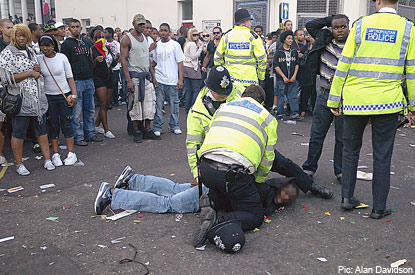
Notting Hill battle line as riot mob attacks

Elizabeth Hopkirk and Aline Nassif, Evening Standard
26.08.08
Rioters fought running street battles with police as the Notting Hill Carnival descended into violence.
A group of 40 thugs threw missiles and bottles at unprotected officers in two-hour running battles last night.
One witness said: « It was a full-scale riot. Bottles were flying everywhere. Carnival-goers and police officers were bloodied. A policewoman was carried off unconscious. Another had a twoinch gash above his eye. He was staggering and supported by two colleagues.
« The mob weren’t scared. They were running towards the police who were chanting ‘one, two, three’ and charging them. It was like a war zone. I haven’t seen anything like it at the carnival since the early Nineties. It reminded me of the Brixton riots. »
Over the weekend 330 people were arrested during the largely trouble-free event. But the mood turned ugly in the final hours when a group rounded on police.
One teenager was beaten and stabbed and scores more injured. The stabbed teenager had been chased by a gang of youths in Clifford Gardens, just yards from where City lawyer Tom ap Rhys Price, 31, was stabbed to death in a robbery two years ago.
Melissa Johnson, 18, said: « I heard people screaming and swearing so I came outside. He was lying on the ground on his back with his head on the side. There was blood all on his face. »
Engineer Robert Dowdy, 40, said: « They chased him up the road like a pack of dogs, yelling and screaming. They were kicking and punching and swinging at him. There were two stab wounds on his upper back. »
A spokesman for the Met said the victim’s injuries were serious but not life threatening.
He said: « We were called at 10pm to reports of between 10 and 12 youths fighting. We found the victim with multiple puncture wounds to the back. » No arrests have yet been made.
Earlier in the day, officers detained 180 youths in Harleyford Road, near the Oval, who were believed to be on their way to cause trouble at the carnival.
Officers bussed 151 of them to south London police stations where they were detained until the carnival was over. Seven were arrested for possession of bladed articles or public order offences.
Commenting on the mini-riot which spoiled the end of the carnival, Chief Inspector Jo Edwards said: « Once again the event ended with a small minority of people determined to fight and cause trouble.
« For over two hours our officers were faced with a hard core, mainly of young men, who came to Carnival not to enjoy the event but to fight, commit crime and cause trouble. Unfortunately members of the public got caught up in it too. »
She added: « This was no longer a carnival. This was completely unacceptable behaviour. Our officers had been out for a very long time and they came under sporadic attacks, having objects and missiles thrown at them. »
The total number of arrests was up from last year’s 247. Ambulance staff treated more than 300 people, taking 75 to hospital. Police also seized 19 dangerous dogs during the event.
Tougher crime-fighting measures, including the use of more metal-detector wands and arches, had been adopted to prevent outbreaks of violence. Possible trouble-makers were also stopped in intelligence-based raids before the carnival.
The late-night violence was in stark contrast to the hugely successful carnival enjoyed by one million people who came just to enjoy the festivities.
Kerry Conway, 25, a teacher from Earlsfield, said: « I’ve really enjoyed the food and the dance. The atmosphere is electric. » Her partner John Lehanee, 25, a plumber, added: « I’ll definitely be coming back next year. »
Lucas Fiddaman, 24, from Australia, said: « This is the best party ever. The music is incredible and I’ve bumped into so many friendly people and had a laugh. The costumes were so bright and everyone was completely in awe. »
Mary Nelson, 26, said: « It’s a melting pot for lots of different ages and races. It’s also a symbol of world-wide cultures embracing the Caribbean. »
Trader Rachid Ahmed, who sold more than 1,300 whistles, said: « Last year, I saw arrests and violence right in front of me. But this year, I’ve only seen one arrest and it was pretty undramatic. The police have done a fantastic job. »
A Londres, le carnaval de Notting Hill se termine dans la violence

26 août 2008
LONDRES (AFP) — Le carnaval de Notting Hill, à Londres, présenté comme le plus important en Europe avec un million de participants, s’est achevé dans la nuit de lundi à mardi dans la violence, a annoncé la police.
Une quarantaine de personnes ont lancé des bouteilles et autres objets vers les policiers, blessant au moins l’un d’entre eux, a indiqué Scotland Yard. Des policiers anti-émeute sont intervenus pendant deux heures environ.
« Tandis que des milliers de personnes ont participé au carnaval dans la joie, une fois de plus, l’événement s’est terminé avec une petite minorité de personnes déterminées à en découdre et à provoquer des incidents », a indiqué la commissaire Jo Edwards.
Sur la durée totale du carnaval, qui s’est déroulé dimanche et lundi, près de deux cents personnes ont été interpellées, pour possession de stupéfiants ou d’armes ou pour agressions et autres délits. 334 incidents ont été répertoriés, selon la police.
Un million de personnes ont participé aux festivités, qui se déroulent chaque année dans le quartier chic londonien de Notting Hill (ouest). Au son de la musique et des percussions antillaises, des défilés regroupent des chars et des personnes masquées et costumées.
Le carnaval a été créé en 1959 par des immigrés originaires des anciennes colonies britanniques des Caraïbes, en réaction à des émeutes raciales de l’année précédente. Il a traversé plusieurs quartiers de Londres avant de s’installer définitivement à Notting Hill en 1964, pour devenir, aujourd’hui, le deuxième carnaval au monde après celui de Rio de Janeiro.





 anthropologie du présent