
Kenya avril 2008
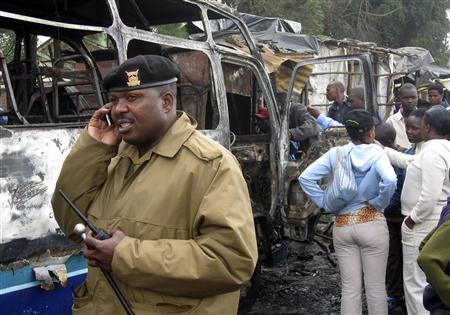
4 Killed in Kenyan Gang Protest

NAIROBI, Kenya (AP) — Kenyan police fired bullets and tear gas to clear machete-waving gang members who blocked roads and set a police post on fire Monday to protest the killing of an imprisoned gang leader’s wife.
At least four people were killed in the violence, police and members of the banned Mungiki gang said, reminding Kenyans of the fragility of the country’s peace after postelection riots earlier this year.
Regional police chief Philip Ndwiga said two people were shot dead in Central province. Gang members who asked not to be identified for fear or reprisals said two others were killed in the Dandora neighborhood of the capital, Nairobi.
Earlier in the day, the gang blocked the main east-west road running through the country but it was quickly cleared, police officer Willy Lugusa said.
Police and gang members fought running battles in Naivasha, a town about 60 miles to the northwest of the capital along the road.
In the western town of Eldoret, senior police officer Muinde Kioko said that two Mungiki supporters had been badly beaten by members of the public and 16 had been arrested.
Within the capital, gang members manned roadblocks of burning tires and pulled people out of vehicles. Local resident Cliff Owino said vehicles in the slum of Mathare were being stoned and gunshots were heard.
Several burned-out, smoldering cars were blocking roads and about a dozen riot police with shields and masks were patrolling a main roundabout littered with broken glass and the blackened shell of a minibus.
« This now is all because of the Mungiki, » said Peter Nyaga, who works at a milling factory. « They are everywhere here. »
In another part of the city, around 200 members of the Mungiki gang armed with machetes and sticks blocked off a road and marched with a banner demanding the release of their leader from prison. Police fired tear gas at them but failed to disperse them.
The Kenya National Youth Alliance, the political wing of the gang, released a statement accusing police of last week’s killings of their imprisoned leader’s wife and their acting leader’s brother.
« On the atrocious murders of the loved ones at the hands of the ruthless police force, the government in its impunity has continued committing extra-judicial killings and is responsible for these two murders. They should stop trying to pass the buck as they are all connected with the killings that have been going on since 2006, » the statement read.
National police spokesman Eric Kiraithe denied any police involvement in the killings.
« That is totally false accusations, » he said. « If we are interested in the wife of the criminal we would have taken her to court. »
The Mungiki, a quasi-religious sect linked to a string of beheadings, promote the culture of the Kikuyu, Kenya’s largest tribe. Gang members say they were also approached by politicians to act as an ethnic militia during the violence following Dec. 27’s disputed elections in which over 1,000 people died. Kiraithe rejected those claims.
On Sunday, President Mwai Kibaki implemented a power-sharing deal aimed at resolving the political crisis that set off that unrest. He made opposition leader Raila Odinga prime minister and appointed several members of Odinga’s party to his Cabinet.
Associated Press Writer Elizabeth Kennedy contributed to this report.
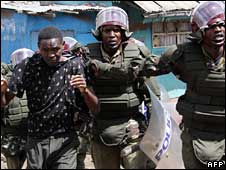
Two killed as Kenya gang protests for second day

Tue Apr 15
By C. Bryson Hull
NAIROBI (Reuters) – Police shot dead two people when Kenya‘s dreaded Mungiki gang took to the streets again on Tuesday, presenting a serious challenge to the new coalition government on only its second day.
The unrest echoed the worst days of post election violence before the power-sharing deal was reached and overshadowed the resumption of business in parliament, due to debate a reform agenda keenly anticipated by many Kenyans.
A Reuters Television journalist saw two people killed by police in Nairobi‘s Industrial Area, where witnesses said members of the outlawed Mungiki gang were stoning cars. The identity of the dead was not immediately clear.
Elsewhere in the capital gang members burned buses, paralyzing transport and business there and in parts of central Kenya.
« The Mungiki gang is taking us back to the mayhem we witnessed a few months ago, » motorist Martin Mutembi said near the burning hulk of a bus in the city’s Kenyatta market. « They hijacked the bus…and threw a bomb that completely burned it. »
The gang caught police off-guard on Monday when they blocked transport in Nairobi, two provinces and Kenya’s main highway, creating the worst turmoil since the riots and ethnic killings after President Mwai Kibaki’s disputed December 27 re-election.
Mungiki is Kenya‘s version of the mafia and has provided muscle-for-hire to politicians in the past. It provoked a bloody police crackdown that led to more than 100 deaths last year, after the group killed and beheaded scores of people.
The gang is drawn from the Kikuyu, Kibaki’s tribe and Kenya‘s largest. The Mungiki say they are protesting against the beheading of a jailed leader’s wife last week, which they blame on police. Police deny the beheading.
Analysts believe the violence may also have a political motive — either dissatisfaction with the power-sharing agreement or unpaid dues from politicians to the Mungiki for their help during the elections and the violence that ensued.
BUSINESS SHUTDOWN
Kibaki on Sunday named a power-sharing cabinet — the largest in Kenyan history — aimed at defusing tension and steering one of Africa‘s most promising economies back on track after more than 1,200 people were killed in the turmoil.
He named election rival Raila Odinga prime minister under the terms of a February 28 deal to end the crisis, which also tasks the divided administration with preparing a new constitution in just 12 months.
Kenya‘s shilling currency appeared to ignore the Mungiki problems, firming slightly to 61.50/60 against the dollar. It has risen 2 percent since the cabinet was named.
Local media said at least 11 people had been killed in the clashes between Mungiki and the police, but police denied that.
Mungiki has de facto control of Kenya‘s minibus industry via a lucrative protection racket, a point the protests have made clear.
« We have circulated leaflets warning businesspeople not to open for a week because we want to make our presence felt, » a gang member who declined to give his name told Reuters in the central Kenyan town of Nyeri 110 km (68 miles) north of Nairobi.
« After that, we shall give our conditions for operating. »
(Additional reporting by Guled Mohamed in Nairobi and Muthigani Kiama in Nyeri)
(For full Reuters Africa coverage and to have your say on the top issues, visit: africa.reuters.com/ )
Fresh deaths in Kenya sect riots

Kenyan police have shot dead two members of the banned Mungiki sect in the capital, Nairobi.
Police opened fire as youths stoned cars, torched a garage and a minibus taxi, bringing the total deaths to 14 since the riots began on Monday.
The latest protests were sparked by the discovery of the beheaded body of the wife of the sect’s leader.
The police say they are investigating the murder. The Mungiki accuse the police of killing its members.
Last year, more than 100 suspected sect members were killed in a police crackdown after a series of grisly beheadings blamed on the Mungiki.
Other reports claim that a leadership dispute has emerged within the sect following the imprisonment of its spiritual leader Maina Njenga two years ago.
Anger
More than 50 people have been arrested following Tuesday’s clashes, police spokesman Eric Kiraithe said.
Mungiki spokesman Njuguna Gitau Njuguna said they have been angered by police brutality.
He said the banned group wanted a special police unit, set up to counter the sect, to be disbanded.
But Mr Kiraithe described Mungiki members as criminals who will face the full force of the law.
« We have intensified patrols across the city and the criminal elements will not be allowed to continue causing havoc, » Mr Kiraithe told BBC News website.
The Mungiki sect, which first emerged in the 1980s, is said to have been initially inspired by the Mau Mau rebellion of the 1950s against British colonial rule.
But since then it is said to have undergone a metamorphosis, and is now likened to Kenya‘s version of the Mafia.
The group is accused of running protection racket that squeeze millions of Kenyan shillings from the minibus network that is the backbone of public transport in Kenya.
There are claims that influential politicians have been backing the activities of the group drawn from the majority Kikuyu ethnic group




 anthropologie du présent